Why in News?
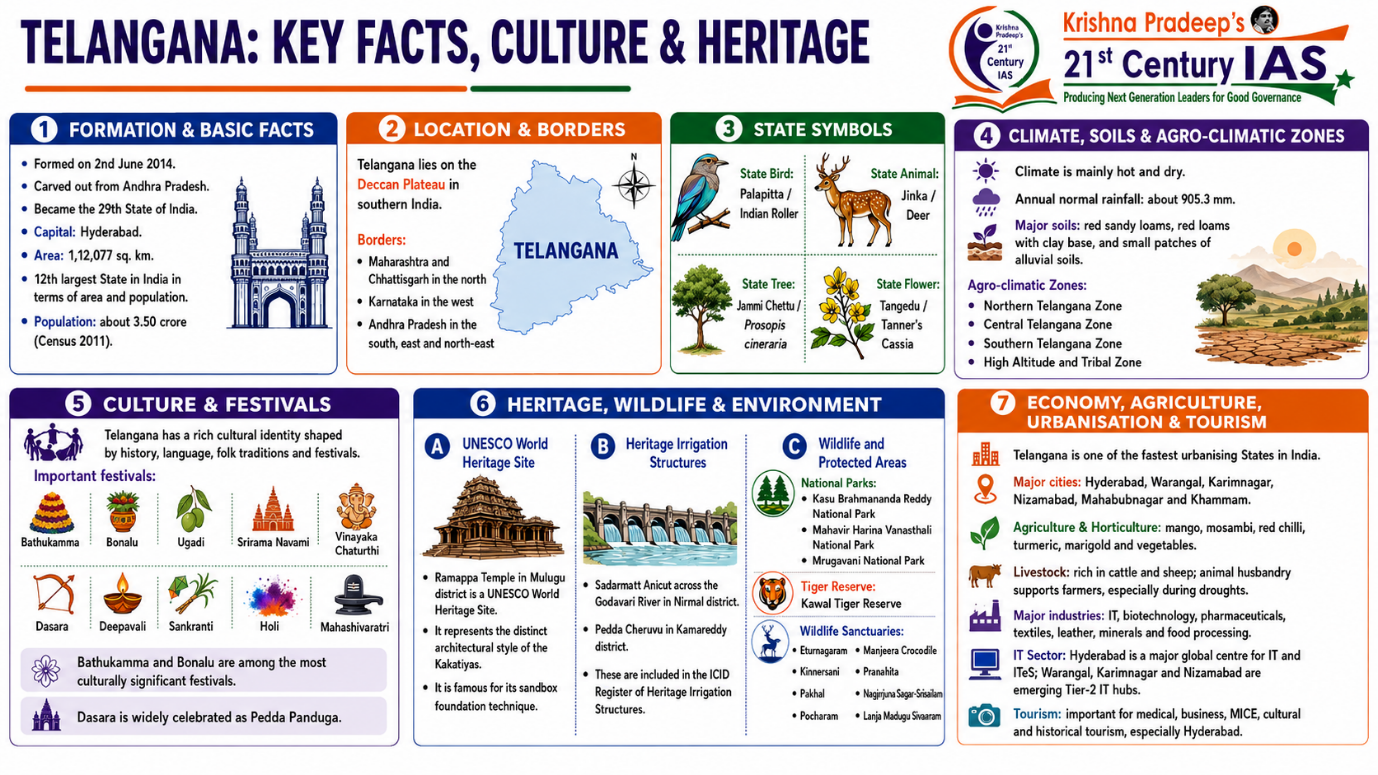
- Telangana State Formation Day is celebrated every year on 2 June to mark the creation of Telangana as a separate State of India in 2014.
- The day represents the long struggle of the people of Telangana for regional identity, self-respect, equitable development and democratic rights. It also reminds us of the historical journey of Telangana from the Hyderabad State period to its formation as a separate State under the Andhra Pradesh Reorganisation Act, 2014.
Historical Background
- Before Independence, Telangana was part of the Hyderabad State ruled by the Nizam. The region had a distinct political, cultural and administrative identity.
- After India became independent, the Nizam of Hyderabad did not immediately agree to join the Indian Union. This created political uncertainty and instability in the region. The later integration of Hyderabad and the linguistic reorganisation of States shaped the political history of Telangana.
Telangana Rebellion
- The Telangana rebellion began in the late 1940s as a peasant struggle against the jagirdari system.
- Under this system, landlords and revenue officials exercised strong control over land and peasants. The movement was linked with agrarian distress and resistance to feudal oppression.
- The rebellion also came into conflict with the Razakars, a militia led by Kasim Rizvi. The disturbed law and order situation in Hyderabad State became one of the major reasons for India’s intervention through Operation Polo.
Standstill Agreement and Operation Polo
- After Independence, the Nizam of Hyderabad did not immediately agree to join the Indian Union.
- India signed a Standstill Agreement with Hyderabad to temporarily continue existing administrative arrangements. However, violence and instability continued due to Razakar activities.
- In September 1948, India launched Operation Polo. Within a few days, Hyderabad State was integrated into the Indian Union. This was a major turning point in the political history of Telangana.
Linguistic Reorganisation and Telangana
- In 1953, Andhra State was created by separating Telugu-speaking areas from the Madras State. It was the first linguistic State in India.
- Later, the question arose whether the Telugu-speaking Telangana region of Hyderabad State should be merged with Andhra.
- The States Reorganisation Commission suggested that Telangana could remain separate for some time and later decide on merger. However, in 1956, Telangana was merged with Andhra State to form Andhra Pradesh under the States Reorganisation Act, 1956.
- Hyderabad became the capital of the enlarged Andhra Pradesh.
Gentlemen’s Agreement and Mulki Rules
- The merger was accompanied by safeguards under the Gentlemen’s Agreement of 1956. These safeguards were meant to protect Telangana’s interests in employment, education, public funds and regional development.
- Telangana also had Mulki Rules, which acted as local employment safeguards in Hyderabad State. These rules aimed to protect government job opportunities for local residents.
- However, protests arose when many non-locals were appointed to government posts. In 1969, student protests intensified due to alleged violations of safeguards promised under the Gentlemen’s Agreement.
- In 1972, the Supreme Court upheld the Mulki Rules. This was followed by the Jai Andhra Movement, and Andhra Pradesh was placed under President’s Rule in 1973.
32nd Constitutional Amendment
In 1973, the 32nd Constitutional Amendment was introduced.
Under this arrangement:
- Andhra Pradesh was divided into six zones for public employment purposes.
- Job reservations were linked with zonal arrangements.
- The Mulki Rules Act was repealed.
This was an attempt to address regional employment concerns, but the demand for separate Telangana continued in different forms.
Telangana Movement
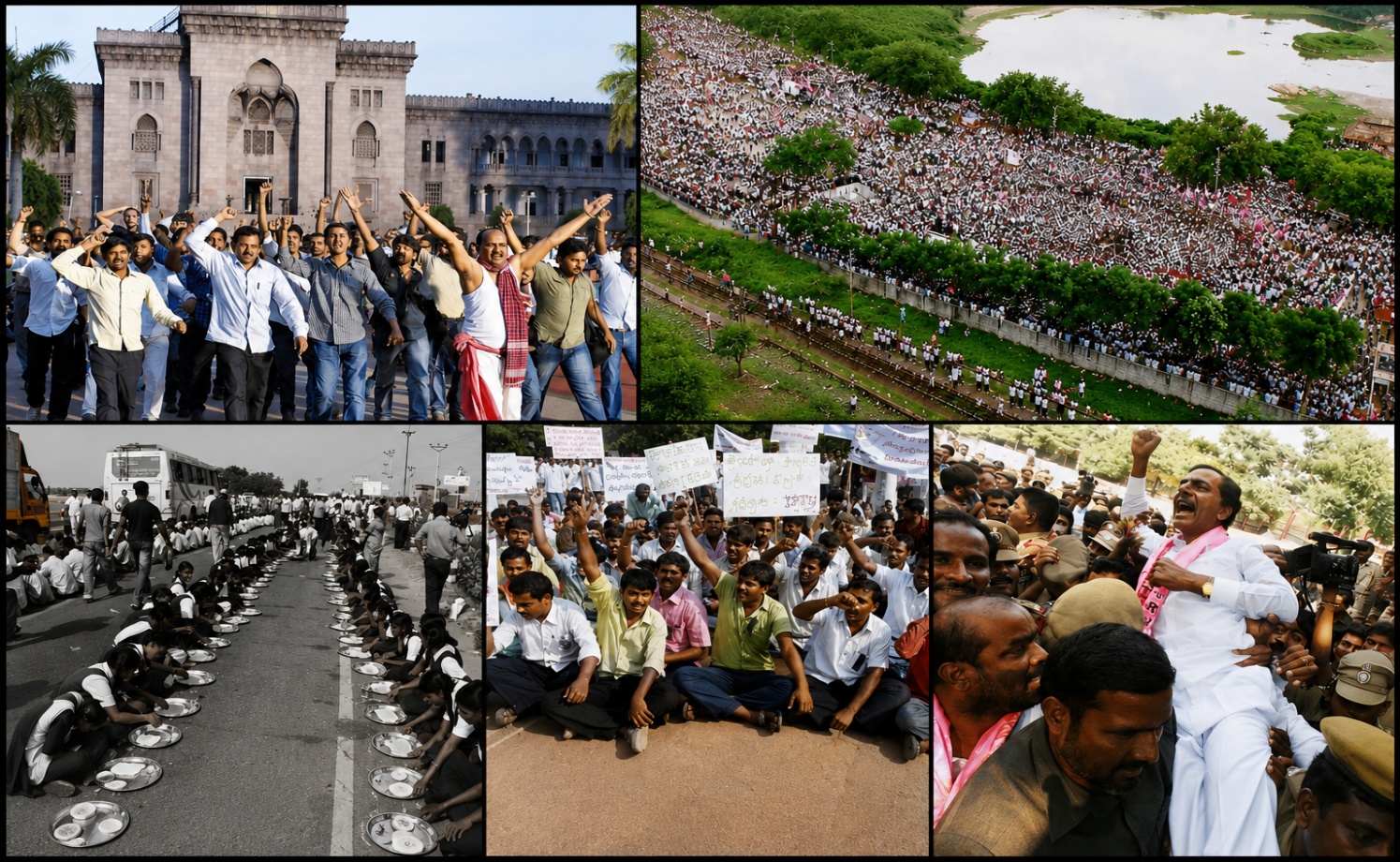
The first major phase of the Telangana movement was the Jai Telangana Movement of 1969. It demanded proper implementation of safeguards and separate Statehood for Telangana.
The movement was based on three major concerns:
- Neellu – Water: fair share of river waters and irrigation.
- Nidhulu – Funds: fair use of Telangana’s revenue for Telangana’s development.
- Niyaamakaalu – Jobs: fair employment opportunities for local people.
These three issues became the emotional and political foundation of the Telangana Statehood movement.
Timeline of the Telangana Movement
| Year | Important Development |
| 1948 | Hyderabad State, including Telangana, was integrated into the Indian Union through Operation Polo. |
| 1952 | Burgula Ramakrishna Rao became the first Chief Minister of Hyderabad State after democratic elections. |
| 1953 | Andhra State was formed on linguistic basis after Potti Sriramulu’s 53-day fast for a separate Telugu-speaking State. |
| 1955 | Andhra Assembly passed a resolution favouring the merger of Andhra with Telangana. |
| 1956 | Telangana was merged with Andhra State to form Andhra Pradesh. The Gentlemen’s Agreement was signed to protect Telangana’s interests. |
| 1969 | Marri Channa Reddy launched the Telangana Praja Samiti demanding a separate Telangana State. Students played a major role in the agitation. |
| 1969 | Prime Minister Indira Gandhi proposed an Eight-Point Plan, but protests continued. |
| 1972 | The Jai Andhra Movement started in Andhra-Rayalaseema as a counter-response to Telangana demands. |
| 1973 | The Six-Point Formula was introduced to address regional concerns in Andhra Pradesh. |
| 1985 | Telangana employees raised concerns about injustice in government appointments. |
| 1999 | The Congress party demanded the creation of Telangana. |
| 2001 | K. Chandrashekar Rao formed the Telangana Rashtra Samithi (TRS) after leaving the Telugu Desam Party. |
| 2004 | Congress came to power, and TRS became part of the coalition government. |
| 2006 | TRS quit the coalition governments and continued its independent struggle for Telangana. |
| 2008 | Telugu Desam Party declared support for the bifurcation of Andhra Pradesh. |
| 2009 | TRS launched a hunger strike. The Centre announced that the process for Telangana formation would be initiated. |
| 2010 | A five-member committee appointed by the Centre submitted its report on the Telangana issue. |
| 2011–12 | Telangana witnessed major agitations such as Million March, Chalo Assembly and Sakalajanula Samme. |
| 2012 | The Union Home Ministry called an all-party meeting to discuss the Telangana issue. |
| 2014 | The Telangana Bill was passed in Parliament, leading to the formation of Telangana on 2 June 2014. |
Renewed Movement in the 2000s
The Telangana movement gained renewed momentum in 2001 with the formation of the Telangana Rashtra Samithi under K. Chandrashekar Rao.
The movement received support from:
- Students, Employees, Farmers, Intellectuals, Civil society organisations, Cultural activists
A major turning point came in 2009, when KCR began a fast unto death demanding Telangana Statehood. The agitation created strong political pressure and brought the issue to the national agenda.
Formation of Telangana
After prolonged public agitations, political negotiations and parliamentary processes, Parliament passed the Andhra Pradesh Reorganisation Act, 2014.
- Telangana officially became a State on 2 June 2014.
- It became the 29th State of India.
- It was carved out of the northwestern part of Andhra Pradesh.
- Hyderabad became the capital of Telangana.
- Telangana initially had 10 districts.
- The districts were later reorganised into 33 districts for administrative convenience.
- K. Chandrashekar Rao became the first Chief Minister of Telangana.
Conclusion
Telangana State Formation Day is not only a celebration of a new State. It is a reminder of a long people’s movement for identity, justice and self-governance.
The journey of Telangana includes the Hyderabad State period, the Telangana rebellion, Operation Polo, linguistic reorganisation, Mulki Rules, the 1969 movement and the final Statehood struggle. It shows that regional aspirations can be addressed within India’s constitutional framework. Telangana’s future depends on balanced development, employment generation, irrigation security, cultural preservation and inclusive governance.
Why in News?
- The Union Health Ministry released the National Family Health Survey-6.
- NFHS-6 shows India’s progress in maternal health, child healthcare, nutrition, immunisation, financial protection and women empowerment.
- The survey highlights improvement in institutional deliveries, antenatal care, child vaccination, reduction in stunting and expansion of health insurance coverage.
About NFHS-6
The National Family Health Survey is a large-scale survey that provides data on health, nutrition, population and family welfare. NFHS-6 was conducted during 2023–24 by the Ministry of Health and Family Welfare. The International Institute for Population Sciences, Mumbai acted as the nodal agency. The survey covered nearly 6.79 lakh households across 715 districts. It supports evidence-based planning and helps governments design policies up to the district level.Key Findings of NFHS-6
1. Maternal and Child Healthcare
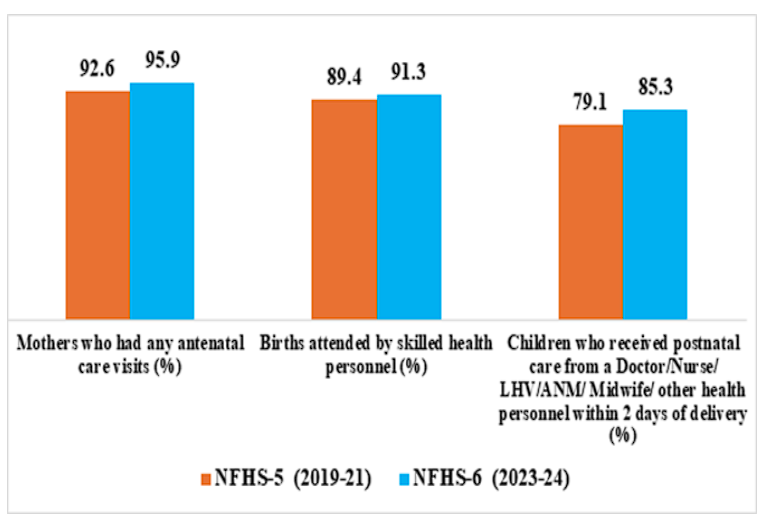
NFHS-6 shows strong improvement in maternal and child healthcare services. Important findings include:- Antenatal care coverage increased from 92.6% to 95.9%.
- Mothers receiving ANC in the first trimester increased from 70.0% to 76.2%.
- Mothers receiving at least four ANC visits increased from 58.5% to 65.2%.
- Institutional deliveries increased from 88.6% to 90.6%.
- Births attended by skilled health personnel increased from 89.4% to 91.3%.
- Postnatal care for newborns within two days improved from 79.1% to 85.3%.
2. Maternal Nutrition
Maternal nutrition also improved.- Mothers consuming iron folic acid tablets for 100 days or more increased from 44.1% to 54.9%.
- Mothers consuming iron folic acid tablets for 180 days or more increased from 26.0% to 37.8%.
3. Family Planning
India’s Total Fertility Rate remains at 2.0. The Contraceptive Prevalence Rate increased from 66.7% to 69.1%. This shows improved access to family planning services and greater awareness among couples.4. Child Immunisation
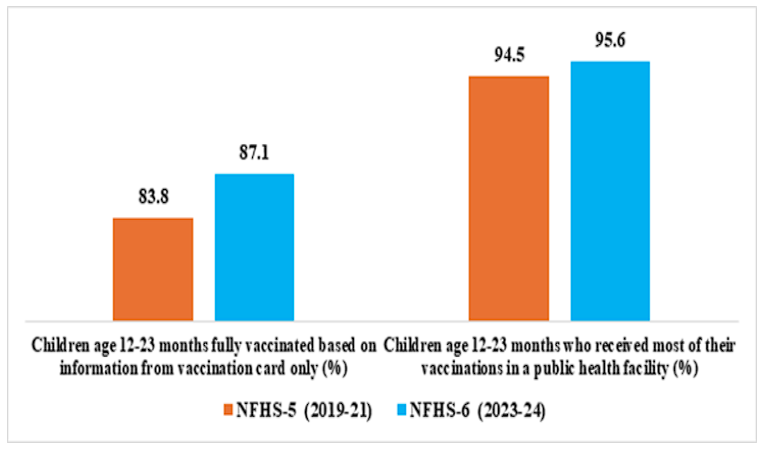
NFHS-6 shows continued progress towards universal immunisation.- Full vaccination coverage among children aged 12–23 months increased from 83.8% to 87.1%.
- Any vaccine received by children aged 12–23 months remained above 96%.
- 95.6% of children received most vaccinations through public health facilities.
- Rotavirus vaccination coverage increased sharply from 36.4% to 85.4%.
- Second dose of measles-containing vaccine increased from 58.6% to 71.8%.
5. Child Health Indicators
NFHS-6 also shows improvement in child health.- Symptoms of acute respiratory infection among children declined from 2.8% to 1.9%.
- Severe diarrhoea declined to 0.5%.
6. Child Nutrition
NFHS-6 indicates encouraging progress in child nutrition.- 95.6% of children under six months were breastfed during the survey period.
- Children breastfed within one hour of birth increased from 41.8% to 50.1%.
- Stunting among children under five declined from 35.5% to 29.3%.
- Severe wasting declined from 7.7% to 5.2%.
- Underweight prevalence declined marginally from 32.1% to 31.8%.
- Children aged 6–8 months receiving solid or semi-solid food along with breastmilk increased from 45.9% to 59.5%.
7. Health Protection and Insurance
Health insurance or financing scheme coverage increased from 41.0% to 60.2% at the household level. This reflects the impact of Ayushman Bharat – Pradhan Mantri Jan Arogya Yojana and other health protection initiatives. It is an important step towards Universal Health Coverage.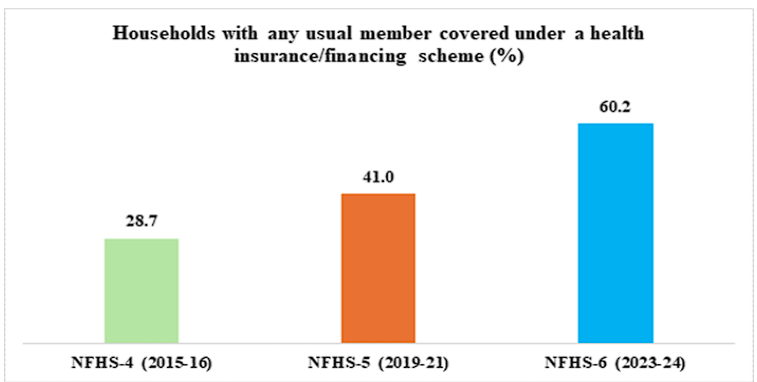
8. Women’s Empowerment and Financial Inclusion
NFHS-6 also records progress in women’s empowerment.- Women who had ever used the internet nearly doubled from 33.3% to 64.3%.
- Women having a bank or savings account that they themselves use increased from 78.6% to 89.0%.
- Women having a mobile phone that they themselves use increased from 53.9% to 63.6%.
- Use of hygienic methods of menstrual protection among women aged 15–24 years increased from 77.6% to 79.2%.
Major Schemes Behind Progress
1. Janani Suraksha Yojana
It promotes institutional deliveries by providing financial assistance to pregnant women, especially from poor households.2. Janani Shishu Suraksha Karyakram
It provides free services to pregnant women and sick newborns in public health institutions.3. Pradhan Mantri Surakshit Matritva Abhiyan
It provides assured antenatal care services to pregnant women.4. SUMAN
Surakshit Matritva Aashwasan aims to provide assured, respectful and quality maternal and newborn healthcare.5. PM Matru Vandana Yojana
It provides maternity benefit support to pregnant and lactating women.6. Universal Immunisation Programme
It provides vaccines to protect children against vaccine-preventable diseases.7. POSHAN Abhiyaan and POSHAN 2.0
These schemes aim to reduce malnutrition among children, adolescent girls, pregnant women and lactating mothers.8. Ayushman Bharat PM-JAY
It provides health insurance coverage to vulnerable families and reduces out-of-pocket expenditure.9. Mission Parivar Vikas
It focuses on improving access to family planning services.10. U-WIN
It supports digital tracking of immunisation services.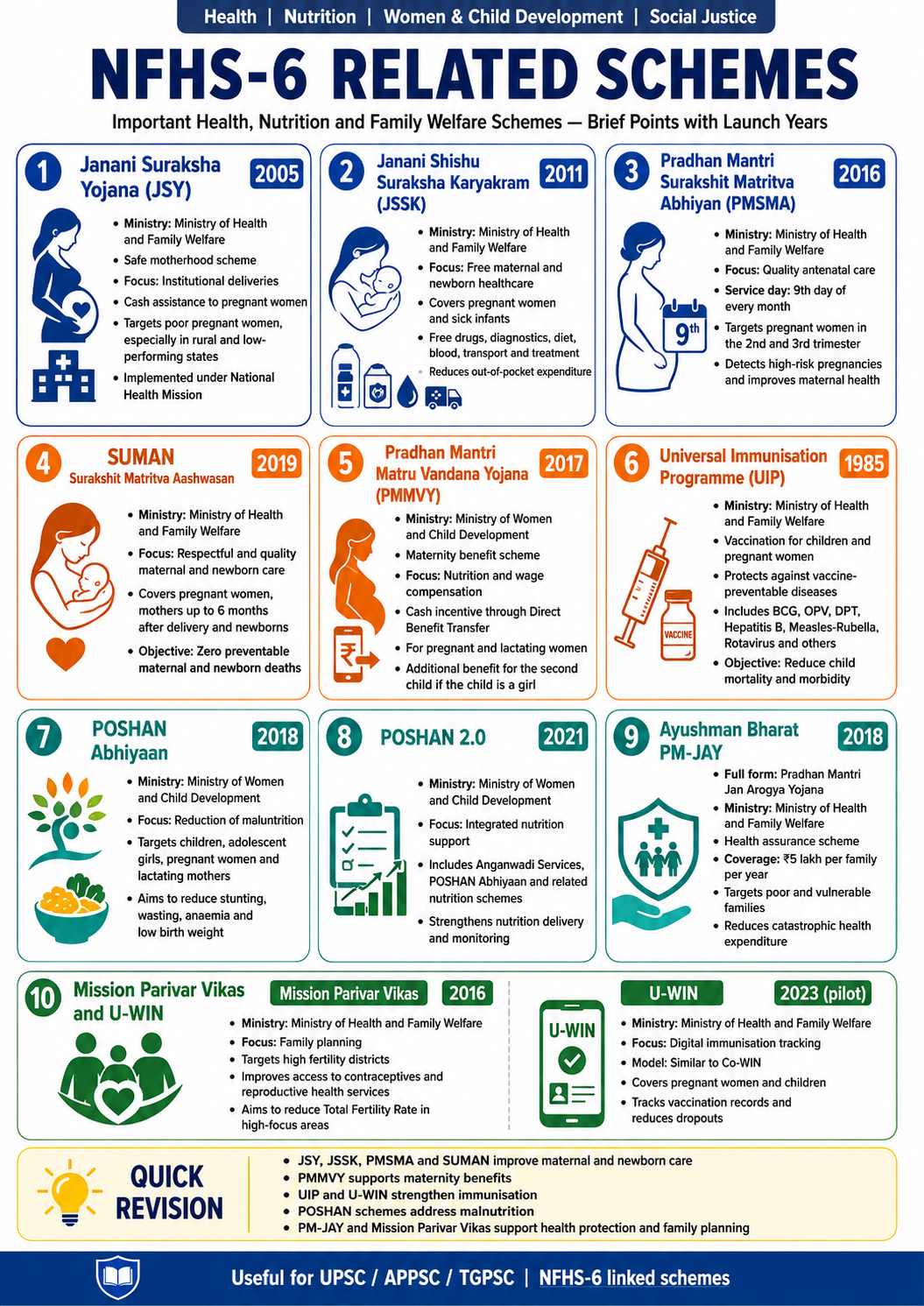
Significance of NFHS-6 Findings
1. Shows Progress in Public Health
NFHS-6 shows that India has improved in maternal healthcare, institutional deliveries, child immunisation and nutrition. This reflects the impact of sustained public health programmes.2. Strengthens Evidence-Based Policymaking
NFHS data helps governments plan policies based on facts. District-level data can guide targeted interventions.3. Supports SDG Achievement
Progress in health, nutrition, women empowerment and financial protection supports India’s progress towards Sustainable Development Goals.4. Shows Public Trust in Government Health Facilities
The fact that 95.6% of children received most vaccinations through public health facilities shows community trust in the public health system.5. Improves Financial Protection
Expansion of health insurance coverage reduces the burden of health expenditure on poor and vulnerable households.6. Promotes Women Empowerment
Improvement in women’s bank account ownership, mobile phone use and internet access reflects rising social and economic empowerment.Challenges
1. Persistent Undernutrition
Stunting and underweight levels have declined, but they remain significant public health concerns.2. Dual Burden of Malnutrition
India faces both undernutrition and rising overweight or obesity among adults. This creates a complex nutrition challenge.3. Non-Communicable Diseases
Rising lifestyle-related risks and non-communicable diseases require greater focus on preventive healthcare.4. Regional Inequality
National improvement may hide gaps between states, districts, rural areas and urban areas.5. Quality of Healthcare
Higher institutional delivery is important, but quality of care during pregnancy, childbirth and postnatal period also needs attention.6. Behavioural Change
Improvements in nutrition, hygiene, breastfeeding and family planning require continuous awareness and community participation.Way Forward
- India should strengthen primary healthcare through Health and Wellness Centres and better frontline health worker support.
- Nutrition programmes must focus on the first 1,000 days of a child’s life, from pregnancy to two years of age.
- The government should improve dietary diversity, breastfeeding practices and complementary feeding.
- Digital platforms such as U-WIN should be used to track immunisation and reduce dropouts.
- There is a need to strengthen preventive healthcare to control non-communicable diseases and lifestyle risks.
- Health insurance coverage should be expanded along with quality and affordability of healthcare services.
- Women’s digital and financial inclusion should be linked with health awareness, nutrition education and welfare delivery.
Conclusion
NFHS-6 reflects India’s steady progress in maternal and child health, immunisation, nutrition, financial protection and women empowerment. The findings show that flagship schemes and stronger primary healthcare delivery have improved several key indicators. However, challenges such as undernutrition, non-communicable diseases, obesity and regional inequalities remain. India must now focus on quality healthcare, preventive health, balanced nutrition and last-mile delivery to achieve inclusive and sustainable health outcomes.Why in News?
India’s dependence on imported fossil fuels has renewed focus on long-term energy security. The deeper challenge is in industries such as fertilisers, refineries, steel, ammonia and petrochemicals, where fossil fuels are part of the production process.the National Green Hydrogen Mission should not focus only on production capacity. It must also make green hydrogen commercially viable for industries by reducing its delivered cost and creating stable demand.
What is Green Hydrogen?
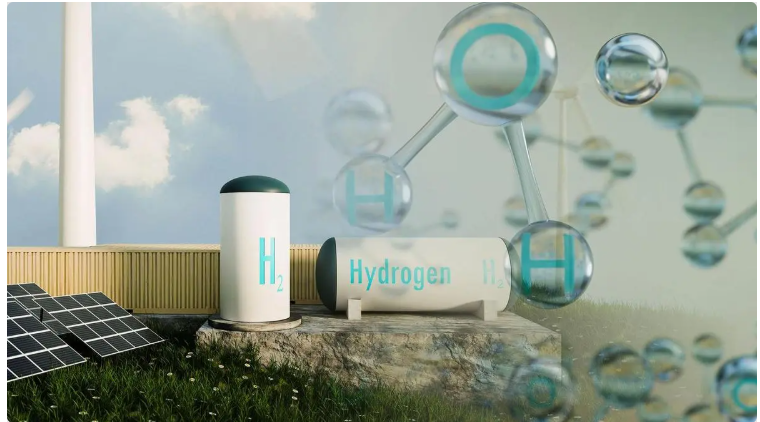
Green hydrogen is hydrogen produced by splitting water through electrolysis using renewable energy such as solar, wind or hydropower.
In this process:
- Water is split into hydrogen and oxygen.
- An electrolyser uses electricity for this process.
- If the electricity comes from renewable energy, the hydrogen is called green hydrogen.
- It produces almost no greenhouse gas emissions during production.
National Green Hydrogen Mission
Nodal Ministry
- Ministry of New and Renewable Energy
Objective
- Decarbonise energy, industry and mobility sectors
- Develop indigenous manufacturing capacity
- Create export opportunities for green hydrogen and its derivatives
Components
- Strategic Interventions for Green Hydrogen Transition Programme (SIGHT)
- Strategic Hydrogen Innovation Partnership (SHIP) for R&D
Expected Outcomes by 2030
- At least 5 MMT green hydrogen production per year
- Nearly ₹1 lakh crore fossil fuel import savings
- Around 6 lakh jobs
- About 50 MMT CO₂ emissions avoided annually
- More than ₹8 lakh crore investment
Types of Hydrogen
| Type | Production Method | Energy Source | Carbon Footprint |
| Green Hydrogen | Electrolysis | Renewable energy | Nearly zero |
| Grey Hydrogen | Steam Methane Reforming | Natural gas | High |
| Blue Hydrogen | SMR with Carbon Capture | Natural gas | Lower than grey |
| Brown Hydrogen | Gasification | Coal | Very high |
Green hydrogen is the cleanest form because it uses renewable energy.
Why Green Hydrogen is Important for India
India imports large quantities of fossil fuels. These imports affect energy security, foreign exchange reserves and industrial competitiveness.
Green hydrogen can help India:
- Reduce dependence on imported natural gas and oil.
- Decarbonise industries where direct electrification is difficult.
- Support India’s Net Zero 2070 target.
- Build a new clean energy manufacturing ecosystem.
- Create high-skilled green jobs.
- Strengthen domestic technology and energy sovereignty.
Major Applications of Green Hydrogen
1. Steel Industry
Steel is one of the most carbon-intensive sectors. Traditionally, coking coal is used to remove oxygen from iron ore.
Green hydrogen can replace coking coal in the Direct Reduced Iron process. This can reduce emissions because the main by-product is water vapour.
The Ministry of Steel has been allocated ₹455 crore for pilot projects using green hydrogen in the steel sector till FY 2029–30.
2. Fertiliser Sector
India is the second-largest consumer and third-largest producer of fertilisers globally.
Fertiliser production needs ammonia, and ammonia production depends heavily on hydrogen. At present, much of this hydrogen comes from natural gas.
Green hydrogen can be used to produce green ammonia, reducing natural gas imports. SECI has signed 10-year contracts to supply 7,24,000 tonnes of green ammonia annually to 13 fertiliser plants. This is expected to save around $2.5 billion in foreign exchange over a decade.
3. Refineries and Petrochemicals
Refineries use hydrogen for processes such as removing sulphur from fuels and upgrading crude oil.
At present, most refinery hydrogen is grey hydrogen, produced from natural gas. Replacing it with green hydrogen can reduce direct industrial emissions.
SECI is also supporting refinery-linked green hydrogen projects of around 30,000 tonnes per annum.
4. Shipping and Ports
Green hydrogen and its derivatives such as green ammonia and green methanol can be used as clean shipping fuels.
India has identified major ports such as:
- Deendayal Port, Kandla
- V.O. Chidambaranar Port, Tuticorin
- Paradip Port, Odisha
as Green Hydrogen Hubs. These hubs can support clean bunkering, storage and distribution.
5. Heavy-Duty Transport
Battery electric vehicles are suitable for small vehicles, but heavy trucks and buses need longer range and faster refuelling.
Hydrogen fuel cells can help in:
- Long-distance buses
- Heavy trucks
- Industrial transport
- Difficult terrain routes
Under NGHM, pilot projects have been sanctioned for 37 hydrogen-fuelled buses and trucks across 10 routes, supported by 9 hydrogen refuelling stations.
6. Grid Balancing and Energy Storage
Solar and wind power are intermittent. Green hydrogen can store surplus renewable electricity.
During high renewable generation, extra electricity can produce hydrogen. Later, this hydrogen can be converted back into electricity when demand rises.
NTPC is developing a major green hydrogen hub at Pudimadaka, Andhra Pradesh, which can support large-scale renewable energy storage.
Key Issue: Delivered Cost Matters More Than Production Cost
One of the most important arguments in the recent debate is that India must focus on the delivered cost of hydrogen, not only its production cost.
Even if hydrogen is produced cheaply, it may become expensive after adding:
- Transport cost
- Storage cost
- Purification cost
- Conversion losses
- Safety infrastructure cost
- Distribution cost
In advanced hydrogen markets, midstream and end-use infrastructure can account for 70–85% of the final delivered cost. Therefore, India should not depend only on large coastal hubs and long-distance supply chains.
Need for Modular Electrolysers
Many small and medium industries need hydrogen in modest quantities near their production units. For them, getting hydrogen from distant hubs may be costly.
Therefore, India should promote:
- Modular electrolysers
- On-site hydrogen production
- Near-site hydrogen production
- Small-scale hydrogen systems for MSMEs
- Application-specific hydrogen engineering
A special SME window for 10 kW to 2 MW electrolyser stacks can help small industries adopt green hydrogen without depending only on large centralised hubs.
Key Challenges
1. High Cost
Green hydrogen is still costlier than grey hydrogen. As of 2026, green hydrogen costs around ₹397–₹560 per kg, while grey hydrogen generally costs around ₹150–₹200 per kg.
2. Green Premium
Industries may not shift to green hydrogen voluntarily unless the cost gap is reduced through incentives, carbon pricing or purchase obligations.
3. High Capital Requirement
Electrolysers require advanced technology, high-precision manufacturing and costly materials.
4. Import Dependence
India still depends on imported components such as specialised membranes, catalysts and electrolyser stacks.
5. Water Requirement
Producing 1 kg of hydrogen through electrolysis needs around 9–11 litres of high-purity water. This can be a concern in water-stressed industrial regions.
6. Storage and Transport
Hydrogen is difficult to store and transport because it is highly flammable and can weaken steel pipelines.
7. Weak Safety Standards
India needs stronger safety rules for hydrogen production, storage, transport, refuelling and industrial use.
8. Global Competition
Countries such as Australia, Chile and West Asian nations are also investing heavily in green hydrogen.
9. Limited R&D
India’s low R&D spending slows down innovation in hydrogen storage, transport, electrolysers and industrial applications.
Measures Needed
1. Create Stable Industrial Demand
The government should convert existing grey hydrogen and ammonia demand into long-term green hydrogen demand. Fertilisers and refineries should be the first priority because they already use hydrogen at scale.
2. Expand SIGHT Incentives
The Strategic Interventions for Green Hydrogen Transition scheme should support both large projects and small modular electrolysers.
3. Develop Hydrogen Valleys
Hydrogen production and consumption should be located close to each other in industrial clusters. This reduces transport, storage and purification costs.
4. Introduce Green Hydrogen Purchase Obligations
Like Renewable Purchase Obligations, India can introduce Green Hydrogen Purchase Obligations for sectors such as fertilisers and refineries.
5. Improve Renewable Power Supply
Electrolysers need renewable electricity that is cheap, reliable and dispatchable. India must improve transmission, storage and open access to renewable power.
6. Promote Indigenous Manufacturing
India should support domestic production of electrolysers, PEM stacks, catalysts and other components through PLI, R&D support and public-private partnerships.
7. Build Hydrogen Infrastructure
India needs hydrogen-ready pipelines, storage facilities, refuelling stations and port infrastructure.
8. Strengthen Safety Protocols
A national hydrogen safety framework is needed for production, storage, transport and use.
9. Skill Development
India must create trained engineers, technicians and safety professionals for the hydrogen economy.
10. Link with Carbon Market
The Indian Carbon Market can make green hydrogen more attractive by increasing the cost of carbon-intensive alternatives.
Way Forward
India’s green hydrogen strategy must shift from only capacity creation to market creation.
The next phase should focus on:
- Reducing delivered cost.
- Creating bankable demand.
- Supporting modular electrolysers for MSMEs.
- Locating production near industrial demand.
- Making renewable power reliable and affordable.
- Building hydrogen safety and transport infrastructure.
- Promoting domestic R&D and manufacturing.
This will make green hydrogen usable not only in large public-sector projects but also in ordinary industrial settings.
Conclusion
Green hydrogen is not merely an energy project. It is a major industrial transformation strategy for India.
To make it viable, India must reduce delivered cost, create long-term demand, promote modular electrolysers, reform the power sector and build domestic manufacturing capacity. If implemented well, green hydrogen can reduce fossil fuel dependence, strengthen energy security, support industrial decarbonisation and help India move towards Net Zero 2070.