Why in News?
- The Union Health Ministry released the National Family Health Survey-6.
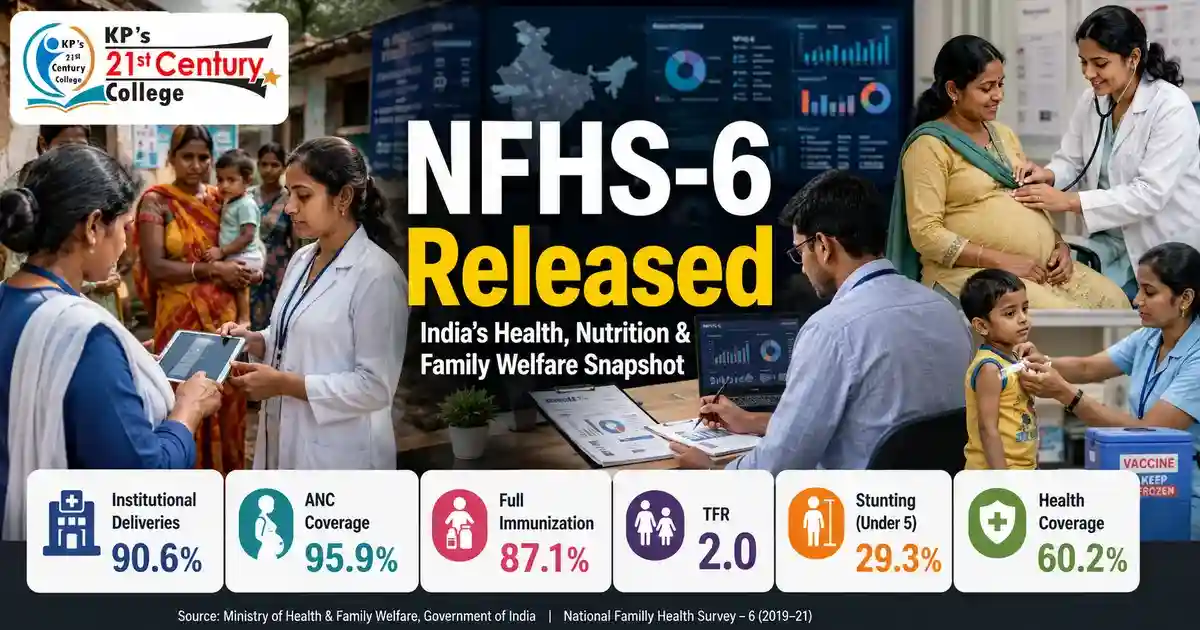
- NFHS-6 shows India’s progress in maternal health, child healthcare, nutrition, immunisation, financial protection and women empowerment.
- The survey highlights improvement in institutional deliveries, antenatal care, child vaccination, reduction in stunting and expansion of health insurance coverage.
About NFHS-6
The National Family Health Survey is a large-scale survey that provides data on health, nutrition, population and family welfare.
NFHS-6 was conducted during 2023–24 by the Ministry of Health and Family Welfare. The International Institute for Population Sciences, Mumbai acted as the nodal agency.
The survey covered nearly 6.79 lakh households across 715 districts.
It supports evidence-based planning and helps governments design policies up to the district level.
Key Findings of NFHS-6
1. Maternal and Child Healthcare
NFHS-6 shows strong improvement in maternal and child healthcare services.
Important findings include:
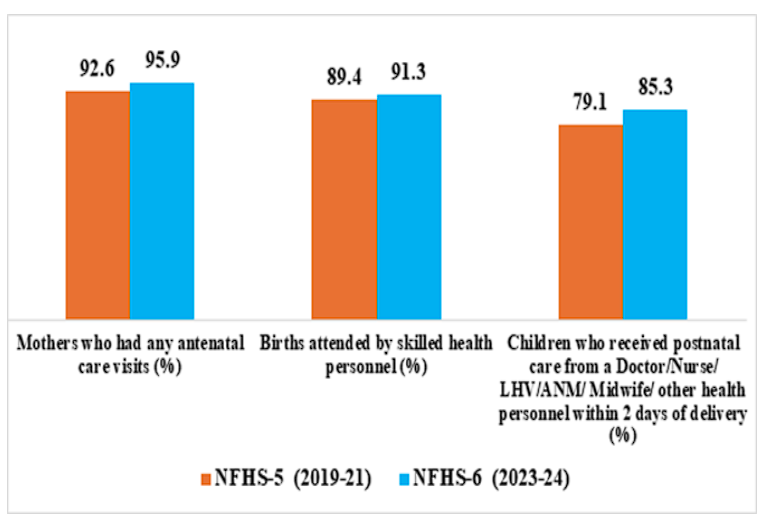
- Antenatal care coverage increased from 92.6% to 95.9%.
- Mothers receiving ANC in the first trimester increased from 70.0% to 76.2%.
- Mothers receiving at least four ANC visits increased from 58.5% to 65.2%.
- Institutional deliveries increased from 88.6% to 90.6%.
- Births attended by skilled health personnel increased from 89.4% to 91.3%.
- Postnatal care for newborns within two days improved from 79.1% to 85.3%.
This shows better access to healthcare during pregnancy, childbirth and postnatal period.
2. Maternal Nutrition
Maternal nutrition also improved.
- Mothers consuming iron folic acid tablets for 100 days or more increased from 44.1% to 54.9%.
- Mothers consuming iron folic acid tablets for 180 days or more increased from 26.0% to 37.8%.
This is important for reducing anaemia and improving maternal and child health outcomes.
3. Family Planning
India’s Total Fertility Rate remains at 2.0.
The Contraceptive Prevalence Rate increased from 66.7% to 69.1%.
This shows improved access to family planning services and greater awareness among couples.
4. Child Immunisation
NFHS-6 shows continued progress towards universal immunisation.
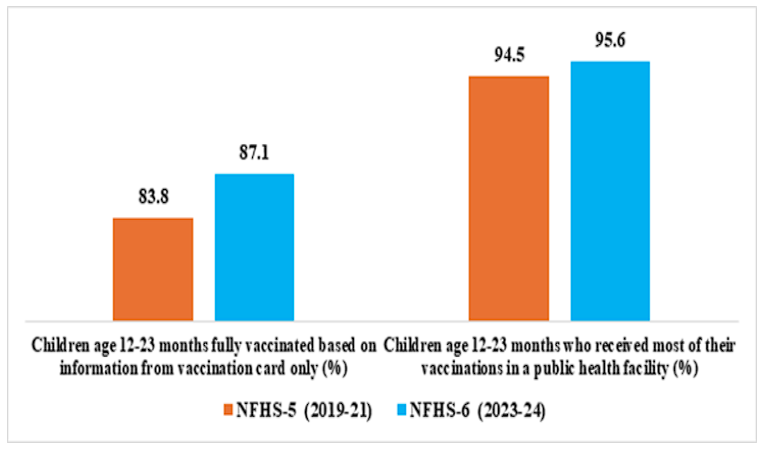
- Full vaccination coverage among children aged 12–23 months increased from 83.8% to 87.1%.
- Any vaccine received by children aged 12–23 months remained above 96%.
- 95.6% of children received most vaccinations through public health facilities.
- Rotavirus vaccination coverage increased sharply from 36.4% to 85.4%.
- Second dose of measles-containing vaccine increased from 58.6% to 71.8%.
This reflects stronger last-mile delivery, better cold chain systems and public trust in government health facilities.
5. Child Health Indicators
NFHS-6 also shows improvement in child health.
- Symptoms of acute respiratory infection among children declined from 2.8% to 1.9%.
- Severe diarrhoea declined to 0.5%.
These improvements indicate better child healthcare, sanitation awareness and early treatment access.
6. Child Nutrition
NFHS-6 indicates encouraging progress in child nutrition.
- 95.6% of children under six months were breastfed during the survey period.
- Children breastfed within one hour of birth increased from 41.8% to 50.1%.
- Stunting among children under five declined from 35.5% to 29.3%.
- Severe wasting declined from 7.7% to 5.2%.
- Underweight prevalence declined marginally from 32.1% to 31.8%.
- Children aged 6–8 months receiving solid or semi-solid food along with breastmilk increased from 45.9% to 59.5%.
This shows improvement in long-term nutrition outcomes, but undernutrition remains a concern.
7. Health Protection and Insurance
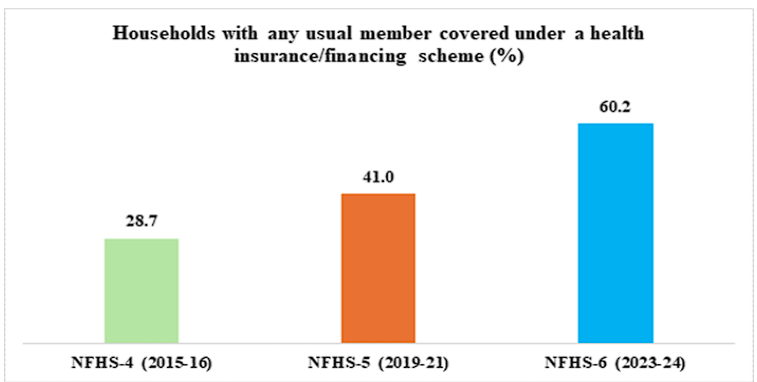
Health insurance or financing scheme coverage increased from 41.0% to 60.2% at the household level.
This reflects the impact of Ayushman Bharat – Pradhan Mantri Jan Arogya Yojana and other health protection initiatives.
It is an important step towards Universal Health Coverage.
8. Women’s Empowerment and Financial Inclusion
NFHS-6 also records progress in women’s empowerment.
- Women who had ever used the internet nearly doubled from 33.3% to 64.3%.
- Women having a bank or savings account that they themselves use increased from 78.6% to 89.0%.
- Women having a mobile phone that they themselves use increased from 53.9% to 63.6%.
- Use of hygienic methods of menstrual protection among women aged 15–24 years increased from 77.6% to 79.2%.
These indicators show improvement in digital access, financial inclusion and health awareness among women.
Major Schemes Behind Progress
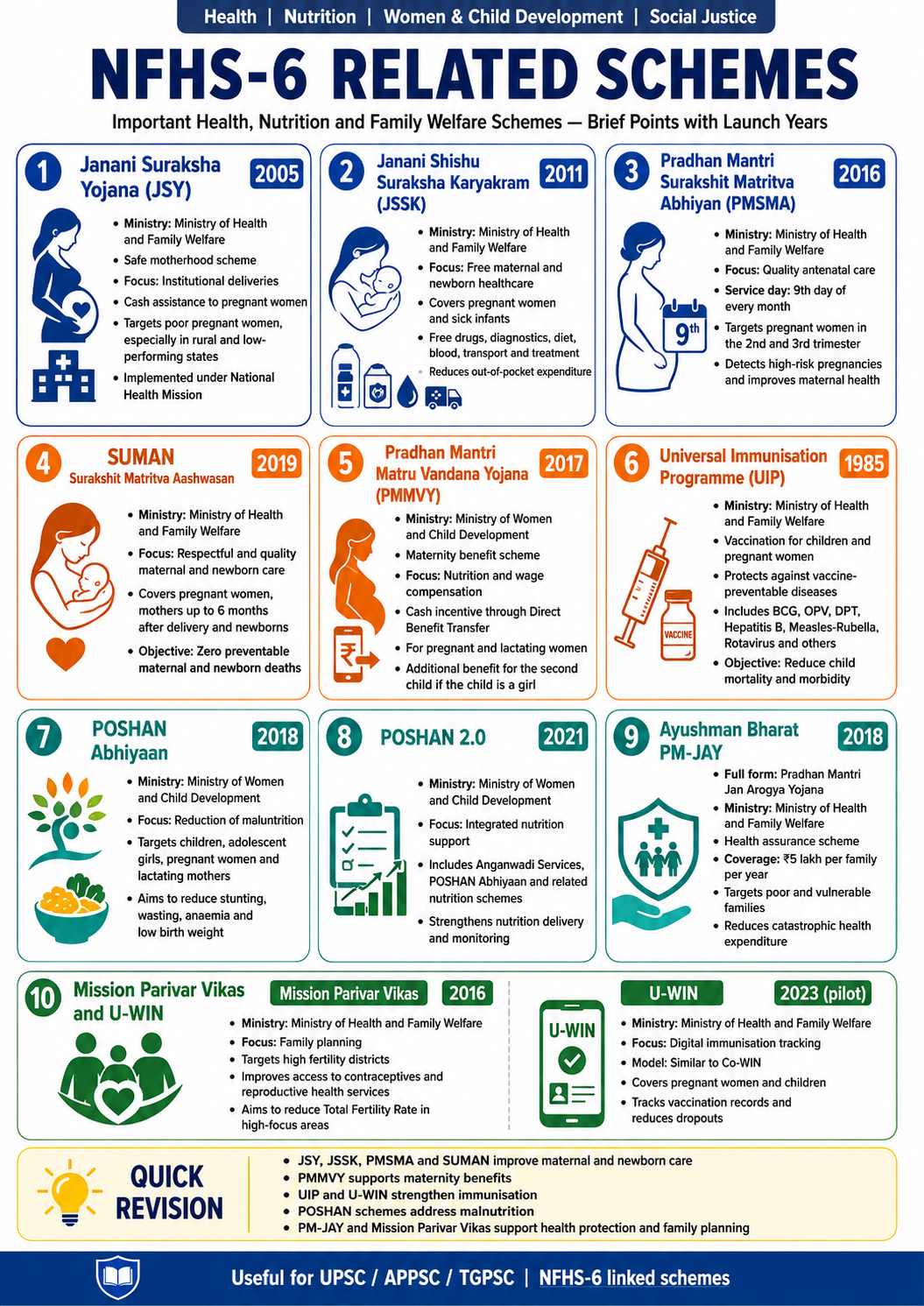
1. Janani Suraksha Yojana
It promotes institutional deliveries by providing financial assistance to pregnant women, especially from poor households.
2. Janani Shishu Suraksha Karyakram
It provides free services to pregnant women and sick newborns in public health institutions.
3. Pradhan Mantri Surakshit Matritva Abhiyan
It provides assured antenatal care services to pregnant women.
4. SUMAN
Surakshit Matritva Aashwasan aims to provide assured, respectful and quality maternal and newborn healthcare.
5. PM Matru Vandana Yojana
It provides maternity benefit support to pregnant and lactating women.
6. Universal Immunisation Programme
It provides vaccines to protect children against vaccine-preventable diseases.
7. POSHAN Abhiyaan and POSHAN 2.0
These schemes aim to reduce malnutrition among children, adolescent girls, pregnant women and lactating mothers.
8. Ayushman Bharat PM-JAY
It provides health insurance coverage to vulnerable families and reduces out-of-pocket expenditure.
9. Mission Parivar Vikas
It focuses on improving access to family planning services.
10. U-WIN
It supports digital tracking of immunisation services.
Significance of NFHS-6 Findings
1. Shows Progress in Public Health
NFHS-6 shows that India has improved in maternal healthcare, institutional deliveries, child immunisation and nutrition.
This reflects the impact of sustained public health programmes.
2. Strengthens Evidence-Based Policymaking
NFHS data helps governments plan policies based on facts.
District-level data can guide targeted interventions.
3. Supports SDG Achievement
Progress in health, nutrition, women empowerment and financial protection supports India’s progress towards Sustainable Development Goals.
4. Shows Public Trust in Government Health Facilities
The fact that 95.6% of children received most vaccinations through public health facilities shows community trust in the public health system.
5. Improves Financial Protection
Expansion of health insurance coverage reduces the burden of health expenditure on poor and vulnerable households.
6. Promotes Women Empowerment
Improvement in women’s bank account ownership, mobile phone use and internet access reflects rising social and economic empowerment.
Challenges
1. Persistent Undernutrition
Stunting and underweight levels have declined, but they remain significant public health concerns.
2. Dual Burden of Malnutrition
India faces both undernutrition and rising overweight or obesity among adults.
This creates a complex nutrition challenge.
3. Non-Communicable Diseases
Rising lifestyle-related risks and non-communicable diseases require greater focus on preventive healthcare.
4. Regional Inequality
National improvement may hide gaps between states, districts, rural areas and urban areas.
5. Quality of Healthcare
Higher institutional delivery is important, but quality of care during pregnancy, childbirth and postnatal period also needs attention.
6. Behavioural Change
Improvements in nutrition, hygiene, breastfeeding and family planning require continuous awareness and community participation.
Way Forward
- India should strengthen primary healthcare through Health and Wellness Centres and better frontline health worker support.
- Nutrition programmes must focus on the first 1,000 days of a child’s life, from pregnancy to two years of age.
- The government should improve dietary diversity, breastfeeding practices and complementary feeding.
- Digital platforms such as U-WIN should be used to track immunisation and reduce dropouts.
- There is a need to strengthen preventive healthcare to control non-communicable diseases and lifestyle risks.
- Health insurance coverage should be expanded along with quality and affordability of healthcare services.
- Women’s digital and financial inclusion should be linked with health awareness, nutrition education and welfare delivery.
Conclusion
NFHS-6 reflects India’s steady progress in maternal and child health, immunisation, nutrition, financial protection and women empowerment.
The findings show that flagship schemes and stronger primary healthcare delivery have improved several key indicators.
However, challenges such as undernutrition, non-communicable diseases, obesity and regional inequalities remain. India must now focus on quality healthcare, preventive health, balanced nutrition and last-mile delivery to achieve inclusive and sustainable health outcomes.