
Why in News?
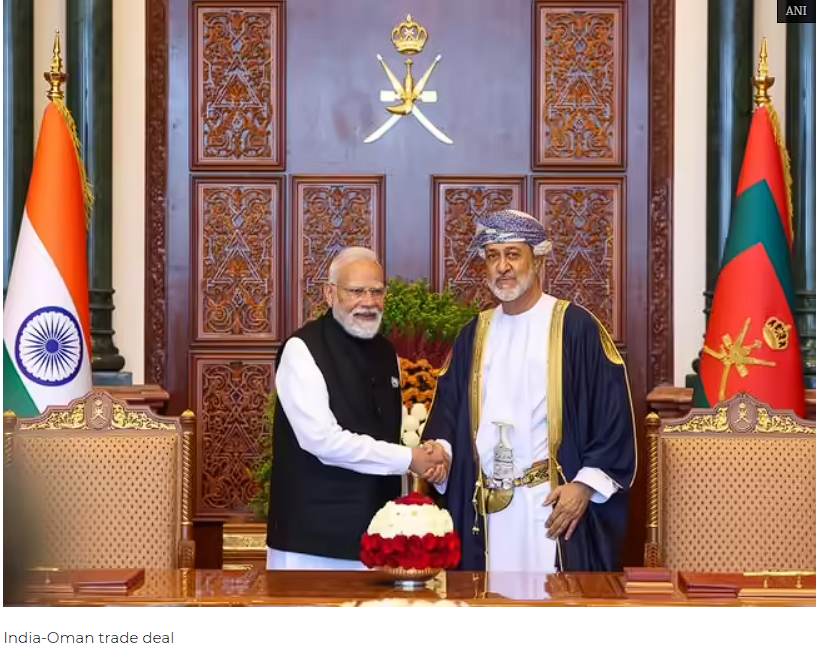
The India–Oman Comprehensive Economic Partnership Agreement (CEPA) came into force on 1 June 2026.
It marks a major step in India’s trade diplomacy with the Gulf region. The agreement is expected to boost exports, create jobs, help MSMEs, support farmers and fishermen, and expand opportunities for Indian professionals in Oman.
The agreement is also important because Oman acts as a strategic gateway to the wider GCC region and East Africa through its ports such as Sohar, Duqm and Salalah.
Background of India–Oman Relations
India and Oman share old civilisational, commercial and people-to-people ties. Indian merchant families have lived in Oman for nearly 200–300 years.
Today, Oman is home to nearly 7 lakh Indians. Indian workers and professionals contribute to Oman’s economy, while remittances from Oman support many Indian families.
Oman is also India’s second-largest trading partner in the Gulf region. Bilateral trade between India and Oman reached USD 11.18 billion in FY 2025–26, showing steady growth in economic relations.
What is CEPA?
A Comprehensive Economic Partnership Agreement (CEPA) is a trade agreement between two countries that goes beyond simple tariff reduction.
It usually covers:
- Trade in goods
- Trade in services
- Investment
- Professional mobility
- Regulatory cooperation
- Customs procedures
- Non-tariff barriers
- Standards and certification
The India–Oman CEPA is therefore not only a tariff agreement. It creates a broader economic partnership between the two countries.

Key Features of India–Oman CEPA
1. Duty-Free Access for Indian Exports
- The agreement provides duty-free access for 99.38% of India’s exports to Oman by value. It covers 98.08% of Oman’s tariff lines.
- Earlier, only about 15.33% of India’s exports entered Oman at zero duty under the MFN system. After CEPA, Indian exporters will get a major price advantage in Oman’s market.
2. Immediate Tariff Benefits
- All zero-duty concessions under the agreement have come into effect immediately. This gives certainty to exporters and allows them to plan long-term trade strategies.
3. Boost to Labour-Intensive Sectors
The agreement is expected to benefit sectors that create large employment in India, such as:
- Textiles
- Leather and footwear
- Marine products
- Gems and jewellery
- Food processing
- Engineering goods
- Pharmaceuticals
- Automobiles
4. Services and Professional Mobility
Oman has made commitments in 127 services sub-sectors. This is important for Indian professionals, startups and service providers.
Sectors that may benefit include:
- IT services
- Engineering
- Healthcare
- Education
- Accounting
- Construction
- Tourism
- Research and development
- Environmental services
5. Faster Market Access for Pharmaceuticals
- Indian medicines approved by regulators such as USFDA, EMA, UK MHRA and TGA will receive marketing authorisation in Oman within 90 days.
- This will help Indian pharmaceutical companies enter the Omani market faster.
Sector-wise Benefits for India
Agriculture and Processed Food
India will benefit in products such as:
- Honey
- Sweet biscuits
- Cashew kernels
- Basmati rice
- Butter
- Eggs
- Condiments
- Mangoes
- Processed food items
India is already a major agricultural supplier to Oman. Duty elimination will make Indian farm and processed food products more competitive.
The agreement also recognises India’s National Programme for Organic Production (NPOP) certification. This will help Indian organic farmers access Oman’s food market.
Marine Products and Fisheries
Marine products have large untapped potential in Oman.
Indian seafood products such as shrimp, fish and frozen cuttlefish will receive duty-free access. This can benefit coastal states such as:
- Andhra Pradesh
- Kerala
- Tamil Nadu
- Gujarat
The marine export sector can create jobs in fishing, processing, cold-chain logistics, packaging and export operations.
Gems and Jewellery
India has strong capabilities in cut and polished diamonds, gold jewellery, silver jewellery and handmade jewellery.
Under CEPA, import duties on gems and jewellery have been removed. This gives Indian exporters a competitive advantage over suppliers from countries such as Italy, Turkey, Thailand and China.
Important jewellery clusters that may benefit include:
- Surat
- Jaipur
- Mumbai
- Kolkata
- Chennai
The sector is expected to create new employment opportunities for artisans, designers, workers and small manufacturers.
Textiles and Apparel
Textiles and apparel are labour-intensive sectors. The agreement can increase demand for Indian textiles in Oman.
Major textile clusters that may benefit include:
- Tirupur
- Surat
- Ludhiana
- Panipat
- Coimbatore
- Karur
- Bhadohi
- Moradabad
- Jaipur
- Ahmedabad
Increased exports can help weavers, artisans, garment workers and MSMEs.
Leather and Footwear
The leather and footwear sector is another employment-intensive sector.
The CEPA can help leather clusters in:
- Tamil Nadu
- Uttar Pradesh
- West Bengal
- Maharashtra
- Punjab
- Karnataka
- Madhya Pradesh
Removal of tariff barriers can improve India’s export competitiveness in footwear, leather goods and related products.
Pharmaceuticals and Healthcare
- India is known as the “pharmacy of the world” because it supplies affordable medicines to many countries.
- The CEPA provides zero-duty access for medicines, vaccines and pharmaceutical ingredients. Faster regulatory approval will reduce delays and compliance burden.
- This is important because Oman’s pharmaceutical market is expected to grow in the coming years. Indian pharma companies can use this opportunity to expand in the Gulf healthcare market.
- The agreement also creates space for cooperation in traditional medicine, including joint research.
Engineering Goods and Electronics
All engineering products will receive zero-duty access in Oman.
Important products include:
- Machinery
- Electrical equipment
- Iron and steel
- Automobiles
- Industrial machinery
- Copper products
- Electronics components
This can benefit Indian manufacturers, including firms working under the Production Linked Incentive (PLI) framework.
Engineering exports to Oman may increase because Indian products will become more price competitive.
Services and Mobility
The services part of the agreement is highly significant.
Oman has given wide commitments in areas such as:
- Computer and IT services
- Professional services
- Healthcare
- Education
- Construction
- Financial services
- Tourism
- Telecommunications
Indian professionals such as doctors, engineers, teachers, accountants, IT experts and consultants are expected to benefit.
The agreement also provides improved temporary entry for:
- Business visitors
- Independent professionals
- Contractual service suppliers
- Intra-corporate transferees
The ceiling for intra-corporate transferees has been raised from 20% to 50%. This will help Indian companies operating in Oman.
Benefits for MSMEs
The India–Oman CEPA is especially important for MSMEs because many beneficiary sectors are dominated by small and medium enterprises.
MSMEs in textiles, leather, footwear, processed foods, gems and jewellery, marine products, engineering goods and industrial equipment may get larger international orders.
This can lead to:
- Higher production
- More exports
- New investment
- Job creation
- Better integration with global value chains
For small businesses, duty-free access can reduce price disadvantage and help them compete with larger foreign firms.
Benefits for Farmers and Fishermen
The agreement creates opportunities for farmers by improving market access for agricultural and processed food products.
It may increase demand for Indian farm produce such as honey, butter, eggs, cashews, mangoes and processed foods.
Fishermen and coastal communities may benefit from higher exports of shrimp, fish and cuttlefish. This can create livelihood opportunities in fishing, cold storage, processing and export logistics.
At the same time, India has protected sensitive agricultural products from tariff concessions.
Strategic Importance of Oman for India
Oman has high strategic value for India because of its location.
It is close to:
- Persian Gulf
- Arabian Sea
- Gulf of Oman
- East African markets
- Wider GCC region
Oman’s ports at Sohar, Duqm and Salalah can help India expand trade connectivity with the Gulf and East Africa.
This is important at a time when global supply chains are being restructured and countries are looking for trusted trade partners.
The agreement also strengthens India’s Act West policy and deepens India’s engagement with West Asia.
Safeguards for Indian Farmers and Domestic Industry
India has followed a calibrated approach. It has not given tariff concessions for several sensitive products.
Protected products include:
- Dairy
- Cereals
- Fruits
- Vegetables
- Edible oils
- Oilseeds
- Rubber
- Leather
- Spices
- Key agricultural products
This is important to protect Indian farmers, food security and rural livelihoods.
The agreement also includes mechanisms such as Tariff Rate Quotas and Minimum Import Price for selected sensitive products.
Trade Facilitation Measures
The CEPA also aims to reduce non-tariff barriers.
Important measures include:
- Acceptance of certificates issued by India’s Export Inspection Council
- Recognition of India’s organic certification system
- Recognition of halal certification systems
- SPS and TBT cooperation
- Faster clearance for perishable goods
- Reduced duplicative testing and inspection
These steps can lower transaction costs and make exports faster and easier.
Significance of the Agreement
1. Strengthens India’s Gulf Policy
- The agreement deepens India’s economic engagement with the Gulf region. It also complements India’s existing ties with the UAE and other West Asian countries.
2. Supports Viksit Bharat 2047
- By increasing exports, jobs, investment and competitiveness, CEPA supports India’s long-term goal of becoming a developed economy by 2047.
3. Promotes Export Diversification
- Indian exporters can reduce dependence on traditional markets and access new opportunities in Oman, GCC and East Africa.
4. Helps Labour-Intensive Sectors
- Sectors such as textiles, leather, gems and jewellery, marine products and food processing employ many workers. Growth in these sectors can support inclusive employment.
5. Boosts Services Exports
- Oman’s services commitments can help Indian professionals and startups expand their presence in the Gulf region.
6. Strengthens MSME Competitiveness
- Lower tariffs and easier market access can help small businesses participate in international trade.
Challenges and Concerns
1. Limited Market Size of Oman
- Oman is strategically important, but its domestic market is smaller than larger economies. India must use Oman as a gateway to GCC and East Africa.
2. Competition from Other Countries
- Indian exporters will face competition from countries such as China, Turkey, Thailand and European exporters.
3. Quality and Standards Compliance
- Indian firms must meet Omani quality, safety, packaging and certification standards.
4. Logistics and Awareness Issues
- Many MSMEs may not know how to use FTA benefits. They need guidance on rules of origin, documentation and export procedures.
5. Risk of Import Pressure
- Though India has protected sensitive sectors, continuous monitoring is needed to prevent harm to domestic producers.
6. Dependence on External Demand
- Export-led growth depends on external market conditions. Global slowdown or regional instability may affect trade.
Way Forward
India should take the following steps to fully use the CEPA:
- Create awareness among MSMEs about tariff benefits.
- Provide simple guidance on rules of origin and documentation.
- Strengthen export infrastructure and logistics.
- Help farmers and fishermen access export markets through cooperatives and FPOs.
- Improve quality testing, packaging and certification facilities.
- Promote Indian brands in Oman and the wider Gulf region.
- Use Oman’s ports to expand trade with East Africa.
- Encourage startups and service firms to enter Omani markets.
- Monitor import flows to protect sensitive domestic sectors.
- Link CEPA with India’s broader manufacturing and export strategy.
Conclusion
The India–Oman CEPA is an important milestone in India’s trade diplomacy. It provides wide market access for Indian goods, opens opportunities for services and professionals, and strengthens India’s strategic presence in the Gulf region.
The agreement can benefit farmers, fishermen, artisans, MSMEs, startups and professionals. It also supports India’s goals of export diversification, job creation, manufacturing growth and integration with global value chains.
In a world marked by protectionism and supply-chain uncertainty, the India–Oman CEPA shows India’s confidence in building prosperity through partnerships, competitiveness and global engagement.
Why in News?
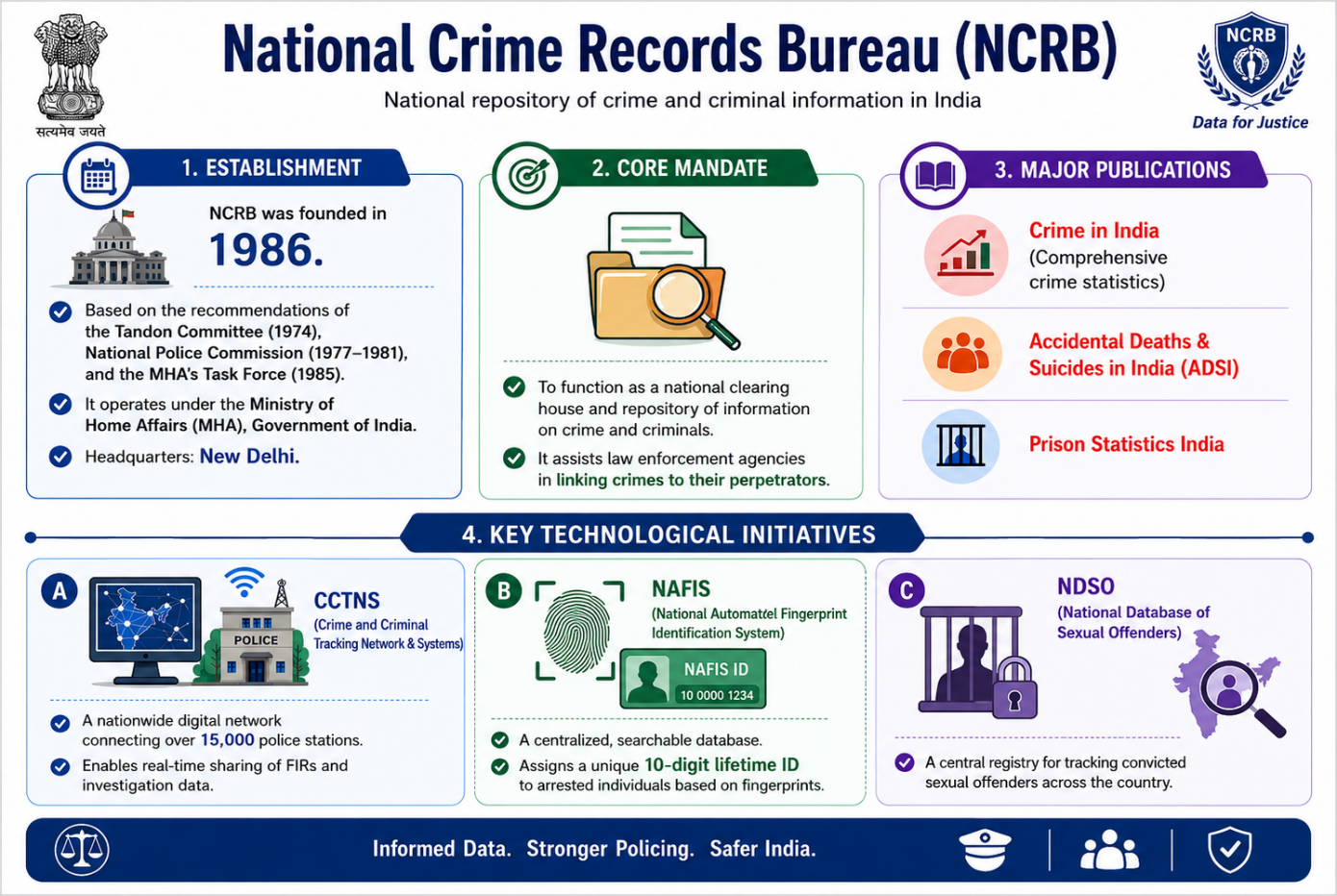
The National Crime Records Bureau (NCRB) released the latest Prison Statistics India Report 2024. The report shows that India’s prison occupancy rate declined to a decade-low of 112.7% in 2024. However, overcrowding continues to remain a serious structural problem in Indian prisons.The issue is mainly driven by the high share of undertrial prisoners, slow judicial processes, limited prison capacity expansion and high staff vacancies.
Key Highlights of Prison Statistics India 2024
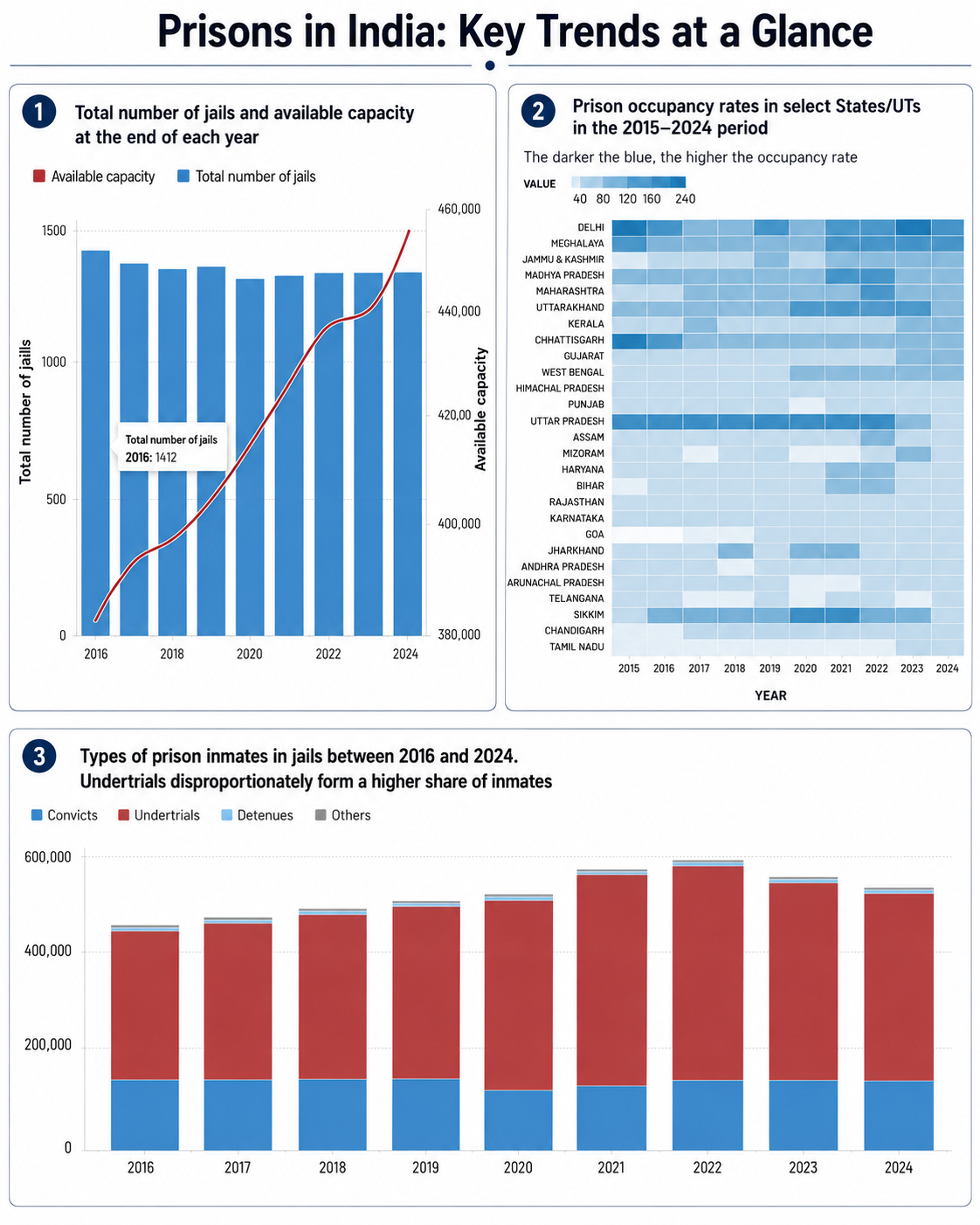
- India had around 1,333 jails at the end of 2024.
- The total sanctioned capacity of prisons was about 4.53 lakh inmates.
- The actual inmate population was over 5.11 lakh.
- National prison occupancy rate stood at 112.7%.
- More than half of the States and Union Territories recorded occupancy rates above 100%.
- Undertrial prisoners accounted for around 73% of total prison inmates in 2024.
- The share of convicts reduced from about 32% in 2016 to 26.6% in 2024.
What is Prison Overcrowding?
Prison overcrowding means that the number of prisoners is higher than the sanctioned capacity of prisons.
For example, if a jail has space for 100 inmates but houses 150 inmates, its occupancy rate is 150%.
Overcrowding creates pressure on:
- Living space
- Food supply
- Sanitation
- Medical care
- Security
- Rehabilitation programmes
- Prison staff
It converts prisons from correctional institutions into spaces of congestion and deprivation.
Why Undertrials are the Main Concern
- An undertrial prisoner is a person who is in jail while the case is still being heard and the court has not yet declared the person guilty.
- In 2024, undertrials formed nearly 73% of India’s prison population. This means that most prisoners in India are not convicts but persons awaiting trial.
This is a serious concern because:
- It weakens the principle of presumption of innocence.
- It turns pre-trial detention into punishment.
- It burdens poor and marginalised communities.
- It increases pressure on prisons.
- It reflects delay in investigation, trial and bail processes.
State-wise Concerns
Prison overcrowding is not uniform across India. Some States and Union Territories face much higher pressure.
- Delhi recorded the highest occupancy rate at around 194.6% in 2024.
- Meghalaya recorded an occupancy rate of 163.5%.
- Jammu and Kashmir recorded around 148.3%.
- Madhya Pradesh recorded around 147.1%.
- Jammu and Kashmir saw a sharp increase from 78% occupancy in 2015 to over 148% in 2023 and 2024.
- Chhattisgarh improved significantly, reducing occupancy from 234% in 2015 to 127.6% in 2024.
Delhi and Bihar had among the highest shares of undertrial prisoners, with over 87% of their prison population being undertrials.
Staff Vacancies and Prison Administration
The Parliamentary Standing Committee on Home Affairs observed that staff vacancies are one of the most neglected areas of prison administration.
High vacancies affect:
- Security management
- Medical care
- Rehabilitation programmes
- Prison discipline
- Mental health support
- Legal aid coordination
Delhi and Jammu and Kashmir, which had high overcrowding and high undertrial shares, also had serious staff shortages. In some States and UTs, nearly half of sanctioned prison posts remained vacant.
Constitutional and Judicial Concerns
Article 21
Article 21 guarantees the right to life and personal liberty. Prison overcrowding violates this right when prisoners are denied basic dignity, healthcare, sanitation and speedy trial.
Hussainara Khatoon v. State of Bihar, 1979
The Supreme Court held that speedy trial is part of Article 21. Long undertrial detention violates this principle.
Sunil Batra v. Delhi Administration, 1980
The Supreme Court held that prisoners do not lose all fundamental rights after imprisonment. Their dignity must be protected.
Bail as the Rule
Indian criminal law follows the principle that bail is the rule and jail is the exception. However, in practice, poor undertrials often remain in jail because they cannot provide bail bonds or sureties.
Causes of Prison Overcrowding
- High share of undertrial prisoners
- Delay in investigation and trial
- Limited access to bail
- Poverty and inability to provide sureties
- Mechanical remand by lower courts
- Unnecessary arrests
- Weak legal aid system
- Poor functioning of Under Trial Review Committees
- Slow prison capacity expansion
- Lack of open prisons
- Staff vacancies and weak prison administration
Impact of Prison Overcrowding
1. Violation of Human Dignity
Overcrowded prisons reduce living space and affect privacy, sleep, sanitation and mental health.
2. Health Risks
Crowded jails increase the spread of diseases such as tuberculosis, skin infections and other communicable diseases.
3. Poor Rehabilitation
Overcrowding reduces access to education, counselling, skill training and reform programmes.
4. Violence and Tension
Congested prisons increase stress, conflicts and violence among inmates.
5. Impact on Poor Families
Many undertrials are from economically weaker sections. Their detention affects family income and pushes households into debt.
6. “School of Crime” Effect
When first-time offenders and petty undertrials are lodged with hardened criminals, prisons may become spaces of criminal networking.
Government Measures
Bharatiya Nagarik Suraksha Sanhita, 2023
Section 479 provides relief for undertrials. First-time offenders who have served one-third of the maximum sentence may be released on bond.
It also places responsibility on the jail superintendent to apply for release when an eligible prisoner reaches the time limit.
Model Prisons and Correctional Services Act, 2023
This Act replaces the old colonial approach and shifts focus from punishment to reformation and rehabilitation.
Model Prison Manual, 2016
It aims to standardise prison management, including classification of prisoners, medical care and vocational training.
E-Prisons Project
It digitises prison records and links them with the criminal justice system. This can help track bail eligibility and prisoner status.
Support to Poor Prisoners Scheme
This scheme provides financial support to poor prisoners who cannot pay bail amounts or fines.
Way Forward
- Enact a comprehensive Bail Act to reduce arbitrary and prolonged detention.
- Strengthen the principle of bail as the rule and jail as the exception.
- Ensure strict compliance with Arnesh Kumar v. State of Bihar, which discourages unnecessary arrests.
- Expand fast-track courts for petty offences.
- Strengthen Under Trial Review Committees and ensure regular review of eligible cases.
- Expand open prisons, especially for low-risk prisoners.
- Improve prison capacity through new buildings, barracks and better infrastructure.
- Fill vacancies in prison staff, especially medical and counselling staff.
- Strengthen free legal aid under Article 39A.
- Use digital systems and AI-based case tracking to identify prisoners eligible for bail.
- Promote skill training, education, counselling and rehabilitation inside prisons.
- Create special gender-sensitive facilities for women prisoners.
Conclusion
India’s prison occupancy rate has declined, but overcrowding remains a serious governance and justice concern. The main reason is the large number of undertrial prisoners, many of whom remain in jail due to poverty, delayed trials and weak bail access.
Prison reform must focus on speedy trial, bail reform, legal aid, staff strengthening, open prisons and humane correctional administration. A democratic society must ensure that prisons protect security without violating dignity, liberty and justice.