Why in News?
- Telangana State Formation Day is celebrated every year on 2 June to mark the creation of Telangana as a separate State of India in 2014.
- The day represents the long struggle of the people of Telangana for regional identity, self-respect, equitable development and democratic rights. It also reminds us of the historical journey of Telangana from the Hyderabad State period to its formation as a separate State under the Andhra Pradesh Reorganisation Act, 2014.
Historical Background
- Before Independence, Telangana was part of the Hyderabad State ruled by the Nizam. The region had a distinct political, cultural and administrative identity.
- After India became independent, the Nizam of Hyderabad did not immediately agree to join the Indian Union. This created political uncertainty and instability in the region. The later integration of Hyderabad and the linguistic reorganisation of States shaped the political history of Telangana.
Telangana Rebellion
- The Telangana rebellion began in the late 1940s as a peasant struggle against the jagirdari system.
- Under this system, landlords and revenue officials exercised strong control over land and peasants. The movement was linked with agrarian distress and resistance to feudal oppression.
- The rebellion also came into conflict with the Razakars, a militia led by Kasim Rizvi. The disturbed law and order situation in Hyderabad State became one of the major reasons for India’s intervention through Operation Polo.
Standstill Agreement and Operation Polo
- After Independence, the Nizam of Hyderabad did not immediately agree to join the Indian Union.
- India signed a Standstill Agreement with Hyderabad to temporarily continue existing administrative arrangements. However, violence and instability continued due to Razakar activities.
- In September 1948, India launched Operation Polo. Within a few days, Hyderabad State was integrated into the Indian Union. This was a major turning point in the political history of Telangana.
Linguistic Reorganisation and Telangana
- In 1953, Andhra State was created by separating Telugu-speaking areas from the Madras State. It was the first linguistic State in India.
- Later, the question arose whether the Telugu-speaking Telangana region of Hyderabad State should be merged with Andhra.
- The States Reorganisation Commission suggested that Telangana could remain separate for some time and later decide on merger. However, in 1956, Telangana was merged with Andhra State to form Andhra Pradesh under the States Reorganisation Act, 1956.
- Hyderabad became the capital of the enlarged Andhra Pradesh.
Gentlemen’s Agreement and Mulki Rules
- The merger was accompanied by safeguards under the Gentlemen’s Agreement of 1956. These safeguards were meant to protect Telangana’s interests in employment, education, public funds and regional development.
- Telangana also had Mulki Rules, which acted as local employment safeguards in Hyderabad State. These rules aimed to protect government job opportunities for local residents.
- However, protests arose when many non-locals were appointed to government posts. In 1969, student protests intensified due to alleged violations of safeguards promised under the Gentlemen’s Agreement.
- In 1972, the Supreme Court upheld the Mulki Rules. This was followed by the Jai Andhra Movement, and Andhra Pradesh was placed under President’s Rule in 1973.
32nd Constitutional Amendment
In 1973, the 32nd Constitutional Amendment was introduced.
Under this arrangement:
- Andhra Pradesh was divided into six zones for public employment purposes.
- Job reservations were linked with zonal arrangements.
- The Mulki Rules Act was repealed.
This was an attempt to address regional employment concerns, but the demand for separate Telangana continued in different forms.
Telangana Movement
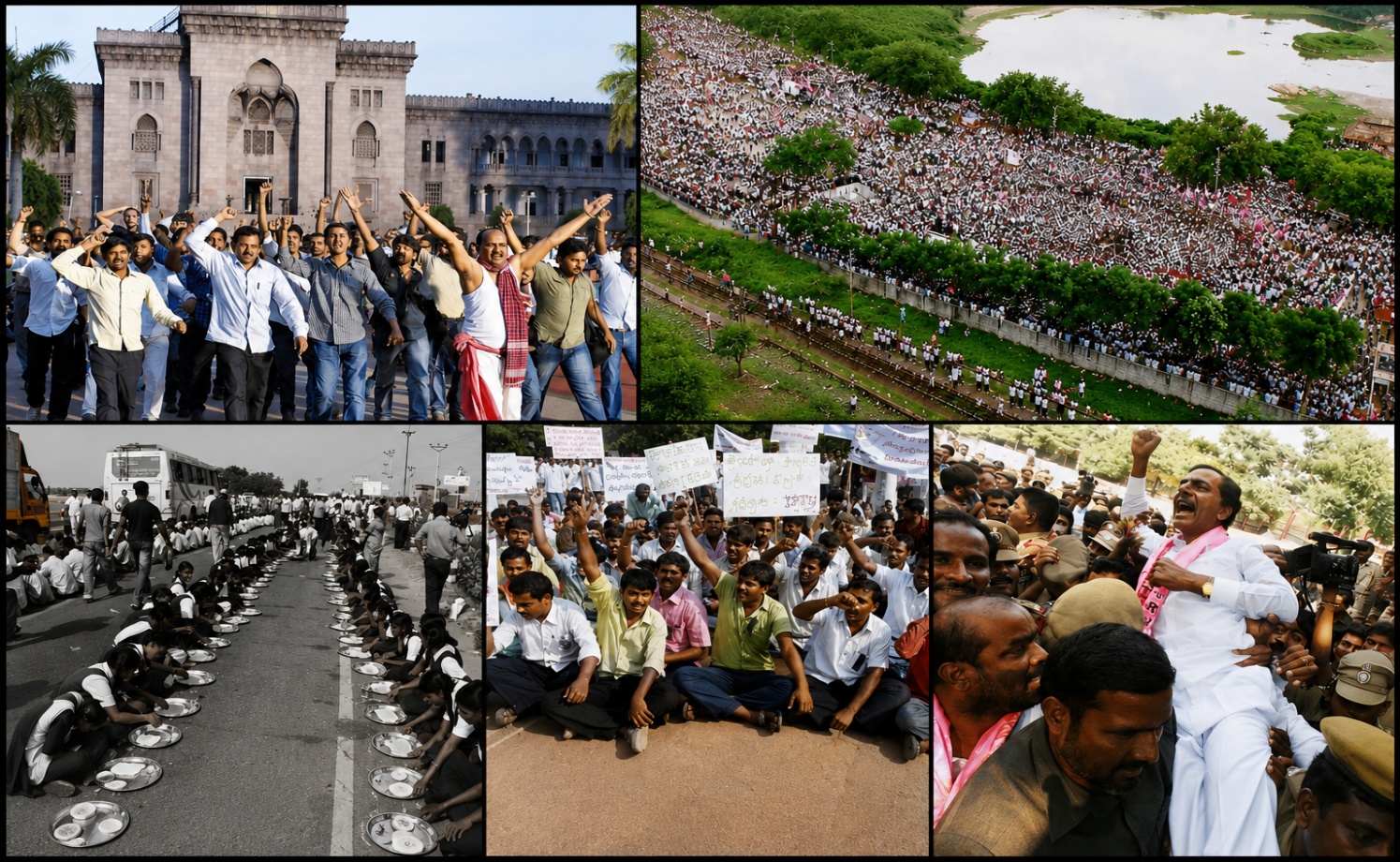
The first major phase of the Telangana movement was the Jai Telangana Movement of 1969. It demanded proper implementation of safeguards and separate Statehood for Telangana.
The movement was based on three major concerns:
- Neellu – Water: fair share of river waters and irrigation.
- Nidhulu – Funds: fair use of Telangana’s revenue for Telangana’s development.
- Niyaamakaalu – Jobs: fair employment opportunities for local people.
These three issues became the emotional and political foundation of the Telangana Statehood movement.
Timeline of the Telangana Movement
| Year | Important Development |
| 1948 | Hyderabad State, including Telangana, was integrated into the Indian Union through Operation Polo. |
| 1952 | Burgula Ramakrishna Rao became the first Chief Minister of Hyderabad State after democratic elections. |
| 1953 | Andhra State was formed on linguistic basis after Potti Sriramulu’s 53-day fast for a separate Telugu-speaking State. |
| 1955 | Andhra Assembly passed a resolution favouring the merger of Andhra with Telangana. |
| 1956 | Telangana was merged with Andhra State to form Andhra Pradesh. The Gentlemen’s Agreement was signed to protect Telangana’s interests. |
| 1969 | Marri Channa Reddy launched the Telangana Praja Samiti demanding a separate Telangana State. Students played a major role in the agitation. |
| 1969 | Prime Minister Indira Gandhi proposed an Eight-Point Plan, but protests continued. |
| 1972 | The Jai Andhra Movement started in Andhra-Rayalaseema as a counter-response to Telangana demands. |
| 1973 | The Six-Point Formula was introduced to address regional concerns in Andhra Pradesh. |
| 1985 | Telangana employees raised concerns about injustice in government appointments. |
| 1999 | The Congress party demanded the creation of Telangana. |
| 2001 | K. Chandrashekar Rao formed the Telangana Rashtra Samithi (TRS) after leaving the Telugu Desam Party. |
| 2004 | Congress came to power, and TRS became part of the coalition government. |
| 2006 | TRS quit the coalition governments and continued its independent struggle for Telangana. |
| 2008 | Telugu Desam Party declared support for the bifurcation of Andhra Pradesh. |
| 2009 | TRS launched a hunger strike. The Centre announced that the process for Telangana formation would be initiated. |
| 2010 | A five-member committee appointed by the Centre submitted its report on the Telangana issue. |
| 2011–12 | Telangana witnessed major agitations such as Million March, Chalo Assembly and Sakalajanula Samme. |
| 2012 | The Union Home Ministry called an all-party meeting to discuss the Telangana issue. |
| 2014 | The Telangana Bill was passed in Parliament, leading to the formation of Telangana on 2 June 2014. |
Renewed Movement in the 2000s
The Telangana movement gained renewed momentum in 2001 with the formation of the Telangana Rashtra Samithi under K. Chandrashekar Rao.
The movement received support from:
- Students, Employees, Farmers, Intellectuals, Civil society organisations, Cultural activists
A major turning point came in 2009, when KCR began a fast unto death demanding Telangana Statehood. The agitation created strong political pressure and brought the issue to the national agenda.
Formation of Telangana
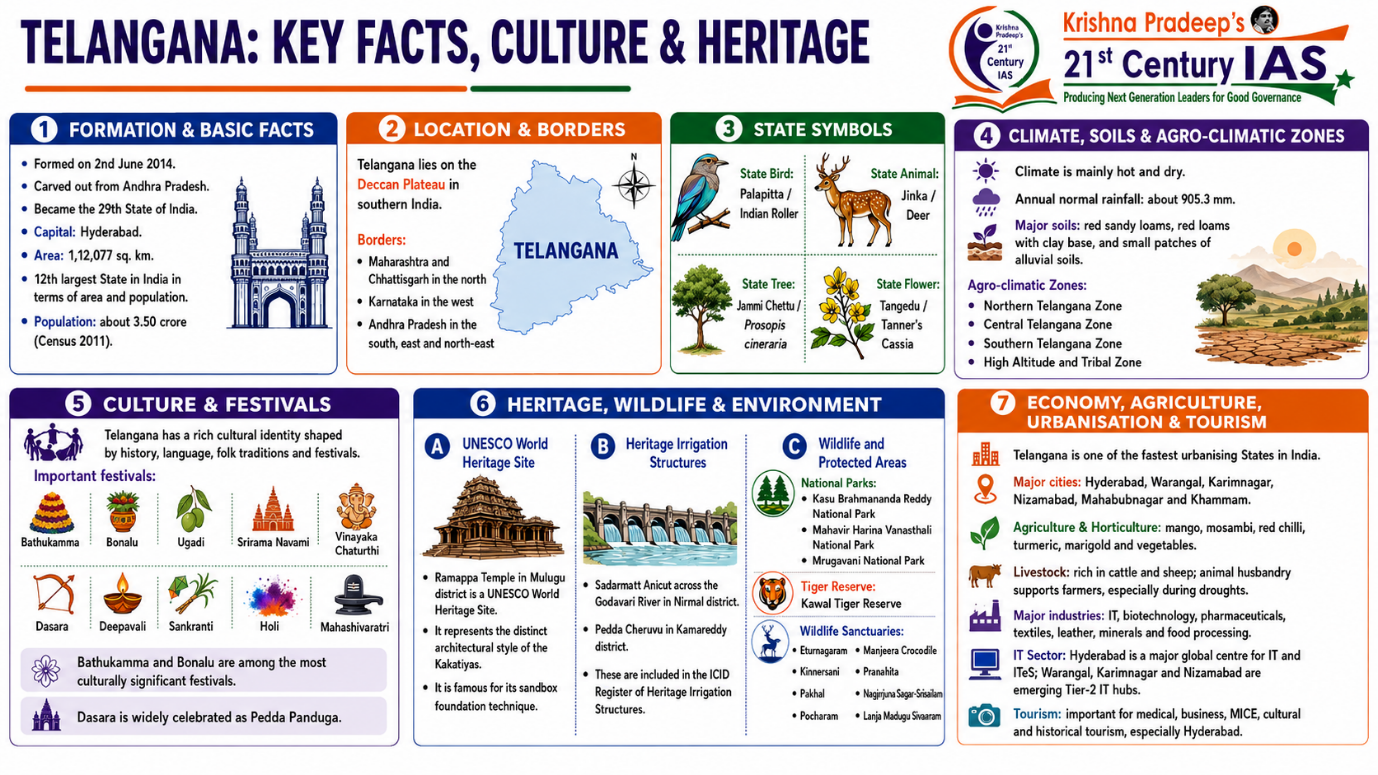
After prolonged public agitations, political negotiations and parliamentary processes, Parliament passed the Andhra Pradesh Reorganisation Act, 2014.
- Telangana officially became a State on 2 June 2014.
- It became the 29th State of India.
- It was carved out of the northwestern part of Andhra Pradesh.
- Hyderabad became the capital of Telangana.
- Telangana initially had 10 districts.
- The districts were later reorganised into 33 districts for administrative convenience.
- K. Chandrashekar Rao became the first Chief Minister of Telangana.
Conclusion
Telangana State Formation Day is not only a celebration of a new State. It is a reminder of a long people’s movement for identity, justice and self-governance.
The journey of Telangana includes the Hyderabad State period, the Telangana rebellion, Operation Polo, linguistic reorganisation, Mulki Rules, the 1969 movement and the final Statehood struggle. It shows that regional aspirations can be addressed within India’s constitutional framework. Telangana’s future depends on balanced development, employment generation, irrigation security, cultural preservation and inclusive governance.