Relevance: Science and Technology, Telangana Economy, Industrial Development, Innovation Ecosystem.
For Prelims:
- Semiconductor, Chip Design, VLSI, SoC, Semiconductor IP, Global Capability Centres, NITI Aayog, Frontier Tech Hub, Advanced Packaging, Chiplets, Compound Semiconductors.
For Mains:
- Semiconductor Ecosystem, Strategic Technology, Design Talent, Technology Self-Reliance, Electronics Manufacturing, Innovation Cluster, Global Value Chains, Digital Economy.
Why in News?
Hyderabad is expected to emerge as one of India’s leading semiconductor design hubs after NITI Aayog’s Frontier Tech Hub released a 10-year road map for the future of India’s semiconductor industry.
The road map aims to build a $120 billion to $150 billion semiconductor ecosystem by 2035. It identifies semiconductor design talent development as one of the five key pillars. Hyderabad, which already hosts seven of the world’s top 10 semiconductor firms, is seen as a major centre for achieving this goal.
What is Semiconductor Design?
Semiconductor design refers to the process of designing the structure and functioning of chips before they are manufactured.
In simple terms, it is like preparing the blueprint of a chip. Engineers decide how the chip will process data, consume power, perform calculations and support devices such as smartphones, computers, electric vehicles, satellites and AI systems.
Semiconductor design includes areas such as:
- VLSI design
- System-on-Chip design
- Chip verification
- AI accelerator design
- Embedded systems
- Semiconductor IP development
NITI Aayog’s Semiconductor Road Map
The NITI Aayog road map focuses on building India’s semiconductor capacity over the next decade. Its larger vision is to make India a strong player in the global semiconductor value chain.
The road map targets:
- A $120–150 billion semiconductor ecosystem by 2035
- Development of 100+ advanced semiconductor design IPs
- Strong focus on design talent
- Growth in advanced packaging
- Expansion of chiplet design
- Promotion of compound semiconductors
- Development of a deeper semiconductor ecosystem beyond only fabrication plants
| A semiconductor is a material that can conduct electricity under certain conditions but does not conduct electricity as freely as metals.
It stands between:
|
Why Hyderabad is Important
Hyderabad is already a major technology centre in India. It has a strong base in IT, AI, life sciences, global capability centres and semiconductor design.
The city is important because:
- It hosts seven of the world’s top 10 semiconductor firms.
- It is reportedly outpacing Bengaluru in chip design hiring.
- It has around 9,300 semiconductor professionals.
- Its semiconductor talent pool is growing at about 4% annually.
- Hyderabad and Bengaluru together account for nearly two-thirds of India’s semiconductor design capability.
- The city has a mature ecosystem of design GCCs and technology companies.
Key Strengths of Hyderabad
1. Strong Talent Base
Hyderabad has engineers working in advanced areas such as chip verification, AI accelerators and System-on-Chip design. This makes the city important for India’s goal of creating advanced semiconductor design IPs.
2. Presence of Global Firms
The presence of leading semiconductor companies gives Hyderabad access to global design practices, skilled professionals and advanced projects.
3. Innovation Cluster
Hyderabad has a unique convergence of:
- IT
- Semiconductors
- Artificial Intelligence
- Life sciences
- Global Capability Centres
This helps create a strong innovation ecosystem.
4. Common Facility Centre
The proposed common facility centre at Knowledge City can help start-ups and mid-sized design firms. Such firms often cannot afford expensive prototyping infrastructure on their own.
5. Infrastructure Expansion
Telangana’s plan to expand Hyderabad’s infrastructure over the next decade can further strengthen its role as a semiconductor hub.
Importance of Semiconductor Design Talent
Semiconductor manufacturing is not only about fabrication plants. Design is one of the most valuable parts of the chip ecosystem.
Design talent is important because:
- It creates intellectual property.
- It supports high-value jobs.
- It strengthens technology self-reliance.
- It reduces dependence on foreign chip design.
- It supports electronics, defence, AI, automotive and telecom sectors.
- It helps India move from being a chip consumer to a chip creator.
More-than-Moore Technologies
The NITI Aayog road map gives importance to “more-than-Moore” technologies.
This means improving chip performance not only by making transistors smaller, but also by using new designs, materials and packaging methods.
Important areas include:
- Advanced packaging
- Chiplet design
- Compound semiconductors
- Embedded systems
- AI-specific chips
Hyderabad is well placed in these areas because of its existing strengths in embedded systems, chip verification and advanced design work.
Challenges
- India still has limited semiconductor manufacturing capacity.
- Design talent must be continuously upgraded.
- Start-ups need access to funding, prototyping and testing infrastructure.
- Semiconductor research requires strong industry-academia collaboration.
- Global competition in chip design is very high.
- Advanced tools and Electronic Design Automation software are expensive.
- India needs more domestic semiconductor IP ownership.
- Supply chain and export control risks can affect semiconductor growth.
Way Forward
- Strengthen semiconductor design education in universities and engineering colleges.
- Create industry-linked training programmes in VLSI, SoC and chip verification.
- Support start-ups with common prototyping and testing facilities.
- Expand the proposed common facility centre at Knowledge City.
- Promote domestic semiconductor IP creation.
- Encourage collaboration among industry, academia and government.
- Provide incentives for advanced packaging, chiplets and compound semiconductor firms.
- Build strong links between Hyderabad, Bengaluru and other semiconductor clusters.
- Ensure long-term policy stability and infrastructure support.
Conclusion
Hyderabad’s rise as a semiconductor design hub reflects India’s shift from being mainly a technology consumer to becoming a technology creator. The city’s strong talent base, presence of global semiconductor firms, mature GCC ecosystem and innovation cluster make it well positioned to support India’s semiconductor ambitions.
However, design capability alone is not enough. India must strengthen skills, research, prototyping infrastructure, start-up support and domestic IP creation. If planned effectively, Hyderabad can become a major driver of India’s semiconductor ecosystem and contribute significantly to the goal of a strong, self-reliant digital economy.
CARE MCQ
Q. With reference to semiconductor design, consider the following statements:
- It involves preparing the blueprint of a chip before manufacturing.
- It includes areas such as VLSI design and chip verification.
- It has no role in artificial intelligence and telecom sectors.
Which of the above statements are correct?
A. 1 and 2 only
B. 2 and 3 only
C. 1 and 3 only
D. 1, 2 and 3
Answer: A
Explanation:
- Statement 1 is correct: Semiconductor design prepares the functional blueprint of a chip.
- Statement 2 is correct: VLSI design, SoC design and chip verification are part of semiconductor design.
- Statement 3 is incorrect: Semiconductor design is very important for AI, telecom, defence, EVs and digital technologies.
FAQs
1. Why is Hyderabad important for India’s semiconductor sector?
Hyderabad has a strong semiconductor talent pool, global chip design companies and expertise in chip verification, embedded systems and AI-related design.
2. What is semiconductor design?
Semiconductor design is the process of creating the blueprint of a chip before it is manufactured.
3. What is VLSI?
VLSI means Very Large Scale Integration. It refers to designing chips with millions or billions of transistors on a small silicon chip.
4. What is System-on-Chip?
A System-on-Chip is a complete electronic system placed on a single chip. It may include processor, memory, communication and control units.
5. What are semiconductor IPs?
Semiconductor IPs are reusable chip design blocks that can be used in different semiconductor products.
6. What are chiplets?
Chiplets are smaller chip components that can be combined to form a larger and more powerful chip system.
7. What is advanced packaging?
Advanced packaging is a method of integrating different chip components to improve performance, reduce size and improve energy efficiency.
8. Why is semiconductor design important for India?
It helps India create high-value intellectual property, reduce dependence on foreign technology and support strategic sectors like AI, telecom, defence and EVs.
Relevance: GS Paper II: Indian Polity, Election Commission of India, Electoral Reforms, Citizenship, Fundamental Rights
For Prelims:
- Special Intensive Revision, Election Commission of India, Article 324, Section 16 of RPA 1950, Citizenship Act 1955, Electoral Roll, Aadhaar, Booth Level Officer, D-Voter, Foreigners Tribunal
For Mains:
- Free and fair elections, electoral integrity, right to vote, citizenship verification, procedural fairness, institutional restraint, disenfranchisement, burden of proof
Why in News?
- The Supreme Court, in Association for Democratic Reforms v. Election Commission of India, upheld the Election Commission of India’s order for Special Intensive Revision of electoral rolls.
- The case arose from the SIR conducted before the November 2025 Bihar Assembly elections. The Supreme Court held that the Election Commission has the power to conduct SIR and examine citizenship-related questions for electoral purposes.
- However, the Court clarified that the Election Commission cannot finally declare whether a person is an Indian citizen or not.
What is Special Intensive Revision?
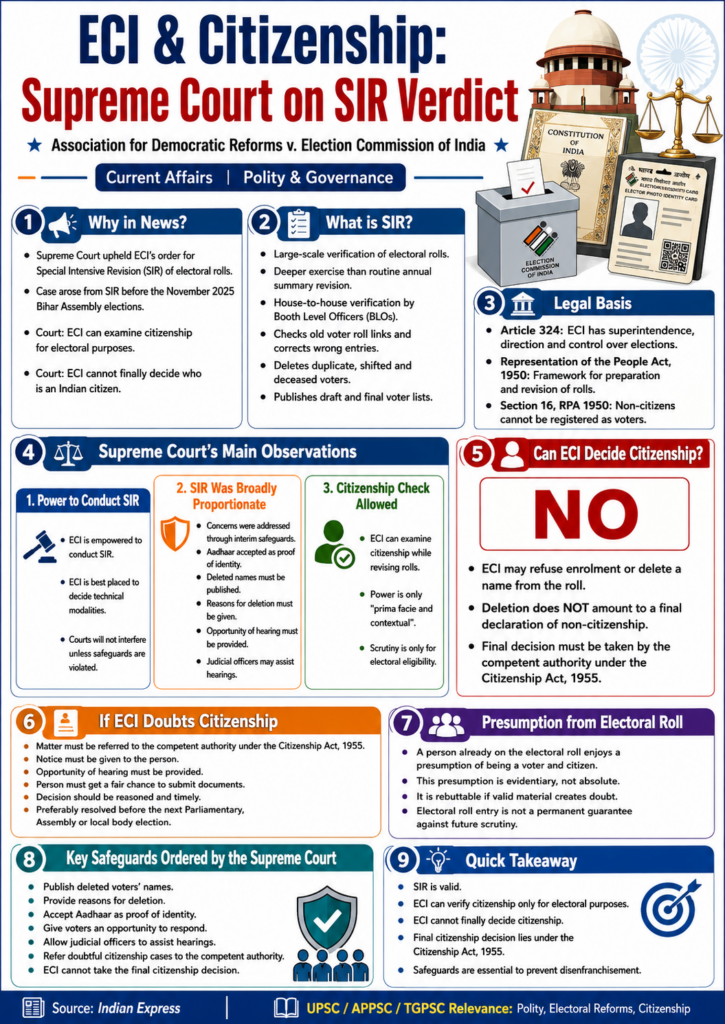
Special Intensive Revision is a large-scale verification process conducted by the Election Commission to update and clean electoral rolls.
It is different from the normal annual summary revision because it involves deeper verification of voter details.
The process may include:
- House-to-house verification by Booth Level Officers
- Checking old voter roll links
- Correction of wrong entries
- Deletion of duplicate, shifted or dead voters
- Verification of citizenship declaration
- Publication of draft and final voter lists
In simple words, SIR is a detailed checking of the voter list to ensure that only eligible citizens remain registered as voters.
Background of the Case
- The Election Commission conducted SIR in Bihar before the 2025 Assembly elections. The process was challenged before the Supreme Court.
- The petitioners argued that the process may lead to large-scale deletion of genuine voters. They also raised concerns about lack of transparency; strict documentation requirements and the burden placed on ordinary citizens.
- The Supreme Court examined whether the Election Commission had the authority to conduct SIR and whether it could examine citizenship-related issues while revising electoral rolls.
Legal Basis of SIR
The Election Commission gets its power mainly from:
- Article 324 of the Constitution
It gives the Election Commission the power of superintendence, direction and control over elections.
- Representation of the People Act, 1950
It provides the legal framework for preparation and revision of electoral rolls.
- Section 16 of RPA, 1950
It states that a person who is not a citizen of India cannot be registered as a voter.
Therefore, the Election Commission can verify whether a person satisfies the legal conditions required for inclusion in the electoral roll.
Supreme Court’s Main Observations
1. ECI Has Power to Conduct SIR
- The Supreme Court held that the Election Commission is empowered to conduct Special Intensive Revision.
- The Court said that the Commission is best placed to decide the technical method of revising electoral rolls.
- This means the judiciary will not normally interfere with the method chosen by the Election Commission unless it violates constitutional or legal safeguards.
2. SIR Was Held Broadly Proportionate
The Court held that the SIR process was broadly proportionate.
It observed that many earlier concerns were addressed through interim directions of the Court.
These directions included:
- Acceptance of Aadhaar as proof of identity
- Publication of deleted voters’ names
- Providing reasons for deletion
- Opportunity of hearing
- Assistance of judicial officers during hearings
The Court said these safeguards made the process more transparent and fairer.
3. ECI Can Examine Citizenship for Electoral Purposes
- The Supreme Court held that the Election Commission can examine citizenship while revising electoral rolls.
- This is because non-citizens are not allowed to be registered as voters under Section 16 of the Representation of the People Act, 1950.
- However, this power is limited. The Court described it as prima facie and contextual.
- This means the Election Commission can only check citizenship for the purpose of deciding whether a person can remain on the voter list.
Can the Election Commission Decide Who is an Indian Citizen?
No. The Election Commission cannot finally decide who is an Indian citizen.
The Supreme Court clearly stated that if the Election Commission is not satisfied with a person’s documents, it may refuse enrolment or delete the name from the electoral roll.
But such deletion does not mean that the person is officially declared a non-citizen.
The final decision on citizenship must be taken by the competent authority under the Citizenship Act, 1955.
What Happens if ECI Doubts Citizenship?
If the Election Commission deletes a person’s name on the ground of doubtful citizenship, it must refer the matter to the competent authority under the Citizenship Act, 1955.
The competent authority must decide the matter according to law after giving:
- Notice to the person
- Opportunity of hearing
- Fair chance to submit documents
- Reasoned decision
The Supreme Court said that such decisions should be taken within a reasonable time, preferably before the next Parliamentary, Assembly or local body election in that constituency.
Presumption of Citizenship from Electoral Roll
- The Court accepted that a person already on the electoral roll enjoys a presumption of being a voter and citizen.
- However, this presumption is not absolute.
- It is only an evidentiary presumption. It can be questioned if valid material creates doubt.
- The Court said that inclusion in the electoral roll is not a permanent guarantee against future verification.
Key Safeguards Ordered by the Supreme Court
The Supreme Court introduced important safeguards to make the SIR process fair.
These include:
- Deleted voters’ names must be published.
- Reasons for deletion must be provided.
- Aadhaar may be accepted as proof of identity.
- Voters must get an opportunity to respond.
- Judicial officers may assist in hearings.
- Citizenship-related cases must be referred to the competent authority.
- Final citizenship decision cannot be taken by ECI.
These safeguards aim to prevent arbitrary deletion of voters.
Significance of the Verdict
1. Strengthens Electoral Integrity
The judgment supports the Election Commission’s power to maintain clean and accurate voter lists.
It may help remove duplicate, false, dead or shifted voters from electoral rolls.
2. Clarifies the Limits of ECI’s Power
The verdict makes it clear that the Election Commission can examine citizenship only for electoral purposes.
It cannot finally decide citizenship status.
3. Protects Procedural Fairness
The Court emphasised notice, hearing, transparency and reasoned decision-making.
This is important because deletion from electoral rolls can affect a citizen’s right to vote.
4. Clears the Way for Nationwide SIR
The verdict allows the Election Commission to continue SIR in other states and Union Territories.
This makes the judgment important for upcoming elections.
5. Balances Two Democratic Goals
The Court tried to balance two objectives:
- Clean and reliable voter lists
- Protection of genuine citizens from wrongful exclusion
Concerns and Challenges
1. Risk of Voter Disenfranchisement
Genuine voters may lose their voting rights if their names are deleted due to clerical mistakes or lack of documents.
This may affect poor, elderly, migrant and marginalised citizens more severely.
2. Burden Shifts to Citizens
After deletion, the burden practically shifts to the individual to prove eligibility or citizenship.
This can be difficult for people who do not have proper documents.
3. Minor Errors May Create Serious Problems
Errors in names, age, parents’ names, spelling, address or old voter roll details may lead to notices or deletion.
In India, such errors are common in official documents.
4. Link Between Voter Roll and Welfare Benefits
The Court clarified that deletion from the voter list does not mean loss of citizenship.
However, if governments link welfare benefits with electoral roll status, excluded persons may face practical difficulties.
5. Assam D-Voter Experience
The Assam experience shows the danger of long citizenship disputes.
During the 1997 revision, several people were marked as doubtful voters and referred to Foreigners Tribunals.
Many cases remained pending for years, creating uncertainty over citizenship and access to basic rights.
6. Administrative Burden
If large numbers of deleted voters are referred for citizenship determination, the competent authorities may become overburdened.
This may delay justice and create long-term uncertainty.
What Citizens Should Do During SIR
Citizens should carefully follow the SIR process.
They should:
- Verify pre-filled details in the SIR form
- Check name, address, EPIC number and photograph
- Provide correct details of parents or spouse
- Check legacy linkage, if required
- Submit the form within the deadline
- Track whether the form has been uploaded
- Check the draft electoral roll
- File correction or inclusion forms if the name is missing
- Appeal within the prescribed time if the name is deleted
This is important because failure to respond may result in exclusion from the voter list.
Way Forward
The Election Commission should conduct SIR in a transparent and citizen-friendly manner.
Minor clerical errors should not become a ground for harsh deletion. Special help desks should be created for elderly persons, migrants, poor citizens and people without easy access to documents.
Deleted voters must receive clear reasons and proper opportunity to appeal. Citizenship-related cases must be referred only where there is genuine doubt and not merely because of spelling or data mismatch.
Political parties, civil society organisations and the media should create awareness among voters. Governments should also ensure that welfare benefits are not denied merely because a person’s name is removed from the electoral roll.
The competent authority under the Citizenship Act should decide referred cases quickly and fairly.
Conclusion
The Supreme Court verdict upholds the Election Commission’s power to conduct Special Intensive Revision of electoral rolls. It also allows the Commission to examine citizenship-related questions for electoral purposes.
However, the Election Commission cannot finally decide whether a person is an Indian citizen. Final citizenship determination belongs to the competent authority under the Citizenship Act, 1955.
The verdict is important because it seeks to protect both electoral integrity and democratic rights. Its success will depend on fair implementation, transparency and protection of genuine citizens from wrongful disenfranchisement.
CARE MCQ
Q. With reference to Special Intensive Revision of electoral rolls, consider the following statements:
- It is a detailed verification process conducted by the Election Commission of India.
- It can be used to update, correct and delete entries in electoral rolls.
- It automatically declares deleted voters as non-citizens.
How many of the above statements are correct?
A. Only one
B. Only two
C. All three
D. None
Answer: B
Explanation:
- Statement 1 is Correct: SIR is a detailed voter verification process conducted by the Election Commission.
- Statement 2 is Correct: It is used to update, correct and delete wrong or ineligible entries.
- Statement 3 is Incorrect: Deletion from electoral roll does not automatically mean that the person is a non-citizen.
Additional Information: The final decision on citizenship must be taken by the competent authority under the Citizenship Act, 1955.
FAQs
1. Can the Election Commission decide who is an Indian citizen?
No. The Election Commission can examine citizenship only for electoral roll purposes. It cannot finally decide citizenship.
2. Does deletion from the voter list mean loss of citizenship?
No. Deletion from the electoral roll only affects voting rights. It does not automatically mean loss of Indian citizenship.
3. Who decides citizenship finally?
The competent authority under the Citizenship Act, 1955 decides citizenship finally.
4. Why is SIR conducted?
SIR is conducted to clean and update electoral rolls by removing wrong, duplicate, dead or ineligible entries.
5. What should voters do during SIR?
Voters should verify their details, submit forms on time, check the draft roll and file corrections or appeals if needed.
6. Why is the verdict important?
It clarifies the Election Commission’s powers and limits while protecting both electoral integrity and voters’ rights.
Source : The Indian Express
Relevance: UPSC GS Paper II – Governance, Government Policies and Local Self-Governance; GS Paper III – Water Resources, Agriculture, Environment and Disaster Management
For Prelims:
- Water Budgeting, Atal Bhujal Yojana, National Water Mission, Varuni Web Application, Jal Shakti Abhiyan, Jal Shakti se Jal Shakti, Participatory Water Governance, Groundwater Recharge, Watershed Management, Gram Sabha,
For Mains:
- Rural water governance, participatory water budgeting, demand-side water management, groundwater depletion, climate-resilient water planning, community-led conservation, water-energy-food nexus, agricultural water demand
Why in News?
The Ministry of Jal Shakti highlighted the importance of water governance in rural India through the idea of participatory water budgeting.Water budgeting is becoming important because India faces rising water demand, uneven water distribution, climate variability, groundwater depletion and increasing pressure from agriculture, domestic use and livestock.The article highlights how community-led planning, supported by schemes such as Atal Bhujal Yojana, National Water Mission, State initiatives and digital tools such as the Varuni Web Application, can improve rural water governance
What is Water Budgeting?
Water budgeting is a systematic assessment of water availability and water demand within a defined geographical unit.This unit may be a village, watershed, block or district.
It compares:
- How much water is available, How much water is needed, Which sectors use water Whether the area has surplus water or water deficit, What actions are needed to manage water better
Need for Water Budgeting in Rural India
- Water budgeting is needed because rural India depends heavily on agriculture and groundwater.
- Agriculture accounts for around 80 to 90 percent of water use in rural areas. Livestock also creates significant water demand for drinking, fodder production and related activities.
Many rural areas face:
- Declining groundwater levels, Seasonal water shortages, uneven rainfall,Droughts and floods, Conflicts over water allocation, Unsuitable cropping patterns, Over-dependence on borewells
Therefore, India needs to move from a supply-driven approach to a demand-based and planned water management system.
Water Resource Dynamics in India
- India has a large population and a large livestock base. It has about 17.5 percent of the global population and around 11.6 percent of the world’s livestock.
- This creates significant pressure on available water resources.
- The average annual water availability depends on rainfall, geology, rivers, aquifers and climate. But per capita water availability depends on population size.
- As population increases, the amount of water available per person declines.
- Climate variability further increases the problem. Some areas may face floods, while others may face droughts in the same season. This makes local-level planning necessary.
Water Availability Includes:
- Rainfall, Surface inflows, Groundwater recharge, Water received from other geographical areas, Stored water in tanks, ponds and reservoirs
Water Demand Includes:
- Drinking water demand, Domestic water demand, Irrigation water demandLivestock water demand, Industrial water demand,Environmental water needs
Water Losses Include:
- Evapotranspiration, Runoff, Groundwater discharge, Leakage, Inefficient irrigation losses
After calculating these elements, the community can identify whether the area is facing a water surplus or water deficit.This helps in choosing suitable crops, planning irrigation, restoring water bodies and regulating groundwater use.
Role in Agriculture and Livestock Management
- Water budgeting is highly useful for agriculture because crop choices must match local water availability.
- If farmers grow water-intensive crops in water-scarce areas, groundwater depletion increases. This creates long-term risk for agriculture.
Water budgeting helps farmers in:
- Selecting suitable crops, Planning sowing based on local water conditions, reducing water-intensive crops in dry regions, promoting drip and sprinkler irrigation, improving productivity with efficient water use,Reducing crop failure risk during droughts
Livestock is also an important part of rural water demand. The livestock census showed an increase in livestock population, which means drinking water and fodder-related water demand also increase.
Therefore, water budgeting must include both agriculture and livestock demand.
Government Initiatives
1. Atal Bhujal Yojana
- The Atal Bhujal Yojana was launched in 2019 to promote community-led groundwater management.
- It focuses on water budgeting at the Gram Panchayat level. The programme is implemented in selected groundwater-stressed States.
- It covers 229 blocks in seven States. The selected States and Gram Panchayats are chosen based on groundwater stress, institutional readiness and willingness to participate.
The scheme promotes:
- Annual water budgeting, Community participation, Groundwater recharge, Water conservation structures, Traditional water system revival ,Demand-side water management
- During assessments conducted in 2023-24 and 2024-25, 180 out of 229 blocks showed measurable improvement in groundwater levels.
- As of March 2026, around 81,700 water conservation and recharge structures were created or restored. Around 8,203 water budgets were completed across participating Gram Panchayats.
2. National Water Mission
The National Water Mission recognises water budgeting as a foundational element of Integrated Water Resources Management.
It focuses on:
- Water conservation, Sustainability, Efficient use of water Long-term water security,Community participation
The Mission also promotes women-led institutions and community groups in water management.
3. Nari Shakti se Jal Shakti
- Under the National Water Mission, Nari Shakti se Jal Shakti promotes women-led water conservation.
- Self-Help Groups, Water Users’ Associations and Village Water and Sanitation Committees are encouraged to participate in water planning and conservation.
4. State-Level Initiatives
Several States have promoted water budgeting and water conservation through local programmes.
Important examples include:
- Mukhya Mantri Jal Swavlamban Abhiyan in Rajasthan
- Jalyukt Shivar Abhiyan in Maharashtra
- Community-led watershed management in Hiware Bazar
- Digital water budgeting using Varuni Web Application
3. Jalyukt Shivar Abhiyan, Maharashtra
- The Jalyukt Shivar Abhiyan was launched in 2014 by the Government of Maharashtra.
- It aims to provide sustainable long-term solutions to rural water scarcity.
- The programme uses geotagging and mobile applications developed by the Maharashtra Remote Sensing Application Centre.
It focuses on:
- Water conservation, Groundwater recharge, Village-level water budgeting, Real-time monitoring
As a result, many villages were declared drought-free. Groundwater levels increased and agricultural productivity improved.
Role of Technology: Varuni Web Application
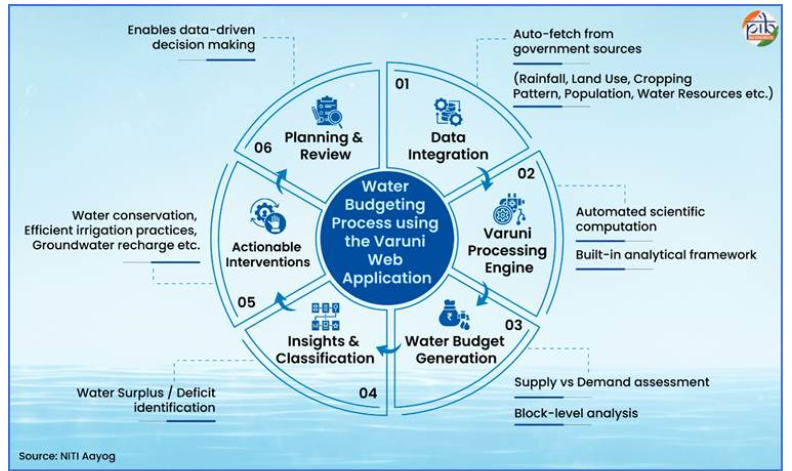
- The Varuni Web Application is a digital tool used for block-level water budgeting.
- It was developed under the Indo-German bilateral project Water Security and Climate Adaptation in Rural India.
- The project is implemented in collaboration with the Ministry of Jal Shakti and the Ministry of Rural Development, with technical support from NITI Aayog.
- The Varuni Web Application uses automatically sourced data from government portals.
It collects data related to:
- Rainfall, Land use, Cropping pattern, Population, Water resources
The application processes this data through an in-built computational framework and generates structured water budget assessments.
Significance
1. Promotes Evidence-Based Governance
Water budgeting helps local bodies make decisions based on data rather than guesswork.
2. Supports Rural Water Security
It helps villages plan water use according to local availability and demand.
3. Improves Agricultural Planning
Farmers can choose crops based on local water conditions, reducing risk and improving productivity.
4. Reduces Groundwater Depletion
Water budgeting encourages groundwater recharge, conservation and regulated extraction.
5. Strengthens Gram Panchayats
It makes Gram Panchayats active institutions in local water governance.
6. Builds Climate Resilience
Water budgeting helps communities prepare for droughts, floods and uncertain rainfall.
7. Promotes Community Participation
The process involves Gram Sabhas, farmers, women’s groups and local institutions.
8. Supports Sustainable Development
It links water conservation with agriculture, livelihoods, food security and environmental protection.
Challenges
1. Fragmented Water Governance
Water is governed by multiple departments such as irrigation, drinking water, rural development and environment. Lack of coordination weakens integrated planning.
2. Overuse of Groundwater
Groundwater extraction remains poorly regulated. In many areas, borewell use has increased without proper recharge.
3. Unsuitable Cropping Patterns
Water-intensive crops such as paddy and sugarcane are often grown in water-stressed areas due to market and policy incentives.
4. Poor Data Availability
Local-level data on rainfall, groundwater, land use and water demand may not always be accurate or updated.
5. Limited Community Capacity
Gram Panchayats and local communities may need training to prepare and use water budgets effectively.
6. Climate Variability
Erratic rainfall, extreme heat, floods and droughts make water planning more difficult.
7. Weak Regulation
Without rules on groundwater extraction and water use, budgeting alone may not produce results.
8. Institutional Silos
Departments often work separately without shared data and common ecological goals.
Way Forward
1. Institutionalise Water Budgeting
Water budgeting should become a regular part of Gram Panchayat development planning.
2. Strengthen Gram Sabhas
Gram Sabhas should be empowered to discuss water availability, crop choices and groundwater use.
3. Promote Demand-Side Management
India must reduce excessive water demand through suitable crop planning, micro-irrigation and efficient water use.
4. Use Digital Tools
Tools such as the Varuni Web Application should be expanded for block-level and village-level water planning.
5. Link Water Budgeting with Agriculture
Crop planning should be aligned with local water availability and agro-climatic conditions.
6. Improve Groundwater Governance
Groundwater should be treated as a common resource and not merely as private property linked to land ownership.
7. Encourage Women’s Participation
Women’s groups, Self-Help Groups and Village Water and Sanitation Committees should be included in water budgeting.
8. Promote Nature-Based Solutions
Traditional tanks, ponds, stepwells, wetlands and watershed structures should be restored.
9. Strengthen Capacity Building
Local officials, Panchayat members and community volunteers should be trained in water accounting and planning.
10. Integrate Climate Adaptation
Water budgeting should include climate risks such as droughts, floods and changing rainfall patterns.
Conclusion
Water budgeting is a practical and community-based tool for improving rural water governance in India. It helps villages understand their water availability, water demand and future risks. By linking water planning with agriculture, livestock, conservation and technology, it supports sustainable rural development. Institutionalising water budgeting at the Gram Panchayat level is essential for ensuring water security, climate resilience and inclusive rural growth.
UPSC PYQ
Q. With reference to ‘Water Credit’, consider the following statements: (2021)
- It puts microfinance tools to work in the water and sanitation sector.
- It is a global initiative launched under the aegis of the World Health Organization and the World Bank.
- It aims to enable the poor people to meet their water needs without depending on subsidies.
Which of the statements given above are correct?
A. 1 and 2 only
B. 2 and 3 only
C. 1 and 3 only
D. 2 and 3
Answer: C
Explanation
Statement 1 is correct:
Water Credit uses microfinance tools to help people access safe water and sanitation facilities.
Statement 2 is incorrect:
Water Credit is not a global initiative launched by the WHO and World Bank. It is an initiative of Water.org.
Statement 3 is correct:
It helps poor households meet their water and sanitation needs through small loans, reducing dependence on subsidies.
CARE MCQ
Q. With reference to water budgeting, consider the following statements:
- It involves assessment of water availability and water demand within a defined geographical unit.
- It helps identify water surplus and water deficit areas.
- It is useful only for urban water management.
How many of the above statements are correct?
A. Only one
B. Only two
C. All the three
D. None
Answer: B
Explanation:
- Statement 1 is correct: Water budgeting compares water availability and water demand in a village, watershed, block or district.
- Statement 2 is correct: It helps identify whether an area has water surplus or water deficit.
- Statement 3 is incorrect: Water budgeting is highly useful in rural areas, especially for agriculture, livestock and groundwater management.
Additional Information:
Water budgeting supports evidence-based and participatory water governance.
FAQs
1. What is water budgeting?
Water budgeting is the assessment of water availability and water demand in a specific area such as a village, watershed or block.
2. Why is water budgeting important in rural India?
It helps villages manage water for drinking, agriculture, livestock and conservation in a planned and sustainable manner.
3. Which scheme promotes groundwater budgeting in India?
The Atal Bhujal Yojana promotes community-led groundwater management and water budgeting.
4. What is the Varuni Web Application?
It is a digital tool that generates block-level water budgets using data on rainfall, land use, cropping pattern, population and water resources.
5. How does water budgeting help farmers?
It helps farmers select crops based on local water availability and reduce the risk of crop failure.