Table of Contents
Relevance: GS Paper II – Governance | Local Self-Government | Decentralisation
For Prelims:
Panchayat Advancement Index (PAI) 2.0, SDGs localization, Gram Panchayat ranking, Ministry of Panchayati Raj, SDG indicators, Local Governance Index
For Mains:
grassroots governance, decentralisation, SDG localisation, rural development, performance-based governance, cooperative federalism, data-driven policy, local accountability, inclusive development
Why in News?
- The Panchayat Advancement Index (PAI) 2.0 report has ranked over 2.5 lakh Gram Panchayats across India based on their performance in achieving Sustainable Development Goals (SDGs).
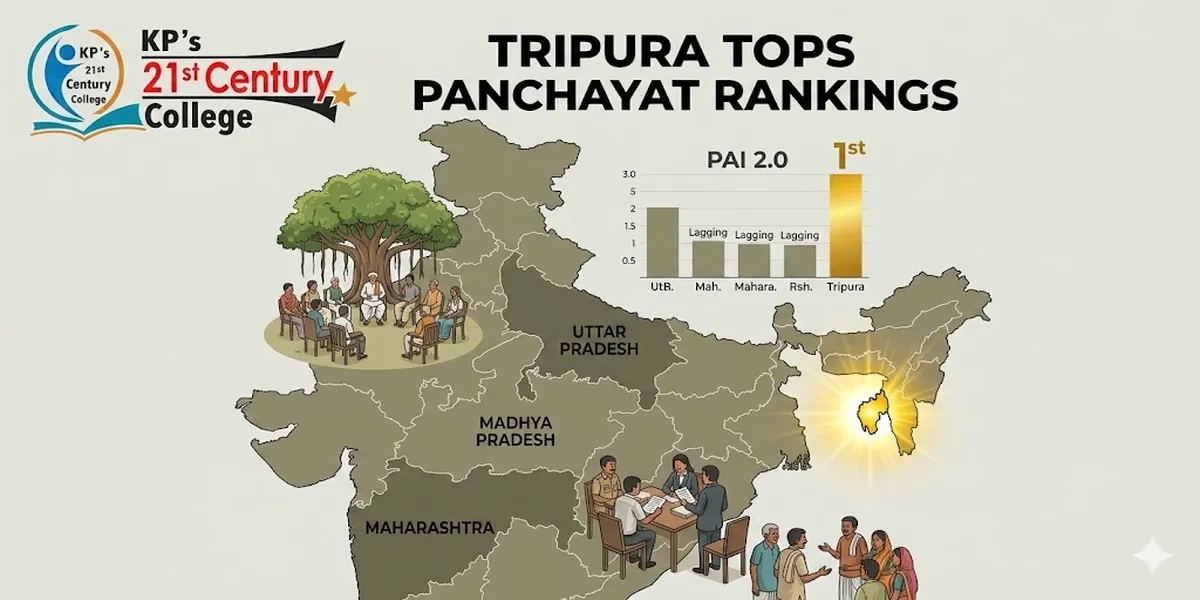
- The report highlights strong performance by smaller states like Tripura, Kerala, and Odisha, while large states such as Uttar Pradesh, Bihar, Rajasthan, and Punjab lag behind.
What is PAI 2.0?
- PAI 2.0 is a comprehensive performance assessment tool developed by the Ministry of Panchayati Raj to evaluate rural local bodies.
- It measures the performance of Gram Panchayats across 150 indicators aligned with 9 Sustainable Development Goals (SDGs).
- The index acts as a report card for grassroots governance, promoting data-driven planning and accountability.
Key Findings of the Report
Top Performing States
- Tripura – Around 80% of its Gram Panchayats ranked as “Front Runner”
- Kerala – About 10% of Panchayats in top category
- Odisha – Around 9% achieved high performance
These states show strong institutional capacity and better local governance outcomes.
Lagging Large States
- Uttar Pradesh
- Bihar
- Rajasthan
- Punjab
These states have large populations and administrative complexities, which affect performance.
Overall Observation
- No Panchayat reached the “Achiever” (90–100) category
- Majority fall in Performer / Aspirant categories
This indicates scope for significant improvement in grassroots governance.
Ranking Framework (Categories)
Gram Panchayats are classified into five categories based on scores:
- Achiever: 90–100
- Front Runner: 75–90
- Performer: 60–75
- Aspirant: 40–60
- Beginner: Below 40
This framework mirrors national SDG ranking methodology.
Indicators and SDG Linkage
PAI 2.0 evaluates Panchayats across 9 SDGs, including:
- Poverty reduction
- Health and nutrition
- Water and sanitation
- Quality education
- Gender equality
- Infrastructure development
- Environmental sustainability
This reflects localisation of SDGs—bringing global goals to village-level governance.
Why Some States Perform Better
- Strong Decentralisation: States like Kerala have a long tradition of decentralised planning and local empowerment.
- Capacity Building: Better training of Panchayat representatives and administrative staff.
- Social Development Model: Higher literacy, awareness, and citizen participation improve outcomes.
- Effective Fund Utilisation: Better use of central and state grants for development schemes.
Why Large States Lag?
- Administrative Scale: Large population and geographical size create governance challenges.
- Capacity Deficit: Limited training and institutional capacity at the Panchayat level.
- Financial Dependence: Over-reliance on higher-level governments reduces autonomy.
- Weak Data Systems: Lack of reliable real-time data affects planning and monitoring.
- Social Inequalities:Deep-rooted socio-economic disparities slow progress.
Significance of PAI 2.0
- Strengthens Grassroots Governance: Encourages performance-based evaluation of Panchayats.
- SDG Localization: Aligns local governance with global development goals.
- Policy Feedback Tool: Helps governments identify gaps and target interventions.
- Promotes Competitive Federalism: States compete to improve local governance outcomes.
- Enhances Accountability: Creates transparency in rural development performance.
Panchayati Raj
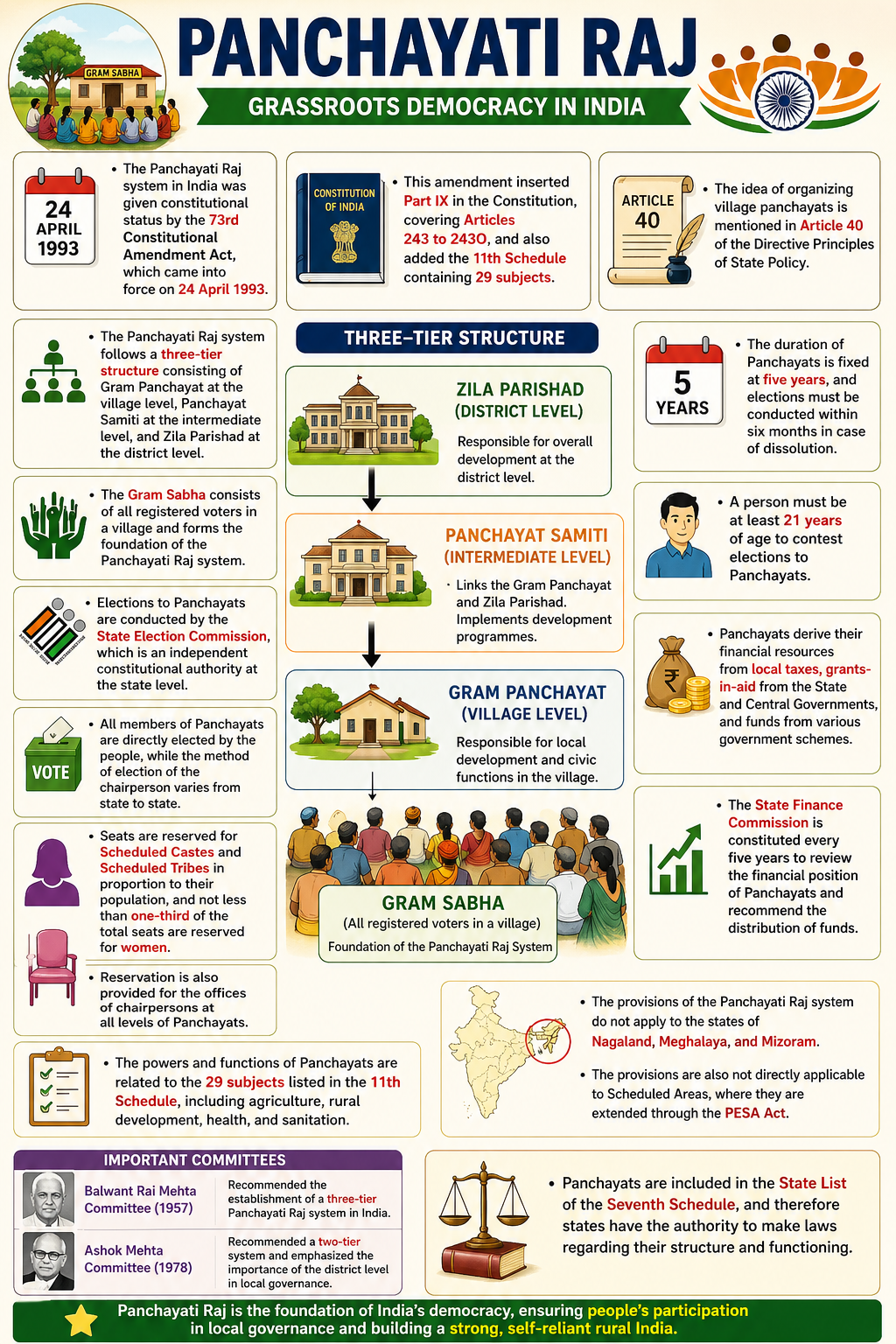
· The Panchayati Raj system in India was given constitutional status by the 73rd Constitutional Amendment Act, which came into force on 24 April 1993. · This amendment inserted Part IX in the Constitution, covering Articles 243 to 243O, and also added the 11th Schedule containing 29 subjects. · The idea of organizing village panchayats is mentioned in Article 40 of the Directive Principles of State Policy. · The Panchayati Raj system follows a three-tier structure consisting of Gram Panchayat at the village level, Panchayat Samiti at the intermediate level, and Zila Parishad at the district level. · The Gram Sabha consists of all registered voters in a village and forms the foundation of the Panchayati Raj system. · Elections to Panchayats are conducted by the State Election Commission, which is an independent constitutional authority at the state level. · All members of Panchayats are directly elected by the people, while the method of election of the chairperson varies from state to state. · Seats are reserved for Scheduled Castes and Scheduled Tribes in proportion to their population, and not less than one-third of the total seats are reserved for women. · Reservation is also provided for the offices of chairpersons at all levels of Panchayats. · The duration of Panchayats is fixed at five years, and elections must be conducted within six months in case of dissolution. · A person must be at least 21 years of age to contest elections to Panchayats. · Panchayats derive their financial resources from local taxes, grants-in-aid from the State and Central Governments, and funds from various government schemes. · The State Finance Commission is constituted every five years to review the financial position of Panchayats and recommend the distribution of funds. · The powers and functions of Panchayats are related to the 29 subjects listed in the 11th Schedule, including agriculture, rural development, health, and sanitation. · The provisions of the Panchayati Raj system do not apply to the states of Nagaland, Meghalaya, and Mizoram. · The provisions are also not directly applicable to Scheduled Areas, where they are extended through the PESA Act. · The Balwant Rai Mehta Committee of 1957 recommended the establishment of a three-tier Panchayati Raj system in India. · The Ashok Mehta Committee of 1978 recommended a two-tier system and emphasized the importance of the district level in local governance. · Panchayats are included in the State List of the Seventh Schedule, and therefore states have the authority to make laws regarding their structure and functioning. |
Challenges in PRI Performance
- Financial Constraints: Limited own revenue generation; heavy dependence on grants.
- Functional Overlap: Unclear division of powers between states and Panchayats.
- Human Resource Issues: Lack of trained personnel and administrative support.
- Political Interference: State governments often dominate local bodies.
Way Forward
- Capacity building of Panchayat representatives must be strengthened.
- Fiscal decentralisation should be enhanced through greater revenue powers.
- Digital governance tools and real-time data systems should be expanded.
- Best practices from top-performing states should be replicated.
- Greater community participation must be encouraged for inclusive governance.
Conclusion
The Panchayat Advancement Index 2.0 highlights the uneven progress of grassroots governance in India. While states like Tripura and Kerala demonstrate the potential of decentralisation, the lag in larger states shows systemic challenges.
Strengthening Panchayati Raj Institutions is essential for achieving inclusive development, effective SDG implementation, and realizing the vision of “Viksit Bharat” from the village level upward.
CARE MCQ
Q. With reference to the Panchayat Advancement Index (PAI) 2.0, consider the following statements:
- It is prepared by the Ministry of Panchayati Raj.
- It evaluates Gram Panchayats based on Sustainable Development Goals.
- All Panchayats in India have been ranked as ‘Front Runner’ or above.
Which of the statements given above is/are correct?
a. 1 and 2 only
b. 2 and 3 only
c. 1 and 3 only
d. 1, 2 and 3
Ans: (a)
Explanation
Statement 1 is correct : PAI is prepared by the Ministry of Panchayati Raj.
Statement 2 is correct : it uses SDG-based indicators.
Statement 3 is incorrect : No Panchayat reached even the “Achiever” category.
Q. Consider the following statements about the role of Panchayati Raj Institutions (PRIs) in rural development:
- Panchayati Raj Institutions are constitutionally empowered to prepare plans for economic development and social justice.
- The 73rd Constitutional Amendment Act, 1992 does not provide for the direct election of all members of Panchayati Raj Institutions.
- PRIs play an important role in the implementation of centrally sponsored schemes such as MGNREGA.
- The financial powers of PRIs are limited only to local taxation and do not include grants from the Union or State governments.
Which of the statements given above are correct?
(a) 1 and 3 only
(b) 2 and 4 only
(c) 1, 2 and 4 only
(d) All of the above
Ans: (a)
Explanation:
Statement 1 is correct: The 73rd Constitutional Amendment Act, 1992 inserted Part IX (Articles 243–243O) into the Constitution, which mandates Panchayats to prepare plans for economic development and social justice. This is further supported by the Eleventh Schedule, which lists 29 subjects that may be devolved to Panchayats.
Statement 2 is incorrect: The 73rd Amendment provides for the direct election of all members of Panchayats at the village, intermediate, and district levels. Only the Chairpersons at higher levels may be elected indirectly. Therefore, this statement is incorrect.
Statement 3 is correct: PRIs play a crucial role in implementing various centrally sponsored schemes, including the Mahatma Gandhi National Rural Employment Guarantee Act (MGNREGA). They are involved in planning, execution, and monitoring at the grassroots level.
Statement 4 is incorrect: PRIs are not limited to collecting local taxes. They also receive grants-in-aid from the Union and State governments, including funds recommended by the Finance Commission. Thus, their financial powers extend beyond traditional local taxation.
Q. Consider the following statements regarding the powers and functions of Panchayats in India:
- Panchayats have the authority to levy, collect, and appropriate taxes, duties, tolls, and fees.
- The preparation of plans for economic development and social justice is the responsibility of the State Government, not the Panchayats.
- Panchayats play a role in implementing schemes for economic development and social justice as entrusted by the State Legislature.
- Panchayats function independently of State legislation in matters of local governance.
How many of the statements given above are correct?
(a) Only one
(b) Only two
(c) Only three
(d) All four
Ans: (b)
Explanation:
Statement 1 is correct: Under Article 243H, Panchayats are empowered to levy, collect, and appropriate taxes, duties, tolls, and fees, subject to State legislation. This provides them with a source of local revenue.
Statement 2 is incorrect: The 73rd Amendment explicitly assigns Panchayats the responsibility of preparing plans for economic development and social justice. Hence, this function is not exclusively with the State Government.
Statement 3 is correct: Panchayats are entrusted with the implementation of development schemes as determined by the State Legislature. They act as grassroots institutions for executing welfare and development programmes.
Statement 4 is incorrect: Panchayats do not function independently of State legislation. Their powers, authority, and functions are largely defined and regulated by State laws under the constitutional framework.
Q. Consider the following statements about the 73rd and 74th Constitutional Amendments:
- The 73rd Amendment deals with the constitutional status and organization of Panchayats.
- The 74th Amendment provides for the constitution of Municipalities only at the district level.
- The 74th Amendment provides for the establishment of a District Planning Committee for district-level planning.
- The 74th Amendment provides for reservation of seats in Municipalities for Scheduled Castes and Scheduled Tribes.
How many of the statements given above are correct?
(a) Only one
(b) Only two
(c) Only three
(d) All four
Ans: (c)
Explanation:
Statement 1 is correct: The 73rd Amendment (1992) gave constitutional status to Panchayati Raj Institutions and established a three-tier system of rural local governance.
Statement 2 is incorrect: The 74th Amendment provides for Municipalities at three levels—Nagar Panchayat, Municipal Council, and Municipal Corporation—depending on the size and nature of the urban area. It is not limited to the district level.
Statement 3 is correct: The 74th Amendment provides for the creation of a District Planning Committee (Article 243ZD) to consolidate plans prepared by Panchayats and Municipalities into a district development plan.
Statement 4 is correct: The 74th Amendment mandates reservation of seats for Scheduled Castes and Scheduled Tribes in Municipalities, ensuring inclusive representation in urban local governance.
FAQs
Q1. What is PAI 2.0?
It is a performance index measuring the development and governance quality of Gram Panchayats.
Q2. Which state topped the PAI 2.0 rankings?
Tripura emerged as the top-performing state.
Q3. Why are large states lagging?
Due to administrative complexity, weak capacity, and socio-economic challenges.
Q4. How is PAI linked to SDGs?
It evaluates Panchayats based on SDG-aligned indicators like poverty, health, and infrastructure.
Q5. Why is PAI important for UPSC?
It connects governance, decentralisation, and SDG implementation—important for GS Paper II and III.