Table of Contents
Relevance: GS Paper I – Geography (Rivers) | GS Paper III – Irrigation | Water Resources | Infrastructure
For Prelims:
Pranahita River, Godavari Basin, Tummidihatti, Yellampalli Project, Kaleshwaram Lift Irrigation Project (KLIS), Medigadda Barrage, Sundilla Barrage, Annaram Barrage, CWPRS, NDSA, Lift Irrigation
For Mains:
River Interlinking (Intra-basin), Water Management, Irrigation Efficiency, Federal River Issues, Infrastructure Sustainability
Why in News?
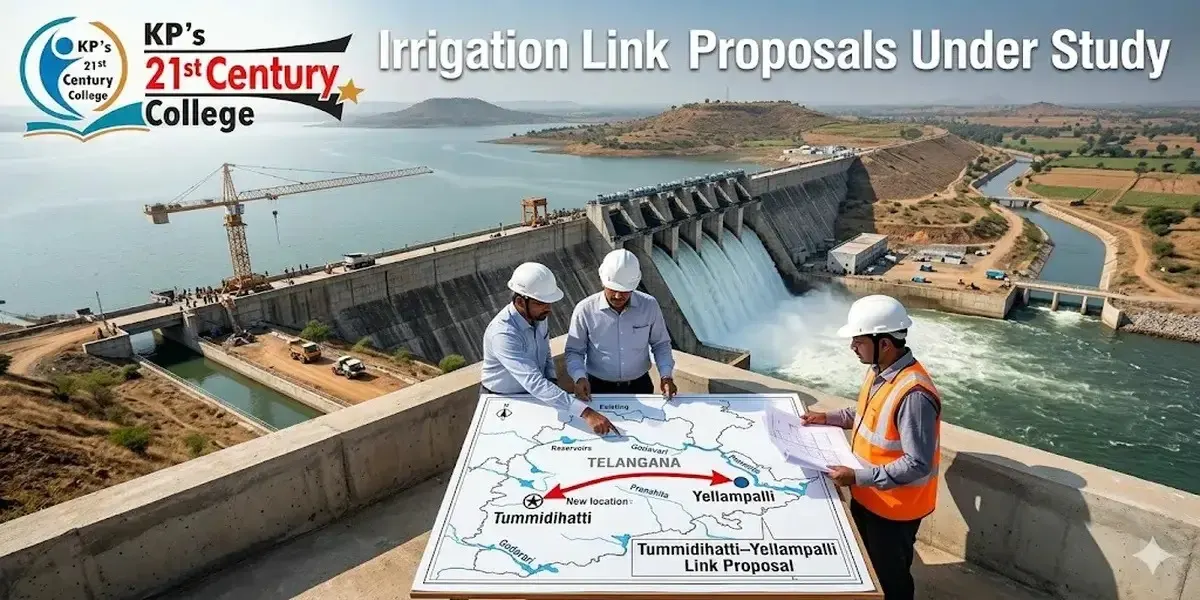
- The Telangana government is examining four alternative proposals to link Tummidihatti with Yellampalli to optimise utilisation of Godavari river waters.
- The proposals are being studied by IIT Hyderabad and RV Associates for feasibility, cost-effectiveness, and irrigation efficiency.
- Simultaneously, restoration of Medigadda, Sundilla, and Annaram barrages under the Kaleshwaram project has been prioritised ahead of the monsoon season.
Geographic Location and River System
- The project is located within the Godavari river basin, which is the second-largest river system in India.
- The Godavari River originates in the Western Ghats at Trimbakeshwar (Maharashtra) and flows eastward into the Bay of Bengal.
- The Pranahita River is its largest tributary in terms of water contribution and is formed by the confluence of:
- Wardha River
- Wainganga River
- Tummidihatti is located on the Pranahita River near the Telangana–Maharashtra border.
- The Sri Sripada Yellampalli Project is situated downstream on the Godavari River and acts as a major storage and distribution reservoir.
- This linkage represents an intra-basin transfer within the Godavari system, connecting a tributary source (Pranahita) with the main river storage system.
What is the Tummidihatti–Yellampalli Proposal?
The proposal involves diverting water from Tummidihatti (on Pranahita) to Yellampalli reservoir (on Godavari) through a suitable alignment.
Four different alignments are being studied based on:
- elevation differences (critical for lift irrigation).
- distance and canal feasibility
- pumping requirements
- cost efficiency
- water transmission losses
The objective is to ensure that water from the upstream Pranahita region is effectively utilised for irrigation across Telangana.
Pranahita–Chevella Project: Concept and Evolution
- The Pranahita-Chevella Lift Irrigation Scheme was originally conceived as a large lift irrigation project.
It aimed to:
- lift water from the Pranahita River
- supply irrigation to drought-prone upland regions
- provide drinking and industrial water
- Due to redesign and engineering modifications, the original plan was restructured into the Kaleshwaram Lift Irrigation Project, which is currently operational.
- Th present proposals attempt to revive and optimise the original intent of utilising Pranahita waters efficiently.
Kaleshwaram Lift Irrigation Project and Barrage System
The Kaleshwaram project is a multi-stage lift irrigation system built across the Godavari River
Key barrages include:
- Medigadda Barrage (Lakshmi Barrage)
- Annaram Barrage (Saraswati Barrage)
- Sundilla Barrage (Parvati Barrage)
- These barrages regulate river flow and facilitate multi-stage water lifting into canals and reservoirs.
- Yellampalli acts as an important intermediate storage node within this system.
Technical Aspects of Barrage Restoration
The government has ordered urgent restoration of barrages before the monsoon.
Key technical instructions include:
- Standard Penetration Tests (SPT) at every 1.5 metres
- Permeability tests at every 3 metres
- Bore drilling up to at least 5 metres even in rocky strata
These tests are essential for:
- assessing soil strength
- identifying seepage risks
- ensuring structural stability
- preventing failure during high discharge
Institutional Mechanisms and Agencies Involved
Several institutions are involved in the project:
- IIT Hyderabad – technical feasibility analysis
- RV Associates – engineering consultancy
- Central Water and Power Research Station (CWPRS) – hydraulic and structural expertise
- National Dam Safety Authority (NDSA) – regulatory oversight
A coordination committee has been formed to monitor restoration works and ensure compliance.
Irrigation Significance for Telangana
The project is crucial for Telangana due to:
- semi-arid climate and rainfall variability
- dependence on lift irrigation in plateau regions
- need to irrigate upland agricultural zones
- requirement to stabilise existing irrigation systems
It aims to ensure water availability to lakhs of acres and strengthen agricultural productivity.
CARE MCQ
Q. Consider the following statements regarding the Pranahita–Godavari system:
- Pranahita is the largest tributary of the Godavari River in terms of water contribution.
- Tummidihatti is located on the Godavari River.
- Yellampalli project is situated on the main channel of the Godavari River.
Which of the statements given above are correct?
(a) 1 only
(b) 1 and 3 only
(c) 2 and 3 only
(d) 1, 2 and 3
Ans: (b)
Explanation:
Statement 1 is correct : Pranahita contributes the highest discharge to Godavari.
Statement 2 is incorrect : Tummidihatti is located on the Pranahita River, not on the main Godavari.
Statement 3 is correct : Yellampalli reservoir is built on the Godavari River.
Q. Which of the following statements about the Godavari River is correct?
(a) It is the longest river in India
(b) It originates from the Brahmagiri Hills in Maharashtra
(c) It flows into the Bay of Bengal through the state of Gujarat
(d) It is primarily associated with the Green Revolution
Ans: (b)
Explanation:
The Godavari River originates from the Brahmagiri Hills at Trimbakeshwar in Maharashtra and is the second longest river in India after the Ganga. It flows eastward across the Deccan Plateau and drains into the Bay of Bengal through Andhra Pradesh.
Q. Consider the following statements regarding the Godavari River system:
Statement-I: The Godavari River originates near Jor village in Maharashtra at an elevation of about 1,337 m.
Statement-II: The Godavari flows eastwards across the Deccan Plateau and empties into the Bay of Bengal.
Which one of the following is correct in respect of the above statements?
(a) Both Statement-I and Statement-II are correct and Statement-II explains Statement-I
(b) Both Statement-I and Statement-II are correct but Statement-II does not explain Statement-I
(c) Statement-I is correct but Statement-II is incorrect
(d) Statement-I is incorrect but Statement-II is correct
Ans: (d)
Explanation:
Statement-I is incorrect: The Godavari River originates from Trimbakeshwar in Nashik district of Maharashtra at an elevation of about 1,067 m, not from Jor village. Jor village is associated with the origin of the Krishna River, not the Godavari.
Statement-II is correct: The Godavari flows eastwards across the Deccan Plateau and drains into the Bay of Bengal, forming one of the largest river deltas in India.
Q. Consider the following statements about Peninsular rivers of India:
- The Godavari is often referred to as the “Dakshin Ganga” due to its large size among peninsular rivers.
- The Krishna River flows through Maharashtra, Karnataka, Telangana, and Andhra Pradesh before entering the Bay of Bengal.
- The Narmada River flows eastward and forms a boundary between North and South India.
- The Tungabhadra River is a tributary of the Krishna River and holds cultural significance in South India.
Which of the statements given above are correct?
(a) 1, 2 and 4 only
(b) 2, 3 and 4 only
(c) 1, 2 and 3 only
(d) All of the above
Ans: (a)
Explanation:
Statement 1 is correct: The Godavari is called the “Dakshin Ganga” (Ganga of the South) due to its length, basin size, and importance among peninsular rivers.
Statement 2 is correct: The Krishna River flows through Maharashtra, Karnataka, Telangana, and Andhra Pradesh before draining into the Bay of Bengal.
Statement 3 is incorrect: The Narmada River flows westward, not eastward, and empties into the Arabian Sea. Although it forms a geographical boundary between northern plains and the Deccan Plateau, the direction mentioned is incorrect.
Statement 4 is correct: The Tungabhadra River is a major tributary of the Krishna River and is culturally and historically significant, especially in regions like Hampi.
Q.Consider the following statements regarding major river systems in India:
Statement-I: The Godavari River, known as “Dakshin Ganga,” forms the second-largest river basin in India after the Ganga basin.
Statement-II: The Cauvery River originates from the Brahmagiri Hills in Karnataka and has a much smaller basin compared to the Godavari.
Which one of the following is correct?
(a) Both Statement-I and Statement-II are correct and Statement-II explains Statement-I
(b) Both Statement-I and Statement-II are correct but Statement-II does not explain Statement-I
(c) Statement-I is correct but Statement-II is incorrect
(d) Statement-I is incorrect but Statement-II is correct
Ans: (d)
Explanation:
Statement-I is incorrect: The Godavari is indeed called the “Dakshin Ganga”, but it forms the third-largest river basin in India, after the Ganga and Indus basins, not the second largest
Statement-II is correct: The Cauvery River originates at Talakaveri in the Brahmagiri Hills (Karnataka) and flows through Karnataka and Tamil Nadu before draining into the Bay of Bengal. Its basin is significantly smaller than that of the Godavari.
Final Conclusion:
Statement-I is incorrect but Statement-II is correct → Option (d)
Q. Consider the following rivers:
- Narmada
- Godavari
- Tapti
- Mahanadi
How many of the above rivers flow into the Bay of Bengal?
(a) Only one
(b) Only two
(c) Only three
(d) All four
Ans: (b)
Explanation:
- Godavari → Flows into the Bay of Bengal
- Mahanadi → Flows into the Bay of Bengal
- Narmada → Flows into the Arabian Sea
- Tapti → Flows into the Arabian Sea
Thus, only two rivers (Godavari and Mahanadi) drain into the Bay of Bengal.
TGPSC Mains Question
Q. Discuss the significance of lift irrigation projects in peninsular India with reference to the Pranahita–Chevella and Kaleshwaram projects.
(250 words)
FAQs
Q.Why is Tummidihatti important?
Ans: It is a key upstream location on the Pranahita River for water diversion.
Q.What is the role of Yellampalli?
Ans:It acts as a storage and redistribution reservoir on the Godavari River.
Q.Why is lift irrigation required in Telangana?
Ans:Due to plateau topography, water must be lifted to higher elevations.
Q.What are barrages in Kaleshwaram?
Ans:They regulate river flow and support multi-stage water lifting.
Q.Which is the largest tributary of Godavari?
Ans:Pranahita River.