
Relevance:
UPSC GS Paper II: Judiciary, Governance, Centre-State Relations

Important Keywords for Prelims and Mains

Prelims Keywords: Ramsar Sites | Asan Wetland Conservation Reserve | NBWL | Wetlands Rules 2017 | Eco-Sensitive Zone

Mains Keywords: Wetland conservation | Judicial environmental governance | Mining regulation | Ecological character | Precautionary principle

Why in News?

The Supreme Court has clarified that its earlier direction requiring prior approval before mining within a 10-km radius of the Asan Wetland Conservation Reserve in Uttarakhand would apply, for the sake of parity, to wetland conservation reserves across the country. This clarification is significant because Ramsar sites and wetland conservation reserves do not have a clearly defined statutory mining buffer under existing wetland rules.
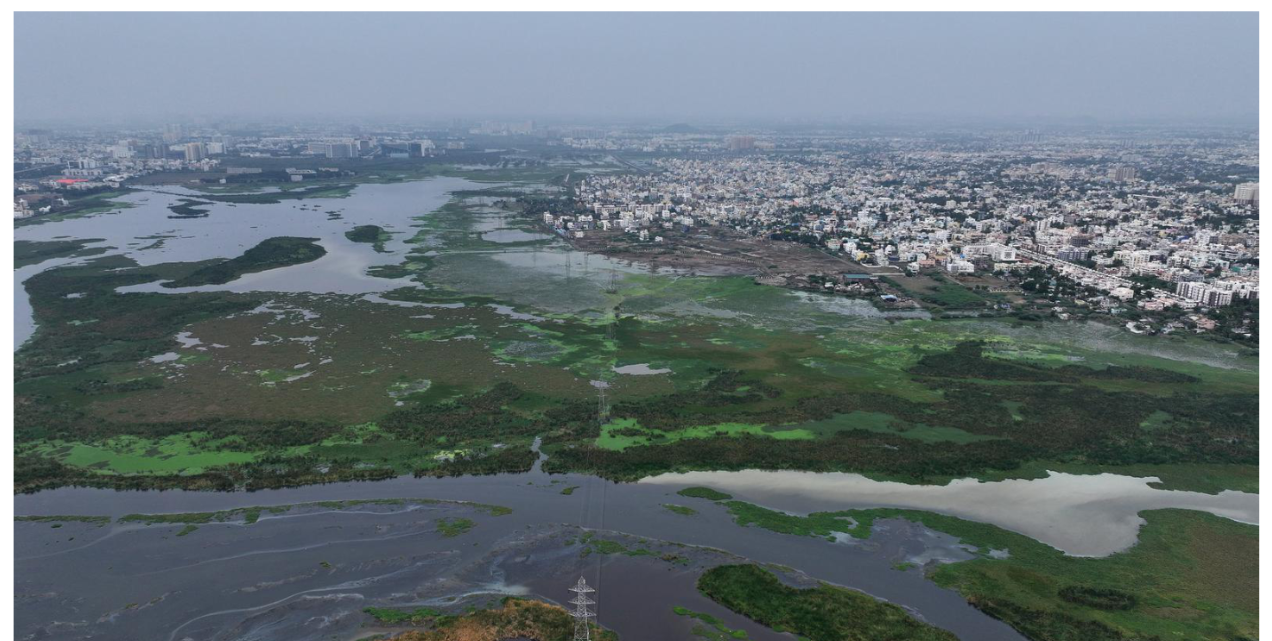
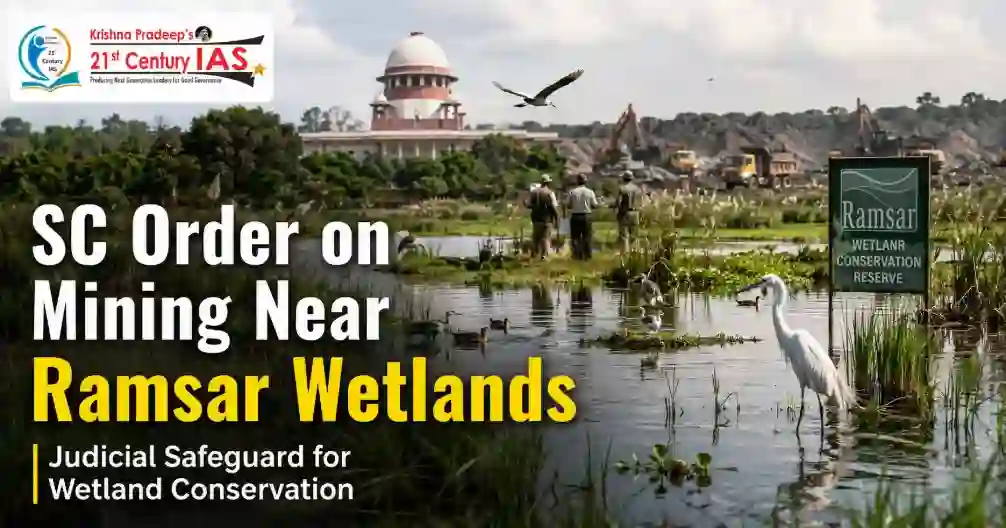
What Did the Supreme Court Clarify?

The Supreme Court clarified that the principle laid down in the Asan Wetland Conservation Reserve case is not limited only to Uttarakhand.

The earlier direction required that no mining activity should be carried out within a 10-km radius of the Asan reserve unless prior permission is obtained from:

  • the Standing Committee of the National Board for Wildlife, and/or
  • the Ministry of Environment, Forest and Climate Change.

The latest clarification means that similar safeguards may apply to other wetland conservation reserves across India. the Court also directed the NBWL Standing Committee or MoEFCC to determine whether the Asan wetland extends into Himachal Pradesh. If it extends into Himachal Pradesh, the 2024 directions would apply there. If not, mining proposals would be governed by the applicable statutory framework.

Background of the Asan Wetland Case

The Asan Wetland Conservation Reserve is located at the confluence of the Asan and Yamuna rivers in Uttarakhand.

FeatureDetails
WetlandAsan Wetland Conservation Reserve
LocationUttarakhand
River ConfluenceAsan and Yamuna rivers
Ramsar StatusDesignated in 2020
Ecological ImportanceMigratory waterbirds and aquatic biodiversity

In its interim order of February 14, 2024, the Supreme Court held that the wetland’s Ramsar status required higher scrutiny of activities that could affect its ecological character.

What are Ramsar Sites?

  • Ramsar sites are wetlands of international importance.
  • They are designated under the Ramsar Convention on Wetlands, adopted in 1971 at Ramsar, Iran.
  • India became a party to the Convention in 1982.
  • Ramsar designation recognises the ecological importance of a wetland and requires the country to maintain its ecological character.
  • India currently has 101 Ramsar sites, the highest among Asian countries.
  • Glaw Lake in Arunachal Pradesh became India’s 101st Ramsar site in August 2026.

Ramsar Sites in India – State-wise List 2026

S.No.Ramsar SiteState / UT
1Kolleru LakeAndhra Pradesh
2Deepor BeelAssam
3Kanwar (Kabar) TaalBihar
4Nagi Bird SanctuaryBihar
5Nakti Bird SanctuaryBihar
6Nanda LakeGoa
7Khijadia WLSGujarat
8Nalsarovar BSGujarat
9Thol LakeGujarat
10Wadhvana WetlandGujarat
11Bhindawas WLSHaryana
12Sultanpur NPHaryana
13Chandra TaalHimachal Pradesh
14Pong Dam LakeHimachal Pradesh
15Renuka LakeHimachal Pradesh
16Ranganathittu BSKarnataka
17Magadi Kere Conservation ReserveKarnataka
18Ankasamudra Bird Conservation ReserveKarnataka
19Aghanashini EstuaryKarnataka
20Ashtamudi WetlandKerala
21Sasthamkotta LakeKerala
22Vembanad-Kol WetlandKerala
23Bhoj WetlandMadhya Pradesh
24Sakhya SagarMadhya Pradesh
25Sirpur WetlandMadhya Pradesh
26Yashwant SagarMadhya Pradesh
27Tawa ReservoirMadhya Pradesh
28Lonar LakeMaharashtra
29Nandur MadhameshwarMaharashtra
30Thane CreekMaharashtra
31Loktak LakeManipur
32Pala WetlandMizoram
33Ansupa LakeOdisha
34Bhitarkanika MangrovesOdisha
35Chilika LakeOdisha
36Hirakud ReservoirOdisha
37Satkosia GorgeOdisha
38Tampara LakeOdisha
39Beas CnRPunjab
40Harike WetlandPunjab
41Kanjli WetlandPunjab
42Keshopur-Miani CmRPunjab
43Nangal WLSPunjab
44Ropar WetlandPunjab
45Keoladeo National ParkRajasthan
46Sambhar LakeRajasthan
47Chitrangudi BSTamil Nadu
48Gulf of Mannar Marine BRTamil Nadu
49Kanjirankulam BSTamil Nadu
50Karikili BSTamil Nadu
51Koonthankulam BSTamil Nadu
52Pallikaranai Marsh Reserve ForestTamil Nadu
53Pichavaram MangroveTamil Nadu
54Point Calimere WLS & BSTamil Nadu
55Suchindram Theroor Wetland ComplexTamil Nadu
56Udhayamarthandapuram BSTamil Nadu
57Vaduvur BSTamil Nadu
58Vedanthangal BSTamil Nadu
59Vellode BSTamil Nadu
60Vembannur Wetland ComplexTamil Nadu
61Karaivetti Bird SanctuaryTamil Nadu
62Longwood Shola Reserve ForestTamil Nadu
63Nanjarayan Bird SanctuaryTamil Nadu
64Kazhuveli Bird SanctuaryTamil Nadu
65Rudrasagar LakeTripura
66Hokera WetlandUT of Jammu & Kashmir
67Hygam Wetland CnRUT of Jammu & Kashmir
68Shallbugh Wetland CnRUT of Jammu & Kashmir
69Surinsar-Mansar LakesUT of Jammu & Kashmir
70Wular LakeUT of Jammu & Kashmir
71Tso KarUT of Ladakh
72TsomoririUT of Ladakh
73Bakhira WLSUttar Pradesh
74Haiderpur WetlandUttar Pradesh
75Nawabganj BSUttar Pradesh
76Parvati Arga BSUttar Pradesh
77Saman BSUttar Pradesh
78Samaspur BSUttar Pradesh
79Sandi BSUttar Pradesh
80Sarsai Nawar JheelUttar Pradesh
81Sur Sarovar (Keetham Lake)Uttar Pradesh
82Upper Ganga River (Brijghat to Narora)Uttar Pradesh
83Asan BarrageUttarakhand
84East Kolkata WetlandsWest Bengal
85Sundarban WetlandWest Bengal
86Sakkarakottai Bird SanctuaryTamil Nadu
87Therthangal Bird SanctuaryTamil Nadu
88Khecheopalri WetlandSikkim
89Udhwa LakeJharkhand
90Khichan (Phalodi)Rajasthan
91Menar (Udaipur)Rajasthan
92Gokul JalashayBihar
93Udaipur JheelBihar
94Gogabeel LakeBihar
95Siliserh LakeRajasthan
96Kopra JalashayChhattisgarh
97Patna Bird SanctuaryUttar Pradesh
98Chhari-DhandKutch (Gujarat)
99Shekha Jheel Bird SanctuaryUttar Pradesh
100Jai Prakash Narayan Bird SanctuaryUttar Pradesh
101Glaw LakeArunachal Pradesh

Do Ramsar Sites Have a Statutory Mining Buffer?

  • A Ramsar designation does not automatically create a separate statutory protection regime under Indian law.
  • Neither the Ramsar Convention nor the Wetlands (Conservation and Management) Rules, 2017 prescribe a fixed statutory buffer zone around Ramsar sites for mining.
  • This means there is no general rule under the Wetlands Rules that mining is automatically prohibited within a specific distance from every Ramsar site.
  • The Supreme Court’s direction is therefore important because it creates a judicial safeguard for mining activities near wetland conservation reserves.

Wetlands Rules: 2010 vs 2017

AspectWetlands Rules, 2010Wetlands Rules, 2017
Regulation ModelMore centralised and detailedDecentralised through State Wetland Authorities
Prohibited ActivitiesListed activities such as reclamation, new industries, dumping of solid waste and harmful activitiesRemoved explicit list of prohibited activities
Zone of InfluenceRequired prior approval for activities within the wetland’s zone of influenceGreater responsibility shifted to States
Environmental ScrutinyEIA required for specified projectsDepends on applicable legal and State-level framework
Current StatusReplaced by 2017 RulesConstitutional validity under challenge before Supreme Court

Petitioners have argued that the 2017 framework weakens protections available under the 2010 Rules and excludes many artificial wetlands recognised under the Ramsar Convention.

Mining Restrictions Near Protected Areas

Mining restrictions near wetlands differ from restrictions near national parks, wildlife sanctuaries and forests.

1. National Parks and Wildlife Sanctuaries

Mining inside national parks and wildlife sanctuaries is prohibited under the Wildlife Protection Act, 1972.

The Supreme Court has also held that mining is impermissible within one kilometre of every national park and wildlife sanctuary unless a larger Eco-Sensitive Zone has already been notified.

2. Eco-Sensitive Zones

If a larger ESZ has been notified around a protected area, the larger notified buffer prevails.

3. Forest Areas

Mining in forest areas requires prior approval of the Union government under the Van (Sanrakshan Evam Samvardhan) Adhiniyam, 1980.

4. Environmental Clearance

Mining projects generally require environmental clearance under the Environment Impact Assessment Notification, 2006.

5. Wetland Conservation Reserves

In the case of wetland conservation reserves, the Supreme Court’s Asan direction requires prior approval before mining within a 10-km radius, but this operates as a judicial safeguard rather than a statutory buffer under the Wetlands Rules.

Significance of the Supreme Court Clarification

1. Strengthens Wetland Protection

The order gives additional protection to wetland conservation reserves where statutory buffer rules are unclear.

2. Applies Precautionary Principle

Wetlands are fragile ecosystems. Prior approval ensures that mining proposals are examined before ecological damage occurs.

3. Protects Ramsar Ecological Character

Ramsar sites are internationally recognised for ecological importance. Activities affecting their ecological character require stricter scrutiny.

4. Improves Regulatory Oversight

Requiring approval from NBWL or MoEFCC introduces higher-level environmental review.

5. Creates Parity Across States

The clarification prevents uneven protection where one wetland receives judicial safeguard while similar wetlands elsewhere remain exposed.

6. Addresses Gaps in Wetland Rules

Since the 2017 Rules do not prescribe a fixed mining buffer, the Court’s direction fills an important regulatory gap.

Challenges and Concerns

1. Legal Ambiguity

The direction applies to wetland conservation reserves, but Ramsar sites as a category still do not have a statutory buffer zone.

2. Federal Concerns

Wetland management under the 2017 Rules is largely decentralised through State Wetland Authorities. Judicial directions may require better Centre-State coordination.

3. Impact on Mining Projects

Mining proposals near wetland conservation reserves may now face additional scrutiny and delays.

4. Need for Clear Mapping

Authorities must clearly map wetland boundaries and zones of influence to avoid disputes.

5. Ecological Character Assessment

Scientific assessment is needed to determine how mining affects hydrology, bird habitats, aquatic biodiversity and sediment flow.

6. Enforcement Capacity

Legal safeguards are effective only when backed by monitoring, field inspections and compliance mechanisms.

Way Forward

1. Notify Clear Wetland Boundaries

All wetland conservation reserves and Ramsar sites should have scientifically demarcated boundaries.

2. Define Zones of Influence

Instead of relying only on fixed-distance rules, authorities should identify ecological zones based on hydrology, biodiversity and land-use patterns.

3. Strengthen State Wetland Authorities

State Wetland Authorities need technical capacity, funding and monitoring systems.

4. Improve Mining Scrutiny

Mining projects near wetlands should undergo cumulative impact assessment, not only project-wise clearance.

5. Harmonise Legal Frameworks

Wetland Rules, Wildlife Protection Act, EIA framework and forest laws should work together to avoid regulatory gaps.

6. Ensure Local Participation

Local communities, fisherfolk, farmers and bird experts should be involved in wetland conservation planning.

7. Strengthen Compliance Monitoring

Use satellite imagery, GIS mapping and field audits to monitor illegal mining and land-use change around wetlands.

Conclusion

The Supreme Court’s clarification on mining near wetland conservation reserves is an important step in strengthening wetland protection. It does not create a universal statutory buffer for all Ramsar sites, but it adds a judicial safeguard by requiring prior approval for mining within a 10-km radius of wetland conservation reserves. This is significant because India’s wetlands face pressure from mining, urbanisation, encroachment and pollution. The larger lesson is that wetland conservation needs clear legal standards, scientific mapping, strong State Wetland Authorities and accountable project clearances. Protecting wetlands is not only about biodiversity; it is also about water security, flood regulation, climate resilience and sustainable development.

UPSC PYQ

Q. Consider the following statements: (UPSC Prelims 2019)

  1. Under the Ramsar Convention, it is mandatory on the part of the Government of India to protect and conserve all the wetlands in the territory of India.
  2. The Wetlands (Conservation and Management) Rules, 2010 were framed by the Government of India based on the recommendations of the Ramsar Convention.
  3. The Wetlands (Conservation and Management) Rules, 2010 also encompass the drainage area or catchment regions of the wetlands as determined by the authority.

Which of the statements given above is/are correct?

(a) 1 and 2 only
(b) 2 and 3 only
(c) 3 only
(d) 1, 2 and 3

Answer: (c) 3 only

Explanation

Statement 1 is incorrect.
The Ramsar Convention does not make it mandatory for the Government of India to protect and conserve all wetlands in the country under the Convention. It mainly provides an international framework for the conservation and wise use of wetlands, especially wetlands designated as being of international importance.

Statement 2 is incorrect.
The Wetlands (Conservation and Management) Rules, 2010 were notified by the Government of India under the Environment (Protection) Act, 1986. Therefore, it is incorrect to state that these Rules were framed based on the recommendations of the Ramsar Convention.

Statement 3 is correct.
The Wetlands (Conservation and Management) Rules, 2010 also covered the drainage area or catchment region associated with a wetland, as determined by the competent authority. This is important because activities in the catchment area can directly affect the ecological condition of a wetland.

CARE MCQ

Q. Consider the following statements regarding Ramsar sites and mining regulation in India:

  1. Ramsar sites are wetlands of international importance under the Ramsar Convention.
  2. Ramsar designation automatically creates a statutory 10-km mining buffer under Indian law.
  3. The Supreme Court directed prior approval for mining within 10 km of the Asan Wetland Conservation Reserve.
  4. Mining inside national parks and wildlife sanctuaries is prohibited under the Wildlife Protection Act, 1972.

Which of the statements given above are correct?

(a) 1, 3 and 4 only
(b) 1 and 2 only
(c) 2, 3 and 4 only
(d) 1, 2, 3 and 4

Answer: (a) 1, 3 and 4 only

Explanation

Statements 1, 3 and 4 are correct. Ramsar sites are wetlands of international importance, the Supreme Court required prior approval for mining within 10 km of the Asan Wetland Conservation Reserve, and mining inside national parks and wildlife sanctuaries is prohibited under the Wildlife Protection Act, 1972.

Statement 2 is incorrect because Ramsar designation does not automatically create a statutory 10-km mining buffer under Indian law.

FAQs

1. What did the Supreme Court clarify?

It clarified that prior approval for mining within 10 km of wetland conservation reserves should apply across the country for parity.

2. Which wetland triggered the case?

The Asan Wetland Conservation Reserve in Uttarakhand.

3. Where is Asan Wetland located?

It lies at the confluence of the Asan and Yamuna rivers in Uttarakhand.

4. When was Asan Wetland designated a Ramsar site?

It was designated a Ramsar site in 2020.

5. Do Ramsar sites automatically have a 10-km statutory mining buffer?

No. Ramsar designation does not automatically create a statutory mining buffer under Indian law.

6. Which authorities must approve mining near wetland conservation reserves as per the Court direction?

The NBWL Standing Committee and/or the MoEFCC.

Relevance:
UPSC GS Paper III: Agriculture, Climate Change, Food Security, Environment, Sustainable Development

Important Keywords for Prelims and Mains

Prelims Keywords: Prelims Keywords: Climate-Resilient Agriculture | Nature-Based Solutions | NICRA | Biochar | National Mission for Sustainable Agriculture

Mains Keywords: Food security | Climate adaptation | Sustainable farming | Small farmers’ resilience | Low-carbon agriculture

Why in News?

As climate change intensifies through rising temperatures, erratic monsoons and frequent extreme weather events, Indian agriculture is facing increasing stress. Nature-based solutions and climate-resilient agriculture have emerged as important approaches to strengthen farm resilience, protect soil health, reduce emissions and ensure food and nutritional security.

Why Indian Agriculture is Climate-Vulnerable

Agriculture remains central to India’s economy and society. It supports the livelihoods of about 58% of India’s population, employs nearly 46.1% of the workforce, and contributes around 18% of Gross Value Added.

However, Indian agriculture is highly exposed to climate shocks due to structural factors.

IndicatorStatus
Average landholding size1.08 hectares
Small and marginal farmers89.4%
Rainfed agricultureAround 60%
Food output from rainfed farmingAround 40%

This makes India’s farm sector highly dependent on monsoon behaviour and local weather conditions.

Climate change affects agriculture by:

  • disrupting sowing and harvesting cycles
  • reducing crop yields
  • increasing pest and disease pressure
  • reducing fertiliser use efficiency
  • lowering soil fertility
  • worsening soil moisture loss
  • affecting photosynthesis and plant growth

At the same time, agriculture itself contributes to climate change through greenhouse gas emissions, crop residue burning and deforestation. Therefore, Indian agriculture needs both adaptation and mitigation strategies.

What is Climate-Resilient Agriculture?

Climate-Resilient Agriculture refers to farming practices that help agricultural systems adapt to changing climatic conditions, reduce vulnerability to climate shocks and maintain productivity.

It includes both adaptation and mitigation measures.

Major Practices

  • selection of climate-adapted crop varieties
  • adjustment of sowing windows
  • use of short-duration or stress-tolerant crops
  • improved planting methods
  • agroforestry
  • biochar application
  • efficient use of fertilisers
  • efficient use of pesticides and insecticides
  • better water management
  • better soil health management
  • reduced tillage and conservation agriculture

Climate-resilient agriculture also depends on social resilience. Farmers, households and communities need access to knowledge, credit, technology, government schemes and extension services.

What are Nature-Based Solutions?

Nature-Based Solutions are sustainable practices that use natural processes to address climate, environmental and livelihood challenges.

In agriculture, nature-based solutions aim to:

  • improve adaptation and food production
  • mitigate climate change
  • restore ecosystems and biodiversity

Examples of Nature-Based Solutions in Agriculture

  • Regenerative agriculture
  • Conservation agriculture
  • Reduced tillage
  • Zero tillage
  • Agroforestry
  • Biochar
  • Improved soil and water management

Nature-based solutions are now part of the emission reduction plans of at least 102 countries under their Nationally Determined Contributions. Studies suggest that such solutions could deliver 37% of cost-effective climate mitigation needed to keep global temperature rise below 2°C by 2030.

Climate Change and Food Security

  • Climate change poses a serious risk to global food systems. As population rises, estimates suggest the world will need 60% additional food by 2050.
  • Developing countries are expected to face disproportionate impacts because their agriculture is more dependent on rainfall and natural resources.

For India, food security is closely linked with:

  • monsoon stability
  • soil health
  • water availability
  • small farmer resilience
  • climate-resilient seeds
  • sustainable farming systems

If farming systems fail to adapt, climate change can affect both farm income and national food security.

Biochar as a Nature-Based Solution

According to the Indian Council of Agricultural Researchbiochar is charred biomass produced by slow pyrolysis, where organic material such as crop residue or wood waste is heated at 300–500°C in the absence of oxygen.

India generates nearly 350 million tonnes of agricultural waste annually. If treated properly, this biomass can be converted into useful products such as organic fertiliser and bioenergy.

Benefits of Biochar

  • improves soil fertility
  • increases soil water retention
  • improves nutrient use efficiency
  • supports carbon sequestration
  • reduces crop residue burning
  • lowers particulate matter emissions
  • helps mitigate climate change

Biochar provides a more sustainable alternative to open-field burning of crop residues. Research cited in the source notes that biochar could sequester an average of 376.11 megatonnes of CO₂-equivalent in Indian soils and potentially reduce 41–63% of emissions from agriculture and allied activities.

India’s Policy Response

India has launched several policies and initiatives to promote climate-resilient and sustainable agriculture.

1. National Action Plan on Climate Change

The National Action Plan on Climate Change, launched in 2008, provides the broad framework for India’s climate policy.

2. National Mission for Sustainable Agriculture

The National Mission for Sustainable Agriculture was launched in 2014–15 under NAPCC.

It promotes:

  • climate-resilient agriculture
  • improved soil health
  • efficient water use
  • sustainable farming practices

3. Important Schemes Under Sustainable Agriculture

  • Per Drop More Crop
  • Rainfed Area Development
  • Soil Health and Fertility Scheme
  • Mission for Integrated Development of Horticulture
  • Agroforestry
  • National Bamboo Mission

4. National Agroforestry Policy

India became the first country to adopt a National Agroforestry Policy in 2014.

5. National Mission on Natural Farming

The National Mission on Natural Farming was launched in 2024 to promote sustainable and chemical-light farming systems.

6. National Innovations in Climate Resilient Agriculture

The National Innovations in Climate Resilient Agriculture project was launched in 2011 by the Ministry of Agriculture and Farmers Welfare and is implemented by ICAR.

NICRA’s vulnerability assessment of 651 agricultural districts identified:

CategoryNumber of Districts
Vulnerable districts310
Very highly vulnerable109
Highly vulnerable201

District Agriculture Contingency Plans have been prepared for all 651 agricultural districts.

7. Climate-Resilient Crop Varieties

Between 2014 and 2024, ICAR released 2,900 crop varieties, of which 2,661 are tolerant to one or more biotic or abiotic stresses.

These stresses include pests, diseases, water stress, temperature stress, humidity and soil-related stress.

Significance for India

1. Food and Nutritional Security

Climate-resilient agriculture can protect yields from climate shocks and help secure food availability for India’s large population.

2. Farmer Income Stability

Small and marginal farmers are highly vulnerable to crop losses. Climate-resilient practices can reduce risk and improve income stability.

3. Soil and Water Conservation

Practices like agroforestry, zero tillage, biochar and efficient irrigation improve soil health and water-use efficiency.

4. Climate Adaptation

Stress-tolerant varieties, contingency plans and improved water management help farmers adapt to changing rainfall and temperature patterns.

5. Emission Reduction

Biochar, reduced residue burning and sustainable farming practices can reduce greenhouse gas emissions from agriculture.

6. Biodiversity and Ecosystem Restoration

Nature-based solutions help restore biodiversity, improve soil organisms and strengthen ecosystem services.

Challenges

1. Low Awareness

Many farmers are unaware of climate risks and climate-resilient technologies.

2. High Upfront Cost

New technologies such as biochar, water-smart systems and improved tools may require initial investment.

3. Limited Credit Access

Small and marginal farmers often lack access to affordable credit.

4. Input Quality Issues

Availability of quality seeds, biofertilisers, biopesticides and equipment remains uneven.

5. Extension Gaps

Farmers need hand-holding and local demonstrations to build confidence in new practices.

6. Regional Variation

Climate risks vary across districts, so one-size-fits-all solutions may not work.

Way Forward

1. Strengthen Farmer Awareness

Climate literacy must be promoted through Krishi Vigyan Kendras, Farmer Producer Organisations and local extension networks.

2. Promote Localised Climate Planning

District Agriculture Contingency Plans should be updated regularly and linked with real-time weather advisories.

3. Support Small and Marginal Farmers

Financial support, subsidies and credit should target small farmers who face the greatest climate risk.

4. Scale Biochar and Residue Management

Biochar can reduce residue burning and improve soil carbon. It should be promoted through local biomass-based enterprises.

5. Improve Access to Stress-Tolerant Varieties

ICAR’s climate-resilient crop varieties must reach farmers through reliable seed systems.

6. Strengthen Water-Smart Agriculture

Micro-irrigation, rainwater harvesting, soil moisture conservation and watershed management must be expanded.

7. Promote Collaborative Governance

Farmers, research institutions, government departments, civil society and private innovators must work together.

Conclusion

Climate change has made Indian agriculture more uncertain, especially for small, marginal and rainfed farmers. Nature-based solutions and climate-resilient agriculture provide a sustainable pathway to protect food security, farmer incomes, soil health and environmental balance. India has taken important steps through NAPCC, NMSA, NICRA, agroforestry, natural farming and stress-tolerant crop varieties. However, the real challenge lies in adoption at the farm level. India must combine scientific innovation with farmer awareness, credit support, extension services and local climate planning. A climate-resilient farm sector is essential not only for agriculture but also for nutrition, rural livelihoods and sustainable development.

CARE MCQ

Q. Consider the following statements regarding climate-resilient agriculture and nature-based solutions in India:

  1. Climate-resilient agriculture aims to reduce vulnerability to climate-induced shocks.
  2. Biochar can improve soil fertility and help in carbon sequestration.
  3. NICRA is implemented by the Indian Council of Agricultural Research.
  4. Nature-based solutions are limited only to chemical fertiliser-based farming.

Which of the statements given above are correct?

(a) 1, 2 and 3 only
(b) 1 and 4 only
(c) 2, 3 and 4 only
(d) 1, 2, 3 and 4

Answer: (a) 1, 2 and 3 only

Explanation

Statements 1, 2 and 3 are correct. Climate-resilient agriculture reduces vulnerability to climate shocks, biochar improves soil fertility and supports carbon sequestration, and NICRA is implemented by ICAR.

Statement 4 is incorrect because nature-based solutions include practices such as agroforestry, conservation agriculture, zero tillage and biochar, not only chemical fertiliser-based farming.

FAQs

1. What is climate-resilient agriculture?

It refers to farming practices that help agriculture adapt to climate change and reduce vulnerability to climate shocks.

2. What are nature-based solutions in agriculture?

They are practices that use natural processes to improve resilience, reduce emissions and restore ecosystems.

3. Give examples of nature-based solutions.

Agroforestry, conservation agriculture, zero tillage, regenerative agriculture and biochar.

4. What is biochar?

Biochar is charred biomass produced by heating organic material without oxygen.

5. Why is Indian agriculture vulnerable to climate change?

Because of small landholdings, dependence on monsoon, rainfed farming and limited farmer capacity.

6. What percentage of Indian agriculture is rainfed?

Around 60%.

7. What is NICRA?

National Innovations in Climate Resilient Agriculture, implemented by ICAR

 
UPSC Current Affairs August 6th 2026

Enroll Now for Unlimited UPSC Utsav

Start Date

22/03/2026

Timings

08 AM – 4 PM

    Courses

    Scroll to Top