Mains Practice Questions for the Day
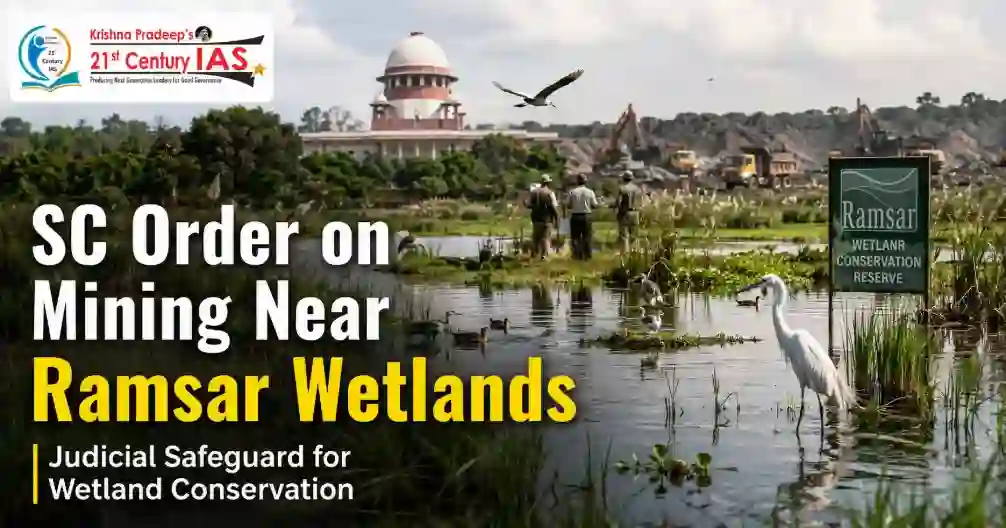
- Q. The Supreme Court’s clarification on mining near wetland conservation reserves highlights the need to strengthen India’s wetland governance framework. Discuss. (GS Paper III – Environment / Biodiversity Conservation)
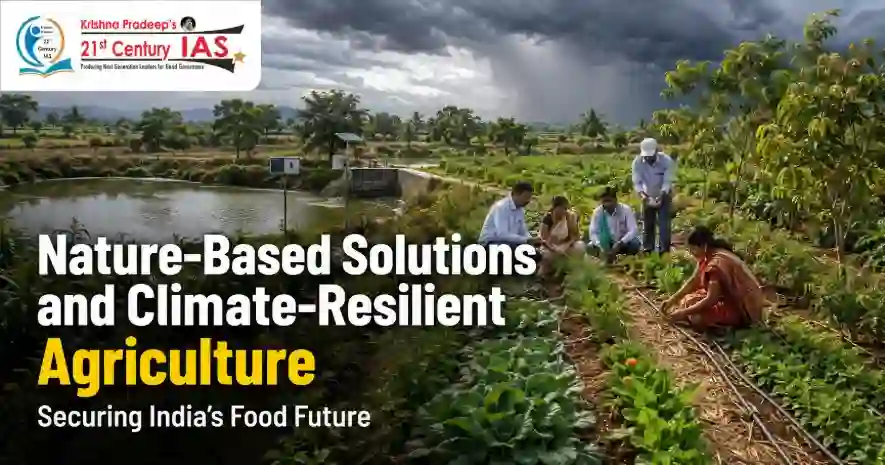
- Q. Nature-based solutions and climate-resilient agriculture are essential for ensuring India’s food security in the age of climate change. Discuss. (GS Paper III – Agriculture / Climate Change / Food Security)
Q. The Supreme Court’s clarification on mining near wetland conservation reserves highlights the need to strengthen India’s wetland governance framework. Discuss.
(GS Paper III – Environment / Biodiversity Conservation)
Introduction:
Wetlands are vital ecosystems that support biodiversity, groundwater recharge, flood moderation, carbon storage and local livelihoods. The Supreme Court’s clarification that prior approval is required for mining within a 10-km radius of wetland conservation reserves, following the Asan Wetland case, highlights the growing role of judicial safeguards in wetland governance.
Body
Significance of the Clarification
1. Protection of Fragile Ecosystems
Wetlands are sensitive to changes in hydrology, sediment flow and pollution. Mining near wetlands can affect aquatic biodiversity, migratory birds and ecological character.
2. Strengthening Ramsar Commitments
The Asan Wetland Conservation Reserve, located at the confluence of the Asan and Yamuna rivers, was designated a Ramsar site in 2020. The Court’s direction reinforces India’s obligation to maintain the ecological character of internationally important wetlands.
3. Filling Regulatory Gaps
Neither the Ramsar Convention nor the Wetlands Rules, 2017 provide a statutory mining buffer around Ramsar sites. The Court’s order therefore creates an additional layer of scrutiny through NBWL or MoEFCC approval.
4. Parity Across States
By extending the Asan principle to wetland conservation reserves across India, the Court seeks uniform ecological protection rather than State-wise inconsistency.
Concerns and Limitations
The order does not create a universal statutory buffer for all Ramsar sites. Wetland governance remains fragmented between State Wetland Authorities, wildlife bodies, forest laws and environmental clearance procedures. Boundary demarcation, monitoring capacity and scientific impact assessment remain weak.
Way Forward
India needs clear wetland mapping, defined zones of influence, stronger State Wetland Authorities, cumulative impact assessments for mining, satellite-based monitoring and local community participation.
Conclusion:
The Supreme Court’s clarification is a timely safeguard, but long-term wetland protection cannot depend only on case-by-case judicial intervention. India must build a coherent wetland governance framework that combines scientific regulation, statutory clarity, ecological sensitivity and accountable enforcement. Wetlands should be treated as critical natural infrastructure for biodiversity, water security, climate resilience and sustainable development.
Q. Nature-based solutions and climate-resilient agriculture are essential for ensuring India’s food security in the age of climate change. Discuss.
(GS Paper III – Agriculture / Climate Change / Food Security)
Introduction:
Indian agriculture is highly vulnerable to climate change due to its dependence on monsoons, small landholdings and large rainfed area. Agriculture supports about 58% of India’s population, while nearly 60% of farming is rainfed. Rising temperatures, erratic rainfall and extreme weather events threaten crop yields, soil fertility and farmer incomes.
Body
Role of Climate-Resilient Agriculture
1. Adaptation to Climate Shocks
Climate-resilient agriculture includes stress-tolerant crop varieties, adjusted sowing windows, better planting methods and improved water management. These practices reduce crop losses from droughts, heat stress and irregular monsoons.
2. Food and Nutritional Security
Climate-resilient practices help stabilise crop production. This is important as India must ensure food security for a large population amid increasing climate uncertainty.
3. Sustainable Soil and Water Management
Practices such as conservation agriculture, zero tillage, agroforestry and biochar improve soil health, water retention and nutrient use efficiency.
4. Climate Mitigation
Nature-based solutions reduce emissions by controlling residue burning, increasing soil carbon and supporting biodiversity. Biochar can sequester carbon and improve soil fertility.
India’s Policy Support
India has promoted climate-resilient agriculture through NAPCC, National Mission for Sustainable Agriculture, NICRA, National Agroforestry Policy, National Mission on Natural Farming and climate-resilient crop varieties released by ICAR. NICRA has identified 310 vulnerable agricultural districts and District Agriculture Contingency Plans have been prepared.
Challenges and Way Forward
Adoption remains limited due to low awareness, credit constraints, upfront costs, weak extension services and poor access to quality inputs. India must strengthen farmer awareness, localised climate planning, biochar adoption, stress-tolerant seeds, water-smart farming and institutional support.
Conclusion:
Nature-based solutions and climate-resilient agriculture are not optional reforms but necessary safeguards for India’s food security, farmer welfare and ecological sustainability. A successful transition requires combining scientific innovation with farmer-centric implementation, financial support and local climate governance.