Why in News?
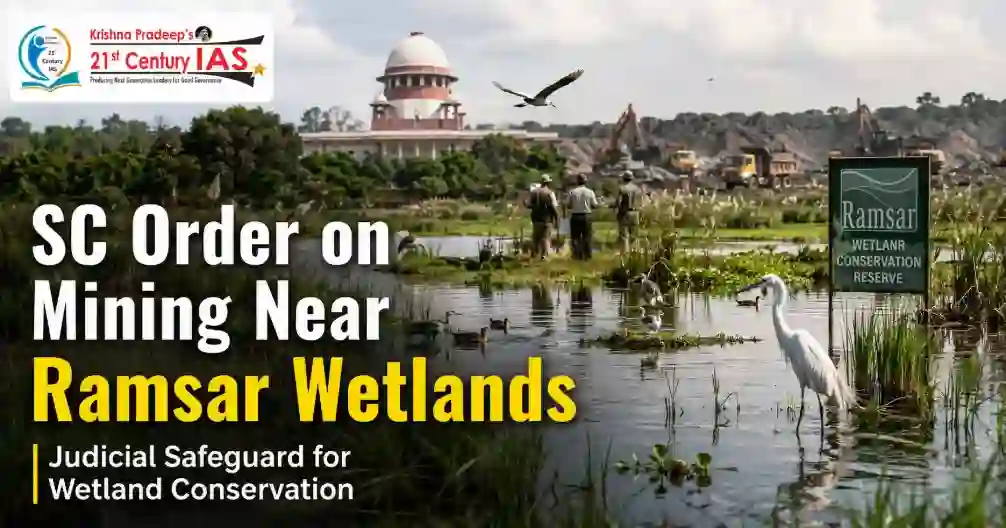
The Supreme Court has clarified that its earlier direction requiring prior approval before mining within a 10-km radius of the Asan Wetland Conservation Reserve in Uttarakhand would apply, for the sake of parity, to wetland conservation reserves across the country. This clarification is significant because Ramsar sites and wetland conservation reserves do not have a clearly defined statutory mining buffer under existing wetland rules.
What Did the Supreme Court Clarify?
The Supreme Court clarified that the principle laid down in the Asan Wetland Conservation Reserve case is not limited only to Uttarakhand.
The earlier direction required that no mining activity should be carried out within a 10-km radius of the Asan reserve unless prior permission is obtained from:
- the Standing Committee of the National Board for Wildlife, and/or
- the Ministry of Environment, Forest and Climate Change.
The latest clarification means that similar safeguards may apply to other wetland conservation reserves across India. the Court also directed the NBWL Standing Committee or MoEFCC to determine whether the Asan wetland extends into Himachal Pradesh. If it extends into Himachal Pradesh, the 2024 directions would apply there. If not, mining proposals would be governed by the applicable statutory framework.
Background of the Asan Wetland Case
The Asan Wetland Conservation Reserve is located at the confluence of the Asan and Yamuna rivers in Uttarakhand.
| Feature | Details |
| Wetland | Asan Wetland Conservation Reserve |
| Location | Uttarakhand |
| River Confluence | Asan and Yamuna rivers |
| Ramsar Status | Designated in 2020 |
| Ecological Importance | Migratory waterbirds and aquatic biodiversity |
In its interim order of February 14, 2024, the Supreme Court held that the wetland’s Ramsar status required higher scrutiny of activities that could affect its ecological character.
What are Ramsar Sites?
- Ramsar sites are wetlands of international importance.
- They are designated under the Ramsar Convention on Wetlands, adopted in 1971 at Ramsar, Iran.
- India became a party to the Convention in 1982.
- Ramsar designation recognises the ecological importance of a wetland and requires the country to maintain its ecological character.
- India currently has 101 Ramsar sites, the highest among Asian countries.
- Glaw Lake in Arunachal Pradesh became India’s 101st Ramsar site in August 2026.
Ramsar Sites in India – State-wise List 2026
| S.No. | Ramsar Site | State / UT |
| 1 | Kolleru Lake | Andhra Pradesh |
| 2 | Deepor Beel | Assam |
| 3 | Kanwar (Kabar) Taal | Bihar |
| 4 | Nagi Bird Sanctuary | Bihar |
| 5 | Nakti Bird Sanctuary | Bihar |
| 6 | Nanda Lake | Goa |
| 7 | Khijadia WLS | Gujarat |
| 8 | Nalsarovar BS | Gujarat |
| 9 | Thol Lake | Gujarat |
| 10 | Wadhvana Wetland | Gujarat |
| 11 | Bhindawas WLS | Haryana |
| 12 | Sultanpur NP | Haryana |
| 13 | Chandra Taal | Himachal Pradesh |
| 14 | Pong Dam Lake | Himachal Pradesh |
| 15 | Renuka Lake | Himachal Pradesh |
| 16 | Ranganathittu BS | Karnataka |
| 17 | Magadi Kere Conservation Reserve | Karnataka |
| 18 | Ankasamudra Bird Conservation Reserve | Karnataka |
| 19 | Aghanashini Estuary | Karnataka |
| 20 | Ashtamudi Wetland | Kerala |
| 21 | Sasthamkotta Lake | Kerala |
| 22 | Vembanad-Kol Wetland | Kerala |
| 23 | Bhoj Wetland | Madhya Pradesh |
| 24 | Sakhya Sagar | Madhya Pradesh |
| 25 | Sirpur Wetland | Madhya Pradesh |
| 26 | Yashwant Sagar | Madhya Pradesh |
| 27 | Tawa Reservoir | Madhya Pradesh |
| 28 | Lonar Lake | Maharashtra |
| 29 | Nandur Madhameshwar | Maharashtra |
| 30 | Thane Creek | Maharashtra |
| 31 | Loktak Lake | Manipur |
| 32 | Pala Wetland | Mizoram |
| 33 | Ansupa Lake | Odisha |
| 34 | Bhitarkanika Mangroves | Odisha |
| 35 | Chilika Lake | Odisha |
| 36 | Hirakud Reservoir | Odisha |
| 37 | Satkosia Gorge | Odisha |
| 38 | Tampara Lake | Odisha |
| 39 | Beas CnR | Punjab |
| 40 | Harike Wetland | Punjab |
| 41 | Kanjli Wetland | Punjab |
| 42 | Keshopur-Miani CmR | Punjab |
| 43 | Nangal WLS | Punjab |
| 44 | Ropar Wetland | Punjab |
| 45 | Keoladeo National Park | Rajasthan |
| 46 | Sambhar Lake | Rajasthan |
| 47 | Chitrangudi BS | Tamil Nadu |
| 48 | Gulf of Mannar Marine BR | Tamil Nadu |
| 49 | Kanjirankulam BS | Tamil Nadu |
| 50 | Karikili BS | Tamil Nadu |
| 51 | Koonthankulam BS | Tamil Nadu |
| 52 | Pallikaranai Marsh Reserve Forest | Tamil Nadu |
| 53 | Pichavaram Mangrove | Tamil Nadu |
| 54 | Point Calimere WLS & BS | Tamil Nadu |
| 55 | Suchindram Theroor Wetland Complex | Tamil Nadu |
| 56 | Udhayamarthandapuram BS | Tamil Nadu |
| 57 | Vaduvur BS | Tamil Nadu |
| 58 | Vedanthangal BS | Tamil Nadu |
| 59 | Vellode BS | Tamil Nadu |
| 60 | Vembannur Wetland Complex | Tamil Nadu |
| 61 | Karaivetti Bird Sanctuary | Tamil Nadu |
| 62 | Longwood Shola Reserve Forest | Tamil Nadu |
| 63 | Nanjarayan Bird Sanctuary | Tamil Nadu |
| 64 | Kazhuveli Bird Sanctuary | Tamil Nadu |
| 65 | Rudrasagar Lake | Tripura |
| 66 | Hokera Wetland | UT of Jammu & Kashmir |
| 67 | Hygam Wetland CnR | UT of Jammu & Kashmir |
| 68 | Shallbugh Wetland CnR | UT of Jammu & Kashmir |
| 69 | Surinsar-Mansar Lakes | UT of Jammu & Kashmir |
| 70 | Wular Lake | UT of Jammu & Kashmir |
| 71 | Tso Kar | UT of Ladakh |
| 72 | Tsomoriri | UT of Ladakh |
| 73 | Bakhira WLS | Uttar Pradesh |
| 74 | Haiderpur Wetland | Uttar Pradesh |
| 75 | Nawabganj BS | Uttar Pradesh |
| 76 | Parvati Arga BS | Uttar Pradesh |
| 77 | Saman BS | Uttar Pradesh |
| 78 | Samaspur BS | Uttar Pradesh |
| 79 | Sandi BS | Uttar Pradesh |
| 80 | Sarsai Nawar Jheel | Uttar Pradesh |
| 81 | Sur Sarovar (Keetham Lake) | Uttar Pradesh |
| 82 | Upper Ganga River (Brijghat to Narora) | Uttar Pradesh |
| 83 | Asan Barrage | Uttarakhand |
| 84 | East Kolkata Wetlands | West Bengal |
| 85 | Sundarban Wetland | West Bengal |
| 86 | Sakkarakottai Bird Sanctuary | Tamil Nadu |
| 87 | Therthangal Bird Sanctuary | Tamil Nadu |
| 88 | Khecheopalri Wetland | Sikkim |
| 89 | Udhwa Lake | Jharkhand |
| 90 | Khichan (Phalodi) | Rajasthan |
| 91 | Menar (Udaipur) | Rajasthan |
| 92 | Gokul Jalashay | Bihar |
| 93 | Udaipur Jheel | Bihar |
| 94 | Gogabeel Lake | Bihar |
| 95 | Siliserh Lake | Rajasthan |
| 96 | Kopra Jalashay | Chhattisgarh |
| 97 | Patna Bird Sanctuary | Uttar Pradesh |
| 98 | Chhari-Dhand | Kutch (Gujarat) |
| 99 | Shekha Jheel Bird Sanctuary | Uttar Pradesh |
| 100 | Jai Prakash Narayan Bird Sanctuary | Uttar Pradesh |
| 101 | Glaw Lake | Arunachal Pradesh |
Do Ramsar Sites Have a Statutory Mining Buffer?
- A Ramsar designation does not automatically create a separate statutory protection regime under Indian law.
- Neither the Ramsar Convention nor the Wetlands (Conservation and Management) Rules, 2017 prescribe a fixed statutory buffer zone around Ramsar sites for mining.
- This means there is no general rule under the Wetlands Rules that mining is automatically prohibited within a specific distance from every Ramsar site.
- The Supreme Court’s direction is therefore important because it creates a judicial safeguard for mining activities near wetland conservation reserves.
Wetlands Rules: 2010 vs 2017
| Aspect | Wetlands Rules, 2010 | Wetlands Rules, 2017 |
| Regulation Model | More centralised and detailed | Decentralised through State Wetland Authorities |
| Prohibited Activities | Listed activities such as reclamation, new industries, dumping of solid waste and harmful activities | Removed explicit list of prohibited activities |
| Zone of Influence | Required prior approval for activities within the wetland’s zone of influence | Greater responsibility shifted to States |
| Environmental Scrutiny | EIA required for specified projects | Depends on applicable legal and State-level framework |
| Current Status | Replaced by 2017 Rules | Constitutional validity under challenge before Supreme Court |
Petitioners have argued that the 2017 framework weakens protections available under the 2010 Rules and excludes many artificial wetlands recognised under the Ramsar Convention.
Mining Restrictions Near Protected Areas
Mining restrictions near wetlands differ from restrictions near national parks, wildlife sanctuaries and forests.
1. National Parks and Wildlife Sanctuaries
Mining inside national parks and wildlife sanctuaries is prohibited under the Wildlife Protection Act, 1972.
The Supreme Court has also held that mining is impermissible within one kilometre of every national park and wildlife sanctuary unless a larger Eco-Sensitive Zone has already been notified.
2. Eco-Sensitive Zones
If a larger ESZ has been notified around a protected area, the larger notified buffer prevails.
3. Forest Areas
Mining in forest areas requires prior approval of the Union government under the Van (Sanrakshan Evam Samvardhan) Adhiniyam, 1980.
4. Environmental Clearance
Mining projects generally require environmental clearance under the Environment Impact Assessment Notification, 2006.
5. Wetland Conservation Reserves
In the case of wetland conservation reserves, the Supreme Court’s Asan direction requires prior approval before mining within a 10-km radius, but this operates as a judicial safeguard rather than a statutory buffer under the Wetlands Rules.
Significance of the Supreme Court Clarification
1. Strengthens Wetland Protection
The order gives additional protection to wetland conservation reserves where statutory buffer rules are unclear.
2. Applies Precautionary Principle
Wetlands are fragile ecosystems. Prior approval ensures that mining proposals are examined before ecological damage occurs.
3. Protects Ramsar Ecological Character
Ramsar sites are internationally recognised for ecological importance. Activities affecting their ecological character require stricter scrutiny.
4. Improves Regulatory Oversight
Requiring approval from NBWL or MoEFCC introduces higher-level environmental review.
5. Creates Parity Across States
The clarification prevents uneven protection where one wetland receives judicial safeguard while similar wetlands elsewhere remain exposed.
6. Addresses Gaps in Wetland Rules
Since the 2017 Rules do not prescribe a fixed mining buffer, the Court’s direction fills an important regulatory gap.
Challenges and Concerns
1. Legal Ambiguity
The direction applies to wetland conservation reserves, but Ramsar sites as a category still do not have a statutory buffer zone.
2. Federal Concerns
Wetland management under the 2017 Rules is largely decentralised through State Wetland Authorities. Judicial directions may require better Centre-State coordination.
3. Impact on Mining Projects
Mining proposals near wetland conservation reserves may now face additional scrutiny and delays.
4. Need for Clear Mapping
Authorities must clearly map wetland boundaries and zones of influence to avoid disputes.
5. Ecological Character Assessment
Scientific assessment is needed to determine how mining affects hydrology, bird habitats, aquatic biodiversity and sediment flow.
6. Enforcement Capacity
Legal safeguards are effective only when backed by monitoring, field inspections and compliance mechanisms.
Way Forward
1. Notify Clear Wetland Boundaries
All wetland conservation reserves and Ramsar sites should have scientifically demarcated boundaries.
2. Define Zones of Influence
Instead of relying only on fixed-distance rules, authorities should identify ecological zones based on hydrology, biodiversity and land-use patterns.
3. Strengthen State Wetland Authorities
State Wetland Authorities need technical capacity, funding and monitoring systems.
4. Improve Mining Scrutiny
Mining projects near wetlands should undergo cumulative impact assessment, not only project-wise clearance.
5. Harmonise Legal Frameworks
Wetland Rules, Wildlife Protection Act, EIA framework and forest laws should work together to avoid regulatory gaps.
6. Ensure Local Participation
Local communities, fisherfolk, farmers and bird experts should be involved in wetland conservation planning.
7. Strengthen Compliance Monitoring
Use satellite imagery, GIS mapping and field audits to monitor illegal mining and land-use change around wetlands.
Conclusion
The Supreme Court’s clarification on mining near wetland conservation reserves is an important step in strengthening wetland protection. It does not create a universal statutory buffer for all Ramsar sites, but it adds a judicial safeguard by requiring prior approval for mining within a 10-km radius of wetland conservation reserves. This is significant because India’s wetlands face pressure from mining, urbanisation, encroachment and pollution. The larger lesson is that wetland conservation needs clear legal standards, scientific mapping, strong State Wetland Authorities and accountable project clearances. Protecting wetlands is not only about biodiversity; it is also about water security, flood regulation, climate resilience and sustainable development.