
- Space Technology Unit 1
- Orbit
- Launchers or Launch Vehicles
- Evolution of Indian Launch Vehicles
- Key Indian space organizations
- Indian Space Research Organisation (ISRO)
- Vikram Sarabhai Space Centre
- Liquid Propulsion Systems Centre (LPSC)
- Satish Dhawan Space Centre (SDSC)
- U R Rao Satellite Centre (URSC),
- Space Applications Centre (SAC)
- National Remote Sensing Centre (NRSC)
- Human Space Flight Centre (HSFC)
- ISRO Propulsion Complex (IPRC)
- ISRO Inertial Systems Unit (IISU)
- ISRO Telemetry, Tracking and Command Network (ISTRAC)
- Master Control Facility (MCF)
- Laboratory for Electro-Optics Systems (LEOS)
- Indian Institute of Remote Sensing (IIRS)
- Indian Space Research Organisation (ISRO)
- Space Sector Reforms and Private Participation
- Indian space Policy, 2023
- Indian National Space Promotion and Authorization Center (IN-SPACe)
- Antrix Corporation Limited
- NewSpace India Limited (NSIL)
- Private sector in Space Technology
- Mission Prarambh & India’s First Private Launch Vehicle: Vikram-S
- Agnikul Cosmos and the Agnibaan SOrTeD Mission
- Other initiatives of ISRO
- PM Modi “directs” ISRO to land man on moon by 2040
- Anti-Satellite Missile Test (ASAT) – Mission Shakti
- YUVIKA – YUva VIgyani KAryakram (Young Scientist Programme)
- NEtwork for space object TRacking and Analysis (NETRA)
- Indian Space Missions and Applications
- Space Based Earth Observation Applications
- Important Foreign Missions
- Recent Missions
- PREVIOUS YEAR QUESTIONS – Space Technology
- MAINS PREVIOUS YEAR QUESTIONS – Space Technology
- GLOSSARY
Indian Space Research Organisation (ISRO)
Indian Space Research Organisation (ISRO) is the space agency of India. The organisation is involved in science, engineering and technology to harvest the benefits of outer space for India and the mankind. ISRO is a major constituent of the Department of Space (DOS), Government of India. The department executes the Indian Space Programme primarily through various Centres or units within ISRO.
- ISRO was previously the Indian National Committee for Space Research (INCOSPAR), set up by the Government of India in 1962, as envisioned by Dr. VikramA Sarabhai. ISRO was formed on August 15, 1969 and superseded INCOSPAR with an expanded role to harness space technology. DOS was set up and ISRO was brought under DOS in 1972.
- The prime objective of ISRO/DOS is the development and application of space technology for various national needs. To fulfil this objective, ISRO has established major space systemsfor communication, television broadcasting and meteorological services; resources monitoring and management; space-based navigation services. ISRO has developed satellite launch vehicles, PSLV and GSLV, to place the satellites in the required orbits.
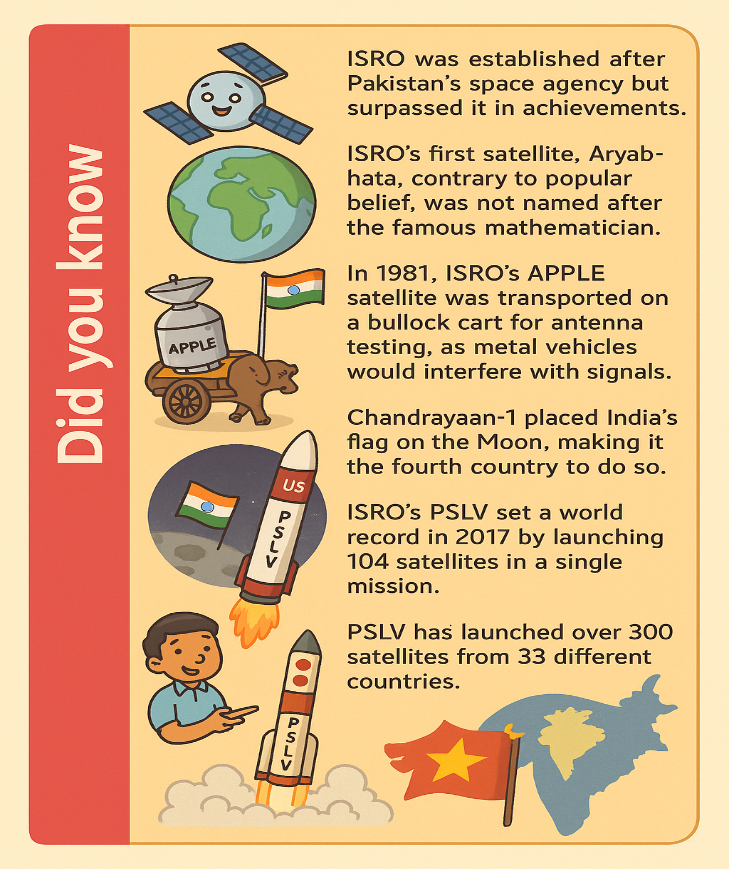
- Alongside its technological advancement, ISRO contributes to science and science education in the country. Various dedicated research centres and autonomous institutions for remote sensing, astronomy and astrophysics, atmospheric sciences and space sciences in general function under the aegis of Department of Space. ISRO’s own Lunar and interplanetary missions along with other scientific projects encourage and promote science education, apart from providing valuable data to the scientific community which in turn enriches science.
ISRO has its headquarters in Bengaluru. Its activities are spread across various centres and units. Launch Vehicles are built at VikramSarabhai Space Centre (VSSC), Thiruvananthapuram; Satellites are designed and developed at U R Rao Satellite Centre (URSC), Bengalure; Integration and launching of satellites and launch vehicles are carried out from Satish
- Dhawan Space Centre (SDSC), Sriharikota; Development of liquid stages including cryogenic stage is carried out at Liquid Propulsion Systems Centre (LPSC), Valiamala& Bengaluru; Sensors for Communication and Remote Sensing satellites and application aspects of the space technology are taken up at Space Applications Centre (SAC), Ahmedabad and Remote Sensing satellite data reception processing and dissemination is entrusted to National Remote Sensing Centre (NRSC), Hyderabad.
Source: https://www.isro.gov.in/
Vision, Mission, and Objectives of the Department of Space:
Vision
- Harness, sustain and augment space technology for national development, while pursuing space science research and planetary exploration.
Mission
- Design and development of launch vehicles and related technologies for providing access to space.
- Design and development of satellites and related technologies for earth observation, communication, navigation, meteorology and space science.
- Communication programme for meeting telecommunication, television broadcasting and developmental applications.
- Satellite-based Remote Sensing programme for management of natural resources and monitoring of environment using space-based imagery.
- Space-based navigation system.
- Space-based applications for societal development.
- Research and development in space science and planetary exploration.
- Promote and authorise private firms to play key role in global space market.
Objectives
- Operational flights of Polar Satellite Launch Vehicle (PSLV), Geo-synchronous Satellite Launch Vehicle (GSLV), and Small Satellite Launch Vehicle (SSLV).
- Design and development of new space transportation solutions.
- Design, development and realization of communication satellites.
- Design, development and realization of Earth observation satellites.
- Development of navigation satellite systems.
- Development of satellites for space science and planetary exploration.
- Earth observation applications.
- Space-based systems for societal applications.
- Advanced technologies and newer initiatives.
- Training, capacity building and education.
- Promotion of space technology.
- Infrastructure/facility development for space research.
- International cooperation.
- Commercial utilisation of the products and services emanating from the Indian space programme.
- Promotion and authorisation of Indian private firms in the space sector.
Organisation Structure of ISRO

