Why in News?
The Union Cabinet has approved GOBARdhan, the National Circular Bioenergy Scheme, with an outlay of ₹23,731 crore for implementation over 10 years from 2026-27 to 2035-36.
The scheme aims to boost Compressed Biogas production in India by nearly 10 times and make CBG projects commercially viable through assured offtake, stable pricing, capital subsidies, credit support and pipeline infrastructure.
About GOBARdhan Scheme
GOBARdhan stands for Galvanising Organic Bio-Agro Resources Dhan. It is to be implemented by the Ministry of Petroleum and Natural Gas.
The scheme seeks to convert India’s organic waste resources into useful economic and energy assets. These include:
- agricultural residue
- cattle dung
- press mud
- municipal organic waste
- other biomass resources
The broader objective is to convert the waste burden into clean fuel, organic manure, rural income and national economic value.
What is Compressed Biogas?
- Biogas is produced from organic waste. It generally contains 55-65% methane, 35-44% carbon dioxide, and small traces of gases such as hydrogen sulphide, nitrogen and ammonia.
- In its raw form, biogas can be used for cooking, lighting, motive power and electricity generation. When biogas is purified and upgraded to nearly 98% methane, and compressed at high pressure, it becomes Compressed Biogas.
- CBG has properties similar to Compressed Natural Gas. Therefore, it can be used in transport, industry and commercial sectors, either as a replacement for CNG or by blending with CNG.
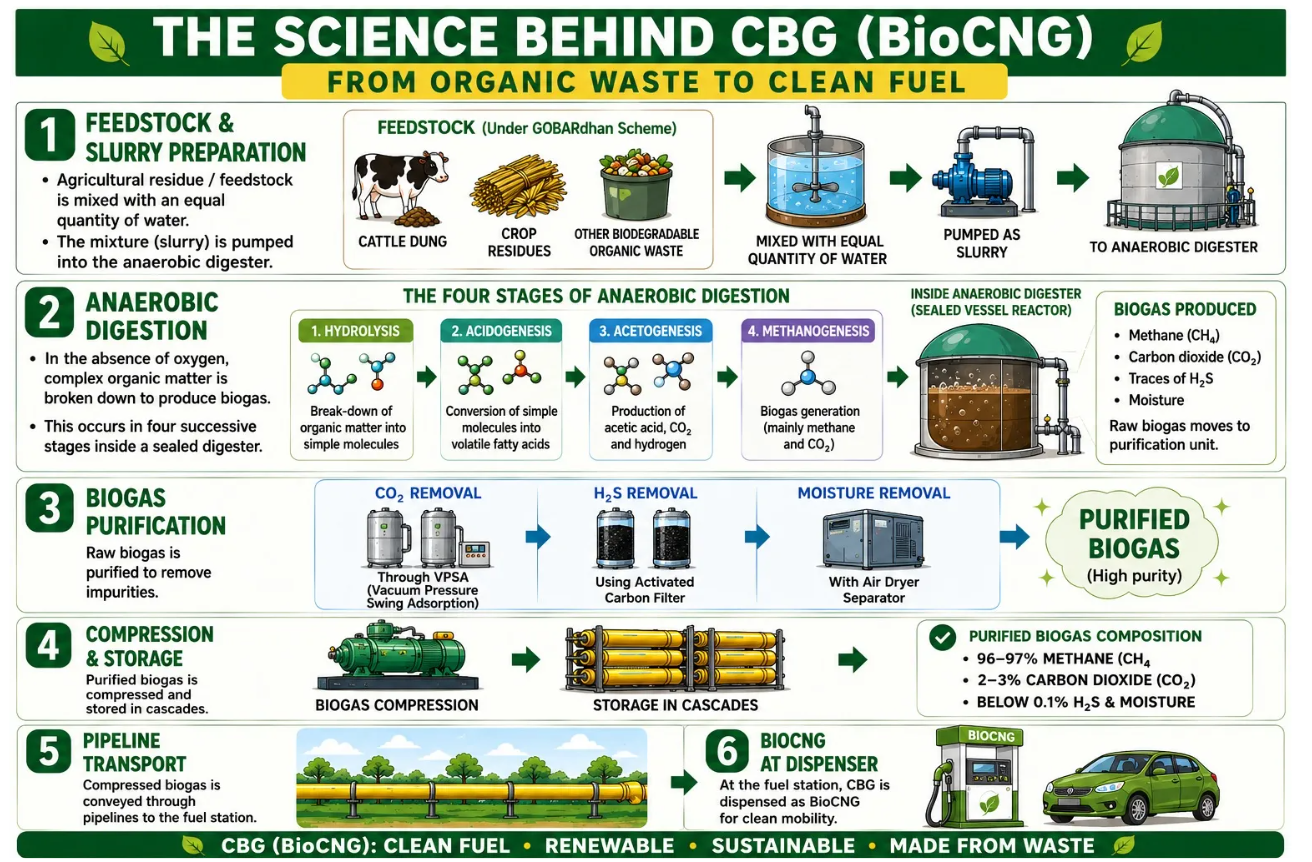
How CBG is Produced?
CBG production is based on anaerobic digestion, where organic matter is broken down in the absence of oxygen.
The process involves four stages:
1. Hydrolysis
Complex organic matter is broken into simpler molecules.
2. Acidogenesis
These simpler molecules are converted into volatile fatty acids.
3. Acetogenesis
Acetic acid, carbon dioxide and hydrogen are produced.
4. Methanogenesis
Methane-rich biogas is generated.
The biogas is then purified, upgraded and compressed to produce CBG suitable for fuel use.
Why CBG is Strategically Important for India?
1. Reduces Import Dependence
India depends on imports for a large part of its natural gas requirement. Domestic CBG production can reduce this dependence and improve energy security.
2. Supports Clean Energy Transition
CBG is a renewable fuel produced from waste. It can support India’s transition from fossil fuels to cleaner energy sources.
3. Protects Against Global Supply Shocks
International gas prices and supply routes can be affected by geopolitical tensions. Domestic CBG can reduce vulnerability to such external shocks.
4. Uses Existing Gas Infrastructure
Since CBG is chemically similar to natural gas, it can be integrated into existing CNG and PNG systems.
5. Strengthens Rural Economy
Farm residue, cattle dung and biomass can become sources of income for farmers, cooperatives, rural entrepreneurs and MSMEs.
How the New Framework Supports Commercial Viability
The main problem with CBG projects has not been technology alone. The bigger challenges have been feedstock supply, high capital cost, weak offtake and limited distribution infrastructure.
The new GOBARdhan framework addresses these issues through:
1. Assured Offtake
City Gas Distribution entities will procure CBG to meet blending obligations in CNG and PNG segments.
The blending obligation is:
- 3% in 2026-27
- 4% in 2027-28
- 5% from 2028-29 onwards
This creates a predictable demand for CBG producers.
2. Stable Administered Price
The scheme introduces a stable administered CBG price of ₹2,110 per MMBTU. This gives producers long-term revenue certainty.
3. Capital Assistance
Eligible greenfield CBG projects will receive capital assistance of up to ₹2 crore per tonne per day of installed capacity. Brownfield projects expanding capacity will also be eligible.
4. Pipeline Infrastructure
The scheme supports cluster-based and standalone pipeline infrastructure to connect CBG plants with trunk pipelines and city gas distribution networks.
5. Credit Guarantee Support
A dedicated credit guarantee mechanism will help MSME-based CBG projects access institutional credit with lower collateral pressure.
Together, these measures aim to move CBG from a pilot-project model to a bankable energy industry.
Government Initiatives for CBG Sector
The government has already supported the CBG sector through several initiatives.
1. SATAT Initiative
Sustainable Alternative Towards Affordable Transportation was launched to promote CBG as an alternative transport fuel.
2. Market Development Assistance Scheme
It supports the organic manure value chain linked with CBG plants.
3. Biomass Aggregation Machinery Scheme
It supports the collection and aggregation of biomass feedstock.
4. Development of Pipeline Infrastructure Scheme
It strengthens the connectivity needed for transporting CBG.
5. National Bioenergy Programme
It provides Central Financial Assistance for CBG plants.
These initiatives have helped commission over 200 CBG plants and demonstrated the potential of CBG across feedstocks and regions.
Waste-to-Energy Technologies:
Waste-to-energy refers to technologies that convert non-recyclable waste into usable forms of energy such as heat, electricity, gas or fuel.
There are two broad types:
1. Thermochemical Technologies
These use heat to convert waste into energy.
Incineration burns waste at high temperature and is suitable for mixed municipal waste with high calorific value.
Pyrolysis breaks down waste in the absence of oxygen and produces char, pyrolysis oil and syngas.
Gasification converts carbon-rich waste into syngas or producer gas containing gases such as hydrogen, carbon monoxide and methane.
2. Biochemical Technologies
These use microorganisms to break down biodegradable waste.
Anaerobic digestion is suitable for organic waste such as kitchen waste, garden waste, cattle dung and agricultural residue. It produces biogas.
Landfilling with gas recovery captures landfill gas, but landfilling is environmentally problematic because of toxic gases and long-term pollution risk.
GOBARdhan mainly uses the biochemical route of anaerobic digestion to produce CBG from organic waste.
Significance
1. Energy Security
Domestic CBG production can reduce dependence on imported natural gas.
2. Waste Management
The scheme can reduce the burden of agricultural residue, cattle dung and municipal organic waste.
3. Rural Income
Farmers, cooperatives and rural entrepreneurs can earn from supplying feedstock and managing CBG-linked activities.
4. Organic Manure Production
The by-products of CBG plants can support organic manure use and improve soil health.
5. Climate Benefits
CBG can reduce methane emissions from unmanaged organic waste and support cleaner fuel use.
6. Circular Economy
The scheme converts waste into fuel, manure and income, making resource use more efficient.
Challenges
1. Feedstock Supply Chain
Reliable collection of cattle dung, crop residue and municipal organic waste is difficult without local organisation.
2. High Initial Cost
CBG plants require investment in plant machinery, feedstock aggregation, purification and compression systems.
3. Market Linkage
Without assured offtake, producers may face uncertainty in selling CBG.
4. Pipeline Connectivity
Lack of pipeline infrastructure can increase evacuation cost and reduce commercial viability.
5. Quality Standards
CBG must meet required methane purity and fuel standards to be used in the gas network.
6. Local Governance Capacity
Panchayats, municipalities and cooperatives need capacity to support feedstock supply and waste segregation.
Way Forward
1. Strengthen Feedstock Aggregation
Village-level and cluster-level systems should collect cattle dung, crop residue and organic waste reliably.
2. Link Farmers with CBG Plants
Farmers should receive fair payment for biomass and access to organic manure produced from CBG plants.
3. Ensure Timely Offtake
City gas distribution entities must implement blending obligations consistently.
4. Expand Pipeline Networks
Pipeline connectivity should be improved to lower transportation cost and increase plant utilisation.
5. Support MSMEs and Cooperatives
Credit guarantee and capital assistance should reach small developers, rural entrepreneurs, cooperatives and women-led enterprises.
6. Promote Waste Segregation
Urban local bodies must strengthen source segregation so that clean organic waste can be used for biogas production.
7. Build Technical Capacity
Training is needed for plant operators, local governments, lenders and entrepreneurs.
Conclusion
GOBARdhan is a strategic attempt to convert India’s organic waste into energy security, rural income and climate benefits. Its success will depend not only on producing more CBG but also on solving commercial bottlenecks such as feedstock supply, offtake assurance, pricing, credit and pipeline infrastructure. If implemented well, the scheme can connect farmers, municipalities, MSMEs and city gas networks into a circular bioenergy ecosystem. It can make waste a productive resource and help India move towards cleaner, more resilient and locally generated energy.
Why in News?
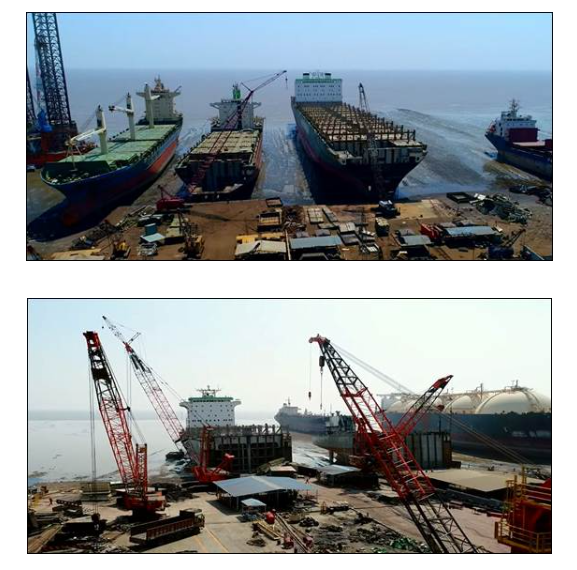
India became the world’s leading ship recycling nation in 2025, with its global market share rising from 30.1% in 2024 to 35.4% in 2025. Its ship recycling volume also increased from 1.86 million gross tons to 2.99 million gross tons, marking nearly 60% growth.
This achievement has been supported by regulatory reforms, Hong Kong Convention compliance, yard modernisation, worker training and stronger safety and environmental standards.
How India Became a Global Leader in Ship Recycling
- According to UNCTAD, India ranked first globally in ship recycling in 2025. The growth shows India’s rising competitiveness in handling end-of-life ships in a regulated and commercially viable manner.
- The achievement is also significant because India has met the Maritime India Vision 2030 target of becoming the world’s leading ship recycling nation five years ahead of schedule.
- India is now planning to nearly double its ship recycling capacity to around 9 million light displacement tons through the planned expansion of the Alang Ship Recycling Yard. This expansion is supported by a comprehensive master plan focused on infrastructure improvement and global competitiveness.
Alang-Sosiya Cluster: Backbone of India’s Ship Recycling Sector
The Alang-Sosiya ship recycling cluster in Gujarat is the centre of India’s ship recycling industry. It accounts for about 98% of India’s ship recycling activity and has an annual recycling capacity of around 6 million gross tons.
Alang produces nearly 3.50 million metric tonnes of steel annually through recycling. This reduces dependence on fresh extraction of natural resources and supports India’s circular economy.
The cluster is supported by:
- authorised ship recycling yards
- downstream steel re-rolling mills
- waste-management facilities
- allied industrial infrastructure
- safety and training institutions
The Safety Training and Labour Welfare Institute at Alang-Sosiya has cumulatively trained over 1.5 lakh workers in occupational safety, hazardous-material handling and emergency response.
Apart from Alang-Sosiya, India also has ship recycling facilities at Amar Iron Udyog in Kolkata and Steel Industrials Kerala Limited in Kerala.
Modernisation of Indian Ship Recycling Yards
Indian yards have been upgraded to meet higher safety and environmental standards.
Major improvements include:
- engineered and demarcated recycling plots
- impermeable working surfaces
- drainage systems
- mechanised material handling equipment
- segregated hazardous-waste storage
- authorised downstream waste treatment linkages
- structured safety, health and emergency response systems
These changes have helped India move from conventional dismantling practices towards a modern, internationally aligned ship recycling industry.
Regulatory and Compliance Framework
India has created a detailed legal and institutional framework for safe and environmentally sound ship recycling.
1. Ship Recycling Act, 2019
The Ship Recycling Act, 2019 is the principal law governing ship recycling in India. It designates the Directorate General of Shipping as the National Authority and provides for authorisation, certification, inspection and enforcement.
2. Ship Recycling Rules, 2021
The Rules operationalise the Act by laying down requirements for facility authorisation, ship recycling plans, hazardous-material management, worker safety, training and reporting.
3. Ship Recycling Regulations, 2026
The Regulations strengthen implementation through detailed operational, environmental and safety standards. They promote uniform compliance across recycling facilities.
Together, the Act, Rules and Regulations regulate the full lifecycle of ship recycling, from ship preparation and certification to yard authorisation and compliance monitoring.
Hong Kong Convention and India’s Alignment
- The Hong Kong International Convention for the Safe and Environmentally Sound Recycling of Ships is the principal global framework for ship recycling. It became legally binding on 26 June 2025.
- India has aligned its domestic framework with the Convention through the Ship Recycling Act, Rules and Regulations. This makes international safety and environmental standards part of India’s national regulatory system.
- The government has provided ₹53.5 crore for yard modernisation, helping 115 ship recycling facilities achieve compliance with Hong Kong Convention requirements.
- Further, 35 Alang ship recycling yards have applied for inclusion in the EU list of approved ship recycling facilities. Shree Ram Vessel Scrap and Y. S. Investments have been included in the draft 16th European List of Ship Recycling Facilities.
Inventory of Hazardous Materials
The Inventory of Hazardous Materials identifies hazardous substances present aboard ships. It supports safe handling throughout the ship lifecycle and before recycling.
IHM improves:
- traceability
- transparency
- hazardous-material risk management
- safety of workers
- environmental compliance
It is an important tool for preventing unsafe dismantling and reducing pollution risks.
Ship-breaking Credit Note Scheme
The Ship-breaking Credit Note Scheme has been introduced under the Ship Building Financial Assistance Scheme 2.0.
It encourages shipowners to recycle vessels at compliant Indian yards while also promoting shipbuilding in India.
Under the scheme:
- scrapping a ship generates a Credit Note equal to 40% of the recycled vessel’s scrap value;
- this Credit Note can be used for purchasing a new vessel built in India;
- it can cover up to 5% of the value of the new Indian-built vessel.
This links sustainable ship recycling with domestic shipbuilding, supporting both environmental responsibility and industrial growth.
| Ex-INS Viraat: Case Study in Responsible Recycling
Ex-INS Viraat is an important example of India’s ship recycling capability. It served the Royal Navy for 27 years and the Indian Navy for 30 years before being decommissioned in March 2017. The aircraft carrier reached Alang, Gujarat, in September 2020 for dismantling and recycling. During its service, Ex-INS Viraat recorded more than 22,622 flying hours, spent 2,252 days at sea, and sailed over 5.88 lakh nautical miles. Its recycling showed India’s ability to handle large and complex vessels, recover valuable materials safely, support employment and follow improved environmental and occupational-safety standards. |
Significance of Ship Recycling for India
1. Resource Security
Ship recycling provides ferrous scrap for the domestic steel industry and reduces dependence on imported raw materials.
2. Circular Economy
Steel and reusable materials recovered from ships reduce waste and support efficient resource use.
3. Environmental Benefits
Regulated recycling prevents unsafe disposal of end-of-life ships and reduces marine and coastal pollution.
4. Lower Energy Use
Recycled steel requires less energy than primary steel production and supports India’s decarbonisation goals.
5. Employment Generation
The sector supports workers engaged in dismantling, processing, material recovery, transport, re-rolling mills and waste management.
6. Industrial Ecosystem
Recovered steel and reusable components support Make in India and Atmanirbhar Bharat by strengthening domestic manufacturing.
Challenges
- Despite India’s progress, some issues require continuous attention.
- Indian yards must maintain global standards consistently as international scrutiny rises. Hazardous-material handling needs strict enforcement because ships may contain asbestos, heavy metals, oils and other risky materials. Worker safety must remain central, especially in physically demanding dismantling operations.
- The sector also needs better technology, stronger waste-management linkages, stable demand for recycled materials and transparent certification systems. India must also ensure that expansion of capacity does not weaken environmental safeguards.
Way Forward
1. Strengthen Green Compliance
All recycling yards should fully comply with the Hong Kong Convention and national safety standards.
2. Improve Worker Welfare
Training, protective equipment, health insurance, emergency response systems and labour welfare measures should be expanded.
3. Upgrade Technology
Mechanised dismantling, digital tracking, hazardous-material mapping and better waste-treatment systems should be promoted.
4. Expand Responsible Capacity
Alang’s expansion should be aligned with environmental safeguards and coastal-zone management.
5. Promote Global Recognition
India should support more yards in securing EU and international approvals.
6. Link Recycling with Shipbuilding
The Ship-breaking Credit Note Scheme should be used to connect recycling, steel recovery and domestic vessel construction.
7. Strengthen Circular Economy Markets
Recycled steel should be integrated into domestic manufacturing, infrastructure and industrial supply chains.
Conclusion
India’s rise as the world’s leading ship recycling nation in 2025 reflects the success of regulatory reform, yard modernisation and international compliance. The sector supports resource security, employment, circular economy and environmental sustainability. The Alang-Sosiya cluster remains the backbone of this progress, while the Hong Kong Convention-aligned framework has improved safety and credibility. Going forward, India must combine capacity expansion with green technologies, worker welfare and strict compliance. Sustainable ship recycling can become a major pillar of India’s maritime economy.