Why in News?
- The AP State Climate Change Cell (APSCCC) has suggested measures to reduce the impact of climate change on the energy sector.
- These measures are part of the Andhra Pradesh State Action Plan on Climate Change 2025–30.
- The Cell has found that the energy sector in many northern and central regions of Andhra Pradesh is highly vulnerable to climate change.
- The plan focuses on renewable energy, green hydrogen, electric vehicle charging, energy efficiency and resilient infrastructure.

Background
- Climate change is expected to affect both energy demand and energy supply.
- Rising temperatures may increase the demand for cooling and electricity.
- Extreme weather events may damage power plants, transmission lines and energy infrastructure.
- Sea-level rise may affect power plants located in coastal areas.
- The energy sector itself contributes to climate change through Greenhouse Gas emissions, mainly due to fossil fuel use.
Climate Change and the Energy Sector
Climate change affects the energy sector in two ways:
1. Impact on Energy Demand
- Rising temperatures increase electricity demand.
- More energy is needed for cooling systems such as fans, air conditioners and refrigeration.
- Heat stress may increase demand in domestic, commercial and industrial sectors.
2. Impact on Energy Supply
- Extreme weather events can damage power plants and transmission networks.
- Variable rainfall can affect hydroelectric power generation.
- Sea-level rise can threaten coastal energy infrastructure.
- Fossil fuel supply chains may also be disrupted.
Eight Adaptation Measures Suggested
1. Increase Renewable Energy Share
- Increase renewable energy generation to 40% of the total energy mix.
- Focus mainly on:
- Solar energy
- Wind energy
2. Establish Renewable Power Projects
- Establish 120 GW renewable power projects.
- This will reduce dependence on fossil fuels.
- It will help improve long-term energy security.
3. Develop Green Hydrogen Hubs
- Establish two environment-friendly hydrogen hubs.
- Combined capacity: 60 MW.
- Green hydrogen can support clean industrial growth.
4. Expand Electric Vehicle Charging Infrastructure
- Install one lakh fast and slow EV charging stations.
- This will support electric mobility.
- It will reduce fossil fuel use in the transport sector.
5. Retrofit Existing Buildings
- Implement energy efficiency measures in existing buildings.
- Retrofitting can reduce electricity consumption.
- It is important for urban climate resilience.
6. Promote Efficient Cooling Systems
- Create an enabling environment for market penetration of efficient cooling systems.
- This is important because rising temperatures will increase cooling demand.
7. Improve Energy Conservation Across Sectors
- Promote energy-efficient street lighting.
- Ensure 100% coverage of Energy Conservation Cells in:
- Commercial sector
- Industrial sector
- Agriculture sector
- Domestic sector
8. Improve Efficiency in Water Pumping and Lift Irrigation
- Increase energy efficiency in:
- Drinking water pumping systems
- Lift irrigation systems
- This is important for agriculture, water supply and rural infrastructure.
Significance of the Measures
1. Supports Clean Energy Transition
- More solar, wind and green hydrogen will reduce fossil fuel dependence.
- It will help lower Greenhouse Gas emissions.
2. Strengthens Energy Security
- Diversified energy sources make the State less vulnerable to supply shocks.
- Renewable energy can improve long-term energy stability.
3. Protects Infrastructure
- Climate-resilient planning can protect power plants, transmission lines and coastal energy assets.
4. Reduces Energy Demand Pressure
- Efficient buildings, cooling systems and street lighting can reduce electricity demand.
- This is important during heatwaves and peak summer months.
5. Promotes Sustainable Mobility
- EV charging infrastructure will support electric vehicles.
- It can reduce pollution and dependence on petrol and diesel.
6. Helps Agriculture and Water Supply
- Efficient pumping and lift irrigation systems reduce energy waste.
- This is important for farmers and drinking water supply.
7. Supports SDG 7
- The measures support UN Sustainable Development Goal 7: Affordable and Clean Energy.
Conclusion
The AP State Climate Change Cell’s recommendations show that climate change is no longer only an environmental issue. It directly affects energy security, infrastructure, agriculture, transport and economic development.For Andhra Pradesh, the energy sector faces both risks and responsibilities. It is vulnerable to rising temperatures, extreme weather events and sea-level rise, but it also has the potential to reduce Greenhouse Gas emissions through renewable energy, green hydrogen, electric mobility and energy efficiency.A climate-resilient and clean energy strategy is therefore essential for sustainable development in Andhra Pradesh.
Why in News?
Recently, the Government highlighted major initiatives for revitalising India’s cultural heritage through conservation, digitisation, tourism infrastructure and cultural preservation. These efforts aim to protect India’s civilisational legacy while improving tourism, connectivity, visitor facilities and local economic development.The focus is not only on preserving monuments but also on making heritage accessible, digitally documented and economically useful for local communities.
What is the Importance of Cultural Heritage?
India’s cultural heritage reflects its civilisational continuity and national identity. It includes monuments, antiquities, manuscripts, museums, sacred relics, languages, oral traditions, films and knowledge systems.
Cultural heritage is important because it:
- preserves India’s historical memory;
- strengthens national identity;
- promotes tourism and local livelihoods;
- supports education and research;
- connects India with global civilisational networks;
- protects traditional knowledge for future generations.
What are the Major Government Initiatives for Heritage Preservation?
1. Adopt a Heritage 2.0
Adopt a Heritage 2.0 was launched in September 2023 to develop and maintain visitor-friendly amenities at Protected Monuments of National Importance. As of March 2026, 30 MoUs have been signed under the programme, and adopted monuments recorded 13.59 million visitors during FY 2024–25.
Significance
- Encourages public-private participation.
- Improves visitor amenities at monuments.
- Helps in professional maintenance and tourism management.
- Makes heritage sites more accessible and tourist-friendly.
, 2. PRASHAD Scheme
The Pilgrimage Rejuvenation and Spiritual, Heritage Augmentation Drive” (PRASHAD) focuses on developing pilgrimage and heritage destinations by improving infrastructure, sanitation, safety and visitor amenities. As of February 2026, 54 projects have been sanctioned across 28 States and Union Territories. By December 2025, 32 projects were completed, with a total project cost of ₹1,726.74 crore.
Significance
- Strengthens spiritual tourism.
- Improves basic facilities at pilgrimage sites.
- Supports local economies around religious and heritage centres.
- Helps balance faith, tourism and infrastructure development.
3. Swadesh Darshan
Swadesh Darshan seeks to develop integrated tourism infrastructure across thematic tourist circuits. The scheme covers 15 thematic circuits, including Buddhist, Coastal, Desert, Eco, Heritage, Himalayan, Krishna, North-East, Ramayana, Rural, Spiritual, Tirthankar, Tribal, Wildlife and Sufi circuits. As of March 2026, 76 projects had been sanctioned with a total investment of ₹5,290.33 crore, and 75 projects had been completed.
Swadesh Darshan 2.0
Under Swadesh Darshan 2.0, the approach has shifted from circuit-based development to a destination-centric approach. Under this version, 53 projects have been sanctioned with a total investment of ₹2,208.31 crore.
Significance
- Promotes thematic tourism.
- Supports destination-based planning.
- Improves infrastructure around tourist locations.
- Encourages sustainable and integrated tourism development.
4. Challenge Based Destination Development
Challenge Based Destination Development (CBDD) was introduced in March 2024 under Swadesh Darshan 2.0. It focuses on sustainable tourism through a competitive, challenge-based framework. Its focus areas include holistic planning, innovation, community participation and destination development. Under CBDD, 38 projects have been sanctioned with a total investment of ₹697.94 crore.
Significance
- Encourages competition among destinations.
- Promotes innovation in tourism planning.
- Gives importance to community participation.
- Supports sustainable destination development.
How is India Strengthening Archaeology and Monument Conservation?
1. Archaeological Survey of India
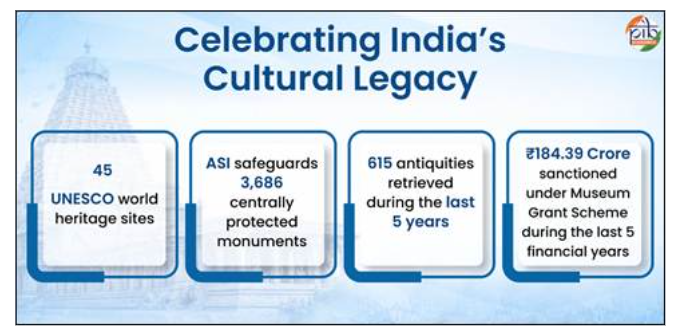
The Archaeological Survey of India (ASI) is the premier organisation for archaeological research and conservation of India’s cultural heritage. It functions through around 38 circles across the country and safeguards 3,686 centrally protected monuments. In FY 2024–25, ₹374 crore was allocated for conservation and maintenance of protected monuments. Over the last five years, ASI issued 121 permissions for archaeological projects.
Importance of ASI
- Conserves nationally important monuments.
- Conducts archaeological research.
- Supports scientific restoration.
- Protects heritage from decay and encroachment.
- Helps in heritage documentation and management.
2. National Mission on Monuments and Antiquities
The National Mission on Monuments and Antiquities (NMMA) is implemented by the ASI. It focuses on creating a comprehensive national database of monuments and antiquities for conservation planning and management. As of March 2026, it documented 1.84 lakh monuments and 17.20 lakh antiquities across India.
Significance
- Creates a national-level heritage database.
- Helps in tracking and protecting antiquities.
- Supports evidence-based conservation.
- Reduces risk of illegal trafficking and loss of heritage objects.
3. HRIDAY Scheme
The Heritage City Development and Augmentation Yojana (HRIDAY) aimed to integrate urban development with heritage conservation while preserving the unique character of heritage cities. It focused on water bodies, green spaces, smart technology, safety and local livelihoods through tourism. It covered 12 heritage cities and concluded on 31 March 2019.
Key Outcomes
- Improved cleanliness, tourism and community development in Ajmer, Amaravati and Badami.
- Promoted heritage revitalisation and economic growth in Amritsar, Gaya and Varanasi.
- Improved tourism infrastructure and public amenities in Warangal and Puri.
- Strengthened safety and urban infrastructure in Kancheepuram and Mathura.
- Advanced environmental sustainability and heritage conservation in Velankanni.
- Developed heritage zones and the Bet Dwarka Darshan Circuit in Dwarka.
What Steps are Being Taken to Reclaim Cultural Treasures?
India has intensified efforts to bring back sacred relics and antiquities taken abroad through colonial exploitation, foreign occupations and illegal trafficking.
Major Repatriation Achievements
- Piprahwa Relics of Lord Buddha returned in 2025 after 127 years.
- Goddess Annapurna idol repatriated from Canada in 2021 after 108 years.
- Rama, Sita and Lakshmana bronze idols returned from the UK in 2020.
- Sacred and cultural objects have also been returned from Australia, USA, UK, Germany, Singapore and Canada.
Repatriation of Antiquities
During the last five years, 615 antiquities were retrieved up to 30 June 2026. Some verified objects were handed over to organisations and institutions, including IGNCA, the National Museum and the Indian Institute of Heritage.
Significance
- Corrects historical injustice.
- Restores cultural pride.
- Strengthens India’s diplomatic efforts.
- Protects heritage from illegal trafficking.
- Reconnects sacred and cultural objects with their civilisational context.
How is India Using Sacred Relics for Cultural Diplomacy?
India has expanded the international exposition of sacred Buddha relics to strengthen civilisational and cultural ties.
Recent expositions include:
- Vietnam, 2025: Over 15 million devotees.
- Kalmykia, Russia, 2025: Over 90,000 visitors.
- Bhutan, 2025: Exposition during the Global Peace Prayer Festival.
- Sri Lanka, 2026: Exposition at Gangaramaya Temple, Colombo.
Domestic exhibitions were also organised in New Delhi and Ladakh in 2026, showcasing the reunited Piprahwa relics.
How are Museums and Cultural Infrastructure Being Strengthened?
1. Museum Grant Scheme
The Museum Grant Scheme provides financial assistance for establishing new museums and strengthening existing museums at regional, state and district levels. It supports modernisation, digitisation of collections and capacity building of museum professionals. It has also supported virtual museums, theme-based museums and Virtual Experiential Museums. In the last five financial years, ₹184.39 crore was sanctioned and ₹101.19 crore was utilised.
2. India’s First Archaeological Experiential Museum at Vadnagar
India’s first Archaeological Experiential Museum at Vadnagar, Gujarat combines history and excavation. It is spread over 12,500 square metres and built at a cost of ₹298 crore. It displays over 5,000 artefacts, including food grains, DNA samples and skeletal remains. It also includes a 4,000 sq. m. open excavation site showing remains at 16–18 metres depth.
Significance
- Makes archaeology accessible to the public.
- Promotes experiential learning.
- Helps students understand excavation-based history.
- Strengthens heritage tourism.
What is India’s Global Heritage Recognition?
India has expanded its global heritage recognition. It now has 45 UNESCO World Heritage Sites and hosted the 46th UNESCO World Heritage Committee Session in New Delhi in 2024.
Significance
- Enhances India’s global cultural profile.
- Promotes international tourism.
- Supports conservation standards.
- Strengthens India’s role in global heritage governance.
How is Digitisation Preserving India’s Knowledge Heritage?
1. Gyan Bharatam Mission
The Gyan Bharatam Mission was launched in 2025 to preserve, digitise and promote access to India’s manuscript heritage. It uses modern technologies for long-term preservation and global accessibility.
2. National Manuscript Survey
The National Manuscript Survey was launched in March 2026 to identify, document and create a national database of manuscripts. More than 1.19 crore manuscripts have been reported. Over 8 lakh manuscripts have been digitised across India, and more than 4.40 lakh manuscripts are available on the Gyan Bharatam portal. The mission has an approved outlay of ₹482.85 crore for 2024–31.
Significance
- Protects fragile manuscripts from physical loss.
- Expands public access to knowledge.
- Supports research in history, literature, religion and philosophy.
- Helps preserve India’s intellectual traditions.
How are Museum Collections Being Digitised?
The Ministry of Culture is digitising museum collections and archival resources through JATAN software, developed with technical support from C-DAC, Pune. A National Digital Repository has been created through the Museums of India portal. The portal hosts digitised collections from 8 National Level Museums, 2 ASI Site Museums and Dr. Babasaheb Ambedkar Museum, Pune. As on 15 July 2026, 3,75,707 artefacts out of 4,88,983 artefacts had been digitised and made available online.
Significance
- Improves public access to museum collections.
- Supports digital education.
- Helps in cataloguing and protection of artefacts.
- Reduces dependence on physical access alone.
What is the Role of Technology and AI in Heritage Conservation?
Modern technologies such as LiDAR scanning, GIS-based mapping and drone surveys are being used for heritage documentation and conservation. Artificial Intelligence is also being used to support digitisation, documentation and accessibility of cultural assets and heritage data.
AI-based Cultural Preservation
India is using AI to preserve languages, manuscripts and cultural heritage.
Important initiatives include:
- BHASHINI: Launched in 2022; supports 22 languages in voice and 36 languages in text, with more than 350 AI models and over 4 billion language transactions.
- BharatGen: Developing AI models for 22 Scheduled Languages.
- Adi-Vaani: AI-based platform for tribal languages such as Santali, Bhili, Mundari and Gondi.
- Platforms like Anuvadini, e-KUMBH, SPPEL, Sanchika and Gyan-Setu support multilingual education and traditional knowledge preservation.
- More than 5 crore learners are connected through digital education platforms such as SWAYAM.
Significance
- Supports linguistic diversity.
- Preserves tribal and endangered languages.
- Makes knowledge accessible in Indian languages.
- Strengthens inclusive education and cultural continuity.
What is the Vedic Heritage Portal?
The Vedic Heritage Portal was launched in March 2023 under the Indira Gandhi National Centre for the Arts (IGNCA). It aims to preserve, document and provide digital access to India’s Vedic knowledge traditions. It covers Rigveda, Yajurveda, Samaveda and Atharvaveda traditions, with more than 500 hours of recordings integrated into the platform.
The Tradition of Vedic Chanting is recognised as UNESCO Intangible Cultural Heritage, and Rigveda manuscripts are included in UNESCO’s Memory of the World Register.
How is India Conserving Cinematic Heritage?
1. National Film Heritage Mission
The National Film Heritage Mission (NFHM) was launched in 2015 to preserve, digitise and restore India’s cinematic heritage. It covers feature films, short films and documentaries across Indian languages. As of December 2025, 1,469 titles, equal to 4.3 lakh minutes of films, had been digitised.
2. National Museum of Indian Cinema
The National Museum of Indian Cinema (NMIC) was inaugurated in 2019 with a project cost of ₹140.61 crore. It showcases more than 100 years of Indian cinema through artefacts, vintage equipment, photographs, memorabilia, interactive exhibits and multimedia displays. It recorded over 17,000 visitors in May 2026.
What is the Significance of India’s Heritage Initiatives?
1. Strengthening Cultural Identity
These initiatives protect India’s civilisational memory and strengthen national identity.
2. Promoting Tourism
Improved infrastructure, visitor amenities and destination development increase tourism potential.
3. Supporting Local Economy
Heritage tourism creates livelihood opportunities for local guides, artisans, transport services and small businesses.
4. Improving Public Access
Digitisation makes manuscripts, museum collections and cultural resources available to students, researchers and citizens.
5. Strengthening Cultural Diplomacy
Repatriation of relics and global expositions of sacred objects strengthen India’s civilisational links with other countries.
6. Preserving Knowledge Systems
The Gyan Bharatam Mission, Vedic Heritage Portal and AI tools help preserve traditional knowledge, languages and manuscripts.
Challenges
- Physical decay of monuments due to age and environmental stress.
- Encroachment and urban pressure around heritage sites.
- Shortage of trained conservation professionals.
- Need for regular maintenance after project completion.
- Illegal trafficking of antiquities.
- Digital divide in accessing online heritage resources.
- Need for better coordination between Centre, States and local bodies.
- Balancing tourism promotion with heritage protection.
Way Forward
- Strengthen scientific conservation and regular maintenance of monuments.
- Expand digital documentation through GIS, LiDAR and drone mapping.
- Improve visitor amenities without damaging heritage character.
- Train local youth as heritage guides.
- Promote community participation in heritage protection.
- Strengthen anti-trafficking measures for antiquities.
- Integrate heritage conservation with urban planning.
- Promote multilingual digital platforms for inclusive access.
- Develop sustainable tourism models around heritage sites.
- Encourage schools and colleges to use heritage sites as learning spaces.
Conclusion
India’s cultural heritage is a living link between the past, present and future. Government initiatives in conservation, digitisation, tourism infrastructure, repatriation, museums, language preservation and cinematic heritage show a broad approach to safeguarding this legacy.the theme is important because heritage is not only about monuments. It is linked with identity, education, tourism, diplomacy, technology and local development. A sustainable heritage strategy must therefore combine preservation, public access, scientific conservation and community participation.
Why in News?
Recently, the Government highlighted India’s progress in strengthening its space sovereignty through reforms, private sector participation, start-up growth, satellite capabilities, launch systems, space applications and human spaceflight ambitions.
India’s space journey has moved from building basic capabilities to developing advanced and globally competitive space technologies. Reforms over the past decade have opened the sector to private enterprises, start-ups and global partnerships.
What is Space Sovereignty?
Space sovereignty means a country’s ability to independently develop, launch, operate and use space technologies for national development and strategic autonomy.
It includes:
- indigenous launch vehicles;
- satellite manufacturing and operations;
- space-based communication and navigation;
- Earth observation capability;
- human spaceflight;
- private sector innovation;
- independent policy and regulatory framework.
For India, space sovereignty is important because space technology supports agriculture, disaster management, communication, defence, navigation, climate monitoring, infrastructure planning and digital governance.
How is India’s Space Ecosystem Expanding?
India’s space sector has seen rapid expansion in recent years.
Key indicators:
- Registered space start-ups increased from 1 in 2014 to around 440 in 2026.
- India’s space economy is valued at USD 9 billion as of August 2026.
- It is projected to reach USD 40–45 billion in the next decade.
- Private investment rose from USD 100.5 million in 2021–22 to USD 618.5 million by March 2026.
- By mid-2026, 113 authorisations were granted to 52 Non-Government Entities, including 18 start-ups.
This reflects a shift from a largely government-led space programme to a broader national space ecosystem involving public agencies, private companies and start-ups.
What is the Earth Observation Public-Private Partnership?
The Earth Observation Public-Private Partnership (EO-PPP) is a public-private framework launched by IN-SPACe.
Its objective is to develop India’s first privately owned Earth observation satellite constellation. It combines government oversight with private industry participation and is backed by around ₹1,200 crore in private investment commitments.
Significance
- Encourages private investment in satellite systems.
- Improves Earth observation capabilities.
- Supports agriculture, disaster management, urban planning and climate monitoring.
- Reduces dependence on foreign satellite data.
What are the Major Space Sector Reforms?
1. Opening of Space Sector to Private Participation
India opened its space sector to private participation in 2020. This allowed industry and start-ups to participate in satellites, launch systems and space applications.
2. Indian Space Policy 2023
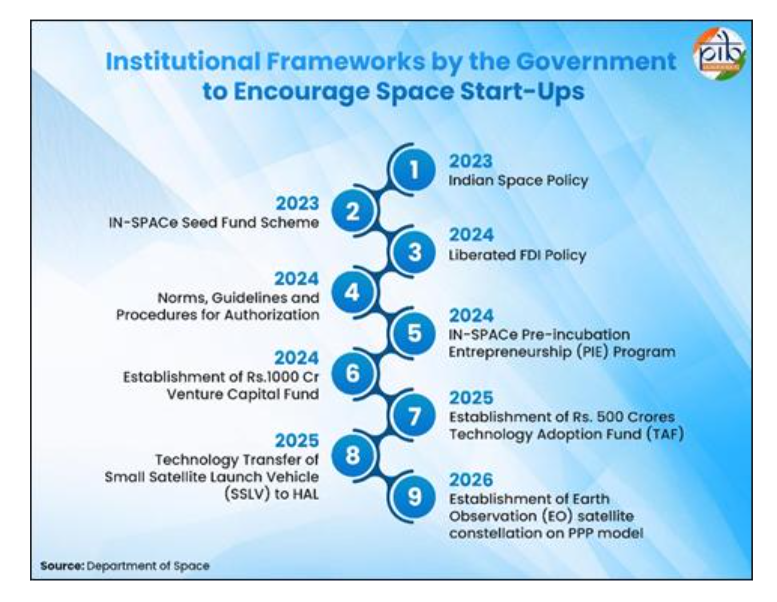
The Indian Space Policy 2023 expanded private participation across the space value chain. It defined the roles of NewSpace India Limited (NSIL) and Indian National Space Promotion and Authorisation Centre (IN-SPACe).
3. Role of NSIL
NSIL is the commercial arm of ISRO. It provides launch, satellite and space-based services and transfers ISRO technologies to Indian industry. Its revenue increased from ₹321.77 crore in FY 2021–22 to over ₹3,000 crore in FY 2024–25.
4. Role of IN-SPACe
IN-SPACe enables private space activities through a single-window mechanism. It facilitated technology transfers from ISRO to industry and start-ups.
5. Liberalised FDI Rules
In February 2024, FDI rules were liberalised for the space sector:
- Up to 74% FDI under automatic route for satellite manufacturing and operations.
- Up to 49% FDI for launch vehicles and spaceports.
- Up to 100% FDI for satellite and ground-segment components.
6. Norms, Guidelines and Procedures 2024
The NGP 2024 created transparent authorisation and compliance requirements. It improves regulatory predictability and ease of doing business.
7. Targeted Financing
Targeted financing is supporting the private space ecosystem through:
- IN-SPACe Seed Fund Scheme;
- ₹1,000 crore Venture Capital Fund;
- ₹500 crore Technology Adoption Fund;
- ₹75 crore Satellite Bus as a Service Scheme.
What are India’s Key Space Capabilities?
1. Indigenous Launch Vehicles
India has operationalised four indigenous launch vehicles:
- PSLV
- GSLV
- GSLV Mk III
- SSLV
These launch vehicles support Earth observation, communication, navigation, space science, exploration and commercial launches. During July 2023–June 2026, India completed 12 launch vehicle missions, carrying 11 national satellites and 9 satellites for international customers.
2. Expanding Launch Infrastructure
India is expanding launch infrastructure to meet national and commercial space demand.
Key developments:
- Sriharikota has two operational launch pads.
- A third launch pad is being established for next-generation launch vehicles.
- Kulasekarapattinam, Tamil Nadu is emerging as India’s second rocket launch site for SSLVs and private-sector launches.
3. Lunar Exploration
India’s lunar programme has achieved major milestones:
- Chandrayaan-1 (2008): Detected water molecules and hydroxyl on the lunar surface.
- Chandrayaan-2 (2019): Captured high-resolution lunar images from orbit.
- Chandrayaan-3 (2023): Made India the first country to soft-land near the Moon’s south pole and the fourth nation to soft-land on the Moon.
4. Mars, Sun and Deep Space Missions
India has expanded beyond lunar exploration:
- Mars Orbiter Mission: Inserted into Martian orbit on 24 September 2014 and operated for over eight years.
- AstroSat: India’s first dedicated astronomy mission.
- Aditya-L1: India’s first space-based solar mission, positioned near the Sun-Earth L1 point.
- XPoSat: Launched in January 2024 for X-ray polarisation astronomy.
- SPADEX: In January 2025, India became the fourth nation to demonstrate autonomous space docking and undocking.
5. NavIC
Navigation with Indian Constellation (NavIC) provides positioning, navigation and timing services across India and up to 1,500 km beyond India’s boundary. It strengthens navigation autonomy and supports civilian and strategic applications.
NavIC is being integrated into:
- power-grid synchronisation;
- real-time train tracking;
- Aadhaar geo-tagging;
- mobile chipsets.
What are India’s Future Space Missions?
1. Gaganyaan
The Gaganyaan human spaceflight programme was approved in January 2019. Its scope was expanded in September 2024 to a total outlay of ₹20,193 crore, covering eight total missions.
Objectives:
- launch a crew of 3 Indian astronauts;
- place them in a 400-km orbit;
- conduct a three-day mission;
- first uncrewed experimental mission targeted in Q4 of 2026;
- crewed mission targeted by 2027.
2. Bharatiya Antariksh Station
India is planning a five-module Bharatiya Antariksh Station (BAS).
Key targets:
- BAS-01 planned for launch by 2028;
- full operationalisation targeted by 2035;
- support for long-duration human spaceflight, microgravity research and advanced space operations.
3. Chandrayaan-4 and Chandrayaan-5/LUPEX
Future lunar missions include:
- Chandrayaan-4: To demonstrate lunar sample collection, ascent from lunar surface and sample return to Earth; planned timeline 2027.
- Chandrayaan-5/LUPEX: Joint ISRO-JAXA mission to study lunar volatiles near the Moon’s south polar region.
4. Venus Orbiter Mission
The Venus Orbiter Mission is targeted for launch in March 2028. It will study Venus’ geology, atmosphere and ionosphere and demonstrate aerobraking and thermal-management technologies.
What Advanced Technologies are Shaping India’s Space Future?
India is developing advanced technologies for next-generation space capabilities.
Key technologies include:
- 200-tonne thrust semi-cryogenic engine;
- semi-cryogenic booster stage for LVM3;
- booster recovery using Vertical Take-off and Vertical Landing technology;
- partially reusable Next Generation Launch Vehicle using LOX-Methane propulsion;
- winged orbital re-entry vehicle for the Reusable Launch Vehicle programme;
- air-breathing propulsion technology.
Significance
These technologies can:
- increase payload capacity;
- reduce launch costs;
- support reusable launch systems;
- improve India’s competitiveness in the global launch market;
- support long-term human spaceflight and deep-space missions.
What is the Significance of India’s Space Push?
1. Strengthens Strategic Autonomy
Indigenous launch vehicles, NavIC and satellite systems reduce dependence on foreign technologies.
2. Expands Space Economy
Start-ups, private investment and commercialisation through NSIL are expanding India’s space economy.
3. Supports National Development
Space applications support agriculture, weather forecasting, disaster management, communication, transport and governance.
4. Enhances Global Standing
Foreign satellite launches increased from 35 before 2014 to 399 as of January 2026, showing India’s growing role as a global launch service provider. India also has more than 300 space cooperation agreements across 61 countries and 5 multilateral organisations.
5. Promotes Innovation
Private participation, start-up growth and funding mechanisms encourage innovation across satellites, launch systems and applications.
6. Builds Human Spaceflight Capability
Gaganyaan, Axiom-4 experience, Bharatiya Antariksh Station and docking experiments are creating the foundation for sustained human presence in space.
What are the Key Challenges?
- High cost of advanced space missions.
- Need for stronger private-sector manufacturing capacity.
- Dependence on critical technologies and components.
- Requirement of robust space regulation and liability frameworks.
- Rising global competition in the launch market.
- Need for skilled human resources.
- Space debris and orbital traffic management concerns.
- Cybersecurity risks for satellite systems.
- Balancing commercial growth with national security.
Way Forward
- Strengthen domestic manufacturing of critical space components.
- Encourage start-ups through predictable regulation and funding.
- Expand public-private partnerships in satellites, launch vehicles and applications.
- Improve space situational awareness and debris management.
- Promote NavIC adoption in civilian and strategic sectors.
- Build stronger university-industry-ISRO research linkages.
- Ensure timely execution of Gaganyaan, BAS and lunar missions.
- Strengthen international cooperation while protecting strategic autonomy.
- Develop skilled manpower for space science, engineering and policy.
Conclusion
India’s space programme is entering a new phase. It is no longer limited to government-led missions but now includes private enterprises, start-ups, commercial services, international partnerships and human spaceflight ambitions.
India’s space sovereignty should be understood as a combination of self-reliance, strategic autonomy, innovation, private participation and global leadership. With reforms, indigenous capabilities and ambitious future missions, India is moving towards becoming a major global space power.