Relevance: APPSC: Andhra Pradesh Fisheries, Fishermen Welfare, Coastal Development
For Prelims:
- Satellite Transponder | PM Matsya Sampada Yojana | SOS Alert | Fishermen Safety | Blue Economy
For Mains:
- Coastal livelihood security | Disaster preparedness | Technology-enabled governance | Marine safety | Fisheries welfare
Why in News?
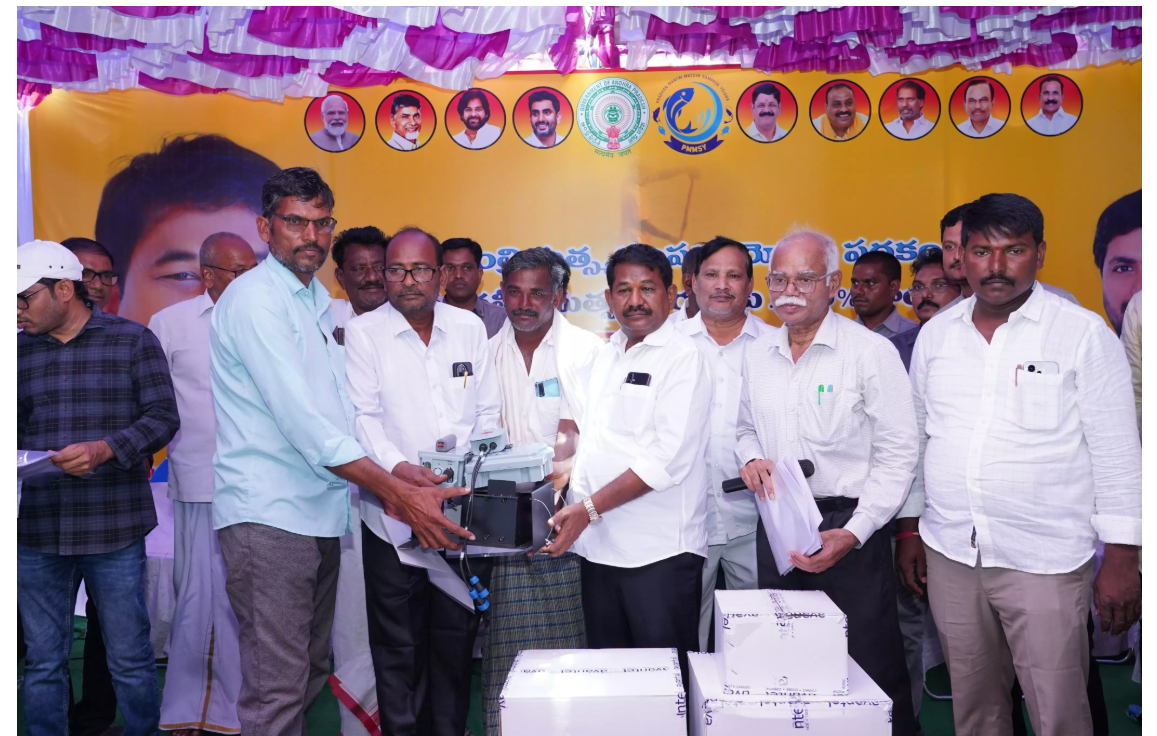
The Andhra Pradesh government is distributing free satellite transponders to fishermen under the Pradhan Mantri Matsya Sampada Yojana. The devices were distributed at Singarayakonda to improve fishermen’s safety by providing weather alerts, SOS services and emergency rescue support while they are at sea.
What are Satellite Transponders?
- A satellite transponder is a communication device fitted on fishing boats to help track and communicate with fishermen at sea.
- In this initiative, the device is connected to fishermen’s smartphones through Bluetooth. It helps them receive alerts and send emergency messages even when they are away from the shore.
Features of the Initiative
| Feature | Details |
| State | Andhra Pradesh |
| Beneficiaries | Fishermen operating at sea |
| Scheme Linkage | Pradhan Mantri Matsya Sampada Yojana |
| Device | Satellite transponder fitted on boats |
| Connectivity | Connected to smartphone through Bluetooth |
| Main Use | Weather alerts, SOS messages and rescue assistance |
| Emergency Link | SOS messages sent to control rooms |
How the System Helps Fishermen
The satellite transponders can help fishermen in four major ways.
1. Weather and Cyclone Alerts
Fishermen can receive warnings about adverse weather conditions, cyclones and sea-related risks, helping them return to safety in time.
2. SOS Emergency Assistance
During accidents or distress situations, fishermen can send SOS messages directly to control rooms for rescue support.
3. Prevention of Accidental Border Crossing
The devices can alert fishermen when they accidentally move towards neighbouring countries’ waters, reducing the risk of detention or legal complications.
4. Faster Rescue Coordination
Since the system is trackable, rescue teams can identify the boat’s location more easily and respond faster.
Welfare Measures for Fishermen
The State government also highlighted several welfare measures for fishing communities.
| Measure | Purpose |
| ₹20,000 assistance during fishing ban period | Income support when fishing activity is restricted |
| Pensions from 50 years of age | Social security for older fishermen |
| Subsidised nets and boats | Support for fishing livelihood |
| Quality life jackets | Physical safety at sea |
| Support for missing fishermen’s families | Faster death certificates, pensions and accident assistance |
| Dedicated diesel bunks | Easier access to fuel subsidy |
| Modern fish market at Singarayakonda | Better marketing infrastructure |
| Permanent housing for local Yanadi community | Social welfare and housing security |
| Fisheries development boards at Visakhapatnam and Bhimavaram | Strengthening fisheries and aquaculture sectors |
Conclusion
The distribution of satellite transponders to fishermen in Andhra Pradesh is an important step towards safer and technology-enabled fishing. By providing weather alerts, SOS communication and border-warning support, the initiative can reduce risks at sea and improve rescue response. However, its success depends on training, device maintenance, effective control rooms and inclusion of small fishermen. When combined with welfare measures such as ban-period assistance, pensions, subsidised equipment, life jackets and market infrastructure, it can strengthen both marine safety and coastal livelihood security.
CARE MCQ
Q. Consider the following statements regarding the satellite transponder initiative for fishermen in Andhra Pradesh:
- The devices are intended to provide weather alerts and SOS support to fishermen at sea.
- They are connected to fishermen’s smartphones through Bluetooth.
- The initiative is linked with the Pradhan Mantri Matsya Sampada Yojana.
- The devices are meant only for inland farmers and not for fishermen.
Which of the statements given above are correct?
(a) 1, 2 and 3 only
(b) 1 and 4 only
(c) 2, 3 and 4 only
(d) 1, 2, 3 and 4
Answer: (a) 1, 2 and 3 only
Explanation
Statements 1, 2 and 3 are correct. The satellite transponders provide alerts and SOS support, connect with smartphones through Bluetooth, and are being distributed under PM Matsya Sampada Yojana.
Statement 4 is incorrect because the devices are meant for fishermen operating at sea, not inland farmers.
FAQs
1. Why are satellite transponders being distributed to fishermen?
They are being distributed to provide weather alerts, SOS services and emergency assistance at sea.
2. Which State launched this initiative?
Andhra Pradesh.
3. Under which scheme are the devices being distributed?
Under the Pradhan Mantri Matsya Sampada Yojana.
4. How do the devices connect with fishermen?
They are fitted on boats and connected to fishermen’s smartphones through Bluetooth.
5. What is the SOS feature used for?
It helps fishermen send emergency messages to control rooms for rescue assistance.
6. How can the devices prevent legal problems?
They can alert fishermen about accidental entry into neighbouring countries’ waters.
7. What welfare support is provided during the fishing ban period?
Fishermen receive ₹20,000 assistance during the fishing ban period.
Relevance: UPSC GS Paper II: Government Policies, Industrial Development, Employment Generation UPSC GS Paper III: Textile Sector, Manufacturing, Infrastructure, Exports, MSMEs
For Prelims:
- PM MITRA Parks | 5F Vision | Special Purpose Vehicle | Competitiveness Incentive Support | Textile Value Chain
For Mains:
- Integrated manufacturing | Textile exports | Employment generation | Industrial infrastructure | Economies of scale
Why in News?
The Ministry of Textiles informed the Lok Sabha that the Government has approved 7 PM Mega Integrated Textile Region and Apparel Parks with a total scheme outlay of ₹4,445 crore for the period 2021-22 to 2027-28.
The Government stated that MoUs have been signed with all seven States, 100% land has been acquired or made available, environmental clearances have been received, and DPRs worth ₹13,537 crore have been finalised. Investment interest worth ₹68,590 crore has been received from PM MITRA States.
What is PM MITRA?
- PM MITRA stands for PM Mega Integrated Textile Region and Apparel.
- It is a scheme to create large-scale, integrated and modern textile industrial parks covering the complete textile value chain.
- The idea is to provide common infrastructure, plug-and-play facilities, logistics, worker support and industrial services in one location.
- The scheme aims to make India’s textile industry more competitive by reducing logistics cost, improving scale, attracting investment and generating employment.
Objectives of the Scheme
1. Integrated Textile Ecosystem
PM MITRA seeks to bring spinning, weaving, processing, dyeing, printing, garmenting and exports closer within a single industrial ecosystem.
2. Large-Scale Industrial Infrastructure
The parks will provide developed factory sites, roads, water, power, waste-water systems, Common Effluent Treatment Plants and testing facilities.
3. Employment Generation
Each PM MITRA Park is expected to generate around 3 lakh jobs, including 1 lakh direct and 2 lakh indirect employment opportunities.
4. Global Competitiveness
By creating economies of scale, the scheme aims to help Indian textile companies become global champions.
5. Investment Promotion
The parks are expected to attract large domestic and foreign investments in textile manufacturing and apparel exports.
Location of the Seven PM MITRA Parks
| State | Location | Park Type |
| Tamil Nadu | Virudhnagar | Greenfield |
| Telangana | Warangal | Brownfield |
| Gujarat | Navsari | Greenfield |
| Karnataka | Kalaburagi | Greenfield |
| Madhya Pradesh | Dhar | Greenfield |
| Uttar Pradesh | Lucknow | Greenfield |
| Maharashtra | Amravati | Brownfield |
| Greenfield: Government selects a new area and develops roads, power, water, factories, warehouses and textile-processing facilities from scratch.Brownfield: An area already has textile industries and infrastructure. The government expands and modernises it by adding better roads, common processing facilities, warehouses, etc. |
Current Progress of PM MITRA Parks
| State | Park Type | Land Available / Acquired | Investment Interest | State Expenditure Incurred |
| Madhya Pradesh | Greenfield | 2,158 acres | ₹19,846 crore | ₹94.06 crore |
| Tamil Nadu | Greenfield | 1,052 acres | ₹2,067.90 crore | ₹34.80 crore |
| Gujarat | Greenfield | 1,000 acres | ₹13,094 crore | ₹196.22 crore |
| Karnataka | Greenfield | 1,142 acres | ₹1,700 crore | ₹95.39 crore |
| Uttar Pradesh | Greenfield | 1,000 acres | ₹5,354 crore | ₹220.69 crore |
| Telangana | Brownfield | 1,020 acres | ₹3,800 crore | ₹123.93 crore |
| Maharashtra | Brownfield | 1,327 acres | ₹12,000 crore | ₹32.21 crore |
Overall Status
- MoUs signed with all States.
- Full land availability achieved for all seven sites.
- Environmental clearances received for all parks.
- Joint Venture Agreements signed for all 5 Greenfield sites.
- SPVs incorporated for all 5 Greenfield sites.
- DPRs worth ₹13,537 crore finalised for all seven States.
- Investment interests worth ₹68,590 crore received so far.
Infrastructure Components
PM MITRA Parks will contain both core infrastructure and support infrastructure.
Core Infrastructure
| Component | Purpose |
| Incubation Centre | Supports new firms, startups and design-led innovation |
| Plug-and-Play Facility | Allows units to start production faster |
| Developed Factory Sites | Reduces project setup time |
| Roads, Power and Water | Provides basic industrial infrastructure |
| Waste-Water System | Supports environmental compliance |
| Common Processing House | Enables shared processing facilities |
| Common Effluent Treatment Plant | Helps manage textile pollution |
| Design and Testing Centres | Improves product quality and competitiveness |
Support Infrastructure
| Component | Purpose |
| Workers’ Hostels and Housing | Supports labour welfare |
| Logistics Park | Reduces transport cost |
| Warehousing | Improves storage and supply chain efficiency |
| Medical Facilities | Provides health support for workers |
| Training and Skill Centres | Builds skilled manpower for textile units |
Land Use Pattern
PM MITRA Parks will follow a planned land-use model.
| Area Use | Share of Park Area |
| Manufacturing Activity | 50% |
| Utilities | 20% |
| Commercial Development | 10% |
This land-use pattern is intended to balance production, common services and commercial activities within the park.
Implementation Model
PM MITRA Parks will be developed through a Special Purpose Vehicle.
Key Features
- The SPV will be owned by the State Government and Government of India.
- It will operate in Public Private Partnership mode.
- The State Government will have majority ownership in the SPV.
- A Master Developer will be selected through objective criteria jointly developed by the Centre and State.
- The Master Developer will develop the industrial park and maintain it during the concession period.
The SPV will receive part of the lease rental from developed industrial sites. This revenue can be used for further expansion of the textile park, skill development and worker welfare.
Competitiveness Incentive Support
The Government of India will provide ₹300 crore for each PM MITRA Park to incentivise manufacturing units.
This support is called Competitiveness Incentive Support.
Main Features
- It is meant for newly established units in PM MITRA Parks.
- It will be paid up to 3% of turnover.
- It supports units during the early stage before they achieve viability.
- It helps reduce the initial business risk of textile manufacturing units.
This incentive can encourage firms to invest in large-scale textile manufacturing within the parks
5F Vision and Textile Value Chain
PM MITRA is inspired by the Prime Minister’s 5F Vision.
| 5F Component | Meaning |
| Farm | Cotton and other raw material production |
| Fibre | Conversion of raw material into fibre |
| Factory | Textile manufacturing and processing |
| Fashion | Apparel design and garmenting |
| Foreign | Export to international markets |
The Farm to Fibre to Factory to Fashion to Foreign approach links agriculture, manufacturing, design and exports into one integrated value chain.
Significance of PM MITRA Parks
1. Boost to Textile Manufacturing
Large integrated parks can reduce fragmentation in the textile sector and create modern industrial clusters.
2. Employment Generation
With each park expected to generate around 3 lakh jobs, the scheme can support labour-intensive manufacturing.
3. Export Competitiveness
Integrated infrastructure, testing centres, logistics parks and scale can help Indian textiles compete better in global markets.
4. Regional Industrial Development
The seven parks are spread across different States, promoting balanced regional growth.
5. Support to MSMEs
Plug-and-play infrastructure and common facilities can help smaller textile units reduce capital burden.
6. Environmental Management
Common Effluent Treatment Plants and waste-water systems can support cleaner textile processing.
7. Women’s Employment Potential
Textile and apparel sectors traditionally create significant employment opportunities for women, especially in garmenting and allied services.
Challenges
1. Timely Execution
Large industrial parks require quick completion of infrastructure, clearances and investor onboarding.
2. Land and Local Livelihood Concerns
Even when land is available, local communities must be included through fair compensation, jobs and welfare measures.
3. Environmental Compliance
Textile processing involves water use, dyes and effluents. Strong monitoring of CETPs is essential.
4. Global Competition
India faces competition from countries with large-scale textile exports and low production costs.
5. Skill Gap
Modern textile parks need trained workers in design, machinery, processing, logistics and quality control.
6. MSME Inclusion
The parks should not become only large-company zones; smaller units and local entrepreneurs must also benefit.
Way Forward
1. Complete Infrastructure on Time
Roads, power, water, CETPs, logistics and factory sites should be made operational quickly.
2. Strengthen Skill Development
Training centres should focus on modern textile machinery, apparel design, quality control, exports and digital production systems.
3. Promote MSME Linkages
Local MSMEs, weavers, garment units and service providers should be connected to the parks through vendor networks.
4. Ensure Environmental Safeguards
CETPs, water recycling and waste-management systems must be monitored through transparent compliance mechanisms.
5. Attract Anchor Investors
Large anchor units can bring supply chains, employment and export networks to each park.
6. Use Scheme Convergence
PM MITRA should be linked with logistics, skilling, MSME, export promotion and State industrial policies.
7. Build Global Branding
India should use the parks to promote itself as a reliable textile manufacturing and apparel export hub.
Conclusion
The PM MITRA Mega Textile Parks scheme is a major step towards transforming India’s textile sector from fragmented production to integrated, large-scale and globally competitive manufacturing. By combining core infrastructure, worker facilities, plug-and-play systems, SPV-based implementation and Competitiveness Incentive Support, the scheme can attract investment and generate employment. However, its success will depend on timely execution, environmental safeguards, MSME inclusion, skill development and export-oriented planning. If implemented effectively, PM MITRA can convert India’s traditional textile strength into a modern industrial and export advantage.
UPSC PYQ
Q. Which one of the following statements is correct about the PM-MITRA Scheme?
(CDS-I, 2026)
(A) Its goal is to develop at least one energy park in every State of India.
(B) It aims at developing integrated textile parks in India.
(C) Its goal is to open employment parks in every district of India.
(D) It aims at opening agro parks in India.
Answer: (B) It aims at developing integrated textile parks in India.
Explanation:
PM MITRA stands for PM Mega Integrated Textile Region and Apparel Parks. It is implemented by the Ministry of Textiles to develop integrated textile and apparel parks in India.
Q. PM MITRA Parks relate to which one of the following industries?
( NDA-I, 2026 )
(A) Automobile
(B) Shipbuilding
(C) Textile
(D) Pottery
Answer: (C) Textile
Explanation:
PM MITRA Parks are related to the textile and apparel industry. They aim to provide integrated infrastructure for different stages of textile production.
CARE MCQ
Q. Consider the following statements regarding PM MITRA Parks:
- PM MITRA stands for PM Mega Integrated Textile Region and Apparel.
- The scheme has approved seven textile parks across Greenfield and Brownfield sites.
- PM MITRA is inspired by the 5F vision: Farm to Fibre to Factory to Fashion to Foreign.
- The scheme is limited only to software parks and has no link with the textile sector.
Which of the statements given above are correct?
(a) 1, 2 and 3 only
(b) 1 and 4 only
(c) 2, 3 and 4 only
(d) 1, 2, 3 and 4
Answer: (a) 1, 2 and 3 only
Explanation
Statements 1, 2 and 3 are correct. PM MITRA relates to integrated textile parks and is based on the 5F textile value-chain vision.
Statement 4 is incorrect because PM MITRA is directly related to the textile and apparel sector, not software parks.
FAQs
1. What is PM MITRA?
PM MITRA stands for PM Mega Integrated Textile Region and Apparel.
2. How many PM MITRA Parks have been approved?
Seven PM MITRA Parks have been approved.
3. What is the total scheme outlay?
The scheme outlay is ₹4,445 crore for 2021-22 to 2027-28.
4. Where are the seven parks located?
They are located in Tamil Nadu, Telangana, Gujarat, Karnataka, Madhya Pradesh, Uttar Pradesh and Maharashtra.
5. Which Telangana location has been selected?
Warangal has been selected for the Telangana PM MITRA Park.
6. What is the 5F vision?
It means Farm to Fibre to Factory to Fashion to Foreign.
7. What is Competitiveness Incentive Support?
It is financial support of ₹300 crore per park to incentivise new manufacturing units, paid up to 3% of turnover.
8. How many jobs can each park generate?
Each park is expected to generate around 3 lakh jobs, including 1 lakh direct and 2 lakh indirect jobs.
Relevance: UPSC GS Paper II: Constitution, Reservation Policy, Social Justice, Judiciary, Welfare of Vulnerable Sections
For Prelims:
- Creamy Layer | Indra Sawhney Case | Articles 341 and 342 | Davinder Singh Judgment | Article 32
For Mains:
- Historical disadvantage | Sub-categorisation | Social justice | Separation of powers | Reservation equity
Why in News?
The Union government has opposed petitions in the Supreme Court seeking the introduction of the creamy layer concept in Scheduled Caste and Scheduled Tribe reservations.The Centre has argued that the historical disadvantages faced by SCs and STs cannot be treated as ordinary economic backwardness. It has also maintained that any change in reservation policy must be based on a holistic review, empirical data and legislative mandate, not judicial direction.
What is Creamy Layer?
- Creamy layer refers to relatively advanced individuals within a reserved category who are excluded from reservation benefits.
- The concept was developed for OBC reservations after the Indra Sawhney judgment, 1992. It is based on the idea that socially and economically advanced sections among OBCs should not corner benefits meant for genuinely backward groups.
Creamy layer identification generally considers factors such as:
- parents holding senior constitutional or government posts
- high-ranking service positions
- income and wealth thresholds
- social and educational advancement
At present, the creamy layer rule applies to OBCs, not to SC/ST reservations.
What is Sub-Categorisation?
- Sub-categorisation means dividing an existing reserved category into smaller internal groups to ensure fairer distribution of reservation benefits.
- It does not remove any community from the reservation list. Instead, it reorganises the existing quota so that communities that are more backward within a reserved category are not crowded out by relatively better-represented groups.
Creamy Layer vs Sub-Categorisation
| Aspect | Creamy Layer | Sub-Categorisation |
| Basic idea | Excludes advanced individuals from reservation benefits | Divides quota among internal groups |
| Focus | Individual or family-level advancement | Group-level unequal access |
| Effect | Removes certain persons from availing quota | Redistributes benefits within the quota |
| Current application | Mainly OBCs | Used for OBCs, SCs and STs in some contexts |
| Purpose | Prevent advanced individuals from cornering benefits | Ensure benefits reach the most deprived groups |
| SC/ST debate | Opposed by Centre | Allowed in principle by Supreme Court |
Background: From Indra Sawhney to Davinder Singh
1. Indra Sawhney Judgment, 1992
The Supreme Court upheld OBC reservations and introduced the creamy layer principle for OBCs. The Court held that advanced sections within OBCs should be excluded to ensure that benefits reach the intended backward sections.
However, the judgment confined creamy layer exclusion to OBCs and did not apply it to SC/ST reservations.
2. Earlier State-Level Sub-Categorisation
Even before the national OBC classification, several States recognised internal inequalities among backward communities. States such as Andhra Pradesh, Tamil Nadu and Maharashtra divided backward class quotas into smaller shares to ensure equitable representation.
3. Davinder Singh Judgment, 2024
In August 2024, a seven-judge Constitution Bench of the Supreme Court recognised heterogeneity and graded backwardness within SC/ST communities. It allowed State governments to undertake sub-categorisation within SC/ST lists so that the most disadvantaged communities could receive fair access to reservation benefits.
However, some observations in the judgment suggested that the government may consider creamy layer exclusion for SC/STs. This triggered fresh petitions before the Supreme Court.
Centre’s Position Before the Supreme Court
- The Centre has opposed the demand to introduce creamy layer exclusion in SC/ST quotas.
- The petition before the Supreme Court argued that affluent families within SC/ST categories are monopolising reservation benefits and causing “elite capture”. It sought income-based preferences across reserved categories.
The Centre rejected this approach and argued that:
- SC/ST disadvantage is not merely economic.
- SCs face historical disadvantage rooted in untouchability.
- STs are identified through distinct cultures, geographical isolation and backwardness.
- Reservation for SC/STs aims at social equality, justice and inclusive participation in public life.
- Discrimination against SCs and STs does not operate only on the basis of income.
Why Centre Opposes Creamy Layer for SC/STs
1. Historical Disadvantage is Different from Economic Backwardness
The Centre has argued that SC/ST reservations are rooted in historical oppression, social stigma, untouchability, exclusion and geographical isolation. These disadvantages may continue even when an individual or family gains some economic mobility.
2. SC/ST Reservation Serves a Broader Social Justice Purpose
The objective is not only poverty alleviation but also representation, dignity, equality and participation in public institutions.
3. Economic Criteria Alone May Be Insufficient
A purely income-based test may fail to capture caste stigma, social discrimination and structural exclusion.
4. Parliament Has the Final Authority
The Centre has maintained that any exclusion affecting SC/ST lists or reservation entitlements must be decided by Parliament.
5. Courts Cannot Direct a Policy Change Merely Because an Alternative Seems Better
The government has argued that courts cannot compel the executive to adopt a particular reservation policy simply on the ground that another option appears fairer or wiser.
Legal and Constitutional Basis of Centre’s Argument
1. Article 32 and Maintainability
The Centre has argued that the petition is not maintainable under Article 32 because it does not demonstrate a violation of fundamental rights.
2. Articles 341 and 342
Under Articles 341 and 342, the President notifies the initial lists of Scheduled Castes and Scheduled Tribes. Once notified, any inclusion or exclusion from these lists can be done only by an Act of Parliament.
3. Indra Sawhney Case, 1992
The Centre has relied on the position that creamy layer exclusion was introduced for OBCs and has no automatic relevance to SC/ST reservations.
4. Ashoka Kumar Thakur Case, 2008
The Centre referred to the ruling that the creamy layer principle does not apply to SCs and STs.
5. E.V. Chinnaiah Case, 2005
The Centre cited the principle that if a situation ever arises requiring exclusion of creamy layer within SCs, the legislative step must come from Parliament.
Reservation policy involves social data, political 6. Separation of Powers
judgment and legislative design. Therefore, the Centre argues that courts should not replace Parliament or the executive in framing policy.
Where Creamy Layer Applies and Where Sub-Categorisation is Used
Creamy Layer Application
| Category | Position |
| OBCs | Creamy layer exclusion applies after Indra Sawhney |
| EWS | Uses income and asset exclusion criteria, though not called creamy layer in the same sense |
| SC/STs | Creamy layer exclusion does not currently apply |
Sub-Categorisation Usage
Sub-categorisation has been used more widely than creamy layer exclusion.
Examples include:
- SC sub-categorisation debates in States such as Telangana, Haryana and Punjab
- ST quota sub-categorisation in some States such as Mizoram
- OBC sub-categorisation by several State governments
- Minimum representation for PVTGs within ST quota in Eklavya Model Residential School admissions
Significance of the Debate
1. Internal Equity Within Reservation
The debate highlights whether benefits are reaching the most disadvantaged sections within reserved categories.
2. Protection of Constitutional Safeguards
It raises concern that creamy layer exclusion may dilute protections meant for historically oppressed communities.
3. Limits of Income-Based Reservation
The issue shows that economic weakness and social discrimination are not identical.
4. Federal Dimension
States seek flexibility to address local caste realities through sub-categorisation.
5. Judicial-Executive Balance
The issue tests the boundary between judicial review and policy-making.
Challenges
1. Lack of Updated Empirical Data
Reliable data is needed to determine who is being crowded out and which communities remain under-represented.
2. Risk of Social Fragmentation
Internal categorisation can create tensions within reserved communities.
3. Complexity of Measuring Social Disadvantage
Caste stigma, untouchability and exclusion cannot be captured by income alone.
4. Implementation Difficulty
Sub-categorisation requires clear criteria, legal clarity and administrative capacity.
5. Politicisation of Reservation
Reservation debates often become politically polarised, making consensus difficult.
Way Forward
1. Evidence-Based Review
Any change in reservation policy should be preceded by a holistic review and socio-economic data on reserved category beneficiaries.
2. Protect SC/ST Safeguards
Reform must not weaken the constitutional purpose of SC/ST reservations, which is rooted in historical discrimination.
3. Use Sub-Categorisation Carefully
Sub-categorisation may be used where evidence shows that certain communities are consistently excluded from benefits.
4. Clarify Legal Boundaries
Parliament, States and courts should clearly define the limits of sub-categorisation and creamy layer exclusion.
5. Strengthen Support Beyond Quotas
Scholarships, hostels, coaching, anti-discrimination enforcement and quality schooling are necessary to make reservation effective.
6. Ensure Social Consensus
Major reservation reforms require consultation with affected communities, State governments and constitutional bodies.
Conclusion
The debate on creamy layer in SC/ST reservations is not simply about income-based exclusion. SC/ST reservations are rooted in histories of untouchability, social stigma, exclusion, geographical isolation and under-representation. While the Davinder Singh judgment has allowed sub-categorisation to address unequal access within SC/ST groups, the Centre has opposed creamy layer exclusion on constitutional, social and institutional grounds. The balanced approach is to protect the core purpose of SC/ST reservations while using data-backed sub-categorisation and targeted welfare to ensure that the most disadvantaged communities are not crowded out. Social justice must be made more effective, not diluted.
CARE MCQ
Q. Consider the following statements regarding creamy layer and SC/ST reservations:
- The creamy layer concept was introduced for OBC reservations through the Indra Sawhney judgment.
- The Centre has argued that SC/ST disadvantage cannot be equated with mere economic backwardness.
- Articles 341 and 342 relate to the notification of Scheduled Castes and Scheduled Tribes.
- Creamy layer exclusion currently applies automatically to SC/ST reservations.
Which of the statements given above are correct?
(a) 1, 2 and 3 only
(b) 1 and 4 only
(c) 2, 3 and 4 only
(d) 1, 2, 3 and 4
Answer: (a) 1, 2 and 3 only
Explanation
Statements 1, 2 and 3 are correct. Creamy layer emerged from Indra Sawhney for OBCs; the Centre argues that SC/ST disadvantage is not merely economic; and Articles 341 and 342 deal with SC/ST lists.
Statement 4 is incorrect because creamy layer exclusion does not currently apply automatically to SC/ST reservations.
FAQs
1. Why is creamy layer for SC/STs in news?
Because the Centre has opposed petitions in the Supreme Court seeking creamy layer exclusion in SC/ST reservations.
2. What is creamy layer?
It refers to advanced individuals within a reserved category who are excluded from reservation benefits.
3. Which category currently has creamy layer exclusion?
It applies mainly to OBC reservations.
4. What is the Centre’s main argument?
SC/ST disadvantage is historical and social, not merely economic.
5. What are Articles 341 and 342?
They deal with the notification of Scheduled Castes and Scheduled Tribes.
6. What did Davinder Singh judgment allow?
It allowed States to undertake sub-categorisation within SC/ST lists.
7. Is sub-categorisation the same as creamy layer?
No. Sub-categorisation redistributes quota internally; creamy layer excludes certain individuals.