Why in News?
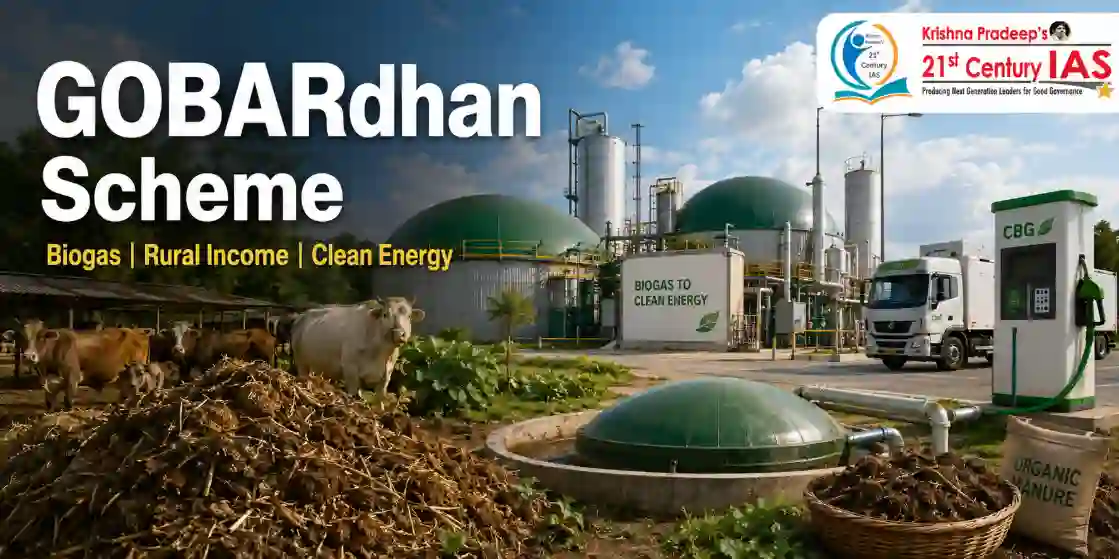
The Union Cabinet has approved GOBARdhan, the National Circular Bioenergy Scheme, with an outlay of ₹23,731 crore for implementation over 10 years from 2026-27 to 2035-36.
The scheme aims to boost Compressed Biogas production in India by nearly 10 times and make CBG projects commercially viable through assured offtake, stable pricing, capital subsidies, credit support and pipeline infrastructure.
About GOBARdhan Scheme
GOBARdhan stands for Galvanising Organic Bio-Agro Resources Dhan. It is to be implemented by the Ministry of Petroleum and Natural Gas.
The scheme seeks to convert India’s organic waste resources into useful economic and energy assets. These include:
- agricultural residue
- cattle dung
- press mud
- municipal organic waste
- other biomass resources
The broader objective is to convert the waste burden into clean fuel, organic manure, rural income and national economic value.
What is Compressed Biogas?
- Biogas is produced from organic waste. It generally contains 55-65% methane, 35-44% carbon dioxide, and small traces of gases such as hydrogen sulphide, nitrogen and ammonia.
- In its raw form, biogas can be used for cooking, lighting, motive power and electricity generation. When biogas is purified and upgraded to nearly 98% methane, and compressed at high pressure, it becomes Compressed Biogas.
- CBG has properties similar to Compressed Natural Gas. Therefore, it can be used in transport, industry and commercial sectors, either as a replacement for CNG or by blending with CNG.
How CBG is Produced?
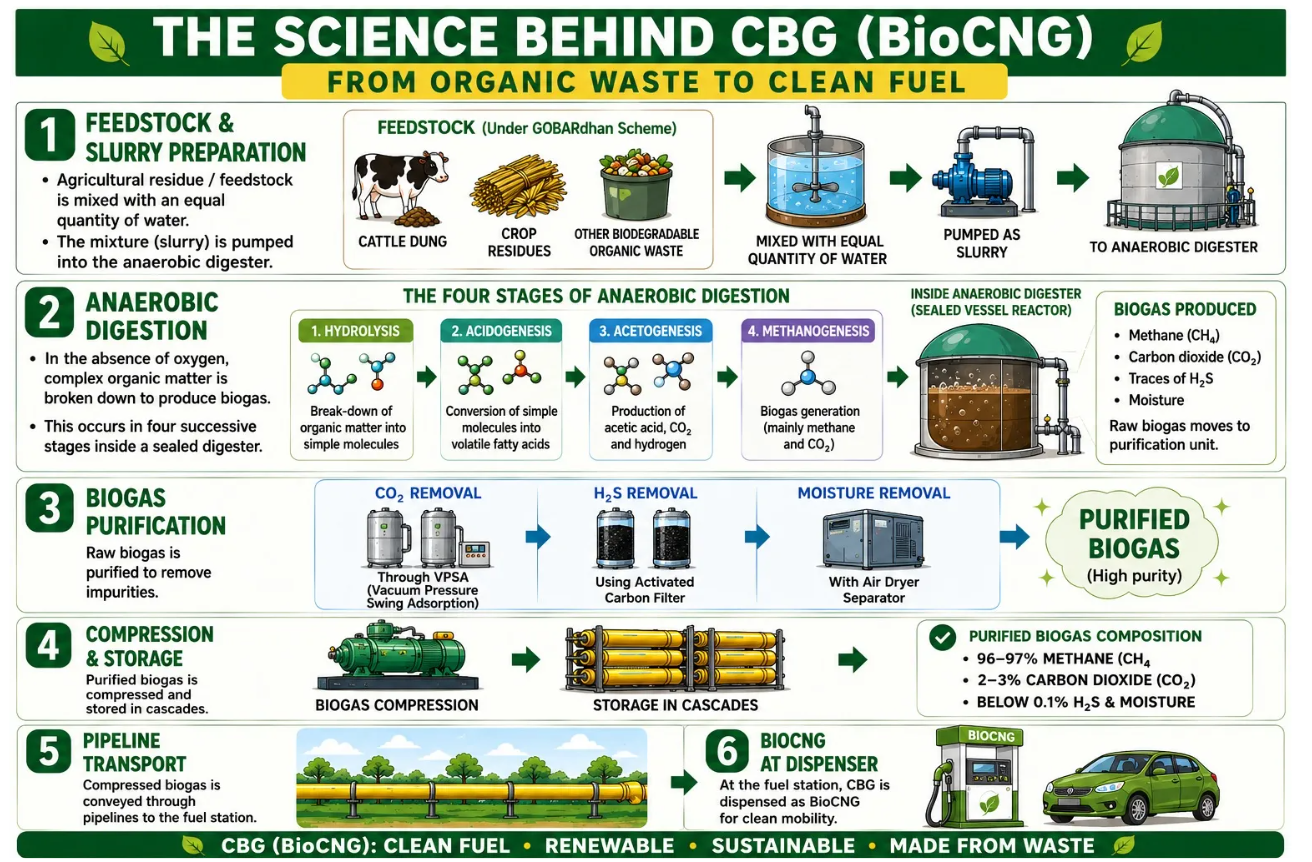
CBG production is based on anaerobic digestion, where organic matter is broken down in the absence of oxygen.
The process involves four stages:
1. Hydrolysis
Complex organic matter is broken into simpler molecules.
2. Acidogenesis
These simpler molecules are converted into volatile fatty acids.
3. Acetogenesis
Acetic acid, carbon dioxide and hydrogen are produced.
4. Methanogenesis
Methane-rich biogas is generated.
The biogas is then purified, upgraded and compressed to produce CBG suitable for fuel use.
Why CBG is Strategically Important for India?
1. Reduces Import Dependence
India depends on imports for a large part of its natural gas requirement. Domestic CBG production can reduce this dependence and improve energy security.
2. Supports Clean Energy Transition
CBG is a renewable fuel produced from waste. It can support India’s transition from fossil fuels to cleaner energy sources.
3. Protects Against Global Supply Shocks
International gas prices and supply routes can be affected by geopolitical tensions. Domestic CBG can reduce vulnerability to such external shocks.
4. Uses Existing Gas Infrastructure
Since CBG is chemically similar to natural gas, it can be integrated into existing CNG and PNG systems.
5. Strengthens Rural Economy
Farm residue, cattle dung and biomass can become sources of income for farmers, cooperatives, rural entrepreneurs and MSMEs.
How the New Framework Supports Commercial Viability
The main problem with CBG projects has not been technology alone. The bigger challenges have been feedstock supply, high capital cost, weak offtake and limited distribution infrastructure.
The new GOBARdhan framework addresses these issues through:
1. Assured Offtake
City Gas Distribution entities will procure CBG to meet blending obligations in CNG and PNG segments.
The blending obligation is:
- 3% in 2026-27
- 4% in 2027-28
- 5% from 2028-29 onwards
This creates a predictable demand for CBG producers.
2. Stable Administered Price
The scheme introduces a stable administered CBG price of ₹2,110 per MMBTU. This gives producers long-term revenue certainty.
3. Capital Assistance
Eligible greenfield CBG projects will receive capital assistance of up to ₹2 crore per tonne per day of installed capacity. Brownfield projects expanding capacity will also be eligible.
4. Pipeline Infrastructure
The scheme supports cluster-based and standalone pipeline infrastructure to connect CBG plants with trunk pipelines and city gas distribution networks.
5. Credit Guarantee Support
A dedicated credit guarantee mechanism will help MSME-based CBG projects access institutional credit with lower collateral pressure.
Together, these measures aim to move CBG from a pilot-project model to a bankable energy industry.
Government Initiatives for CBG Sector
The government has already supported the CBG sector through several initiatives.
1. SATAT Initiative
Sustainable Alternative Towards Affordable Transportation was launched to promote CBG as an alternative transport fuel.
2. Market Development Assistance Scheme
It supports the organic manure value chain linked with CBG plants.
3. Biomass Aggregation Machinery Scheme
It supports the collection and aggregation of biomass feedstock.
4. Development of Pipeline Infrastructure Scheme
It strengthens the connectivity needed for transporting CBG.
5. National Bioenergy Programme
It provides Central Financial Assistance for CBG plants.
These initiatives have helped commission over 200 CBG plants and demonstrated the potential of CBG across feedstocks and regions.
Waste-to-Energy Technologies:
Waste-to-energy refers to technologies that convert non-recyclable waste into usable forms of energy such as heat, electricity, gas or fuel.
There are two broad types:
1. Thermochemical Technologies
These use heat to convert waste into energy.
Incineration burns waste at high temperature and is suitable for mixed municipal waste with high calorific value.
Pyrolysis breaks down waste in the absence of oxygen and produces char, pyrolysis oil and syngas.
Gasification converts carbon-rich waste into syngas or producer gas containing gases such as hydrogen, carbon monoxide and methane.
2. Biochemical Technologies
These use microorganisms to break down biodegradable waste.
Anaerobic digestion is suitable for organic waste such as kitchen waste, garden waste, cattle dung and agricultural residue. It produces biogas.
Landfilling with gas recovery captures landfill gas, but landfilling is environmentally problematic because of toxic gases and long-term pollution risk.
GOBARdhan mainly uses the biochemical route of anaerobic digestion to produce CBG from organic waste.
Significance
1. Energy Security
Domestic CBG production can reduce dependence on imported natural gas.
2. Waste Management
The scheme can reduce the burden of agricultural residue, cattle dung and municipal organic waste.
3. Rural Income
Farmers, cooperatives and rural entrepreneurs can earn from supplying feedstock and managing CBG-linked activities.
4. Organic Manure Production
The by-products of CBG plants can support organic manure use and improve soil health.
5. Climate Benefits
CBG can reduce methane emissions from unmanaged organic waste and support cleaner fuel use.
6. Circular Economy
The scheme converts waste into fuel, manure and income, making resource use more efficient.
Challenges
1. Feedstock Supply Chain
Reliable collection of cattle dung, crop residue and municipal organic waste is difficult without local organisation.
2. High Initial Cost
CBG plants require investment in plant machinery, feedstock aggregation, purification and compression systems.
3. Market Linkage
Without assured offtake, producers may face uncertainty in selling CBG.
4. Pipeline Connectivity
Lack of pipeline infrastructure can increase evacuation cost and reduce commercial viability.
5. Quality Standards
CBG must meet required methane purity and fuel standards to be used in the gas network.
6. Local Governance Capacity
Panchayats, municipalities and cooperatives need capacity to support feedstock supply and waste segregation.
Way Forward
1. Strengthen Feedstock Aggregation
Village-level and cluster-level systems should collect cattle dung, crop residue and organic waste reliably.
2. Link Farmers with CBG Plants
Farmers should receive fair payment for biomass and access to organic manure produced from CBG plants.
3. Ensure Timely Offtake
City gas distribution entities must implement blending obligations consistently.
4. Expand Pipeline Networks
Pipeline connectivity should be improved to lower transportation cost and increase plant utilisation.
5. Support MSMEs and Cooperatives
Credit guarantee and capital assistance should reach small developers, rural entrepreneurs, cooperatives and women-led enterprises.
6. Promote Waste Segregation
Urban local bodies must strengthen source segregation so that clean organic waste can be used for biogas production.
7. Build Technical Capacity
Training is needed for plant operators, local governments, lenders and entrepreneurs.
Conclusion
GOBARdhan is a strategic attempt to convert India’s organic waste into energy security, rural income and climate benefits. Its success will depend not only on producing more CBG but also on solving commercial bottlenecks such as feedstock supply, offtake assurance, pricing, credit and pipeline infrastructure. If implemented well, the scheme can connect farmers, municipalities, MSMEs and city gas networks into a circular bioenergy ecosystem. It can make waste a productive resource and help India move towards cleaner, more resilient and locally generated energy.