Relevance: GS Paper III – Economy | Energy | Renewable Energy | Inclusive Development | Welfare Schemes
For Prelims:
PM Surya Ghar Muft Bijli Yojana, Rooftop Solar Programme, Net Metering, Renewable Energy, Solar Panels, SC/ST Subsidy, MNRE, Distributed Energy System, Solar Grid Connectivity
For Mains:
Renewable Energy Transition, Energy Security, Inclusive Growth, Rooftop Solar Economy, Decentralized Energy Generation, Subsidy Model, Energy Access, Sustainable Development
Why in News?
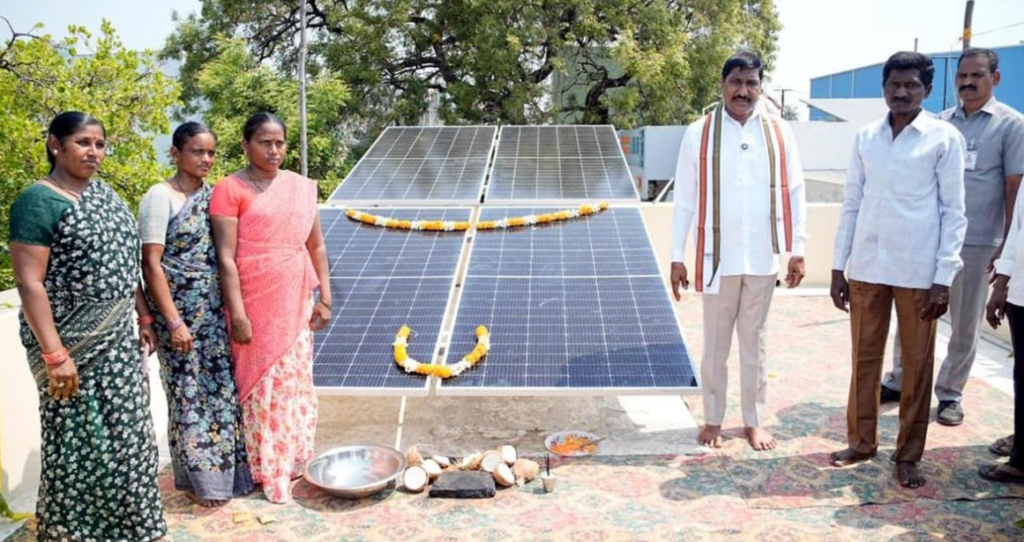
- The Andhra Pradesh government launched the PM Surya Ghar Utsav in Banaganapalle of Nandyal district to provide subsidised rooftop solar power systems for households, especially targeting Scheduled Caste and Scheduled Tribe families.
- Minister for Roads and Buildings B.C. Janardhan Reddy stated that Andhra Pradesh is providing 100% subsidy for rooftop solar panels to SC and ST beneficiaries, while other eligible social categories can receive subsidies of up to 40%.
- The scheme aims to provide up to 300 units of free electricity per month and also allows households to sell surplus electricity back to the government.
- This initiative is being seen as an important step toward renewable energy expansion and social welfare integration.
Background of the Scheme
- India has been focusing on expanding renewable energy to reduce dependence on fossil fuels, improve energy security, and lower electricity costs for households.
- Rooftop solar systems are an important part of this strategy because they allow decentralised electricity generation directly at the household level.
- Instead of depending entirely on large power plants and transmission networks, households can generate electricity from solar panels installed on rooftops.
- The PM Surya Ghar scheme supports this transition by combining clean energy goals with direct household-level benefits such as lower electricity bills and income from surplus power generation.
- Andhra Pradesh has further strengthened this model by extending full subsidy support to SC and ST families.
For aspirants enrolled in best APPSC Group 1 coaching online or APPSC Group 2 coaching online, this reform is a classic example of governance transformation, often asked in APPSC Group 1 mains preparation and APPSC Group 2 mains preparation
PM Surya Ghar Muft Bijli Yojana
- The PM Surya Ghar Muft Bijli Yojana is a centrally supported rooftop solar programme designed to provide free electricity benefits to one crore households across India.
- The scheme encourages installation of rooftop solar panels for domestic electricity consumption.
- Its major objective is to reduce electricity bills for households while promoting renewable energy adoption.
- The programme also supports India’s larger climate commitments and energy transition strategy.
- Under the scheme, households can receive subsidies for rooftop solar installations and benefit from net metering systems through which excess electricity can be sold to the grid.
- The scheme is implemented with the support of the Ministry of New and Renewable Energy (MNRE).
Such developments are frequently covered in APPSC test series, APPSC Group 1 test series, and APPSC Group 2 mock tests, making them crucial for APPSC Group 1 preparation strategy 2026.
Andhra Pradesh Implementation Model
- Andhra Pradesh has adopted an expanded welfare-oriented model for implementation of the PM Surya Ghar scheme.
- The State government has focused particularly on weaker sections and rural beneficiaries.
- In Banaganapalle constituency alone, more than 4,600 beneficiaries are being covered under the scheme, including more than 2,900 SC and ST households.
- In Panchamapeta village specifically, more than 300 beneficiaries are receiving support under the programme.
- The State has positioned the scheme not merely as an energy policy but also as a social justice and poverty reduction initiative.
- This model gives Andhra Pradesh a distinct place in scheme implementation.
Special Provision for SC and ST Beneficiaries
- One of the most important features of the Andhra Pradesh model is the provision of complete 100% subsidy for SC and ST beneficiaries.
- This means eligible families can install rooftop solar systems without bearing installation costs.
- For beneficiaries belonging to other social categories, subsidy support is available up to 40%.
- This targeted subsidy approach ensures that access to renewable energy does not remain limited only to financially stronger households.
- It also supports inclusive development by bringing vulnerable communities into the clean energy transition.
- Such targeted energy welfare schemes are increasingly becoming important in social policy design.
These topics are important for those using APPSC study material, APPSC Group 1 study material PDF, and APPSC Group 2 study material, especially while practicing APPSC Group 1 previous papers with answers and APPSC Group 2 previous papers with solutions
Net Metering and Surplus Power Sale
- A major benefit of rooftop solar systems is the ability to generate additional income through net metering.
- Under this system, if a household produces more electricity than it consumes, the surplus electricity is supplied back to the government grid.
- In return, the household receives financial credit or payment.
- This transforms electricity consumers into small energy producers.
- It reduces pressure on conventional electricity supply systems and creates distributed energy security.
- For rural and middle-class households, this model reduces recurring electricity expenditure and improves household financial stability.
Other Energy Schemes
Scheme | Core Objective | Key Features |
PM-KUSUM Scheme | Use solar energy in agriculture and reduce dependence on diesel irrigation | Provides solar pumps and enables farmers to install decentralized solar plants; allows sale of surplus electricity to the grid; supported through significant Central and State subsidies |
Rooftop Solar Programme Phase II | Promote solar energy adoption at the household level | Implemented by Ministry of New and Renewable Energy; provides subsidy for residential rooftop systems; supports grid-connected solar and net metering |
Andhra Pradesh Free Power Scheme | Reduce irrigation cost and support farmers | Provides free electricity for agricultural connections, especially benefiting small and marginal farmers |
YSR Jala Kala Scheme | Improve irrigation access for marginalized farmers | Facilitates free borewell drilling for SC/ST and small farmers to ensure groundwater availability |
Saubhagya Scheme | Achieve universal household electrification | Provides free electricity connections to poor households and focuses on last-mile connectivity |
UDAY Scheme | Improve financial and operational performance of power distribution companies | Involves state takeover of DISCOM debt and introduces measures to improve efficiency and reduce losses |
National Bioenergy Programme | Promote renewable energy from organic and waste sources | Supports energy generation from biomass, biogas, and waste, contributing to alternative energy sources |
These examples are frequently asked in exams and are well covered in APPSC Group 1 coaching Telugu, APPSC Group 2 online coaching Telugu, and APPSC coaching in Hyderabad.
Renewable Energy and Rural Development
- Renewable energy is increasingly becoming a tool of rural transformation.
- Solar power improves electricity access, reduces household expenditure, supports productive activities, and creates new income opportunities.
- In villages, reliable electricity supports education, health services, drinking water supply, and small enterprises.
- By linking rooftop solar with direct welfare benefits, the government improves both economic resilience and environmental sustainability.
- This also reduces dependence on fossil-fuel-based electricity and helps in achieving long-term climate goals.
This concept is critical for how to prepare for APPSC Group 1 at home and for candidates following best coaching for APPSC Group 1 and best coaching for APPSC Group 2.
Significance for Andhra Pradesh
- The scheme is particularly important for Andhra Pradesh because of its high solar potential and large rural population.
- It strengthens household energy security and reduces dependence on subsidised conventional power.
- It supports the State’s efforts toward renewable energy expansion and climate-responsive development.
- For SC and ST communities, it acts as both an economic support measure and a tool of social inclusion.
- It also helps reduce future electricity shortages by promoting decentralised power generation.
- The policy demonstrates how welfare schemes can be combined with sustainable development goals.
These points are essential for writing answers in APPSC Group 1 mains preparation and scoring high using APPSC Group 1 books and APPSC Group 2 preparation plan 3 months.
Challenges
- High initial installation costs remain a challenge in many areas where subsidy coverage is limited.
- Awareness regarding rooftop solar systems and net metering remains low among rural households.
- Technical maintenance and after-installation support can become difficult in remote regions.
- DISCOMs may face operational challenges in managing decentralised grid integration.
- There is also a need to ensure transparency in beneficiary selection and subsidy delivery.
- Without proper implementation monitoring, scheme benefits may not reach intended households fully.
These challenges are often discussed in APPSC Group 1 exam date-based current affairs revisions and APPSC Group 1 eligibility stage preparation
Way Forward
- Greater awareness campaigns are needed to improve household participation in rooftop solar adoption.
- Technical support systems should be strengthened at the local level for maintenance and grievance redressal.
- DISCOM infrastructure must be upgraded to support efficient net metering and grid management.
- Targeted schemes for weaker sections should continue with transparency and accountability.
- Promotion of rooftop solar should be integrated with broader state energy planning and climate resilience policies.
- Long-term sustainability requires strong coordination between central and state governments.
Conclusion
- The PM Surya Ghar Utsav in Andhra Pradesh represents an important shift where renewable energy policy is directly linked with social welfare and inclusive growth.
- By providing 100% subsidy for SC and ST households and encouraging surplus power sale through net metering, the State has created a strong model of decentralised clean energy development.
- This initiative shows that renewable energy is not only about electricity generation but also about reducing inequality, strengthening rural livelihoods, and building sustainable economic growth.
CARE MCQ
Q. With reference to the PM Surya Ghar Muft Bijli Yojana, consider the following statements:
- It promotes installation of rooftop solar systems for households.
- It allows beneficiaries to sell surplus electricity back to the grid through net metering.
- It is implemented by the Ministry of Agriculture and Farmers Welfare.
Which of the statements given above are correct?
A. 1 and 2 only
B. 2 and 3 only
C. 1 and 3 only
D. 1, 2 and 3
Ans: (a)
Explanation
Statement 1 is correct: The scheme promotes rooftop solar panel installation for domestic electricity generation.
Statement 2 is correct : Net metering allows households to export surplus electricity to the grid and receive financial benefits.
Statement 3 is incorrect : The scheme is implemented by the Ministry of New and Renewable Energy, not the Ministry of Agriculture.
Therefore, the correct answer is A.
Q. Consider the following statements regarding energy-related schemes:
- The PM-KUSUM Scheme enables farmers to sell surplus solar power to the grid.
- The Rooftop Solar Programme Phase II is restricted to off-grid solar systems.
- The National Bioenergy Programme supports energy generation from waste and biomass.
Which of the statements given above is/are correct?
A. 1 and 3 only
B. 1 only
C. 2 and 3 only
D. 1, 2 and 3
Answer: A
Explanation:
Statement 1 is correct: The PM-KUSUM Scheme promotes decentralized solar energy in agriculture and allows farmers to feed surplus electricity into the grid, generating additional income.
Statement 2 is incorrect: The Rooftop Solar Programme Phase II focuses on grid-connected rooftop systems supported by net metering, not off-grid installations alone.
Statement 3 is correct: The National Bioenergy Programme promotes energy generation from biomass, biogas, and waste materials as part of renewable energy expansion.
Q. The core difference between Saubhagya Scheme and PM Surya Ghar Scheme lies in:
A. Type of energy source used
B. Focus on connection versus generation at household level
C. Rural versus urban implementation
D. Central versus state funding
Ans: (b)
Explanation:
Option B is correct: The Saubhagya Scheme aims at providing electricity connections to un-electrified households, ensuring last-mile access. In contrast, the PM Surya Ghar Scheme focuses on household-level electricity generation through rooftop solar systems, enabling self-production of power.
APPSC MAINS QUESTION
Q.Discuss how rooftop solar schemes such as PM Surya Ghar Muft Bijli Yojana can contribute to inclusive growth, renewable energy transition, and rural development in Andhra Pradesh.
(250 Words)
FAQs
Q1. What is PM Surya Ghar Muft Bijli Yojana?
It is a central scheme promoting rooftop solar installations for households to provide free electricity benefits and reduce power bills.
Q2. What is special about Andhra Pradesh’s implementation?
Andhra Pradesh provides 100% subsidy for SC and ST beneficiaries, making rooftop solar completely free for eligible households.
Q3. What is net metering?
It is a system through which surplus electricity generated from rooftop solar panels is supplied back to the electricity grid for financial credit.
Q4. Which ministry implements the scheme?
The scheme is implemented by the Ministry of New and Renewable Energy (MNRE).
Q5. How many free electricity units can households receive?
Under the scheme, households can access up to 300 units of free electricity per month depending on installation and consumption.
Relevance: GS Paper II – Polity | Representation | Social Justice
For Prelims:
Women’s Reservation, Nari Shakti Vandan Adhiniyam, 106th Constitutional Amendment Act, Article 334A, Delimitation Commission, Article 82, Article 170, Article 81, 131st Constitutional Amendment Bill, Rotation of Reserved Seats
For Mains:
Gender justice, political representation, substantive democracy, inclusive governance, legislative reservation, structural exclusion, democratic legitimacy, federalism and delimitation
Why in News?
The defeat of the Constitution (131st Amendment) Bill, 2026 in April 2026 has revived the debate on the immediate implementation of women’s reservation in Parliament and State Assemblies.
Although the Nari Shakti Vandan Adhiniyam was passed in 2023, its implementation remains delayed due to its linkage with the next Census and delimitation process.
This has intensified demands for delinking women’s reservation from delimitation and ensuring immediate political representation.
Why Women’s Reservation Cannot Wait
- The demand for immediate reservation arises from the sharp gap between women’s electoral participation and their representation in law-making institutions.
- Women vote in large numbers and in many States female voter turnout equals or exceeds male turnout, yet their presence in Parliament and Assemblies remains extremely low.
- The political system is not purely merit-based but often controlled by social networks, financial influence, and patriarchal gatekeeping that systematically exclude women.
- Reservation is therefore seen not as a privilege, but as a structural correction for structural exclusion.

Present Status of Women’s Political Representation
- Women constitute nearly 50% of India’s population, but their representation in the Lok Sabha remains only around 14–15%.
- In State Legislative Assemblies, the average representation is even lower, around 9%.
- This creates a serious democratic imbalance where half the population has limited influence over law-making and policy priorities.
- At the Panchayati Raj level, however, reservation of 33% to 50% has produced transformative results, especially in health, sanitation, drinking water, and education governance.
106th Constitutional Amendment Act, 2023
- The Nari Shakti Vandan Adhiniyam, 2023, popularly known as the Women’s Reservation Act, is a major constitutional reform aimed at strengthening women’s political participation in India. It provides for 33 percent reservation for women in the Lok Sabha and State Legislative Assemblies and seeks to ensure greater representation of women in law-making institutions.
- The Act is based on the principle that political democracy cannot be complete without adequate participation of women in representative bodies. It attempts to correct the long-standing imbalance between women’s role as voters and their limited presence as legislators.
- Women’s representation in India remains relatively low despite high electoral participation. At present, women constitute only around 15 percent of the Lok Sabha, which is significantly lower than countries such as Rwanda, where women’s representation is above 60 percent, and Sweden, where it is around 46 percent.
- The demand for reservation for women has a long legislative history. The first Women’s Reservation Bill was introduced in 1996 but could not be passed due to repeated political opposition. In 2010, the Bill was passed in the Rajya Sabha but lapsed because it was not approved by the Lok Sabha.
- After nearly three decades of debate and political negotiation, the law was finally enacted in 2023 as the Constitution (106th Amendment) Act and came to be known as the Nari Shakti Vandan Adhiniyam.
- Despite its passage, the Act does not come into force immediately. Its implementation has been made conditional upon the conduct of the next Census and the completion of delimitation of constituencies, making reservation dependent on future administrative and constitutional processes.
- The next Census is expected around 2027, and the publication and processing of Census data may take another 12 to 18 months. After that, the delimitation process itself may take three to six years, pushing the likely implementation of women’s reservation to around 2033–34.
- This delay transforms the Act from an immediate political reform into a long-term constitutional commitment. While the law has been passed, its actual effect on elections may not be visible for nearly a decade.
Why Implementation is Delayed?
- The most controversial part of the law is its linkage with delimitation after the first Census conducted after 2023.
- This means reservation will come into effect only after the next Census is completed and constituency boundaries are redrawn.
- Since delimitation is expected only after the post-2026 Census process, effective implementation may be pushed beyond the 2029 elections.
- This delay means another full electoral cycle without adequate women’s representation.
Three Bills to Fast-track Women’s Reservation
Constitution (131st Amendment) Bill, 2026
- This Bill proposed increasing the maximum strength of the Lok Sabha from 550 to 850 seats by amending Article 81.
- It also proposed changes in Article 82, Article 170, and Article 334A to allow delimitation based on the 2011 Census instead of waiting for the post-2026 Census.
- Its purpose was to immediately operationalise women’s reservation before the 2029 general elections.
- Since it amends the Constitution, it required a special majority in Parliament and ratification by at least half of the States.
Delimitation Bill, 2026
- This Bill proposed a new Delimitation Commission to replace the framework under the Delimitation Act, 2002.
- The Commission would redraw constituency boundaries and reallocate seats based on the latest published Census figures, which currently means the 2011 Census.
- It would also determine SC, ST, and women’s reserved constituencies.
- Its orders would have the force of law and could not be challenged in court except in cases of constitutional arbitrariness.
Union Territories Laws (Amendment) Bill, 2026
- This Bill was designed to extend the same reservation and delimitation framework to Union Territories with legislatures such as Delhi, Jammu and Kashmir, and Puducherry.
- It ensures that women’s reservation is uniformly implemented across parliamentary and legislative institutions.
Delimitation and Its Constitutional Framework
- Delimitation is the process of redrawing the boundaries of Lok Sabha and State Assembly constituencies to ensure equal representation based on population.
- Its objective is to uphold the democratic principle of “one person, one vote, one value.”
- Article 82 deals with delimitation for Parliament, while Article 170 deals with State Assemblies.
- The Delimitation Commission is a high-powered independent body whose orders have the force of law and cannot ordinarily be challenged in court.
- India has had Delimitation Commissions in 1952, 1963, 1973, and 2002.
Arguments Supporting Immediate Reservation
- Women’s reservation is necessary because voluntary party reforms have consistently failed to ensure adequate representation.
- Reservation improves policy priorities, as evidence from Panchayati Raj institutions shows greater focus on healthcare, education, sanitation, and welfare.
- Women leaders act as role models, challenging patriarchal norms and encouraging political participation by younger generations.
- A representative democracy must reflect its population composition; otherwise, institutional legitimacy is weakened.
- Excluding women from decision-making also creates economic inefficiency because governance outcomes improve when leadership becomes more inclusive.
Challenges and Criticisms
- One major criticism is that reservation linked with delimitation creates indefinite delay rather than immediate reform.
- Another criticism is the absence of a separate reservation for women from Other Backward Classes (OBCs), raising concerns about unequal inclusion.
- Frequent rotation of reserved seats may discourage long-term constituency development by elected representatives.
- Some critics also argue that reservation should be accompanied by internal party democracy, campaign finance reform, and leadership training rather than relying only on constitutional quotas.
Way Forward
- Women’s reservation should be delinked from Census and delimitation so that implementation is not indefinitely postponed.
- Political parties should adopt internal ticket quotas for women even before legal compulsion.
- Successful women leaders from Panchayati Raj institutions and Self-Help Groups should be supported as a pipeline for higher political leadership.
- Institutional mentorship, campaign funding support, and leadership development programmes are necessary for sustainable representation.
- Women’s reservation must be treated as a democratic necessity, not as a symbolic reform.
Conclusion
India’s democracy remains incomplete as long as women are present mainly as voters but not equally as lawmakers.
The immediate implementation of women’s reservation is not merely a question of fairness but a constitutional requirement for representative democracy.
Delaying this reform weakens democratic legitimacy and postpones social transformation that India urgently needs.
CARE MCQ
Q. With reference to the Nari Shakti Vandan Adhiniyam, consider the following statements:
- It provides one-third reservation for women in the Lok Sabha and State Legislative Assemblies.
- It includes a separate reservation for women belonging to Other Backward Classes (OBCs).
- Its implementation is linked with delimitation after the next Census.
Which of the statements given above are correct?
A. 1 and 3 only
B. 2 and 3 only
C. 1 and 2 only
D. 1, 2 and 3
Ans: (a)
Explanation
Statement 1 is correct: The 106th Constitutional Amendment provides 33% reservation for women in the Lok Sabha and State Assemblies.
Statement 2 is incorrect : No separate OBC reservation for women is provided in the Act. Only SC and ST women receive sub-quotas within reserved seats.
Statement 3 is correct : Implementation is linked with delimitation after the next Census.
Q. Regarding the reservation of seats in Municipalities, which of the following statements is accurate?
(a) One-third of the total number of seats are reserved for women in all municipalities.
(b) Reservation for Scheduled Castes and Scheduled Tribes is provided in every municipality in proportion to their population in the municipal area.
(c) The offices of Chairpersons in the municipalities are reserved for Scheduled Castes, Scheduled Tribes, and women in every municipality.
(d) The State Legislature has the sole discretion to decide whether to reserve seats for Scheduled Castes, Scheduled Tribes, and women in municipalities.
Ans: (b)
Explanation:
Article 243T mandates that reservation of seats for Scheduled Castes and Scheduled Tribes must be provided in every municipality in proportion to their population in that municipal area. This is a direct constitutional requirement under the 74th Constitutional Amendment Act, ensuring representation of historically disadvantaged communities in urban local governance.
Q.Consider the following statements regarding the implementation of recommendations made by the Delimitation Commission of India:
- The orders of the Delimitation Commission have the force of law and cannot be challenged in any court.
- While Parliament cannot alter the Commission’s delimitation orders, a parliamentary committee reviews the orders before they are laid before the House of the People.
- A Delimitation Commission continues to exist until a new Commission is appointed, allowing it to address unforeseen issues arising from its delimitation exercise.
Which of the above statements are correct?
(a) 1 only
(b) 3 only
(c) 1 and 3 only
(d) 2 and 3 only
Ans: (a)
Explanation:
Statement 1 is correct: The orders of the Delimitation Commission have the full force of law and cannot be challenged in any court. This finality is protected under Article 329(a) of the Constitution, which prevents judicial interference in delimitation matters so that elections are not delayed by litigation.
Statement 2 is incorrect: There is no parliamentary committee empowered to review or modify the delimitation orders. Once the Delimitation Commission finalizes its report, it is submitted to the President and published in the Gazette of India. The orders are laid before Parliament and State Legislatures only for information, not for approval or modification. Parliament cannot alter them.
Statement 3 is incorrect: The Delimitation Commission is not a permanent body. It is a temporary statutory body constituted for a specific delimitation exercise. Once it completes its work and submits its report, it stands dissolved. A fresh Commission is constituted separately for the next delimitation exercise.
Q. Under Article 169, the abolition of a State Legislative Council requires Parliament to pass
(a) a Constitutional Amendment Bill
(b) an Ordinary Law after a special majority resolution by the State Assembly
(c) a Money Bill with President’s recommendation
(d) a Resolution passed by half of the States
Ans: (b)
Explanation:
Article 169 of the Constitution deals with the creation or abolition of a State Legislative Council. A Legislative Council is the Upper House in states having a bicameral legislature. Parliament cannot abolish or create it on its own initiative. The process begins only when the concerned State Legislative Assembly passes a resolution requesting such creation or abolition.
This resolution must be passed by a special majority, which means a majority of the total membership of the Assembly and a majority of not less than two-thirds of the members present and voting. After such a resolution is passed, Parliament may enact an ordinary law to create or abolish the Council. It is not treated as a Constitutional Amendment under Article 368, even though it changes the legislative structure of the State.
UPSC MAINS
Q.Discuss the constitutional position of the Legislative Council in Indian States. Examine the arguments for and against the abolition of bicameralism at the State level.
[250 WORDS]
FAQs
Q1. What is Nari Shakti Vandan Adhiniyam?
It is the 106th Constitutional Amendment Act, 2023 providing one-third reservation for women in legislatures.
Q2. Why has women’s reservation not yet been implemented?
Because it is linked to delimitation after the next Census, which delays actual enforcement.
Q3. Which Article is associated with women’s reservation?
Article 334A contains provisions related to reservation for women in legislatures.
Q4. Does the Act provide OBC reservation for women?
No, it provides only SC and ST sub-quotas within the reserved seats.
Q5. Why is immediate implementation important?
Because continued delay excludes another generation of women from legislative representation and weakens democratic inclusiveness.
Relevance: GS Paper I – Geography | GS Paper III – Environment, Water Resources, Disaster Management
For Prelims:
River Basin Management Scheme, Ministry of Jal Shakti, National Water Development Agency (NWDA), Interlinking of Rivers (ILR), Brahmaputra Board, Central Water Commission (CWC), LiDAR, Springshed Management, Indus Basin, Brahmaputra Basin
For Mains:
integrated water governance, basin-level planning, hydrological unit, inter-state water disputes, climate resilience, flood management, groundwater sustainability, ecological balance, water security, river basin approach
Why in News?
- The Government of India has approved the continuation of the River Basin Management (RBM) Scheme for the period 2026–27 to 2030–31 with an increased financial outlay of ₹2,183 crore.
- The previous cycle had an outlay of ₹1,276 crore, showing a major expansion in funding and strategic importance.
- The renewed scheme focuses on scientific planning, inter-basin coordination, flood control, groundwater sustainability, and strengthening India’s long-term water security.
What is the River Basin Management (RBM) Scheme
- The River Basin Management Scheme is a scientific and institutional framework under the Ministry of Jal Shakti for the integrated management, protection, and sustainable development of India’s river basins.
- Instead of treating rivers as isolated water channels, the scheme views the entire river system—including tributaries, floodplains, groundwater, wetlands, and ecological zones—as a single hydrological unit.
- This marks a shift from project-based water governance toward basin-level planning where irrigation, hydropower, drinking water, navigation, ecology, and disaster management are handled together.
- It promotes sustainable use of water resources while balancing developmental and environmental priorities.
Why Basin-Level Water Governance is Necessary
- India has only about 4% of the world’s freshwater resources but supports nearly 17% of the global population, making efficient water governance essential.
- Rapid urbanisation, industrial expansion, and agricultural demand have increased pressure on rivers and groundwater reserves.
- Climate change has intensified floods, droughts, erratic monsoons, glacial melt, and riverbank erosion, making traditional fragmented planning inadequate.
- River systems such as the Indus and Brahmaputra also have international strategic importance, requiring basin-level data for water diplomacy and national security.
- Localized project-based planning often ignores upstream-downstream interdependence, causing ecological degradation and inefficient water use.
Key Features of the RBM Scheme
Integrated Basin Planning
- The scheme provides for preparation and periodic revision of Master Plans for major river basins.
- These plans identify long-term requirements related to irrigation, flood control, hydropower generation, inland navigation, drinking water supply, and ecological restoration.
- This helps in coordinated development rather than isolated departmental planning.
Scientific Survey and Investigation
- The scheme uses GIS, remote sensing, hydrological modelling, LiDAR surveys, and drone-based mapping for accurate basin assessment.
- These technologies improve preparation of Feasibility Reports and Detailed Project Reports (DPRs) for multipurpose river projects.
- Accurate terrain mapping also improves flood forecasting and sediment management.
Flood and Erosion Control
- Special attention is given to flood-prone and erosion-prone regions, especially in the North Eastern States and the Brahmaputra basin.
- Projects include anti-erosion works, raised flood shelters, embankment strengthening, and protection of vulnerable zones such as Majuli Island in Assam.
- Drainage development in Himalayan foothills also helps reduce chronic waterlogging.
Springshed Management
- In hilly and tribal areas, especially in the North East, the scheme promotes rejuvenation of natural springs through springshed management.
- This improves water availability during dry seasons and supports local livelihoods dependent on springs.
- Traditional indigenous water conservation methods are also encouraged.
Community-Based Participation
- The scheme recognises that long-term water governance requires local participation.
- Tribal communities, farmers, and local institutions are encouraged to participate in conservation, monitoring, and maintenance.
- This improves sustainability and reduces dependence only on top-down engineering solutions.
Institutional Framework for River Basin Management
Ministry of Jal Shakti
- It is the nodal ministry responsible for water resources, river development, and Ganga rejuvenation.
- It coordinates policy planning and implementation of national river basin programmes.
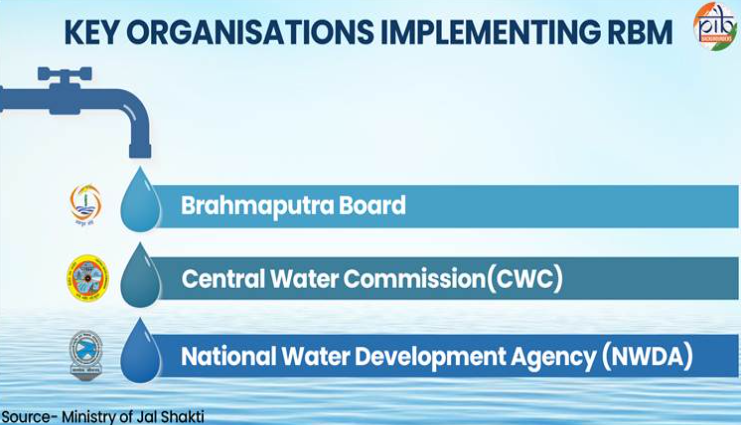
Central Water Commission (CWC)
- It is the premier technical organisation dealing with water resources planning, flood forecasting, irrigation, and hydrological studies.
- It supports basin planning and technical investigations.
National Water Development Agency (NWDA)
- It is responsible for planning and execution of river interlinking projects and water balance studies across basins.
- It plays a central role in inter-basin water transfer proposals.
Brahmaputra Board
- It focuses on flood control, drainage development, and anti-erosion measures in the Brahmaputra and Barak valleys.
- Its role is especially important for the North Eastern region.
Major Challenges in Water Governance
- Inter-state disputes over river water sharing continue to delay implementation of basin plans and transfer projects.
- Examples such as Cauvery, Krishna, and Ravi-Beas disputes show how political friction affects water governance.
- Remote terrain in Jammu and Kashmir and the North East causes logistical difficulties and short working seasons, delaying project execution.
- Historically, lack of real-time hydrological data has weakened accurate streamflow prediction and flood management.
- Large infrastructure projects such as dams and diversion canals can disturb ecosystems, fish migration, wetlands, and biodiversity.
- High costs of anti-erosion works in rivers like the Brahmaputra often exceed original estimates, creating fiscal pressure.
Significance for India
- RBM strengthens national water security by ensuring scientific planning of limited freshwater resources.
- It improves agricultural productivity by supporting irrigation expansion and groundwater recharge.
- Flood management reduces disaster losses and protects vulnerable populations in riverine areas.
- River basin planning supports energy security through hydropower development and navigation infrastructure.
- Strategically important river systems like the Indus and Brahmaputra gain stronger hydrological assessment for cross-border negotiations.
- It also supports inclusive development by improving water access in tribal and remote regions.
Way Forward
- Modern technologies such as LiDAR, drone surveys, and SCADA systems should be expanded for high-resolution basin monitoring and real-time flood forecasting.
- Capacity building of state-level technical officers must be strengthened through institutions like NEHARI and other hydrological training centres.
- Springshed rejuvenation should become a priority for North Eastern and Himalayan regions where natural springs are the primary water source.
- Better coordination among the CWC, NWDA, Brahmaputra Board, and State Governments is essential for faster DPR preparation and execution.
- Ecological sustainability must remain central so that infrastructure development does not destroy long-term river health.
- Local communities should be treated as partners rather than only beneficiaries in water governance.
Conclusion
The River Basin Management Scheme represents a major shift from fragmented water management to scientific and integrated river governance.
In a climate-stressed and water-scarce future, basin-level planning is not merely an administrative reform but a strategic necessity for national security and economic stability.
Its success will depend on balancing engineering solutions with ecological sustainability and community participation.
CARE MCQ
Q.With reference to the River Basin Management (RBM) Scheme, consider the following statements:
- It treats an entire river system including tributaries and groundwater as a single hydrological unit.
- The National Water Development Agency is responsible for Interlinking of Rivers projects.
- The Brahmaputra Board primarily deals with coastal erosion management in peninsular India.
Which of the statements given above are correct?
A. 1 and 2 only
B. 2 and 3 only
C. 1 and 3 only
D. 1, 2 and 3
Ans: (a)
Explanation
Statement 1 is correct: RBM follows an integrated basin approach where the full river system is treated as one hydrological unit.
Statement 2 is correct : The NWDA is the main agency for planning river interlinking projects.
Statement 3 is incorrect : The Brahmaputra Board deals mainly with flood control and erosion management in the Brahmaputra and Barak valleys of North East India.
Q.Consider the following statements regarding the Interlinking of Rivers Programme:
- It is based on the idea of transferring water from river basins with relatively higher availability to those facing water stress.
- The National Water Development Agency plays an important role in planning and feasibility studies for river linking projects.
- The Ken-Betwa Link Project represents an important project under this programme.
Which of the statements given above are correct?
(a) 1 and 2 only
(b) 2 and 3 only
(c) 1 and 3 only
(d) 1, 2 and 3
Ans: (d)
Explanation:
Statement 1 is correct: the interlinking programme is based on the principle of balancing regional water availability by transferring water from relatively surplus basins to water-deficit areas to support irrigation, drinking water, and drought mitigation.
Statement 2 is correct : the National Water Development Agency (NWDA) is the central technical body responsible for preparing feasibility reports, conducting studies, and coordinating implementation of river linking proposals.
Statement 3 is correct : the Ken-Betwa Link Project is one of the most significant and advanced projects under the river interlinking programme and is often regarded as a model for future implementation.
Q. With reference to the Brahmaputra River system, consider the following statements:
- The Brahmaputra enters India through a gorge formed near Namcha Barwa after traversing the Tibetan Plateau.
- Unlike the Indus, the Brahmaputra carries a larger volume of water and sediment due to its humid catchment in the eastern Himalayas.
Which of the statements given above is/are correct?
(a) 1 only
(b) 2 only
(c) Both 1 and 2
(d) Neither 1 nor 2
Ans: (c)
Explanation:
Statement 1 is correct: The Brahmaputra originates in southwestern Tibet and flows eastward as the Yarlung Tsangpo across the Tibetan Plateau. Near Namcha Barwa peak, it takes a dramatic U-turn called the “Great Bend” and passes through one of the deepest gorges in the world before entering India through Arunachal Pradesh as the Siang (or Dihang). This gorge is an important geomorphological feature and distinguishes the Brahmaputra from many other Himalayan rivers.
Statement 2 is correct: The Brahmaputra carries one of the highest sediment loads and water discharges amog Indian rivers. Unlike the Indus, whose basin lies largely in arid and semi-arid regions, the Brahmaputra drains the high-rainfall eastern Himalayas and Assam valley, where intense monsoonal rainfall and active erosion contribute to very high sediment transport. This is why the river is highly braided, flood-prone, and responsible for large-scale deposition in Assam and Bangladesh.
FAQs
Q1. What is the main objective of the RBM Scheme?
Its objective is to ensure integrated, scientific, and sustainable management of entire river basins for irrigation, ecology, flood control, and water security.
Q2. Which ministry implements the RBM Scheme?
The scheme is implemented under the Ministry of Jal Shakti.
Q3. What is the role of NWDA?
The National Water Development Agency plans and prepares projects related to interlinking of rivers and basin water balance studies.
Q4. Why is basin-level planning important?
Because upstream and downstream river activities are interconnected and cannot be managed effectively through isolated local projects
Q5. What is springshed management?
It is the protection and rejuvenation of natural springs and their recharge zones, especially important in hilly and tribal regions.