Table of Contents
Relevance: GS Paper III – Economy | Energy | Renewable Energy | Inclusive Development | Welfare Schemes
For Prelims:
PM Surya Ghar Muft Bijli Yojana, Rooftop Solar Programme, Net Metering, Renewable Energy, Solar Panels, SC/ST Subsidy, MNRE, Distributed Energy System, Solar Grid Connectivity
For Mains:
Renewable Energy Transition, Energy Security, Inclusive Growth, Rooftop Solar Economy, Decentralized Energy Generation, Subsidy Model, Energy Access, Sustainable Development
Why in News?
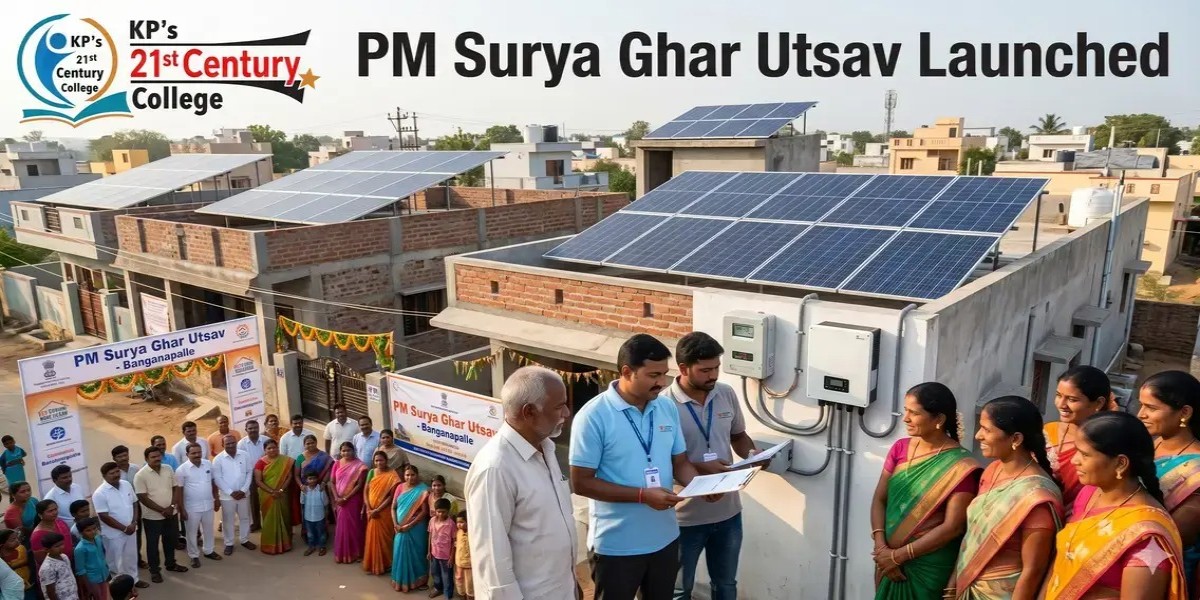
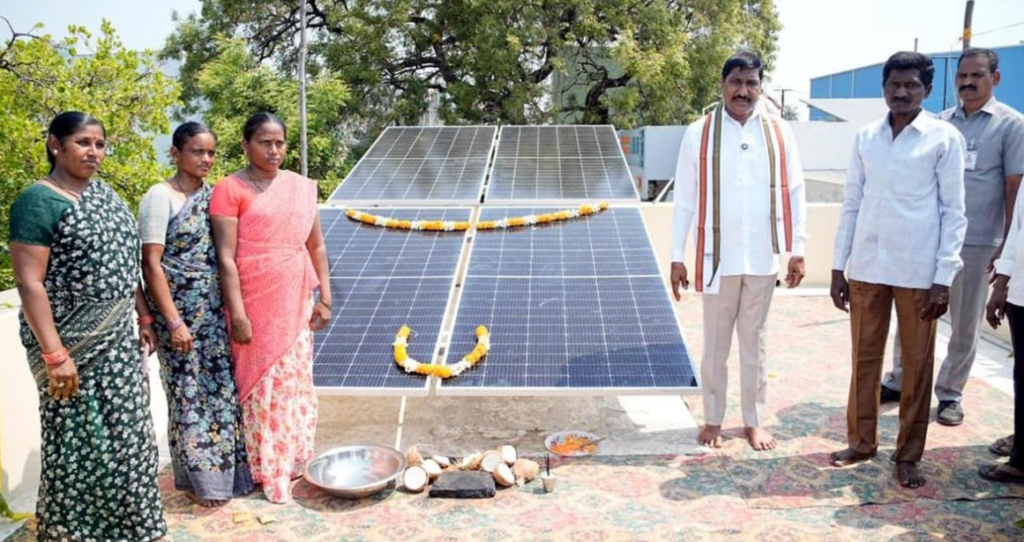
- The Andhra Pradesh government launched the PM Surya Ghar Utsav in Banaganapalle of Nandyal district to provide subsidised rooftop solar power systems for households, especially targeting Scheduled Caste and Scheduled Tribe families.
- Minister for Roads and Buildings B.C. Janardhan Reddy stated that Andhra Pradesh is providing 100% subsidy for rooftop solar panels to SC and ST beneficiaries, while other eligible social categories can receive subsidies of up to 40%.
- The scheme aims to provide up to 300 units of free electricity per month and also allows households to sell surplus electricity back to the government.
- This initiative is being seen as an important step toward renewable energy expansion and social welfare integration.
Background of the Scheme
- India has been focusing on expanding renewable energy to reduce dependence on fossil fuels, improve energy security, and lower electricity costs for households.
- Rooftop solar systems are an important part of this strategy because they allow decentralised electricity generation directly at the household level.
- Instead of depending entirely on large power plants and transmission networks, households can generate electricity from solar panels installed on rooftops.
- The PM Surya Ghar scheme supports this transition by combining clean energy goals with direct household-level benefits such as lower electricity bills and income from surplus power generation.
- Andhra Pradesh has further strengthened this model by extending full subsidy support to SC and ST families.
For aspirants enrolled in best APPSC Group 1 coaching online or APPSC Group 2 coaching online, this reform is a classic example of governance transformation, often asked in APPSC Group 1 mains preparation and APPSC Group 2 mains preparation
PM Surya Ghar Muft Bijli Yojana
- The PM Surya Ghar Muft Bijli Yojana is a centrally supported rooftop solar programme designed to provide free electricity benefits to one crore households across India.
- The scheme encourages installation of rooftop solar panels for domestic electricity consumption.
- Its major objective is to reduce electricity bills for households while promoting renewable energy adoption.
- The programme also supports India’s larger climate commitments and energy transition strategy.
- Under the scheme, households can receive subsidies for rooftop solar installations and benefit from net metering systems through which excess electricity can be sold to the grid.
- The scheme is implemented with the support of the Ministry of New and Renewable Energy (MNRE).
Such developments are frequently covered in APPSC test series, APPSC Group 1 test series, and APPSC Group 2 mock tests, making them crucial for APPSC Group 1 preparation strategy 2026.
Andhra Pradesh Implementation Model
- Andhra Pradesh has adopted an expanded welfare-oriented model for implementation of the PM Surya Ghar scheme.
- The State government has focused particularly on weaker sections and rural beneficiaries.
- In Banaganapalle constituency alone, more than 4,600 beneficiaries are being covered under the scheme, including more than 2,900 SC and ST households.
- In Panchamapeta village specifically, more than 300 beneficiaries are receiving support under the programme.
- The State has positioned the scheme not merely as an energy policy but also as a social justice and poverty reduction initiative.
- This model gives Andhra Pradesh a distinct place in scheme implementation.
Special Provision for SC and ST Beneficiaries
- One of the most important features of the Andhra Pradesh model is the provision of complete 100% subsidy for SC and ST beneficiaries.
- This means eligible families can install rooftop solar systems without bearing installation costs.
- For beneficiaries belonging to other social categories, subsidy support is available up to 40%.
- This targeted subsidy approach ensures that access to renewable energy does not remain limited only to financially stronger households.
- It also supports inclusive development by bringing vulnerable communities into the clean energy transition.
- Such targeted energy welfare schemes are increasingly becoming important in social policy design.
These topics are important for those using APPSC study material, APPSC Group 1 study material PDF, and APPSC Group 2 study material, especially while practicing APPSC Group 1 previous papers with answers and APPSC Group 2 previous papers with solutions
Net Metering and Surplus Power Sale
- A major benefit of rooftop solar systems is the ability to generate additional income through net metering.
- Under this system, if a household produces more electricity than it consumes, the surplus electricity is supplied back to the government grid.
- In return, the household receives financial credit or payment.
- This transforms electricity consumers into small energy producers.
- It reduces pressure on conventional electricity supply systems and creates distributed energy security.
- For rural and middle-class households, this model reduces recurring electricity expenditure and improves household financial stability.
Other Energy Schemes
Scheme | Core Objective | Key Features |
PM-KUSUM Scheme | Use solar energy in agriculture and reduce dependence on diesel irrigation | Provides solar pumps and enables farmers to install decentralized solar plants; allows sale of surplus electricity to the grid; supported through significant Central and State subsidies |
Rooftop Solar Programme Phase II | Promote solar energy adoption at the household level | Implemented by Ministry of New and Renewable Energy; provides subsidy for residential rooftop systems; supports grid-connected solar and net metering |
Andhra Pradesh Free Power Scheme | Reduce irrigation cost and support farmers | Provides free electricity for agricultural connections, especially benefiting small and marginal farmers |
YSR Jala Kala Scheme | Improve irrigation access for marginalized farmers | Facilitates free borewell drilling for SC/ST and small farmers to ensure groundwater availability |
Saubhagya Scheme | Achieve universal household electrification | Provides free electricity connections to poor households and focuses on last-mile connectivity |
UDAY Scheme | Improve financial and operational performance of power distribution companies | Involves state takeover of DISCOM debt and introduces measures to improve efficiency and reduce losses |
National Bioenergy Programme | Promote renewable energy from organic and waste sources | Supports energy generation from biomass, biogas, and waste, contributing to alternative energy sources |
These examples are frequently asked in exams and are well covered in APPSC Group 1 coaching Telugu, APPSC Group 2 online coaching Telugu, and APPSC coaching in Hyderabad.
Renewable Energy and Rural Development
- Renewable energy is increasingly becoming a tool of rural transformation.
- Solar power improves electricity access, reduces household expenditure, supports productive activities, and creates new income opportunities.
- In villages, reliable electricity supports education, health services, drinking water supply, and small enterprises.
- By linking rooftop solar with direct welfare benefits, the government improves both economic resilience and environmental sustainability.
- This also reduces dependence on fossil-fuel-based electricity and helps in achieving long-term climate goals.
This concept is critical for how to prepare for APPSC Group 1 at home and for candidates following best coaching for APPSC Group 1 and best coaching for APPSC Group 2.
Significance for Andhra Pradesh
- The scheme is particularly important for Andhra Pradesh because of its high solar potential and large rural population.
- It strengthens household energy security and reduces dependence on subsidised conventional power.
- It supports the State’s efforts toward renewable energy expansion and climate-responsive development.
- For SC and ST communities, it acts as both an economic support measure and a tool of social inclusion.
- It also helps reduce future electricity shortages by promoting decentralised power generation.
- The policy demonstrates how welfare schemes can be combined with sustainable development goals.
These points are essential for writing answers in APPSC Group 1 mains preparation and scoring high using APPSC Group 1 books and APPSC Group 2 preparation plan 3 months.
Challenges
- High initial installation costs remain a challenge in many areas where subsidy coverage is limited.
- Awareness regarding rooftop solar systems and net metering remains low among rural households.
- Technical maintenance and after-installation support can become difficult in remote regions.
- DISCOMs may face operational challenges in managing decentralised grid integration.
- There is also a need to ensure transparency in beneficiary selection and subsidy delivery.
- Without proper implementation monitoring, scheme benefits may not reach intended households fully.
These challenges are often discussed in APPSC Group 1 exam date-based current affairs revisions and APPSC Group 1 eligibility stage preparation
Way Forward
- Greater awareness campaigns are needed to improve household participation in rooftop solar adoption.
- Technical support systems should be strengthened at the local level for maintenance and grievance redressal.
- DISCOM infrastructure must be upgraded to support efficient net metering and grid management.
- Targeted schemes for weaker sections should continue with transparency and accountability.
- Promotion of rooftop solar should be integrated with broader state energy planning and climate resilience policies.
- Long-term sustainability requires strong coordination between central and state governments.
Conclusion
- The PM Surya Ghar Utsav in Andhra Pradesh represents an important shift where renewable energy policy is directly linked with social welfare and inclusive growth.
- By providing 100% subsidy for SC and ST households and encouraging surplus power sale through net metering, the State has created a strong model of decentralised clean energy development.
- This initiative shows that renewable energy is not only about electricity generation but also about reducing inequality, strengthening rural livelihoods, and building sustainable economic growth.
CARE MCQ
Q. With reference to the PM Surya Ghar Muft Bijli Yojana, consider the following statements:
- It promotes installation of rooftop solar systems for households.
- It allows beneficiaries to sell surplus electricity back to the grid through net metering.
- It is implemented by the Ministry of Agriculture and Farmers Welfare.
Which of the statements given above are correct?
A. 1 and 2 only
B. 2 and 3 only
C. 1 and 3 only
D. 1, 2 and 3
Ans: (a)
Explanation
Statement 1 is correct: The scheme promotes rooftop solar panel installation for domestic electricity generation.
Statement 2 is correct : Net metering allows households to export surplus electricity to the grid and receive financial benefits.
Statement 3 is incorrect : The scheme is implemented by the Ministry of New and Renewable Energy, not the Ministry of Agriculture.
Therefore, the correct answer is A.
Q. Consider the following statements regarding energy-related schemes:
- The PM-KUSUM Scheme enables farmers to sell surplus solar power to the grid.
- The Rooftop Solar Programme Phase II is restricted to off-grid solar systems.
- The National Bioenergy Programme supports energy generation from waste and biomass.
Which of the statements given above is/are correct?
A. 1 and 3 only
B. 1 only
C. 2 and 3 only
D. 1, 2 and 3
Answer: A
Explanation:
Statement 1 is correct: The PM-KUSUM Scheme promotes decentralized solar energy in agriculture and allows farmers to feed surplus electricity into the grid, generating additional income.
Statement 2 is incorrect: The Rooftop Solar Programme Phase II focuses on grid-connected rooftop systems supported by net metering, not off-grid installations alone.
Statement 3 is correct: The National Bioenergy Programme promotes energy generation from biomass, biogas, and waste materials as part of renewable energy expansion.
Q. The core difference between Saubhagya Scheme and PM Surya Ghar Scheme lies in:
A. Type of energy source used
B. Focus on connection versus generation at household level
C. Rural versus urban implementation
D. Central versus state funding
Ans: (b)
Explanation:
Option B is correct: The Saubhagya Scheme aims at providing electricity connections to un-electrified households, ensuring last-mile access. In contrast, the PM Surya Ghar Scheme focuses on household-level electricity generation through rooftop solar systems, enabling self-production of power.
APPSC MAINS QUESTION
Q.Discuss how rooftop solar schemes such as PM Surya Ghar Muft Bijli Yojana can contribute to inclusive growth, renewable energy transition, and rural development in Andhra Pradesh.
(250 Words)
FAQs
Q1. What is PM Surya Ghar Muft Bijli Yojana?
It is a central scheme promoting rooftop solar installations for households to provide free electricity benefits and reduce power bills.
Q2. What is special about Andhra Pradesh’s implementation?
Andhra Pradesh provides 100% subsidy for SC and ST beneficiaries, making rooftop solar completely free for eligible households.
Q3. What is net metering?
It is a system through which surplus electricity generated from rooftop solar panels is supplied back to the electricity grid for financial credit.
Q4. Which ministry implements the scheme?
The scheme is implemented by the Ministry of New and Renewable Energy (MNRE).
Q5. How many free electricity units can households receive?
Under the scheme, households can access up to 300 units of free electricity per month depending on installation and consumption.