Table of Contents
Relevance: GS Paper II – International Relations | India and Africa | Global South | South-South Cooperation
For Prelims:
India-Africa Forum Summit (IAFS), African Union (AU), Global South, Line of Credit (LoC), Indian Technical and Economic Cooperation (ITEC), Pan-African e-Network, EXIM Bank, Indian Diaspora, Development Partnership Administration (DPA), SAGAR, MAHASAGAR
For Mains:
strategic autonomy, South-South cooperation, maritime security, development partnership, capacity building, food security, energy security, diplomatic outreach, multipolarity, Global South leadership
Why in News?
- strategic autonomy, South-South cooperation, maritime security, development partnership, capacity building, food security, energy security, diplomatic outreach, multipolarity, Global South leadership
Historical Foundation of India-Africa Relations
- Contacts between India and Africa date back to ancient times through Indian Ocean maritime trade.
- Monsoon wind system enabled predictable navigation between western Indian ports and the East African (Swahili) coast.
- Trade exchange included:
- India → textiles, beads, spices
- Africa → gold, ivory, and other raw materials
- Indian merchant communities settled in East Africa (e.g., coastal regions of present-day Kenya, Tanzania).
- In the medieval period, trade expanded further through Arab intermediaries, integrating India–Africa links into a wider Indian Ocean commercial network.
- Resulted in cultural diffusion, including language influences, food habits, and commercial practices along the Swahili coast.
Anti-Colonial Solidarity and Post-Independence Cooperation
- Common struggle against colonialism strengthened political ties between India and African nations.
- Mahatma Gandhi’s experiences in South Africa deeply influenced India’s freedom movement and symbolized India–Africa connection.
- India actively supported African liberation movements and opposed apartheid at global forums.
- Bandung Conference marked the beginning of structured Afro-Asian solidarity.
- Both India and African countries became key members of the Non-Aligned Movement, emphasizing:
- Anti-colonialism
- Racial equality
- South–South cooperation
- This phase laid the foundation of modern India–Africa relations, based on political solidarity, mutual respect, and developmental partnership.
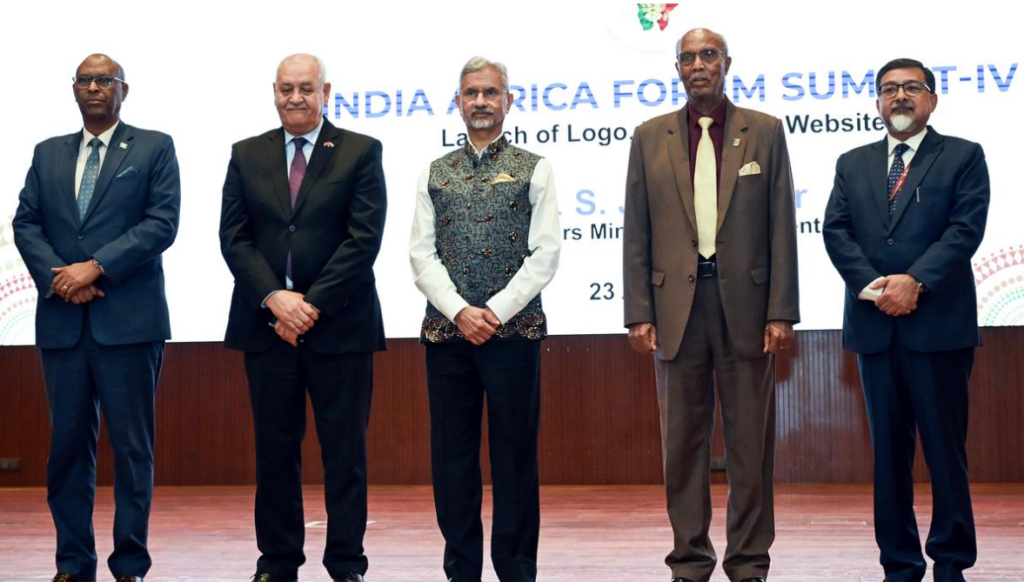
India-Africa Forum Summit (IAFS-IV)
- The India-Africa Forum Summit is the highest institutional mechanism for engagement between India and African countries.
- It serves as the main platform for political dialogue, economic cooperation, and strategic partnership.
- The fourth summit in 2026 is highly significant because it is being held after more than a decade, making it an important opportunity to reset and deepen the relationship.
- The summit will focus on major areas such as trade, healthcare, digital cooperation, food security, maritime security, education, technology transfer, and green development
- India wants the summit to move the relationship from a donor-recipient model toward a partnership of equals based on shared development goals.
Strategic Importance of Africa for India
- Africa is resource-rich: crude oil, natural gas, gold, diamonds, cobalt, lithium → critical for India’s energy and industrial needs.
- Around 15–20% of India’s crude oil imports come from African countries (e.g., Nigeria, Angola).
- Africa is a growing export market for Indian goods: pharmaceuticals, automobiles, textiles, engineering products.
- India is among the top investors in Africa in sectors like telecom, mining, infrastructure, and agriculture.
- Potential for food security cooperation through land availability and agricultural partnerships.
- Africa lies along key Sea Lines of Communication (SLOCs) in the Indian Ocean, crucial for India’s trade and energy flows.
- Eastern African coast is strategically located near major chokepoints:
- Strait of Hormuz
- Bab-el-Mandeb
- Ensures maritime security cooperation (anti-piracy operations, naval presence).
- Africa is central to India’s vision of SAGAR (Security and Growth for All in the Region).
- Counterbalance to growing influence of external powers, especially China, in Africa.
Energy, Fertilizer and Resource Security
- Africa is a major source of hydrocarbons; countries like Nigeria and Angola supply a significant share (≈15–20%) of India’s crude oil imports.
- Availability of natural gas reserves (e.g., Mozambique, Tanzania) supports India’s diversification of energy sources, including LNG imports.
- Rich deposits of critical minerals such as cobalt (DRC), lithium, manganese, and rare earths are essential for renewable energy, batteries, and electronics industries in India.
- Africa holds large reserves of phosphates (Morocco) and potash, crucial for India’s fertilizer security and agricultural productivity.
- India has invested in fertilizer projects and long-term supply agreements in African countries to reduce import dependence.
- Africa’s untapped renewable energy potential (solar, wind) provides scope for collaboration in clean energy transition.
- Ensures diversification of supply chains, reducing overdependence on West Asia and other regions.
- Resource cooperation supports India’s goals of energy security, food security, and industrial growth
Diplomatic Expansion and Institutional Presence
- India has significantly expanded its diplomatic footprint across Africa in recent years.
- India now has 46 diplomatic missions covering all regions of the African continent.
- Since 2018, several new embassies and consulates have been opened to improve political engagement and faster execution of development projects.
- A stronger diplomatic presence helps in trade promotion, protection of Indian citizens, support for Indian businesses, development cooperation, and strategic coordination during crises.
- Diplomatic presence is not only symbolic—it is necessary for sustained and effective foreign policy implementation.
Challenges in India-Africa Relations
- Despite strong goodwill, India faces several challenges in deepening its relationship with Africa. China has a much larger economic presence through infrastructure financing, mining investments, and Belt and Road projects.
- India often faces delays in implementing projects under Lines of Credit due to administrative bottlenecks and financing issues. This affects credibility and speed.
- Trade volume between India and Africa is still lower than its actual potential. Private sector participation from India also remains limited in many strategic sectors.
- Political instability, military coups, terrorism, and civil conflicts in some African countries create additional uncertainty for long-term investments.
- Competition from China, the United States, the European Union, Turkey, and Gulf countries makes strategic engagement more complex.
India vs China in Africa
- China is Africa’s largest trading partner, while India is among the top trading partners but far behind China in volume.
- China follows a state-driven, infrastructure-led model (railways, ports, highways), whereas India follows a demand-driven, partnership-based approach focusing on local needs.
- China provides large-scale loans and finance (often tied to projects); India provides Lines of Credit (LoCs) on concessional and transparent terms.
- China aggressively secures energy and mineral resources through long-term contracts and ownership; India adopts a diversified and less aggressive resource strategy.
Way Forward
India must convert historical goodwill into stronger economic and strategic outcomes. Project execution under Lines of Credit must become faster and more transparent.
Trade agreements and investment partnerships should be expanded, especially in pharmaceuticals, digital public infrastructure, renewable energy, food security, and critical minerals.
Conclusion
India-Africa relations are no longer limited to diplomacy—they are central to India’s strategic autonomy, economic security, and leadership in the Global South.
In a world affected by sanctions, wars, supply disruptions, and geopolitical rivalry, Africa offers India both stability and long-term partnership.
CARE MCQ
Q.With reference to India–Africa relations, consider the following statements:
- The India–Africa Forum Summit is the official platform for cooperation between India and African countries.
- India is a member of the African Union.
- India provides Lines of Credit and capacity-building support to African nations under its development partnership programme.
Which of the statements given above are correct?
(a) 1 and 3 only
(b) 2 and 3 only
(c) 1 and 2 only
(d) 1, 2 and 3
Answer: (a) 1 and 3 only
Explanation:
- Statement 1 is correct: The India–Africa Forum Summit serves as the formal platform for political, economic, and strategic cooperation between India and African countries.
- Statement 2 is incorrect: India is not a member of the African Union; it is a continental organization of African states.
- Statement 3 is correct: India extends Lines of Credit, grants, and capacity-building support to African countries as part of its development partnership and South-South cooperation policy.
Q.With reference to India–Africa trade relations, consider the following statements:
- Africa is one of India’s major partners for crude oil and natural gas imports.
- India has signed a continent-wide Free Trade Agreement with the African Union.
- India is among the top five trading partners of Africa.
Which of the statements given above are correct?
(a) 1 and 3 only
(b) 2 and 3 only
(c) 1 and 2 only
(d) 1, 2 and 3
Answer: (a) 1 and 3 only
Explanation:
- Statement 1 is correct: Africa plays an important role in India’s energy security. Countries such as Nigeria, Angola, Algeria, and Libya have been major suppliers of crude oil and natural gas to India. India imports a significant share of its petroleum requirements from African nations, making the continent an important trade and strategic partner in the energy sector.
- Statement 2 is incorrect: India has not entered into a continent-wide Free Trade Agreement with the African Union. Trade relations are mainly conducted through bilateral agreements with individual African countries and through broader cooperation platforms like the India–Africa Forum Summit. The African Continental Free Trade Area (AfCFTA) is an African initiative and India is not a part of it.
- Statement 3 is correct: India is among the leading trading partners of Africa, along with countries such as China, the United States, and the European Union. India exports pharmaceuticals, machinery, automobiles, textiles, and manufactured goods to Africa, while importing crude oil, gold, phosphates, and other raw materials. This makes India one of Africa’s top five trade partners.
Q. With reference to India’s development cooperation with Africa, consider the following statements:
- The Pan-African e-Network Project was launched to provide tele-education and telemedicine services.
- The project was implemented by the Indian Space Research Organisation alone without involvement of any other institution.
- India offers scholarships and training programmes for African students and professionals under ITEC.
Which of the statements given above are correct?
(a) 1 and 3 only
(b) 2 and 3 only
(c) 1 and 2 only
(d) 1, 2 and 3
Answer: (a) 1 and 3 only
Explanation:
- Statement 1 is correct: The Pan-African e-Network Project was launched by India in 2009 to connect African countries with Indian universities and hospitals through satellite and fibre-optic technology. Its purpose was to provide tele-education, telemedicine, e-governance, and capacity-building support, strengthening India’s development partnership with Africa.
- Statement 2 is incorrect: The project was not implemented by Indian Space Research Organisation alone. It involved multiple institutions, including TCIL (Telecommunications Consultants India Limited), Indian universities, and super-specialty hospitals. ISRO provided satellite support, but the project was a collaborative initiative involving several agencies.
- Statement 3 is correct: Under the Indian Technical and Economic Cooperation (ITEC) programme, India provides scholarships, training courses, skill development, and professional capacity-building programmes for students, civil servants, defence personnel, and professionals from African countries. This reflects India’s emphasis on human resource development and South-South cooperation.
FAQs
Q1. What is IAFS?
IAFS stands for India-Africa Forum Summit, which is the highest political and institutional platform for cooperation between India and African countries.
Q2. Why is Africa important for India?
Africa is important for India because of energy security, fertilizer supply, strategic minerals, trade expansion, maritime security, and Global South diplomacy.
Q3. What is India’s biggest strength in Africa?
India’s biggest strength is historical trust created through anti-colonial solidarity, development partnership, and people-centric cooperation.
Q4. How does India differ from China in Africa?
India focuses more on human development and institutional capacity-building, while China focuses more on infrastructure financing and strategic capital investments.
Q5. Why is the Indian diaspora important in Africa?
The Indian diaspora acts as a living bridge by strengthening trade, cultural trust, long-term partnerships, and India’s soft power influence.