Table of Contents
Relevance: GS Paper II – Polity | Judiciary | Constitutional Bodies | APPSC State Current Affairs
For Prelims:
Article 214, Article 217, Article 222, Article 215, Article 226, High Court, Chief Justice of High Court, Puisne Judge, Collegium System, Transfer of Judges, Writ Jurisdiction, Court of Record
For Mains:
Judicial Appointments, Independence of Judiciary, Collegium System, Federal Judicial Structure, High Court Administration, Constitutional Governance
Why in News?
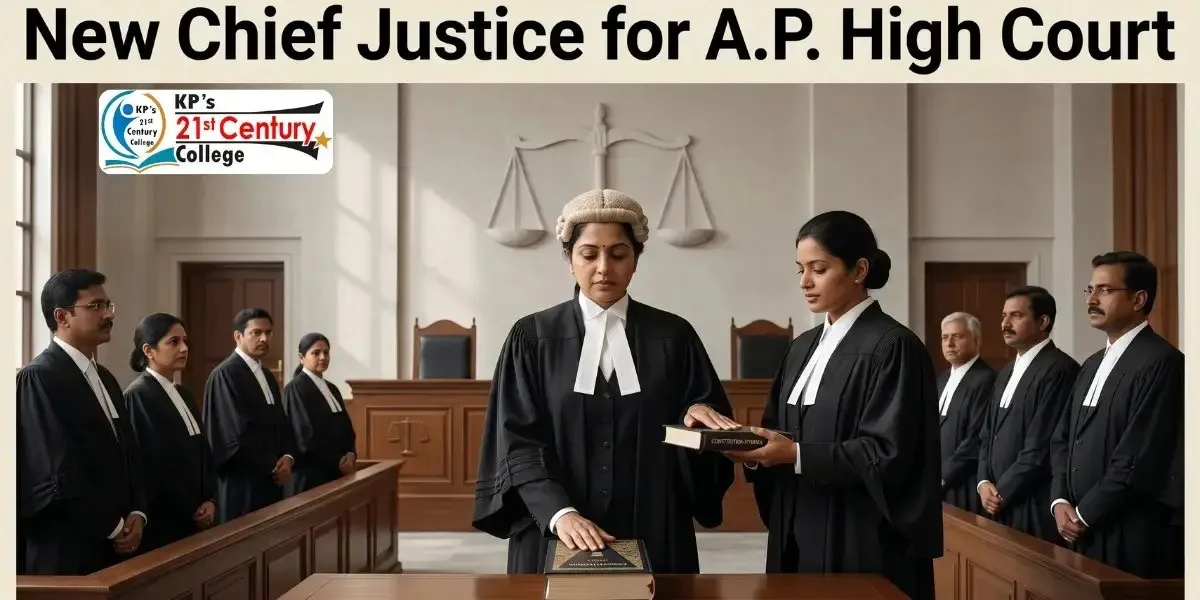
President Droupadi Murmu has appointed Justice Lisa Gill as the Chief Justice of the Andhra Pradesh High Court.
She will assume office on April 25, 2026, after the retirement of the present Chief Justice, Justice Dhiraj Singh Thakur, on April 24.
Justice Lisa Gill was recently transferred from the Punjab and Haryana High Court to the Andhra Pradesh High Court and was serving as a puisne judge before her elevation as Chief Justice.
Her appointment is significant because it reflects the constitutional process of judicial appointments and the recent practice of transferring judges in advance before their elevation as Chief Justice of a High Court.
Constitutional Basis of High Court and Chief Justice Appointment
· High Courts are provided under Part VI, Chapter V of the Constitution of India, and Parliament can establish a common High Court for two or more states. · Under Article 217, the Chief Justice of a High Court is appointed by the President of India. · The appointment is made after consultation with the Chief Justice of India and the Governor of the concerned state; for other judges, the Chief Justice of that High Court is also consulted. · A person is eligible if they are a citizen of India and have either served as a judicial officer for at least ten years or practiced as an advocate of a High Court for at least ten years. · The collegium system, evolved through the Second Judges Case and the Third Judges Case, gives primacy to the judiciary in recommending appointments and transfers. · Article 222 empowers the President to transfer High Court judges; in practice, judges are often transferred in advance when they are likely to be elevated as Chief Justice to ensure administrative continuity. · By convention, the Chief Justice of a High Court is appointed from outside the state to reduce local influence and maintain judicial neutrality. · High Court judges hold office till 62 years, take oath before the Governor, and can be removed only through impeachment by Parliament on grounds of proved misbehaviour or incapacity. |
Appointment Process of Chief Justice of High Court
- The Chief Justice of a High Court is appointed under Article 217 of the Constitution of India by the President of India.
- The process begins with the collegium headed by the Chief Justice of India, which recommends a suitable senior High Court judge for elevation as Chief Justice.
- The collegium system, which gives primacy to the judiciary in appointments, has evolved through the Second Judges Case and the Third Judges Case.
- As a convention, the senior-most judge is generally considered for appointment as Chief Justice, subject to suitability and integrity.
- The Union Law Ministry processes the recommendation and forwards it to the President after obtaining the views of the concerned state Governor.
- It is a settled practice to appoint the Chief Justice from outside the concerned High Court to ensure independence and avoid local bias.
- In many cases, the judge is transferred earlier under Article 222 to the concerned High Court so that they gain administrative experience before assuming office as Chief Justice.
- The appointment becomes effective after the President issues the warrant of appointment, and the Chief Justice takes oath before the Governor of the state.
Transfer of Judges and Collegium System
- Article 222 of the Constitution of India provides that a High Court judge can be transferred from one High Court to another by the President of India.
- Such transfer is made only after consultation with the Chief Justice of India, and this consultation is mandatory.
- The Constitution does not mention the collegium system; it has evolved through judicial decisions like the Second Judges Case and the Third Judges Case.
- Under the collegium system, the recommendation of the Chief Justice of India and senior Supreme Court judges has primacy in matters of transfer and appointment.
- The consent of the judge being transferred is not required.
- The Constitution allows payment of compensatory allowance to a transferred judge.
- Transfer of judges and appointment of Chief Justices from outside the state are used to reduce local influence and ensure judicial independence.
- The Constitution does not specify detailed grounds or procedure for transfer, making it largely dependent on judicial conventions.
Retirement Age
- High Court judges retire at the age of 62 years.
- This is different from Supreme Court judges, who retire at 65 years.
Removal of Judges
- The removal of a High Court judge is provided under Article 217(1)(b) read with Article 124(4) of the Constitution of India.
- A judge can be removed only on two grounds: proved misbehaviour or incapacity.
- The removal motion can be introduced in either House of Parliament.
- The motion must be signed by at least 100 members in Lok Sabha or 50 members in Rajya Sabha before being admitted.
- The presiding officer (Speaker/Chairman) may admit or refuse the motion.
- If admitted, a three-member inquiry committee is constituted under the Judges Inquiry Act, 1968, consisting of:
- A Supreme Court judge
- A Chief Justice of a High Court
- A distinguished jurist
- The judge has the right to defend himself/herself during the investigation.
- If the committee finds the judge guilty, the motion is taken up for voting in both Houses.
- The motion must be passed in each House by a special majority (majority of total membership + 2/3rd of members present and voting).
- After passage in both Houses, the order of removal is issued by the President of India.
- The Constitution does not use the term “impeachment” for judges.
- The same removal procedure applies to both Supreme Court and High Court judges
Control over Subordinate Courts – Article 235
- The High Court exercises administrative and disciplinary control over subordinate courts in the State.
- This ensures judicial discipline and independence of the lower judiciary.
Significance of the Appointment
The appointment of Justice Lisa Gill highlights the functioning of India’s constitutional judicial structure.
It also brings attention to:
- federal nature of judicial administration
- independence of the judiciary
- importance of the collegium system
- constitutional role of the President in judicial appointments
- relationship between constitutional text and judicial conventions
CARE MCQ
Q.With reference to the appointment of the Chief Justice of a High Court, consider the following statements:
- The appointment is made by the President of India under Article 217 of the Constitution.
- A High Court judge can be transferred to another High Court under Article 222.
- A puisne judge refers to the senior-most judge of the Supreme Court after the Chief Justice of India.
Which of the statements given above are correct?
A. 1 and 2 only
B. 2 and 3 only
C. 1 and 3 only
D. 1, 2 and 3
Ans: (a)
Explanation
Statement 1 is correct : Article 217 governs the appointment of High Court judges including the Chief Justice by the President of India.
Statement 2 is correct : Article 222 provides for transfer of judges from one High Court to another.
Statement 3 is incorrect : a puisne judge means any regular High Court judge other than the Chief Justice and is not related to the Supreme Court.
Hence, the correct answer is A.
Q.Consider the following statements regarding the removal of a High Court judge in India:
- The removal of a High Court judge is governed by Article 217 read with Article 124(4) of the Constitution of India.
- A motion for removal can be passed by a simple majority in both Houses of Parliament.
Which of the statements given above is/are correct?
A. 1 only
B. 2 only
C. Both 1 and 2
D. Neither 1 nor 2
Ans: (a)
Explanation:
Statement 1 is correct: Removal provisions for High Court judges are derived from Article 217 along with Article 124(4).
Statement 2 is incorrect: The Constitution requires a special majority, not a simple majority, in both Houses of Parliament for removal.
Q.Consider the following statements regarding the removal of a High Court judge in India:
- The removal motion must be supported by at least 100 members in the Lok Sabha or 50 members in the Rajya Sabha.
- The order for removal is issued by the President of India after the motion is passed by Parliament.
Which of the statements given above is/are correct?
A. 1 only
B. 2 only
C. Both 1 and 2
D. Neither 1 nor 2
Ans: (c)
Explanation:
Statement 1 is correct : the Constitution requires a minimum level of parliamentary support before initiating the removal process. A motion for removal of a judge cannot be introduced casually; it must be signed by at least 100 members in the Lok Sabha or 50 members in the Rajya Sabha. This requirement ensures that only serious and well-founded allegations are taken up for consideration.
Statement 2 is correct: After the motion is passed in both Houses of Parliament by the required special majority, it is presented to the President. The President of India then formally issues the order for removal. The President’s role here is formal, as the decision is effectively taken by Parliament through the prescribed constitutional procedure under the Constitution of India.
APPSC Mains Question
Q. Discuss the constitutional provisions relating to the appointment and transfer of High Court judges in India. How does the collegium system influence this process?
(250 words)
FAQs
Q1. Under which Article is the Chief Justice of a High Court appointed?
Under Article 217 of the Constitution of India.
Q2. What is a puisne judge?
A puisne judge is a regular judge of a High Court other than the Chief Justice.
Q3. Under which Article can a High Court judge be transferred?
Under Article 222 of the Constitution.
Q4. What is the retirement age of High Court judges?
62 years.
Q5. Why are Chief Justices often appointed from outside the parent High Court?
To maintain judicial independence and reduce local influence.