Table of Contents
Relevance: GS Paper III – Agriculture | Economy | Rural Development | Agri-value Chains
For Prelims:
Milky Mushroom, Paddy Straw Mushroom, Button Mushroom, Self Help Groups (SHGs), Agri Diversification, High-Value Crops
For Mains:
Agricultural Diversification, Rural Livelihoods, Value Chain Development, Export-Oriented Agriculture, Women Empowerment
Why in News?
- The Government of Andhra Pradesh, led by N. Chandrababu Naidu, is preparing to launch a “Mushroom Mission” with an estimated investment of ₹13,000 crore.
- The initiative aims to transform the State into India’s largest mushroom producer and create a new agri-based economic ecosystem focused on high-value crops.
What is the Mushroom Mission?
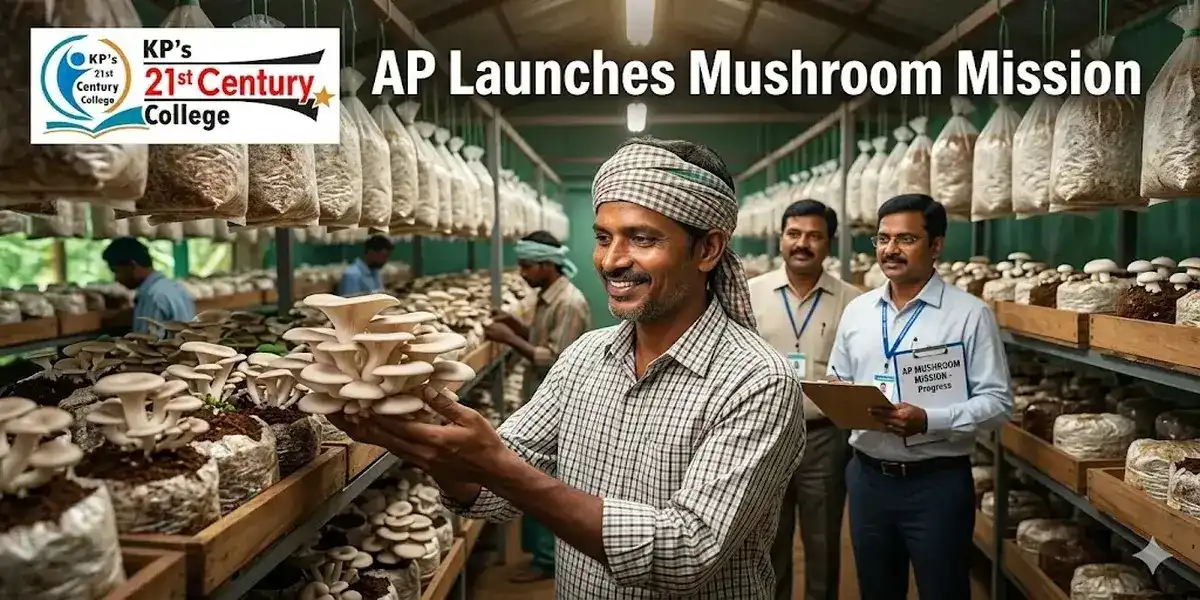
- The Mushroom Mission is a large-scale agricultural diversification programme designed to promote mushroom cultivation as a commercial activity across Andhra Pradesh.
- The mission proposes the establishment of around 62 lakh mushroom production units, primarily small and medium-scale units spread across approximately 5,000 sq ft each.
- The initiative is structured to promote decentralised production, linking cultivation with processing, storage, and marketing.
- The government also proposes to classify mushrooms as agricultural produce, which will enable farmers to access subsidies, institutional credit, and market support systems.
Production Targets and National Context
- The mission aims to increase annual mushroom production in Andhra Pradesh to 67,500 tonnes, surpassing the current leading producer state.
- At present, Bihar is the largest mushroom producer in India with approximately 45,000 tonnes of annual output.
- This shift indicates a strategic move by Andhra Pradesh to enter high-value agricultural markets and compete at the national level.
Institutional and Financial Framework
The total investment proposed under the mission is ₹13,000 crore.
Out of this, approximately ₹5,184 crore will be provided as subsidy support, accounting for nearly 40% of the total cost.
This subsidy will be jointly funded by the Central and State governments.
The mission will involve:
- development of production infrastructure
- support for small and medium enterprises
- establishment of processing units
- strengthening supply chains
This reflects a model similar to earlier successful sectoral missions like aquaculture and millets.
Role of SHGs and Rural Economy
The mission plans to leverage Andhra Pradesh’s strong network of Self Help Groups (SHGs).
SHGs will play a central role in:
- promoting mushroom cultivation at the grassroots level
- enabling women participation in agriculture
- facilitating micro-enterprises
- improving rural household incomes
This aligns the mission with broader goals of women empowerment and inclusive rural development.
Mushroom Varieties and Agro-Climatic Suitability
The mission focuses on commercially viable mushroom varieties suitable for Indian climatic conditions:
Mushroom Type | Key Feature | Suitability |
Milky Mushroom | Heat-resistant | Ideal for tropical climates like Andhra Pradesh |
Paddy Straw Mushroom | Fast-growing | Suitable for paddy-growing regions |
Button Mushroom | High market demand | Requires controlled environment |
These varieties ensure both climatic adaptability and market viability.
Agricultural Significance of Mushroom
Aspect | Key Fact (Prelims-Oriented) |
Nutrient Recycling | Mushrooms decompose lignin and cellulose → convert agro-waste into humus |
Waste Utilization | Grown on paddy straw, wheat straw, bagasse, sawdust (low-cost substrates) |
Soil Health | Spent mushroom substrate (SMS) improves soil organic carbon and microbial activity |
Biofertilizer Role | Certain fungi enhance nutrient availability (especially phosphorus solubilization) |
Climate Resilience | Requires less land, water, and time compared to traditional crops |
Crop Diversification | Ideal for small and marginal farmers; indoor cultivation possible |
Income Source | High value crop with short production cycle (30–60 days) |
Nutritional Security | Rich in protein (20–30% dry weight), vitamins (B-complex), and minerals |
Integrated Farming | Can be linked with poultry, dairy, and vermicomposting systems |
Export Potential | Button mushroom dominates global trade; In |
CARE MCQ
Q. Consider the following statements regarding mushroom cultivation:
- Mushrooms are autotrophic organisms.
- Milky mushrooms are suitable for tropical climates.
- Mushroom cultivation requires large land areas compared to traditional crops.
Which of the statements given above are correct?
(a) 1 only
(b) 2 only
(c) 2 and 3 only
(d) 1, 2 and 3
Ans: (b)
Explanation
Statement 1 is incorrect : mushrooms are heterotrophic fungi and do not perform photosynthesis.
Statement 2 is correct :milky mushrooms are adapted to warm tropical climates.
Statement 3 is incorrect : mushroom cultivation requires relatively small land area.
Q. In mushroom cultivation, the term “spawn” refers to:
(a) Sterilized organic substrate used as a growth medium
(b) Pure culture of fungal mycelium used for inoculation
(c) Fruiting body of the fungus harvested for consumption
(d) Chemical nutrient solution added to enhance growth
Ans: (b)
Explanation: Spawn is the vegetative mycelium of fungi grown on a carrier (like grains) used as inoculum to initiate mushroom cultivation; it is analogous to “seed” in plant cultivation.
Q. In controlled mushroom cultivation, which of the following environmental changes most directly triggers the transition from vegetative mycelial growth to fruiting body formation?
(a) Reduction in carbon dioxide concentration along with increased oxygen availability
(b) Increase in carbon dioxide concentration to enhance metabolic activity
(c) Complete exclusion of light to prevent photo-inhibition of mycelium
(d) Sudden increase in substrate nutrient concentration
Ans: (a)
Explanation:
Fruiting (pinning) in mushrooms is triggered by a shift in environmental conditions, especially:
- Lower CO₂ levels (fresh air exchange)
- Higher oxygen availability
- Along with humidity and temperature adjustments
APPSC Mains Question
Q. Discuss the role of agricultural diversification in enhancing rural incomes. Examine the potential of mushroom cultivation as a sustainable agri-based livelihood option.
(250 words)
FAQs
Q1. Why is the Mushroom Mission important?
Ans: It promotes high-value agriculture and creates new livelihood opportunities.
Q2. Why are mushrooms considered a good crop?
Ans: They require less land, grow quickly, and have high market demand.
Q3. Which state currently leads mushroom production in India?
Ans: Bihar.
Q4. What role do SHGs play in this mission?
Ans: They help in grassroots implementation and promote women’s participation.
Q5. What is the export potential of mushrooms?
Ans: There is high demand in Gulf countries and international markets.