Table of Contents
Relevance: :GS Paper II – International Relations | GS Paper III – Energy | Science and Technology
For Prelims:
Rooppur Nuclear Power Plant (RNPP), VVER-1200, Uranium Fuel Loading, Nuclear Fission, Rosatom, IAEA, Bangladesh Atomic Energy Commission (BAEC), Generation III+ Reactor, Physical Start-up, Nuclear Fuel Assemblies
For Mains:
energy security, nuclear diplomacy, clean energy transition, regional strategic cooperation, low-carbon development, civil nuclear cooperation, sustainable development, South Asian energy transition, nuclear safety governance, Russia-Bangladesh relations
Why in News?
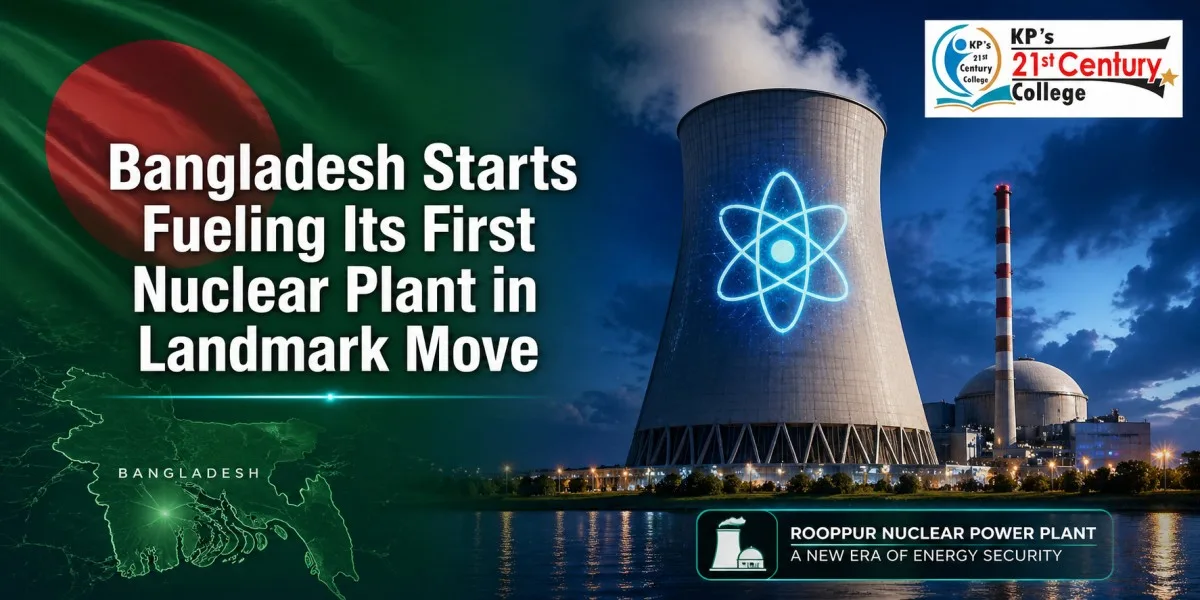
- Bangladesh has started loading uranium fuel into its first nuclear power plant, the Rooppur Nuclear Power Plant (RNPP), marking a historic step in its energy journey.
- This makes Bangladesh enter the final phase before electricity generation from nuclear power begins.
- The plant is expected to generate 2,400 MW of electricity and may meet nearly 10% of the country’s total power demand.
- The project has been built with Russian financial and technical support and represents a major milestone in South Asia’s clean energy transition.
About Rooppur Nuclear Power Plant (RNPP)
- Rooppur Nuclear Power Plant is Bangladesh’s first nuclear power project and the country’s largest power generation project.
- It is located at Rooppur in Ishwardi, Pabna District, on the banks of the Padma River.
- The project is being developed by the Bangladesh Atomic Energy Commission (BAEC) with major support from Russia’s state nuclear corporation Rosatom.
- Bangladesh becomes the 33rd country in the world to use nuclear power for electricity generation.
What is Uranium Fuel Loading?
- Fuel loading is the process of placing enriched uranium fuel assemblies inside the reactor core.
- This marks the beginning of the “physical start-up” phase of a nuclear power plant.
- In RNPP, 163 fuel assemblies are being inserted into the first reactor unit.
- After this stage, the reactor reaches the minimum controllable power level, followed by testing, safety checks, and gradual increase in power generation.
- Only after successful testing does the plant begin supplying electricity to the national grid.
- Thus, fuel loading is one of the most important milestones before actual electricity production begins.
Key Features:
Feature | Details |
Capacity | 2 × 1,200 MW = 2,400 MW |
Reactor Type | VVER-1200 (Generation III+ reactor) |
Safety | Passive & active safety, double containment, core catcher, emergency cooling |
Financial Support | Mainly funded by Russian loans |
India’s Strategic Relevance
- India has a strategic interest in Bangladesh’s nuclear development because of geographical proximity and regional stability.
- India has supported Bangladesh through technical consultations and training assistance.
- A safe and stable nuclear programme in Bangladesh contributes to regional energy cooperation and strengthens South Asian strategic balance.
- It also reflects broader India-Bangladesh cooperation in power, connectivity, and economic development.
Nuclear Fission vs Nuclear Fusion
Nuclear Fission
- It is the splitting of a heavy atomic nucleus such as Uranium-235 into smaller nuclei.
- This releases a huge amount of energy and more neutrons, creating a chain reaction.
- Used in nuclear power plants and atomic bombs.
Nuclear Fusion
- It is the combining of light nuclei such as hydrogen isotopes to form a heavier nucleus.
- This releases even more energy than fission.
- Fusion powers the Sun and stars but is still under experimental research for commercial electricity generation.
Advantages of Nuclear Energy
- Low Carbon Emissions: Supports climate goals and net-zero pathways.
- Reliable Base Load Power:Unlike solar and wind, nuclear plants provide continuous electricity.
- High Energy Density: A small amount of fuel produces a very large amount of energy.
- Reduced Fossil Fuel Dependence:Improves strategic autonomy and energy security.
- Long-Term Supply Stability:Useful for rapidly growing economies with rising power demand.
Challenges of Nuclear Energy
- Radioactive Waste: Safe disposal remains a major long-term challenge.
- High Initial Cost:Plant construction requires massive capital investment and long time periods.
- Safety Risks:Accidents like Chernobyl and Fukushima created major public concern.
- Nuclear Proliferation: Technology misuse for weapons remains a global security concern.
India’s Nuclear Programme
India follows a unique Three-Stage Nuclear Power Programme designed by Dr. Homi J. Bhabha.
Stage I: Pressurized Heavy Water Reactors (PHWRs) using natural uranium
Stage II: Fast Breeder Reactors (FBRs) using plutonium and uranium
Stage III: Thorium-based reactors using India’s large thorium reserves
Recently, the Prototype Fast Breeder Reactor (PFBR) at Kalpakkam achieved criticality, marking India’s progress in Stage II.
Bangladesh’s Rooppur project highlights how nuclear energy remains central to South Asia’s energy future.
Way Forward
Strong regulatory oversight by the IAEA and national authorities must continue.
Regional cooperation in nuclear safety, emergency response, and training should be strengthened. Public awareness regarding peaceful nuclear energy must improve.
Waste management systems and long-term safety protocols should remain a priority.
South Asian countries should balance nuclear expansion with renewable energy integration for sustainable development.
Conclusion
- The start of uranium fuel loading at the Rooppur Nuclear Power Plant marks a historic milestone for Bangladesh’s development journey.
- It strengthens energy security, supports clean growth, and transforms Bangladesh into a nuclear power-producing nation.
- For South Asia, it highlights the growing importance of nuclear energy in achieving sustainable development and strategic autonomy.
CARE MCQ
Q. With reference to the Rooppur Nuclear Power Plant, consider the following statements:
- It is Bangladesh’s first nuclear power plant.
- It uses VVER-1200 Generation III+ reactors.
- The project is being developed with technical and financial support from France.
Which of the statements given above is/are correct?
a) 1 and 2 only
b) 2 and 3 only
c) 1 and 3 only
d) 1, 2 and 3
Ans: (a)
Explanation
Statement 1 is correct : Rooppur is Bangladesh’s first nuclear power project.
Statement 2 is correct : it uses Russian-designed VVER-1200 Generation III+ reactors.
Statement 3 is incorrect: the project is supported by Russia, not France.
Q. Which of the following best describes the principle behind fusion energy production?
(a) Splitting heavy nuclei into lighter fragments through a neutron-induced chain reaction
(b) Combining light nuclei to form a heavier nucleus, with energy released due to mass defect
(c) Sustaining energy release by successive neutron captures in light nuclei at relatively low temperatures
(d) Maintaining the process with slow neutrons in a moderated, subcritical assembly heated to plasma conditions
Ans: (b)
Explanation:
Nuclear fusion is the process in which two light atomic nuclei combine to form a heavier nucleus, releasing a very large amount of energy. This energy comes from the mass defect, where a small amount of mass is converted into energy according to Einstein’s equation E = mc².
A common example is the fusion of Deuterium (D) and Tritium (T) to form Helium and a neutron. Fusion powers the Sun and other stars and is considered a future clean energy source because it produces enormous energy with less long-term radioactive waste compared to fission.
Q. Consider the following statements regarding India’s three-stage nuclear power programme:
Statement-I: The first stage of India’s nuclear power programme, involving Pressurised Heavy Water Reactors (PHWRs), uses natural uranium as fuel and does not require enrichment.
Statement-II: The second stage, focused on Fast Breeder Reactors (FBRs), uses plutonium-239 produced from the first stage and breeds thorium-232 into uranium-235 for use in the third stage.
Which one of the following is correct in respect of the above statements?
(a) Both Statement-I and Statement-II are correct and Statement-II is the correct explanation for Statement-I
(b) Both Statement-I and Statement-II are correct but Statement-II is not the correct explanation for Statement-I
(c) Statement-I is correct but Statement-II is incorrect
(d) Statement-I is incorrect but Statement-II is correct
Ans: (c)
Explanation:
In the first stage of India’s nuclear programme, Pressurised Heavy Water Reactors (PHWRs) are used. These reactors use natural uranium as fuel and heavy water (D₂O) as moderator and coolant. Since PHWRs can efficiently use natural uranium, uranium enrichment is not required, which makes them suitable for India’s limited uranium resources. Therefore, this statement is correct.
Q.Consider the following statements about the applications of nuclear fission:
- Nuclear fission is used in the production of electricity in nuclear power plants.
- It is utilized in the medical field for the treatment of certain types of cancer.
- Nuclear fission is a primary method for the propulsion of deep-space exploration spacecraft.
- The process of nuclear fission is applied in agricultural industries for food irradiation to eliminate pests and extend shelf life.
Which of the statements given above are correct?
a) 1 and 2 only
b) 1, 2, and 4 only
c) 2, 3, and 4 only
d) All of the above
Ans: (b)
Explanation:
Statement 1 is correct: Nuclear fission is used in nuclear power plants to produce heat, which is then converted into electricity through steam turbines.
Statement 2 is correct: In the medical field, radioisotopes produced in nuclear reactors (an outcome of nuclear fission processes) are used in radiation therapy for treating certain cancers.
Statement 3 is incorrect: Deep-space spacecraft generally use solar power or radioisotope thermoelectric generators (RTGs) that rely on natural radioactive decay, not controlled nuclear fission reactors for propulsion.
Statement 4 is correct: Food irradiation to eliminate pests and extend shelf life uses gamma radiation from radioisotopes (like Cobalt-60) that are commonly produced in nuclear reactors, linking it to nuclear fission applications.
FAQs
Q1. Why is Rooppur Nuclear Power Plant important?
Ans: It is Bangladesh’s first nuclear power plant and helps improve energy security and clean energy generation.
Q2. What does uranium fuel loading mean?
Ans:It means placing nuclear fuel inside the reactor core before electricity generation begins.
Q3. What is VVER-1200?
Ans:It is a Russian-designed advanced Generation III+ nuclear reactor with strong safety features.
Q4. How much electricity will RNPP generate?
Ans:It will generate 2,400 MW through two units of 1,200 MW each.
Q5. Why is nuclear power important for developing countries?
Ans: It provides reliable, large-scale, low-carbon electricity and reduces dependence on imported fossil fuels.