
Why in News?
The Prevention of Insults to National Honour (Amendment) Act, 2026 amended Section 3 of the Prevention of Insults to National Honour Act, 1971.
It extends to the National Song, Vande Mataram, the same legal protection previously available to the National Anthem, Jana Gana Mana. It penalises intentional prevention or disruption of its singing but does not make participation compulsory.
About Vande Mataram
- Vande Mataram means “Mother, I Bow to Thee”.
- It was composed by Bankim Chandra Chatterjee.
- It was first published in the literary journal Bangadarshan on November 7, 1875.
- It was later included in the novel Anandamath, published in 1882.
- Rabindranath Tagore set it to music and sang it at the 1896 session of the Indian National Congress in Calcutta.
- It became an important symbol of resistance during the freedom struggle.
- It was used as a political slogan on August 7, 1905, during the Swadeshi movement.
Historical and Constitutional Status
Congress Decision of 1937
- The opening stanzas describe the motherland through pastoral imagery such as water, fruits, cooling breezes and fertile fields.
- The later stanzas contain devotional references to the Hindu goddesses Durga, Lakshmi and Saraswati. Objections were also raised about the context of the song in Anandamath.
- In October 1937, the Congress Working Committee decided that only the first two stanzas would be sung at official gatherings. These stanzas were considered secular in imagery and free from references to deities.
Constituent Assembly Statement
On January 24, 1950, Constituent Assembly President Dr. Rajendra Prasad stated that:
- Jana Gana Mana would be the National Anthem; and
- Vande Mataram, because of its historic role in the freedom struggle, would be honoured equally and accorded equal status.
However:
- Vande Mataram was not made the National Anthem;
- it was not declared a co-anthem; and
- the Constitution does not expressly refer to a “National Song”.
Its status rests on the 1950 statement and subsequent convention.
Prevention of Insults to National Honour Act, 1971
The Act was enacted on December 23, 1971 and extends to the whole of India. It provides statutory protection to:
- the Indian National Flag;
- the Constitution of India; and
- the National Anthem.
Section 2: National Flag and Constitution
Section 2 penalises public acts such as:
- burning;
- mutilating;
- defacing;
- defiling;
- disfiguring;
- destroying; or
- trampling upon
the National Flag or the Constitution.
The punishment may extend to three years’ imprisonment, a fine or both.
Lawful Criticism Protected
Comments criticising the Constitution, the National Flag or government measures do not constitute an offence when they seek a lawful amendment or alteration.
Thus, lawful criticism is distinguished from physical desecration or intentional disrespect.
Original Section 3: National Anthem
Before the 2026 amendment, Section 3 punished anyone who intentionally:
- prevented the singing of the National Anthem; or
- caused disturbance to an assembly singing it.
The punishment could extend to three years’ imprisonment, a fine or both.
Section 3A: Repeat Offences
Section 3A was added in 2003. A person convicted for a second or subsequent offence under Sections 2 or 3 faces a mandatory minimum imprisonment of one year.
Why Was the 2026 Amendment Proposed?
- The 1971 Act expressly protected the National Anthem but contained no corresponding provision for Vande Mataram.
- The Statement of Objects and Reasons recalled Dr. Rajendra Prasad’s declaration that the song should be honoured equally with Jana Gana Mana because of its historic role in the freedom struggle.
- The amendment sought to remove this gap by including the National Song within Section 3.
Legislative Process
The Amendment Bill was:
- introduced in the Rajya Sabha on July 24, 2026;
- passed by the Rajya Sabha on July 29;
- passed by the Lok Sabha on July 30; and
- subsequently given presidential assent.
Major Provisions of the Amendment
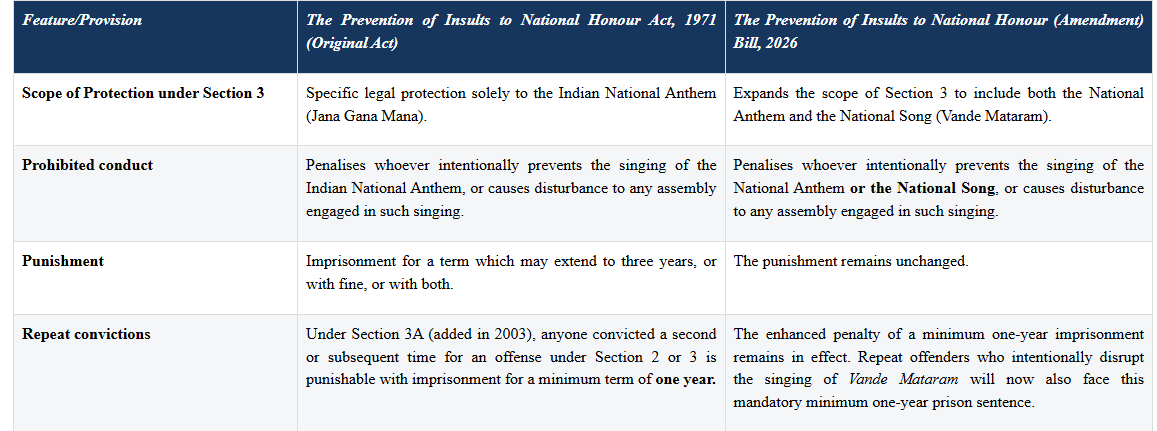
Amendment of Section 3
Clause 2 substituted the existing Section 3 with a provision covering both:
- the National Anthem—Jana Gana Mana; and
- the National Song—Vande Mataram.
Prohibited Conduct
A person commits an offence if the person intentionally:
- prevents the singing of the National Anthem or National Song; or
- causes disturbance to an assembly engaged in such singing.
Punishment
The amendment retains the existing punishment:
- imprisonment of up to three years;
- a fine; or
- both.
For a repeat conviction, Section 3A prescribes a minimum imprisonment of one year.
Amendment at a Glance
What Does the Amendment Not Mandate?
The amendment does not:
- compel anyone to sing Vande Mataram;
- require all six stanzas to be sung;
- prescribe a mandatory version;
- require active participation from every person present; or
- criminalise respectful silence.
Its protection operates only when a rendition is taking place and someone intentionally prevents or disturbs it.
| Constitutionally protected conduct | Punishable conduct |
| Respectfully remaining silent | Intentionally stopping the singing |
| Declining to sing on grounds of conscience | Deliberately disturbing the assembly |
| Permitting others to participate peacefully | Obstructing an ongoing rendition |
Constitutional Concerns Regarding the Later Stanzas
- The first two stanzas describe the motherland through nature-based imagery. The later stanzas identify the motherland with Durga, Lakshmi and Saraswati and use devotional language.
- Compulsory recitation of the complete song may create concerns for citizens whose religious beliefs prohibit participation in the worship of other deities. However, the amendment creates no such compulsion because it neither prescribes the number of stanzas nor requires anyone to participate.
Constitutional Protection of Individual Conscience
Article 19(1)(a): Freedom of Expression
Article 19(1)(a) protects freedom of speech and expression. The Supreme Court has held that this freedom also includes the right to remain silent.
Article 25: Freedom of Conscience
Article 25 protects:
- freedom of conscience; and
- the right freely to profess, practise and propagate religion.
Therefore, a genuine refusal to participate in an activity considered inconsistent with one’s faith may receive constitutional protection.
Article 26: Religious Autonomy
Article 26 protects the right of religious denominations to manage their religious affairs, subject to constitutional limitations.
Article 51A: Fundamental Duties
Article 51A lays down Fundamental Duties, including respect for national symbols. However, Fundamental Duties cannot override the Fundamental Rights guaranteed under Part III of the Constitution.
Bijoe Emmanuel v. State of Kerala, 1986
Background
Three students belonging to the Jehovah’s Witnesses faith stood respectfully during the National Anthem but did not sing it because of their religious beliefs.
They:
- remained silent;
- showed no disrespect; and
- did not disturb other students.
They were nevertheless expelled from school.
Supreme Court’s Decision
The Supreme Court reversed the Kerala High Court’s decision and held that compelling the children to sing violated:
- Article 19(1)(a): freedom of expression, including silence; and
- Article 25(1): freedom of conscience.
Principles Established
The judgment clarified that:
- respect does not necessarily require active participation;
- peaceful silence is different from insult;
- sincere conscientious objection is protected;
- Fundamental Duties cannot override Fundamental Rights; and
- constitutional tolerance protects minority beliefs.
Application to Vande Mataram
The reasoning in Bijoe Emmanuel applies to the National Song.
A person may:
- decline to sing;
- remain respectfully silent; and
- allow others to continue singing.
Such conduct does not amount to intentional prevention or disturbance. The constitutional protection is particularly relevant when an objection concerns the devotional content of the later stanzas.
Present Legal Position
- Vande Mataram has an honoured national status based on the 1950 Constituent Assembly statement and convention.
- Section 3 protects its performance against intentional prevention and disruption.
- The law does not make singing compulsory.
- It does not require all six stanzas or prescribe a mandatory version.
- Respectful silence remains protected under Articles 19 and 25.
- Criminal liability arises from intentional obstruction, not mere non-participation.
Significance
Equal Statutory Protection
The amendment removes the earlier difference between the legal protection given to the National Anthem and the National Song.
Protection of Peaceful Assemblies
It prevents deliberate obstruction of assemblies singing either national composition.
Balance between Honour and Liberty
The provision protects national honour without expressly compelling individual participation.
Recognition of Constitutional Dissent
The legal framework distinguishes peaceful non-participation from intentional disruption.
Major Concerns
- “Disturbance” may receive an excessively broad interpretation.
- Respectful silence could be incorrectly treated as disrespect.
- The law does not specify the protected version of the song.
- Promotion of all six stanzas may create religious concerns.
- The legislation received limited parliamentary scrutiny.
- Incorrect enforcement may create indirect pressure to participate.
Way Forward
- Clearly distinguish intentional disruption from peaceful silence.
- Issue implementation guidelines protecting conscientious objection.
- Avoid using criminal law to compel participation.
- Apply Section 3 consistently with Articles 19 and 25.
- Follow the principles laid down in Bijoe Emmanuel.
- Promote respect for national symbols through tolerance and constitutional awareness.
Conclusion
The 2026 amendment extends legal protection to Vande Mataram without making its singing compulsory. It punishes intentional prevention and disruption, not respectful silence. Constitutional patriotism requires the protection of national honour alongside freedom of expression, religious pluralism and individual conscience.