Why in News?
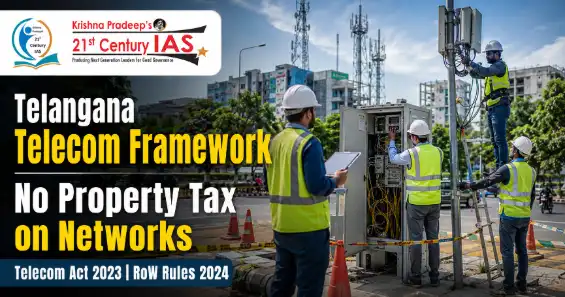
The Telangana government has adopted the Telecommunications Act, 2023 and the Telecommunications (Right of Way) Rules, 2024 through the ITE&C Department’s GO Ms. No. 3. The new framework supersedes Telangana’s 2021 RoW orders and prohibits local authorities from levying property tax, cess or other property-related duties on telecom networks installed on, over or under any property.
Objectives of the New Framework
The orders seek to:
- ensure uniform implementation of the Central telecom law;
- enable time-bound digital processing of RoW applications;
- protect underground telecom infrastructure;
- facilitate BharatNet implementation; and
- strengthen administrative monitoring.
What Is Right of Way?
Right of Way (RoW) refers to permission for installing telecom infrastructure on, over or under public property.
The State’s departments, local bodies, corporations and public-sector units are responsible for processing such applications under the new framework.
Key Provisions
1. Exclusive Digital Processing
All concerned public authorities must:
- nominate nodal officers;
- onboard them on the DoT Telecom e-Services Portal within 30 days; and
- process every RoW application exclusively through the portal.
This creates a uniform and time-bound application system across Telangana.
2. No Property Tax on Telecom Networks
A telecommunication network installed on, over or under a property cannot be treated as part of that property for:
- property transactions;
- property tax;
- levies;
- cess;
- fees; or
- duties.
Municipal corporations, municipalities, gram panchayats and other authorities must exclude such networks from tax assessments.
3. Special Status for BharatNet
BharatNet has been notified as a special project.
Public entities cannot demand the following from its implementing agencies or contractors for infrastructure installed on public property:
- fees;
- rent;
- annuity; or
- bank guarantee.
4. Mandatory Call Before u Dig
The Central government’s Call Before u Dig (CBuD) application has been made mandatory for all excavation work.
Its objective is to prevent accidental damage to underground telecom infrastructure by ensuring prior coordination before digging.
Damage to critical telecom infrastructure may attract:
- imprisonment of up to three years;
- a fine of up to ₹2 crore; or
- both.
5. Electricity Connections
Power distribution companies must:
- treat connections for BharatNet and other notified telecom projects as government connections;
- prioritise new electricity connections; and
- introduce composite billing for multi-site operators.
6. Clearance of Pending Applications
All RoW applications pending up to March 31, 2026 must be cleared by September 30, 2026.
Institutional Monitoring
| Authority | Responsibility |
| Special Chief Secretary, ITE&C | State nodal officer |
| Departments and public entities | Nomination and onboarding of nodal officers |
| District collectors | Monthly telecom committee reviews |
| State Broadband Committee | Quarterly progress reviews |
| Local authorities | Exclusion of telecom networks from tax assessments |
| Discoms | Priority connections and composite billing |
Significance
Uniform Regulation
A common framework prevents departments and local authorities from following different RoW procedures.
Faster Telecom Expansion
Portal-based processing and a deadline for pending applications can accelerate infrastructure deployment.
Reduced Financial Burden
Excluding telecom networks from property taxation provides relief and regulatory clarity to operators.
Support for BharatNet
Special-project status removes specified charges on infrastructure established on public property.
Protection of Critical Infrastructure
Mandatory CBuD use can prevent damage to underground networks during excavation.
Stronger Accountability
Monthly district reviews and quarterly State reviews establish clear administrative supervision.
Conclusion
Telangana’s new telecom framework combines uniform regulation, digital approvals, tax clarity and infrastructure protection. Effective coordination among public authorities, local bodies, discoms and telecom operators will determine its success.