Why in News?
India is promoting regenerative farming through natural farming clusters, micro-irrigation, agroforestry, Integrated Farming Systems and scientific soil management.
As of March 2026:
- natural farming clusters covered 8.80 lakh hectares and enrolled 18.19 lakh farmers;
- approximately 109 lakh hectares were covered under Per Drop More Crop by May 2026; and
- 25.89 crore Soil Health Cards had been generated since the scheme’s inception.
Need for Regenerative Agriculture
India’s agriculture and allied sectors recorded decadal growth of 4.45% during FY2016–FY2025. Sustaining this progress requires restoration of the natural resources on which farming depends.
Major Concerns
- Intensive cultivation has reduced soil vitality.
- Excessive chemical use has increased dependence on external inputs.
- Declining soil health requires farmers to use more inputs for the same output.
- Erratic rainfall, heatwaves, droughts and excess rain increase crop losses.
- Small and marginal farmers face rising costs and uncertain harvests.
- Degraded land and declining water availability threaten long-term productivity.
Regenerative agriculture addresses these concerns by rebuilding soil fertility and strengthening farm resilience.
What Is Regenerative Agriculture?
Regenerative agriculture is a holistic farming approach that seeks to restore soil health, enhance biodiversity and improve the long-term productivity and resilience of farming systems.
Healthy soils:
- support food and nutritional production;
- store carbon;
- retain water;
- promote microorganisms; and
- sustain biodiversity.
Sustainable and Regenerative Agriculture
| Sustainable agriculture | Regenerative agriculture |
| Seeks to maintain existing natural resources | Seeks to restore degraded natural resources |
| Focuses on reducing further environmental harm | Focuses on actively improving ecosystem health |
| Preserves current soil conditions | Rebuilds soil organic matter and fertility |
| Emphasises long-term continuity | Emphasises ecological renewal and resilience |
Core Principles
Regenerative agriculture is based on:
- minimising soil disturbance;
- protecting living roots of perennial crops;
- maintaining continuous soil cover;
- integrating livestock;
- limiting chemical inputs; and
- enhancing biodiversity.
Major Regenerative Practices
1. Water and Resource Efficiency
Micro-irrigation
Drip, sprinkler and fogger systems deliver water more precisely to crops.
They help to:
- reduce water wastage;
- improve water-use efficiency;
- increase crop productivity; and
- strengthen resilience to drought and water stress.
Farm Mechanisation
Mechanisation enables timely and precise agricultural operations. It optimises the use of:
- water;
- fuel;
- fertilisers; and
- other farm inputs.
This reduces wastage, lowers the carbon footprint and improves resource management.
2. Soil and Nutrient Management
Nitrogen Fertiliser Management
Scientific nitrogen management involves:
- selecting the appropriate fertiliser;
- applying it at the correct time and dose;
- deep placement of supergranular urea;
- using leaf-colour charts to assess nitrogen requirements;
- using cyanobacteria as a biological input; and
- practising legume intercropping.
These measures improve nitrogen-use efficiency and reduce nitrous oxide emissions and nutrient losses.
Natural Farming
Natural farming is a chemical-free approach based on traditional knowledge and locally prepared biological inputs.
Important inputs include:
- Beejamrut;
- Jeevamrut;
- GhanJeevamrut;
- Neemastra; and
- Dashparni.
It also promotes:
- native livestock-based inputs;
- traditional seed varieties;
- botanical pest-control formulations;
- continuous cover cropping;
- multi-cropping;
- mulching;
- minimum soil disturbance;
- trees along farm boundaries; and
- integration of crops and livestock.
These practices reduce input costs, maintain soil fertility and restore ecological balance.
Green Manuring
Green-manure crops are grown and incorporated into the soil to:
- add organic matter;
- supply nutrients;
- improve soil structure; and
- increase carbon sequestration.
Cover Cropping
Cover crops are grown mainly to protect the soil rather than for harvesting. They:
- prevent soil erosion;
- maintain organic carbon;
- retain living roots; and
- support nutrient cycling.
Mulching
Mulching covers the soil with organic residues such as leaves and straw. It:
- conserves moisture;
- regulates soil temperature;
- suppresses weeds;
- supports beneficial microorganisms; and
- improves crop productivity.
3. Integrated and Climate-Resilient Farming
Integrated Farming Systems
Integrated Farming Systems combine several farm enterprises within a single system, including:
- crops;
- livestock;
- fisheries;
- horticulture;
- agroforestry; and
- apiculture.
They promote intercropping, crop rotation, multi-cropping and mixed farming.
This approach:
- uses farm resources more efficiently;
- converts the waste of one activity into inputs for another;
- diversifies farmers’ incomes;
- reduces the risk of complete crop failure; and
- improves resilience to floods and droughts.
Agroforestry
Agroforestry integrates trees with agricultural and plantation crops.
It helps to:
- generate additional farm income;
- restore degraded land;
- improve soil moisture;
- regulate local temperatures;
- store carbon;
- reduce greenhouse-gas emissions; and
- strengthen rainfed agriculture.
Climate-Resilient Agriculture
Climate-resilient agriculture includes:
- balanced nutrient and fertiliser use;
- effective pest management;
- judicious water use;
- field-level moisture conservation; and
- soil-protective land preparation.
Its community-level innovations include:
- water-sharing groups;
- seed and fodder systems;
- community nurseries;
- collective marketing arrangements; and
- locally suitable farming technologies.
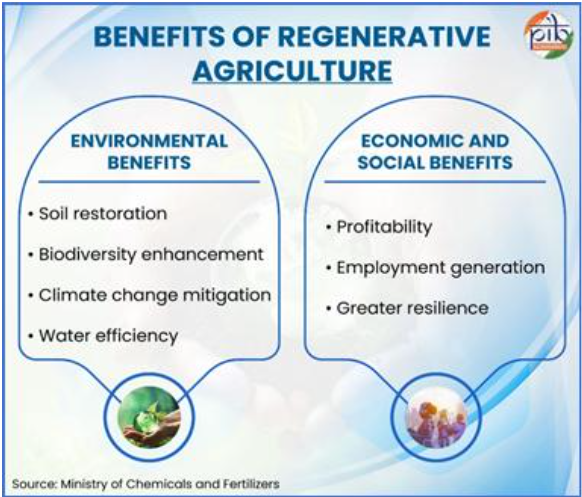
Benefits of Regenerative Agriculture
Environmental Benefits
Soil Restoration
It improves soil organic matter, structure and long-term fertility.
Biodiversity Enhancement
It supports pollinators, beneficial insects, soil microorganisms and other species.
Climate-change Mitigation
Improved soils and tree-based systems absorb and store carbon, helping reduce agricultural emissions.
Water Conservation
Healthy soils retain more water, reduce runoff and limit the movement of sediment and pollutants into rivers and lakes.
Economic and Social Benefits
Lower Input Costs
Reduced dependence on synthetic fertilisers, pesticides and excessive irrigation lowers cultivation costs.
Improved Profitability
Healthier soils and efficient resource use help stabilise yields and improve net farm income.
Greater Resilience
Diversified farms can better withstand climatic variability, crop failure and market fluctuations.
Employment Generation
New opportunities can emerge in:
- farming;
- advisory services;
- bio-input production;
- technology; and
- ecological management.
Link with Sustainable Development Goals
Regenerative agriculture supports SDG 13—Climate Action, particularly Target 13.1, which seeks to strengthen resilience and adaptive capacity to climate-related hazards and natural disasters.
It contributes by:
- improving farm-level adaptation;
- increasing carbon storage;
- reducing emissions;
- protecting water resources; and
- strengthening resilience to climatic shocks.
Government Initiatives
1. National Mission on Natural Farming
The National Mission on Natural Farming (NMNF) was launched in 2024 to help farmers progressively shift towards natural farming.
Key Features
- Output-based incentive of ₹4,000 per acre per year for two years
- Assistance limited to one acre per farmer
- Provision for 10,000 need-based Bio-input Resource Centres
- Formation of natural farming clusters
- Two Community Resource Persons for each cluster
The CRPs were trained through Krishi Vigyan Kendras, agricultural universities and local natural-farming institutions.
2. Paramparagat Krishi Vikas Yojana
The Paramparagat Krishi Vikas Yojana (PKVY) was launched in 2015 to support organic farming.
It assists farmers in:
- adopting eco-friendly practices;
- obtaining organic certification; and
- accessing markets for organic produce.
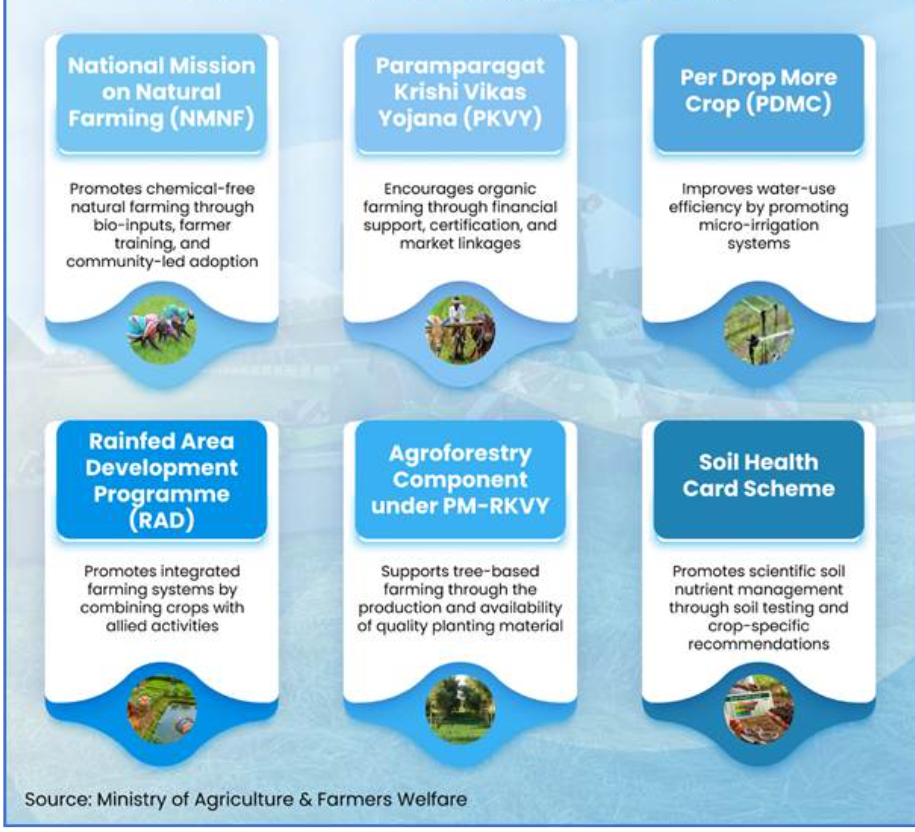
3. Per Drop More Crop
Per Drop More Crop (PDMC) has been implemented since 2015–16 to promote drip and sprinkler irrigation.
Financial Assistance
- Small and marginal farmers: 55%
- Other farmers: 45%
- States may provide additional subsidies from their budgets.
4. Rainfed Area Development Programme
The Rainfed Area Development Programme (RAD) has operated since 2014–15. It promotes Integrated Farming Systems through an area-based cluster approach.
Key Features
- Clusters of approximately 20 hectares
- Multi-cropping, crop rotation, intercropping and mixed cropping
- Integration of horticulture, livestock, fisheries and apiculture
- Assistance of ₹30,000 per family
- Additional ₹10,000 per cluster for training and capacity building
During 2024–25, KVKs conducted 4,416 demonstrations and trained 96,013 farmers in location-specific IFS models. An allocation of ₹343.86 crore was made to States and Union Territories for RAD in 2025–26.
5. Agroforestry Component under PM-RKVY
The former Sub-Mission on Agroforestry was restructured as the Agroforestry Component under PM-RKVY from 2023–24.
Activities Supported
- establishment of new nurseries;
- sapling production in existing nurseries;
- tissue-culture units;
- skill development;
- awareness programmes;
- research and development;
- monitoring and evaluation;
- voluntary agricultural carbon-market projects; and
- local agroforestry initiatives.
Assistance Pattern
- Government agencies: 100% assistance
- Private beneficiaries: 50% back-ended credit-linked assistance
Progress during 2025–26
- Sanctions: ₹78.31 crore
- States and Union Territories covered: 27
- New nurseries established: 135
- Existing nurseries producing saplings: 614
- Saplings raised: 176.59 lakh
- Farmers benefited: approximately 25,693
6. Soil Health Card Scheme
The Soil Health Card Scheme, launched in 2015, provides plot-wise soil-test reports for each landholding.
Key Features
- Assesses soil health across 12 parameters
- Covers macronutrients, micronutrients and soil properties
- Cards are issued every two years
- Provides crop-specific recommendations on:
- chemical fertilisers;
- bio-fertilisers;
- organic inputs; and
- soil treatments.
Major Implementation Challenges
- Convincing farmers to shift from familiar input-intensive practices
- Managing initial transition risks and possible short-term uncertainty
- Ensuring access to quality biological inputs and planting material
- Providing location-specific technical guidance
- Expanding micro-irrigation in water-stressed areas
- Creating reliable certification and market access for organic produce
- Coordinating multiple schemes and implementing institutions
- Measuring soil improvement and carbon storage scientifically
- Making regenerative practices economically viable for small farmers
Way Forward
- Strengthen cluster-based implementation and farmer-to-farmer learning.
- Expand Bio-input Resource Centres near natural-farming clusters.
- Provide location-specific advice through KVKs and trained Krishi Sakhis.
- Integrate Soil Health Card recommendations with farm-level planning.
- Promote water-efficient systems according to local water availability.
- Develop assured markets and credible certification for regenerative produce.
- Encourage crop-livestock-tree integration in rainfed regions.
- Monitor soil carbon, biodiversity, water use and farmers’ income.
- Support farmers during the initial transition period.
- Converge natural farming, micro-irrigation, agroforestry and IFS programmes.
Conclusion
Regenerative agriculture seeks to move Indian farming from resource depletion towards ecological restoration. By rebuilding soil health, conserving water, increasing biodiversity and diversifying farm income, it can strengthen both agricultural productivity and climate resilience. Government schemes provide an expanding support system, but successful transformation will depend on local adaptation, scientific monitoring, farmer training and remunerative markets.