
Why in News?
The Telangana government has adopted the Telecommunications Act, 2023 and the Telecommunications (Right of Way) Rules, 2024 through the ITE&C Department’s GO Ms. No. 3. The new framework supersedes Telangana’s 2021 RoW orders and prohibits local authorities from levying property tax, cess or other property-related duties on telecom networks installed on, over or under any property.
Objectives of the New Framework
The orders seek to:
- ensure uniform implementation of the Central telecom law;
- enable time-bound digital processing of RoW applications;
- protect underground telecom infrastructure;
- facilitate BharatNet implementation; and
- strengthen administrative monitoring.
What Is Right of Way?
Right of Way (RoW) refers to permission for installing telecom infrastructure on, over or under public property.
The State’s departments, local bodies, corporations and public-sector units are responsible for processing such applications under the new framework.
Key Provisions
1. Exclusive Digital Processing
All concerned public authorities must:
- nominate nodal officers;
- onboard them on the DoT Telecom e-Services Portal within 30 days; and
- process every RoW application exclusively through the portal.
This creates a uniform and time-bound application system across Telangana.
2. No Property Tax on Telecom Networks
A telecommunication network installed on, over or under a property cannot be treated as part of that property for:
- property transactions;
- property tax;
- levies;
- cess;
- fees; or
- duties.
Municipal corporations, municipalities, gram panchayats and other authorities must exclude such networks from tax assessments.
3. Special Status for BharatNet
BharatNet has been notified as a special project.
Public entities cannot demand the following from its implementing agencies or contractors for infrastructure installed on public property:
- fees;
- rent;
- annuity; or
- bank guarantee.
4. Mandatory Call Before u Dig
The Central government’s Call Before u Dig (CBuD) application has been made mandatory for all excavation work.
Its objective is to prevent accidental damage to underground telecom infrastructure by ensuring prior coordination before digging.
Damage to critical telecom infrastructure may attract:
- imprisonment of up to three years;
- a fine of up to ₹2 crore; or
- both.
5. Electricity Connections
Power distribution companies must:
- treat connections for BharatNet and other notified telecom projects as government connections;
- prioritise new electricity connections; and
- introduce composite billing for multi-site operators.
6. Clearance of Pending Applications
All RoW applications pending up to March 31, 2026 must be cleared by September 30, 2026.
Institutional Monitoring
| Authority | Responsibility |
| Special Chief Secretary, ITE&C | State nodal officer |
| Departments and public entities | Nomination and onboarding of nodal officers |
| District collectors | Monthly telecom committee reviews |
| State Broadband Committee | Quarterly progress reviews |
| Local authorities | Exclusion of telecom networks from tax assessments |
| Discoms | Priority connections and composite billing |
Significance
Uniform Regulation
A common framework prevents departments and local authorities from following different RoW procedures.
Faster Telecom Expansion
Portal-based processing and a deadline for pending applications can accelerate infrastructure deployment.
Reduced Financial Burden
Excluding telecom networks from property taxation provides relief and regulatory clarity to operators.
Support for BharatNet
Special-project status removes specified charges on infrastructure established on public property.
Protection of Critical Infrastructure
Mandatory CBuD use can prevent damage to underground networks during excavation.
Stronger Accountability
Monthly district reviews and quarterly State reviews establish clear administrative supervision.
Conclusion
Telangana’s new telecom framework combines uniform regulation, digital approvals, tax clarity and infrastructure protection. Effective coordination among public authorities, local bodies, discoms and telecom operators will determine its success.
Why in News?
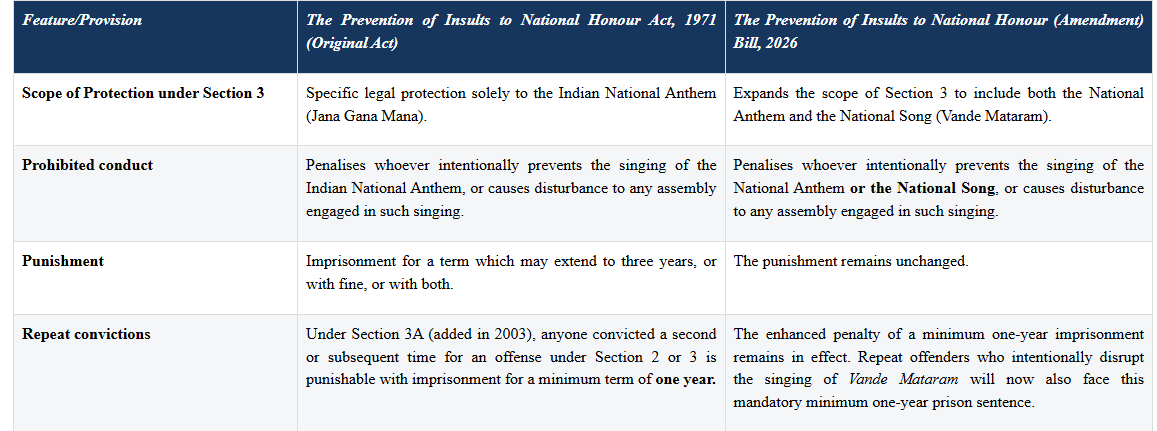
The Prevention of Insults to National Honour (Amendment) Act, 2026 amended Section 3 of the Prevention of Insults to National Honour Act, 1971.
It extends to the National Song, Vande Mataram, the same legal protection previously available to the National Anthem, Jana Gana Mana. It penalises intentional prevention or disruption of its singing but does not make participation compulsory.
About Vande Mataram
- Vande Mataram means “Mother, I Bow to Thee”.
- It was composed by Bankim Chandra Chatterjee.
- It was first published in the literary journal Bangadarshan on November 7, 1875.
- It was later included in the novel Anandamath, published in 1882.
- Rabindranath Tagore set it to music and sang it at the 1896 session of the Indian National Congress in Calcutta.
- It became an important symbol of resistance during the freedom struggle.
- It was used as a political slogan on August 7, 1905, during the Swadeshi movement.
Historical and Constitutional Status
Congress Decision of 1937
- The opening stanzas describe the motherland through pastoral imagery such as water, fruits, cooling breezes and fertile fields.
- The later stanzas contain devotional references to the Hindu goddesses Durga, Lakshmi and Saraswati. Objections were also raised about the context of the song in Anandamath.
- In October 1937, the Congress Working Committee decided that only the first two stanzas would be sung at official gatherings. These stanzas were considered secular in imagery and free from references to deities.
Constituent Assembly Statement
On January 24, 1950, Constituent Assembly President Dr. Rajendra Prasad stated that:
- Jana Gana Mana would be the National Anthem; and
- Vande Mataram, because of its historic role in the freedom struggle, would be honoured equally and accorded equal status.
However:
- Vande Mataram was not made the National Anthem;
- it was not declared a co-anthem; and
- the Constitution does not expressly refer to a “National Song”.
Its status rests on the 1950 statement and subsequent convention.
Prevention of Insults to National Honour Act, 1971
The Act was enacted on December 23, 1971 and extends to the whole of India. It provides statutory protection to:
- the Indian National Flag;
- the Constitution of India; and
- the National Anthem.
Section 2: National Flag and Constitution
Section 2 penalises public acts such as:
- burning;
- mutilating;
- defacing;
- defiling;
- disfiguring;
- destroying; or
- trampling upon
the National Flag or the Constitution.
The punishment may extend to three years’ imprisonment, a fine or both.
Lawful Criticism Protected
Comments criticising the Constitution, the National Flag or government measures do not constitute an offence when they seek a lawful amendment or alteration.
Thus, lawful criticism is distinguished from physical desecration or intentional disrespect.
Original Section 3: National Anthem
Before the 2026 amendment, Section 3 punished anyone who intentionally:
- prevented the singing of the National Anthem; or
- caused disturbance to an assembly singing it.
The punishment could extend to three years’ imprisonment, a fine or both.
Section 3A: Repeat Offences
Section 3A was added in 2003. A person convicted for a second or subsequent offence under Sections 2 or 3 faces a mandatory minimum imprisonment of one year.
Why Was the 2026 Amendment Proposed?
- The 1971 Act expressly protected the National Anthem but contained no corresponding provision for Vande Mataram.
- The Statement of Objects and Reasons recalled Dr. Rajendra Prasad’s declaration that the song should be honoured equally with Jana Gana Mana because of its historic role in the freedom struggle.
- The amendment sought to remove this gap by including the National Song within Section 3.
Legislative Process
The Amendment Bill was:
- introduced in the Rajya Sabha on July 24, 2026;
- passed by the Rajya Sabha on July 29;
- passed by the Lok Sabha on July 30; and
- subsequently given presidential assent.
Major Provisions of the Amendment
Amendment of Section 3
Clause 2 substituted the existing Section 3 with a provision covering both:
- the National Anthem—Jana Gana Mana; and
- the National Song—Vande Mataram.
Prohibited Conduct
A person commits an offence if the person intentionally:
- prevents the singing of the National Anthem or National Song; or
- causes disturbance to an assembly engaged in such singing.
Punishment
The amendment retains the existing punishment:
- imprisonment of up to three years;
- a fine; or
- both.
For a repeat conviction, Section 3A prescribes a minimum imprisonment of one year.
Amendment at a Glance
What Does the Amendment Not Mandate?
The amendment does not:
- compel anyone to sing Vande Mataram;
- require all six stanzas to be sung;
- prescribe a mandatory version;
- require active participation from every person present; or
- criminalise respectful silence.
Its protection operates only when a rendition is taking place and someone intentionally prevents or disturbs it.
| Constitutionally protected conduct | Punishable conduct |
| Respectfully remaining silent | Intentionally stopping the singing |
| Declining to sing on grounds of conscience | Deliberately disturbing the assembly |
| Permitting others to participate peacefully | Obstructing an ongoing rendition |
Constitutional Concerns Regarding the Later Stanzas
- The first two stanzas describe the motherland through nature-based imagery. The later stanzas identify the motherland with Durga, Lakshmi and Saraswati and use devotional language.
- Compulsory recitation of the complete song may create concerns for citizens whose religious beliefs prohibit participation in the worship of other deities. However, the amendment creates no such compulsion because it neither prescribes the number of stanzas nor requires anyone to participate.
Constitutional Protection of Individual Conscience
Article 19(1)(a): Freedom of Expression
Article 19(1)(a) protects freedom of speech and expression. The Supreme Court has held that this freedom also includes the right to remain silent.
Article 25: Freedom of Conscience
Article 25 protects:
- freedom of conscience; and
- the right freely to profess, practise and propagate religion.
Therefore, a genuine refusal to participate in an activity considered inconsistent with one’s faith may receive constitutional protection.
Article 26: Religious Autonomy
Article 26 protects the right of religious denominations to manage their religious affairs, subject to constitutional limitations.
Article 51A: Fundamental Duties
Article 51A lays down Fundamental Duties, including respect for national symbols. However, Fundamental Duties cannot override the Fundamental Rights guaranteed under Part III of the Constitution.
Bijoe Emmanuel v. State of Kerala, 1986
Background
Three students belonging to the Jehovah’s Witnesses faith stood respectfully during the National Anthem but did not sing it because of their religious beliefs.
They:
- remained silent;
- showed no disrespect; and
- did not disturb other students.
They were nevertheless expelled from school.
Supreme Court’s Decision
The Supreme Court reversed the Kerala High Court’s decision and held that compelling the children to sing violated:
- Article 19(1)(a): freedom of expression, including silence; and
- Article 25(1): freedom of conscience.
Principles Established
The judgment clarified that:
- respect does not necessarily require active participation;
- peaceful silence is different from insult;
- sincere conscientious objection is protected;
- Fundamental Duties cannot override Fundamental Rights; and
- constitutional tolerance protects minority beliefs.
Application to Vande Mataram
The reasoning in Bijoe Emmanuel applies to the National Song.
A person may:
- decline to sing;
- remain respectfully silent; and
- allow others to continue singing.
Such conduct does not amount to intentional prevention or disturbance. The constitutional protection is particularly relevant when an objection concerns the devotional content of the later stanzas.
Present Legal Position
- Vande Mataram has an honoured national status based on the 1950 Constituent Assembly statement and convention.
- Section 3 protects its performance against intentional prevention and disruption.
- The law does not make singing compulsory.
- It does not require all six stanzas or prescribe a mandatory version.
- Respectful silence remains protected under Articles 19 and 25.
- Criminal liability arises from intentional obstruction, not mere non-participation.
Significance
Equal Statutory Protection
The amendment removes the earlier difference between the legal protection given to the National Anthem and the National Song.
Protection of Peaceful Assemblies
It prevents deliberate obstruction of assemblies singing either national composition.
Balance between Honour and Liberty
The provision protects national honour without expressly compelling individual participation.
Recognition of Constitutional Dissent
The legal framework distinguishes peaceful non-participation from intentional disruption.
Major Concerns
- “Disturbance” may receive an excessively broad interpretation.
- Respectful silence could be incorrectly treated as disrespect.
- The law does not specify the protected version of the song.
- Promotion of all six stanzas may create religious concerns.
- The legislation received limited parliamentary scrutiny.
- Incorrect enforcement may create indirect pressure to participate.
Way Forward
- Clearly distinguish intentional disruption from peaceful silence.
- Issue implementation guidelines protecting conscientious objection.
- Avoid using criminal law to compel participation.
- Apply Section 3 consistently with Articles 19 and 25.
- Follow the principles laid down in Bijoe Emmanuel.
- Promote respect for national symbols through tolerance and constitutional awareness.
Conclusion
The 2026 amendment extends legal protection to Vande Mataram without making its singing compulsory. It punishes intentional prevention and disruption, not respectful silence. Constitutional patriotism requires the protection of national honour alongside freedom of expression, religious pluralism and individual conscience.
Why in News?
India is promoting regenerative farming through natural farming clusters, micro-irrigation, agroforestry, Integrated Farming Systems and scientific soil management.
As of March 2026:
- natural farming clusters covered 8.80 lakh hectares and enrolled 18.19 lakh farmers;
- approximately 109 lakh hectares were covered under Per Drop More Crop by May 2026; and
- 25.89 crore Soil Health Cards had been generated since the scheme’s inception.
Need for Regenerative Agriculture
India’s agriculture and allied sectors recorded decadal growth of 4.45% during FY2016–FY2025. Sustaining this progress requires restoration of the natural resources on which farming depends.
Major Concerns
- Intensive cultivation has reduced soil vitality.
- Excessive chemical use has increased dependence on external inputs.
- Declining soil health requires farmers to use more inputs for the same output.
- Erratic rainfall, heatwaves, droughts and excess rain increase crop losses.
- Small and marginal farmers face rising costs and uncertain harvests.
- Degraded land and declining water availability threaten long-term productivity.
Regenerative agriculture addresses these concerns by rebuilding soil fertility and strengthening farm resilience.
What Is Regenerative Agriculture?
Regenerative agriculture is a holistic farming approach that seeks to restore soil health, enhance biodiversity and improve the long-term productivity and resilience of farming systems.
Healthy soils:
- support food and nutritional production;
- store carbon;
- retain water;
- promote microorganisms; and
- sustain biodiversity.
Sustainable and Regenerative Agriculture
| Sustainable agriculture | Regenerative agriculture |
| Seeks to maintain existing natural resources | Seeks to restore degraded natural resources |
| Focuses on reducing further environmental harm | Focuses on actively improving ecosystem health |
| Preserves current soil conditions | Rebuilds soil organic matter and fertility |
| Emphasises long-term continuity | Emphasises ecological renewal and resilience |
Core Principles
Regenerative agriculture is based on:
- minimising soil disturbance;
- protecting living roots of perennial crops;
- maintaining continuous soil cover;
- integrating livestock;
- limiting chemical inputs; and
- enhancing biodiversity.
Major Regenerative Practices
1. Water and Resource Efficiency
Micro-irrigation
Drip, sprinkler and fogger systems deliver water more precisely to crops.
They help to:
- reduce water wastage;
- improve water-use efficiency;
- increase crop productivity; and
- strengthen resilience to drought and water stress.
Farm Mechanisation
Mechanisation enables timely and precise agricultural operations. It optimises the use of:
- water;
- fuel;
- fertilisers; and
- other farm inputs.
This reduces wastage, lowers the carbon footprint and improves resource management.
2. Soil and Nutrient Management
Nitrogen Fertiliser Management
Scientific nitrogen management involves:
- selecting the appropriate fertiliser;
- applying it at the correct time and dose;
- deep placement of supergranular urea;
- using leaf-colour charts to assess nitrogen requirements;
- using cyanobacteria as a biological input; and
- practising legume intercropping.
These measures improve nitrogen-use efficiency and reduce nitrous oxide emissions and nutrient losses.
Natural Farming
Natural farming is a chemical-free approach based on traditional knowledge and locally prepared biological inputs.
Important inputs include:
- Beejamrut;
- Jeevamrut;
- GhanJeevamrut;
- Neemastra; and
- Dashparni.
It also promotes:
- native livestock-based inputs;
- traditional seed varieties;
- botanical pest-control formulations;
- continuous cover cropping;
- multi-cropping;
- mulching;
- minimum soil disturbance;
- trees along farm boundaries; and
- integration of crops and livestock.
These practices reduce input costs, maintain soil fertility and restore ecological balance.
Green Manuring
Green-manure crops are grown and incorporated into the soil to:
- add organic matter;
- supply nutrients;
- improve soil structure; and
- increase carbon sequestration.
Cover Cropping
Cover crops are grown mainly to protect the soil rather than for harvesting. They:
- prevent soil erosion;
- maintain organic carbon;
- retain living roots; and
- support nutrient cycling.
Mulching
Mulching covers the soil with organic residues such as leaves and straw. It:
- conserves moisture;
- regulates soil temperature;
- suppresses weeds;
- supports beneficial microorganisms; and
- improves crop productivity.
3. Integrated and Climate-Resilient Farming
Integrated Farming Systems
Integrated Farming Systems combine several farm enterprises within a single system, including:
- crops;
- livestock;
- fisheries;
- horticulture;
- agroforestry; and
- apiculture.
They promote intercropping, crop rotation, multi-cropping and mixed farming.
This approach:
- uses farm resources more efficiently;
- converts the waste of one activity into inputs for another;
- diversifies farmers’ incomes;
- reduces the risk of complete crop failure; and
- improves resilience to floods and droughts.
Agroforestry
Agroforestry integrates trees with agricultural and plantation crops.
It helps to:
- generate additional farm income;
- restore degraded land;
- improve soil moisture;
- regulate local temperatures;
- store carbon;
- reduce greenhouse-gas emissions; and
- strengthen rainfed agriculture.
Climate-Resilient Agriculture
Climate-resilient agriculture includes:
- balanced nutrient and fertiliser use;
- effective pest management;
- judicious water use;
- field-level moisture conservation; and
- soil-protective land preparation.
Its community-level innovations include:
- water-sharing groups;
- seed and fodder systems;
- community nurseries;
- collective marketing arrangements; and
- locally suitable farming technologies.
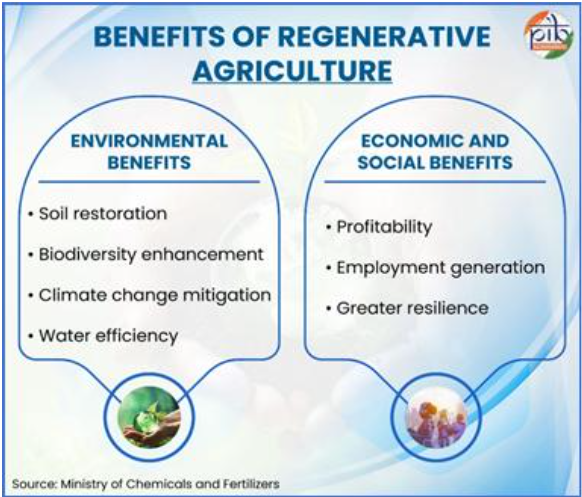
Benefits of Regenerative Agriculture
Environmental Benefits
Soil Restoration
It improves soil organic matter, structure and long-term fertility.
Biodiversity Enhancement
It supports pollinators, beneficial insects, soil microorganisms and other species.
Climate-change Mitigation
Improved soils and tree-based systems absorb and store carbon, helping reduce agricultural emissions.
Water Conservation
Healthy soils retain more water, reduce runoff and limit the movement of sediment and pollutants into rivers and lakes.
Economic and Social Benefits
Lower Input Costs
Reduced dependence on synthetic fertilisers, pesticides and excessive irrigation lowers cultivation costs.
Improved Profitability
Healthier soils and efficient resource use help stabilise yields and improve net farm income.
Greater Resilience
Diversified farms can better withstand climatic variability, crop failure and market fluctuations.
Employment Generation
New opportunities can emerge in:
- farming;
- advisory services;
- bio-input production;
- technology; and
- ecological management.
Link with Sustainable Development Goals
Regenerative agriculture supports SDG 13—Climate Action, particularly Target 13.1, which seeks to strengthen resilience and adaptive capacity to climate-related hazards and natural disasters.
It contributes by:
- improving farm-level adaptation;
- increasing carbon storage;
- reducing emissions;
- protecting water resources; and
- strengthening resilience to climatic shocks.
Government Initiatives
1. National Mission on Natural Farming
The National Mission on Natural Farming (NMNF) was launched in 2024 to help farmers progressively shift towards natural farming.
Key Features
- Output-based incentive of ₹4,000 per acre per year for two years
- Assistance limited to one acre per farmer
- Provision for 10,000 need-based Bio-input Resource Centres
- Formation of natural farming clusters
- Two Community Resource Persons for each cluster
The CRPs were trained through Krishi Vigyan Kendras, agricultural universities and local natural-farming institutions.
2. Paramparagat Krishi Vikas Yojana
The Paramparagat Krishi Vikas Yojana (PKVY) was launched in 2015 to support organic farming.
It assists farmers in:
- adopting eco-friendly practices;
- obtaining organic certification; and
- accessing markets for organic produce.
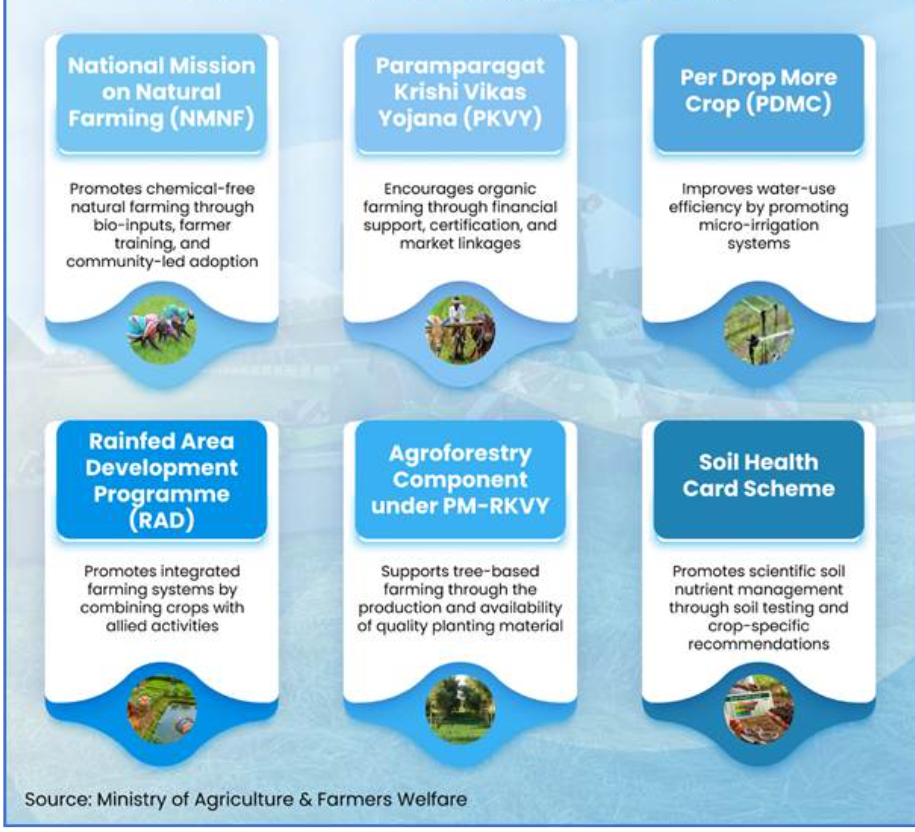
3. Per Drop More Crop
Per Drop More Crop (PDMC) has been implemented since 2015–16 to promote drip and sprinkler irrigation.
Financial Assistance
- Small and marginal farmers: 55%
- Other farmers: 45%
- States may provide additional subsidies from their budgets.
4. Rainfed Area Development Programme
The Rainfed Area Development Programme (RAD) has operated since 2014–15. It promotes Integrated Farming Systems through an area-based cluster approach.
Key Features
- Clusters of approximately 20 hectares
- Multi-cropping, crop rotation, intercropping and mixed cropping
- Integration of horticulture, livestock, fisheries and apiculture
- Assistance of ₹30,000 per family
- Additional ₹10,000 per cluster for training and capacity building
During 2024–25, KVKs conducted 4,416 demonstrations and trained 96,013 farmers in location-specific IFS models. An allocation of ₹343.86 crore was made to States and Union Territories for RAD in 2025–26.
5. Agroforestry Component under PM-RKVY
The former Sub-Mission on Agroforestry was restructured as the Agroforestry Component under PM-RKVY from 2023–24.
Activities Supported
- establishment of new nurseries;
- sapling production in existing nurseries;
- tissue-culture units;
- skill development;
- awareness programmes;
- research and development;
- monitoring and evaluation;
- voluntary agricultural carbon-market projects; and
- local agroforestry initiatives.
Assistance Pattern
- Government agencies: 100% assistance
- Private beneficiaries: 50% back-ended credit-linked assistance
Progress during 2025–26
- Sanctions: ₹78.31 crore
- States and Union Territories covered: 27
- New nurseries established: 135
- Existing nurseries producing saplings: 614
- Saplings raised: 176.59 lakh
- Farmers benefited: approximately 25,693
6. Soil Health Card Scheme
The Soil Health Card Scheme, launched in 2015, provides plot-wise soil-test reports for each landholding.
Key Features
- Assesses soil health across 12 parameters
- Covers macronutrients, micronutrients and soil properties
- Cards are issued every two years
- Provides crop-specific recommendations on:
- chemical fertilisers;
- bio-fertilisers;
- organic inputs; and
- soil treatments.
Major Implementation Challenges
- Convincing farmers to shift from familiar input-intensive practices
- Managing initial transition risks and possible short-term uncertainty
- Ensuring access to quality biological inputs and planting material
- Providing location-specific technical guidance
- Expanding micro-irrigation in water-stressed areas
- Creating reliable certification and market access for organic produce
- Coordinating multiple schemes and implementing institutions
- Measuring soil improvement and carbon storage scientifically
- Making regenerative practices economically viable for small farmers
Way Forward
- Strengthen cluster-based implementation and farmer-to-farmer learning.
- Expand Bio-input Resource Centres near natural-farming clusters.
- Provide location-specific advice through KVKs and trained Krishi Sakhis.
- Integrate Soil Health Card recommendations with farm-level planning.
- Promote water-efficient systems according to local water availability.
- Develop assured markets and credible certification for regenerative produce.
- Encourage crop-livestock-tree integration in rainfed regions.
- Monitor soil carbon, biodiversity, water use and farmers’ income.
- Support farmers during the initial transition period.
- Converge natural farming, micro-irrigation, agroforestry and IFS programmes.
Conclusion
Regenerative agriculture seeks to move Indian farming from resource depletion towards ecological restoration. By rebuilding soil health, conserving water, increasing biodiversity and diversifying farm income, it can strengthen both agricultural productivity and climate resilience. Government schemes provide an expanding support system, but successful transformation will depend on local adaptation, scientific monitoring, farmer training and remunerative markets.