
Why in News?
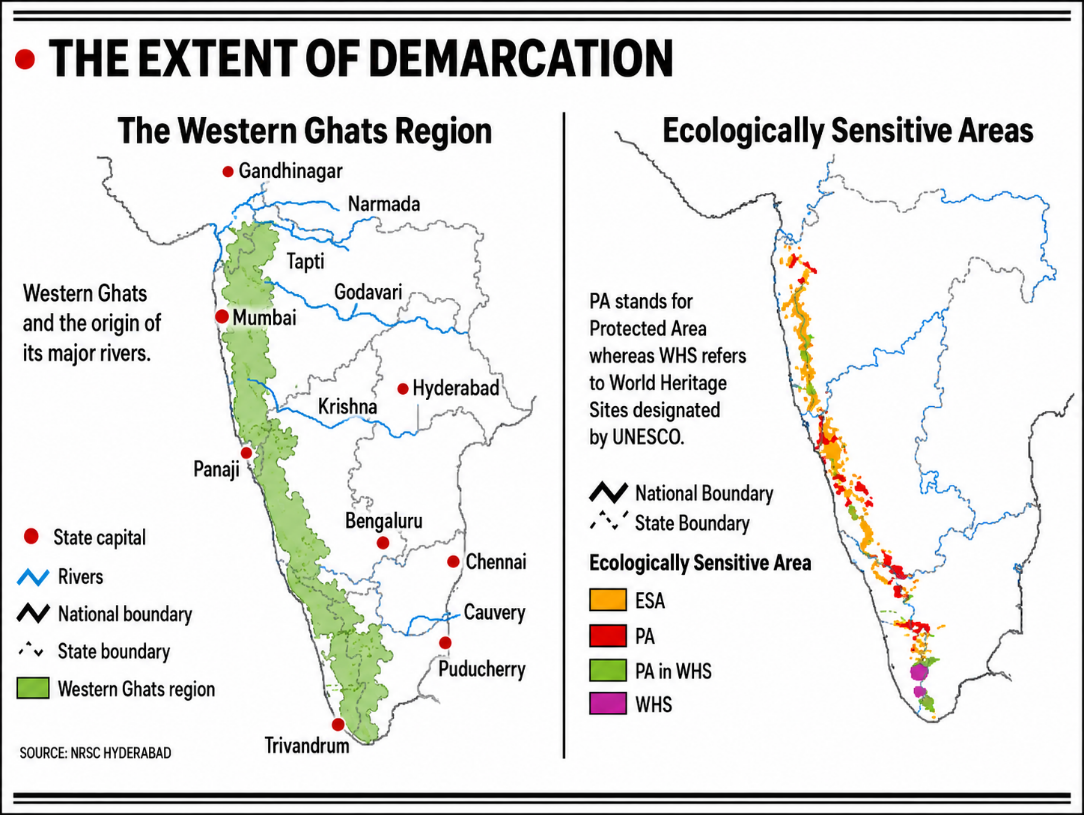
The Centre is considering a phased notification of Ecologically Sensitive Areas in the Western Ghats, beginning with States where agreement on boundaries is close, particularly Gujarat, Maharashtra and Goa.
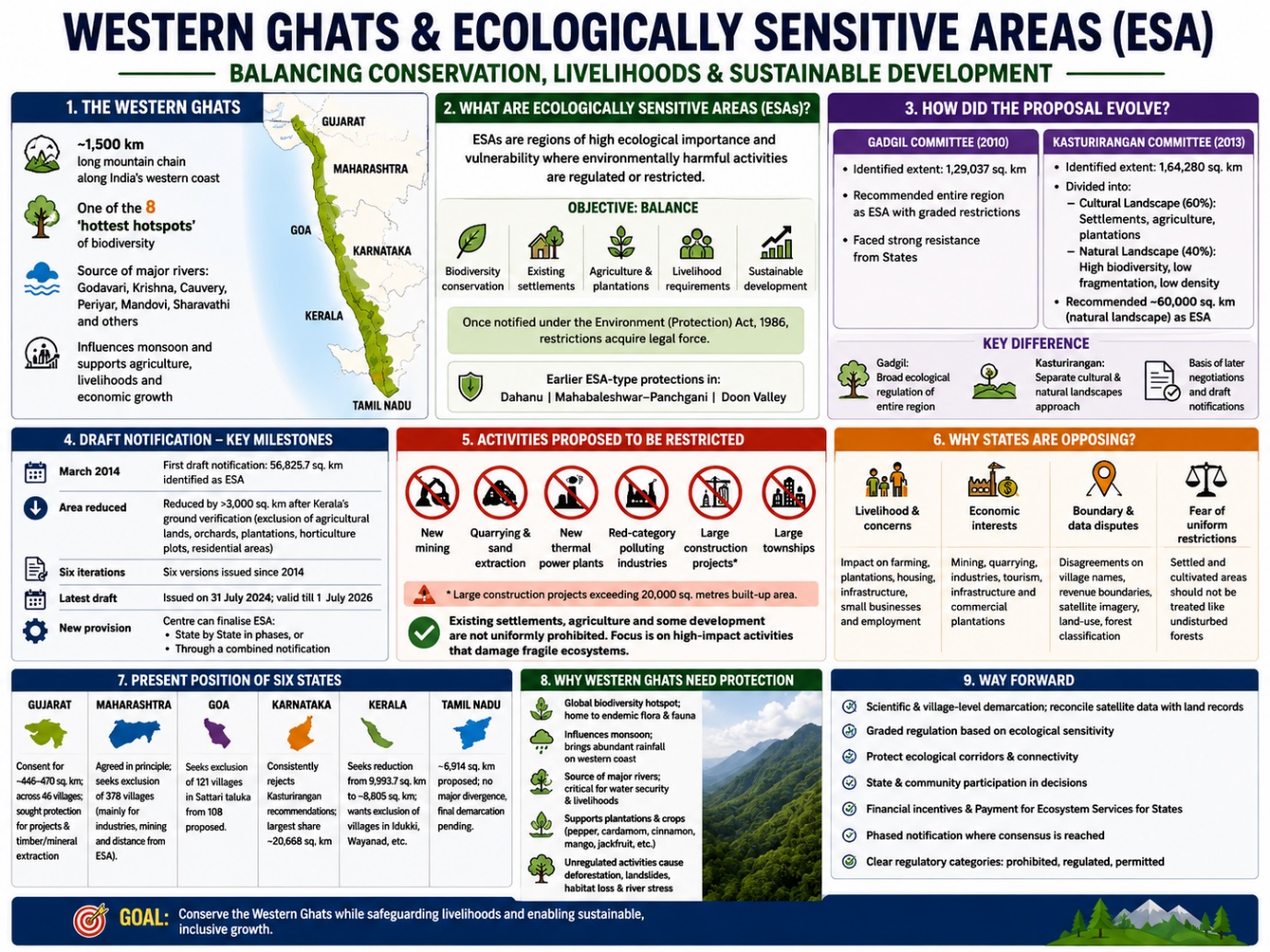
The latest draft notification proposes to designate 56,825.7 sq. km across six States as ESA. However, disagreements over village boundaries, agricultural areas, plantations, industries, mining and development restrictions have prevented final notification for more than a decade.
The six concerned States are:
- Gujarat
- Maharashtra
- Goa
- Karnataka
- Kerala
- Tamil Nadu
What are Ecologically Sensitive Areas?
Ecologically Sensitive Areas are regions of high ecological importance and vulnerability where environmentally harmful activities are regulated or restricted.
The objective is not necessarily to prohibit all human activity, but to balance:
- Biodiversity conservation
- Existing settlements
- Agriculture and plantations
- Livelihood requirements
- Sustainable development
Once notified under the Environment (Protection) Act, 1986, the restrictions acquire legal force.
Earlier ESA-type protections have been applied in areas such as:
- Dahanu
- Mahabaleshwar–Panchgani
- Doon Valley
How Did the Western Ghats ESA Proposal Evolve?
Gadgil Committee
- The Madhav Gadgil-led Western Ghats Ecology Expert Panel, constituted in 2010, identified the Western Ghats as covering about 1,29,037 sq. km.
- It recommended that the entire region be treated as ecologically sensitive, with restrictions based on the degree of ecological fragility.
- The proposal faced strong resistance from States because of concerns over extensive restrictions on economic and developmental activities.
Kasturirangan Committee
A High-Level Working Group chaired by former ISRO Chairman K. Kasturirangan was subsequently constituted.
Its 2013 report identified the geographical extent of the Western Ghats as approximately 1,64,280 sq. km and divided it into:
- Cultural Landscape — 60%: Settlements, agriculture and plantations dominated by human activity.
- Natural Landscape — 40%: Regions with high biodiversity, low fragmentation and low population density, including national parks and tiger and elephant habitats.
The Committee proposed that around 60,000 sq. km of natural landscape be designated as ESA.
How Did the Gadgil and Kasturirangan Approaches Differ?
| Aspect | Gadgil Committee | Kasturirangan Committee |
| Identified extent | 1,29,037 sq. km | 1,64,280 sq. km |
| Proposed coverage | Entire Western Ghats | Mainly natural landscape |
| Approach | Broad ecological regulation | Separation of cultural and natural landscapes |
| Approximate ESA | Entire identified region with graded restrictions | Around 60,000 sq. km |
| State response | Strong resistance | Basis of later negotiations and draft notifications |
The Kasturirangan approach attempted to reduce the impact on settlements, plantations and agricultural areas while protecting relatively undisturbed ecosystems.
How Did the Draft Notification Evolve?
The recommendations were accepted in principle, but States were invited to submit their objections before finalising the boundaries.
In March 2014, the Centre issued the first draft notification identifying 56,825.7 sq. km as ESA.
The area was reduced by more than 3,000 sq. km after Kerala conducted a ground-verification exercise and sought the exclusion of:
- Agricultural lands
- Orchards
- Horticultural plots
- Plantations
- Residential areas
Six versions of the draft notification have been issued since 2014. The latest was issued on July 31, 2024, and remains valid until late July 2026.
A significant change in the latest draft allows the Centre to finalise the ESA:
- State by State in phases, or
- Through a combined notification covering all six States
What Activities Would be Restricted?
The proposed framework seeks to prohibit or tightly regulate activities with a major ecological impact, including:
- New mining
- Quarrying and sand extraction
- New thermal power plants
- Red-category polluting industries
- Large construction projects
- Large townships
The supplied proposal also refers to restrictions on large construction projects exceeding a built-up area of 20,000 sq. metres.
Existing settlements, agriculture and some forms of development are not intended to be uniformly prohibited. The regulatory focus is primarily on high-impact activities that may fragment or damage fragile ecosystems.
Why are States Opposing the Proposal?
Livelihood and Settlement Concerns
The Western Ghats are densely populated, unlike many remote mountain ecosystems. Numerous villages, farms and plantations fall close to the proposed ESA boundaries.
States fear that restrictions may affect:
- Farming
- Plantation activities
- Housing
- Local infrastructure
- Small businesses
- Employment
Economic Interests
The region supports:
- Mining
- Quarrying
- Industries
- Tourism
- Infrastructure projects
- Commercial plantations
Some States have sought exclusions to preserve space for these activities.
Boundary and Data Disputes
Disagreements remain over:
- Village names
- Revenue boundaries
- Satellite imagery
- Land-use classification
- Forest and non-forest areas
- Differences between official records and ground conditions
Fear of Uniform Restrictions
States argue that villages with settlements and agricultural activity should not be treated in the same way as undisturbed forests or wildlife habitats.
What is the Present Position of the Six States?
Gujarat
- Gujarat has reportedly given final consent for approximately 449–470 sq. km across 64 villages. It has sought protection for ongoing projects and limited minor-mineral extraction in non-forest areas.
Maharashtra
- Maharashtra has agreed in principle but has sought the exclusion of 378 villages, citing industries, mining and the distance of some villages from ecologically sensitive zones.
- The supplied reports give different totals for the number of villages initially identified, but both agree on the demand to exclude 378 villages.
Goa
- Goa has sought the exclusion of 21 villages in Sattari taluka from the 108 villages proposed under ESA.
Tamil Nadu
- Tamil Nadu has about 6,914 sq. km proposed under ESA and has not raised major divergences, although final demarcation remains pending.
Karnataka
- Karnataka has the largest proposed ESA share, around 20,668 sq. km, but has consistently rejected the Kasturirangan recommendations.
Kerala
- Kerala has sought to reduce its proposed ESA from 9,993.7 sq. km to around 8,805 sq. km.
It has demanded the exclusion of villages in areas such as:
- Idukki
- Wayanad
- Cardamom Hills
The State argues that these regions contain plantations, agriculture and settlements. The expert committee has not accepted all the proposed exclusions.
Why Do the Western Ghats Need Protection?
Global Biodiversity Importance
- The Western Ghats are one of the world’s recognised biodiversity hotspots and are counted among the eight hottest hotspots of biological diversity.
- They support hundreds of plants and animals found nowhere else.
Influence on the Monsoon
- The mountain chain acts as a physical barrier to moisture-bearing winds, producing abundant rainfall on its western coastal side.
Source of Major Rivers
Its forests, springs and rainfall sustain important rivers, including:
- Godavari
- Krishna
- Cauvery
- Periyar
- Mandovi
- Sharavathi
These river systems support water security, agriculture, livelihoods and economic activity across peninsular India.
Ecological Continuity
- Mining, deforestation, habitat loss and unregulated construction can fragment wildlife habitats and disrupt ecological corridors.
Disaster Vulnerability
- Concerns over landslides, deforestation and uncontrolled construction have increased the demand for stronger environmental regulation.
Livelihood Dependence
The region has historically supported plantations and cultivation of:
- Pepper
- Cardamom
- Cinnamon
- Mango
- Jackfruit
Its conservation is therefore connected not only with wildlife but also with long-term livelihood and water security.
What is the Centre’s Phased Plan?
The Centre is considering moving ahead with ESA notifications in States where consensus is close instead of waiting for agreement from all six States.
The first phase may include:
- Gujarat
- Maharashtra
- Goa
This phased approach seeks to prevent disputes in Karnataka and Kerala from indefinitely delaying legal protection in States where boundaries are largely settled.
What is the Role of the 2022 Expert Committee?
The Centre constituted a fresh expert committee in 2022 under Sanjay Kumar, former Director General of Forests.
The Committee has:
- Held meetings with State governments
- Conducted field visits in all concerned States except Kerala
- Examined satellite imagery
- Reconciled village-level records
- Reviewed revenue and boundary details
- Considered State objections
- Studied the continuity of ecological corridors
The Committee includes experts associated with institutions such as:
- Indian Institute of Science
- Indian Institute of Remote Sensing
- Geological Survey of India
Its final report will determine whether the additional reductions sought by States should be accepted.
Can Financial Incentives Improve State Cooperation?
The expert committee has considered financial incentives for States that protect the Western Ghats.
The Kasturirangan Committee had recommended that the six States negotiate with the Centre for grant-in-aid in return for conserving natural resources.
It also suggested arrangements for Payment for Ecosystem Services, recognising benefits such as:
- Water security
- Forest conservation
- Biodiversity protection
- Climate regulation
- Ecological services extending beyond State boundaries
Such financial support could help compensate States and local communities for restrictions on revenue-generating activities.
Way Forward
Scientific and Village-Level Demarcation
- Satellite imagery must be reconciled with land records and field verification to prevent settlements and agricultural areas from being wrongly classified.
Graded Regulation
- Restrictions should be based on ecological sensitivity rather than applying identical rules to forests, plantations and densely populated villages.
State and Community Participation
- State governments, local bodies, farmers, plantation workers and civil society should participate in finalising boundaries and regulatory conditions.
Protect Ecological Corridors
- Exclusions should not break the continuity of forests, wildlife habitats and river catchments.
Compensate Conservation
- Grant-in-aid and Payment for Ecosystem Services can reduce the financial burden of protecting ecologically valuable regions.
Adopt Phased Notification
- States where consensus has been achieved should not be forced to wait indefinitely for unresolved disputes elsewhere.
Ensure Regulatory Clarity
- The final notification should clearly distinguish between prohibited activities, regulated activities and activities that may continue.
Conclusion
The Western Ghats ESA debate represents a difficult balance between ecological security, local livelihoods and State development priorities. The region’s biodiversity, monsoon influence and role in sustaining major rivers make conservation essential, but its dense population and plantation economy require a carefully differentiated approach.
A scientifically demarcated, consultative and phased framework—supported by financial compensation and graded restrictions—can protect the Western Ghats without treating conservation and development as mutually exclusive goals.
Why in News?
Biochar is emerging as a possible carbon-negative solution to India’s interconnected problems of crop-residue burning, declining soil fertility, climate vulnerability and growing organic-waste generation.By converting agricultural and biodegradable waste into a stable carbon-rich material, India can reduce farm smoke, improve degraded soils, produce renewable-energy by-products and create additional income through carbon credits.
What Problem Can Biochar Address?
- India produces more than 500 million tonnes of crop waste annually, but a significant quantity is treated as a disposal problem.
- Punjab and Haryana alone burn more than 20 million tonnes of paddy straw in open fields every year because of short post-harvest periods and limited practical alternatives.
This causes:
- Greenhouse-gas emissions
- Fine particulate pollution
- Loss of valuable organic matter
- Decline in regional air quality
- Wastage of a potential soil resource
At the same time, agricultural lands ranging from Maharashtra’s black soils to Kerala’s red soils suffer from:
- Low soil organic carbon
- Poor water-holding capacity
- Rapid nutrient loss
- Declining productivity
Crop-residue burning and soil degradation therefore reflect a common failure to recycle natural resources efficiently.
What is Biochar?
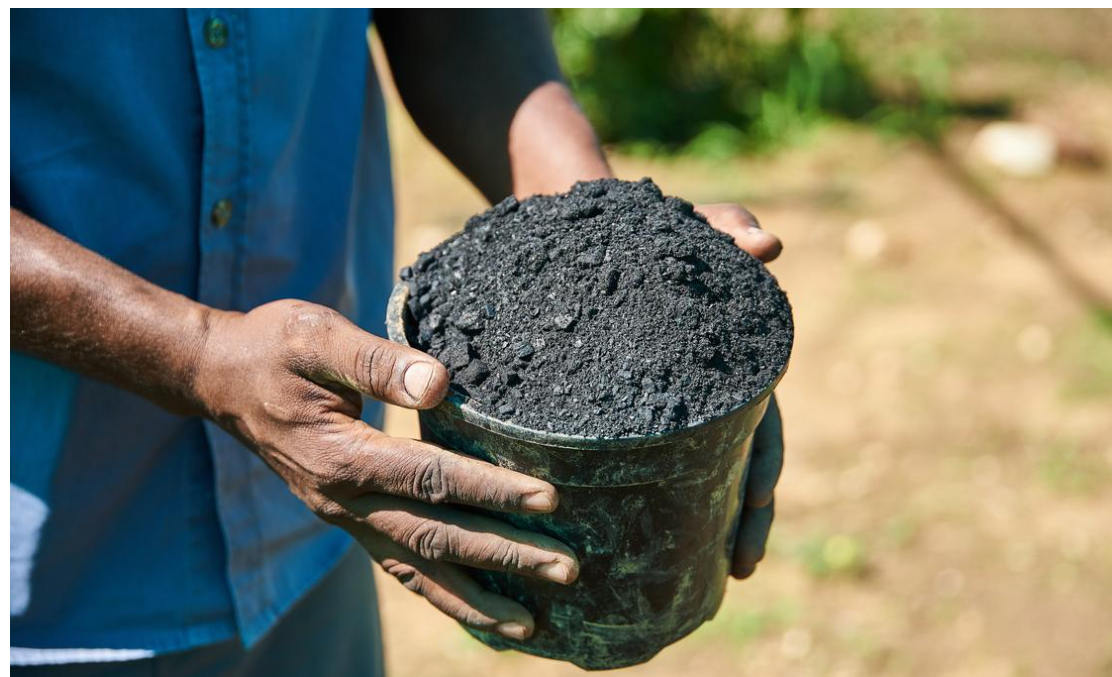
Biochar is a highly porous, carbon-rich material resembling charcoal, produced through the thermal decomposition of organic biomass.
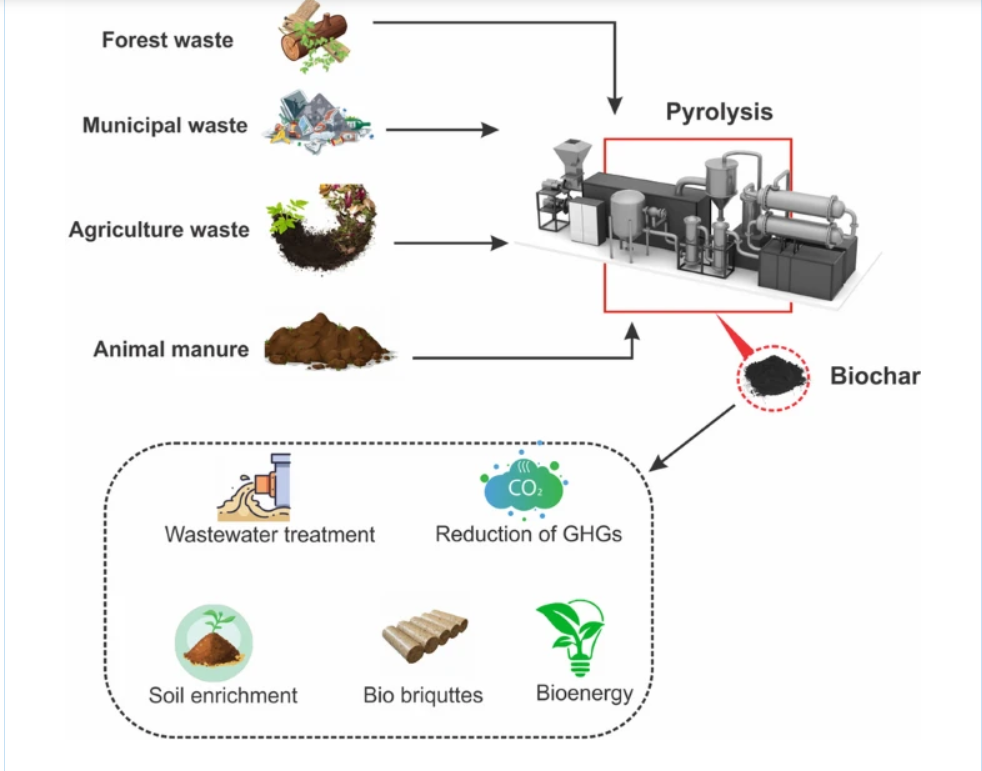
Its feedstock may include:
- Agricultural residues
- Forestry waste
- Food-processing waste
- Biodegradable municipal waste
- Sewage sludge
Biochar decomposes very slowly after being added to soil, allowing carbon to remain stored for long periods.
How is Biochar Produced?
Pyrolysis
Biochar is produced through pyrolysis, in which biomass is heated in an oxygen-depleted environment at temperatures generally ranging from 300°C to 700°C.
The process produces three valuable outputs:
- Biochar: A stable, solid carbon-rich material
- Syngas: A combustible gas that can be used for energy generation
- Bio-oil: A liquid fuel that can substitute some conventional fossil fuels
Thus, pyrolysis converts waste into soil inputs, energy products and climate benefits.
How Does Biochar Improve Agriculture?
Soil Structure
Its porous structure aggregates soil particles and improves the physical condition of degraded soils.
Water Retention
Biochar may increase water-holding capacity by 10% to 25%, helping crops withstand drought, heat waves and moisture stress.
Crop Productivity
Studies indicate that biochar application can improve crop productivity by 10% to 30%, particularly in nutrient-deficient soils.
Beneficial Microorganisms
Its pores provide a suitable habitat for beneficial soil microbes that support nutrient cycling and plant growth.
Nutrient Efficiency
Biochar helps retain nutrients in the root zone, reducing nutrient loss and dependence on external inputs.
Long-Term Soil Health
Because it decomposes slowly, biochar can maintain higher soil organic carbon, fertility and crop output over long periods.
What Do Indian Field Trials Show?
Maharashtra
Biochar produced from maize stalks and applied to black soils in Akola district improved soil organic carbon and overall fertility.
Kerala
Biochar made from coconut leaf stalks improved soil quality under different cropping systems.
These trials demonstrate the importance of using locally available biomass suited to regional soils and cropping systems.
How Can Biochar Support Climate Action?
Biochar contributes to climate mitigation in two ways:
- It prevents emissions that would have resulted from burning or decomposition of organic waste.
- It locks carbon into a stable form that may remain in soil for centuries.
One tonne of biochar can potentially sequester approximately 2.5–3 tonnes of carbon-dioxide equivalent.
Biochar is therefore recognised as a persistent carbon-dioxide removal technology and a nature-based climate solution.
Its soil benefits also support adaptation by helping crops cope with:
- Drought
- Heat waves
- Erratic rainfall
- Declining soil moisture
These benefits are particularly important for small and marginal farmers exposed to climatic and economic risks.
Can Biochar Generate Carbon-Credit Income?
Biochar activities can be linked with carbon markets by accounting for:
- Avoided emissions from crop-residue burning
- Long-term carbon sequestration in soils
VM0042 Methodology
- The VM0042 agricultural land-management methodology measures both avoided emissions and carbon stored through biochar application.
- Each tonne of certified biochar may generate around 2–2.8 tonnes of carbon-dioxide-equivalent credits.
Depending on carbon-market prices, this can provide additional income to:
- Farmers
- Rural communities
- Cooperatives
- Project developers
Projects using the KISAN kiln developed by IIT Kharagpur are testing how smallholders can convert and monetise farm waste.
What are Biochar’s Energy Applications?
The pyrolysis of biomass produces syngas and bio-oil in addition to solid biochar.
Syngas
- Biochar production in India could generate approximately 20–30 million tonnes of syngas.
- It could produce around 8–13 terawatt-hours of electricity annually.
Bio-oil
Pyrolysis may generate approximately 24–40 million tonnes of bio-oil.
This could substitute about 12–19 million tonnes of diesel or kerosene, helping to:
- Reduce crude-oil imports
- Lower fossil-fuel consumption
- Cut fossil-fuel emissions by more than 2%
Biochar production can therefore link agricultural waste management with renewable-energy generation.
How Can Biochar Support Urban Waste Management?
India generates around 62 million tonnes of municipal solid waste annually, of which more than 50% is biodegradable.
Suitable organic feedstock such as:
- Food waste
- Biodegradable municipal waste
- Sewage sludge
- Crop residues
can be converted into biochar.
This can:
- Divert organic waste from landfills
- Reduce methane emissions
- Produce useful agricultural inputs
- Improve municipal waste management
- Connect urban waste streams with rural soil restoration
It reflects the principles of a circular economy, where waste is converted into productive economic value.
What are Biochar’s Other Applications?
Water Purification
Chemically modified biochar can be used in wastewater treatment to filter toxic heavy metals such as:
- Chromium
- Arsenic
- Lead
Its porous structure allows it to absorb and retain contaminants.
Construction Sector
Adding approximately 2–5% biochar to concrete can:
- Improve mechanical strength
- Increase heat resistance by about 20%
- Capture nearly 115 kg of carbon dioxide per cubic metre
This expands biochar’s role beyond agriculture into low-carbon construction.
| What Do International Experiences Show?
Kenya Rice husks have been converted into biochar, producing certified carbon credits while improving soil pH and phosphorus content. Thailand National programmes link biochar use with soil rehabilitation, carbon management and access to the national carbon registry. Brazil Brazil’s Embrapa Institute has reported high carbon retention and major yield improvements from biochar produced using sugarcane bagasse. These experiences show that biochar can be scaled when production technology, certification, soil management and carbon markets operate together |
What Limits Biochar Adoption in India?
- Low Farmer Awareness: Biochar remains unfamiliar to many cultivators.
- Pilot-Scale Use: Most applications remain confined to research trials.
- Technology Gaps: Affordable and decentralised pyrolysis units are not widely available.
- Collection Challenges: Biomass must be collected, transported and processed efficiently.
- Certification Costs: Carbon-credit projects require credible measurement, reporting and verification.
- Weak Market Linkages: Farmers need buyers for biochar and access to carbon markets.
- Limited Investment: Innovation, entrepreneurship and commercial production remain fragmented.
- Affordability: Small farmers require cost-effective access to biochar and processing technologies.
Way Forward
Develop Decentralised Pyrolysis Units
Appropriately scaled plants should be established near farms and organic-waste generation centres to reduce transport costs.
Integrate with Agricultural Programmes
Biochar should be connected with natural farming, soil-health management, climate-resilient agriculture and carbon-farming initiatives.
Strengthen Carbon-Market Access
Farmers and cooperatives need institutional support for aggregation, certification and measurement, reporting and verification.
Promote Local Feedstock
Regional residues such as paddy straw, maize stalks, coconut leaf stalks and sugarcane bagasse should be used according to local availability.
Demonstrate Farm Benefits
Field trials and farmer demonstrations should communicate improvements in soil fertility, water retention and crop productivity.
Encourage Multiple Applications
Policy should support biochar use in agriculture, renewable energy, wastewater treatment and low-carbon construction.
Build an Integrated Ecosystem
Technology providers, farmers, researchers, cooperatives, municipalities, investors and carbon markets must be connected through a common framework.
Conclusion
Biochar offers India a practical pathway to convert crop residues and biodegradable waste into valuable “black gold.” It can improve degraded soils, conserve water, raise crop productivity, generate renewable energy, purify wastewater and reduce the carbon footprint of construction.
Its large-scale success, however, will depend on affordable pyrolysis technology, farmer awareness, credible carbon accounting, investment and strong market linkages. An integrated biochar ecosystem can simultaneously advance waste-to-wealth, climate action, energy security and agricultural resilience.