Relevance: GS Paper III – Science & Technology, Space Technology, Indigenisation, Innovation and Disaster Management
For Prelims:
Chandrayaan-3, Aditya-L1, SPADEX, Gaganyaan, Bharatiya Antariksh Station
For Mains:
- Strategic Autonomy, Space Commercialisation, Public–Private Partnership, Space-Based Governance, Responsible Space Power
Why in News?
Over the past twelve years, India’s space programme has evolved from a government-led scientific initiative into a strategic ecosystem supporting deep-space exploration, human spaceflight, private innovation, commercial services, international cooperation and citizen-centric development.Major achievements include Chandrayaan-3, Aditya-L1, SPADEX, preparations for Gaganyaan and the Bharatiya Antariksh Station, and rapid growth of private space start-ups.
What Has Driven India’s Space Transformation?
India’s space progress has been shaped by three broad pillars:
Expanding Space Capability
India has strengthened its capacity in lunar science, planetary exploration, solar observation, human spaceflight, space docking and launch-vehicle development.
Building National Capacity
Space applications now support agriculture, water management, connectivity, disaster response, healthcare, education, governance and livelihoods.
Strengthening Global Partnerships
India has expanded cooperation with major space agencies and partner countries in joint missions, research, training, data sharing and peaceful uses of outer space.
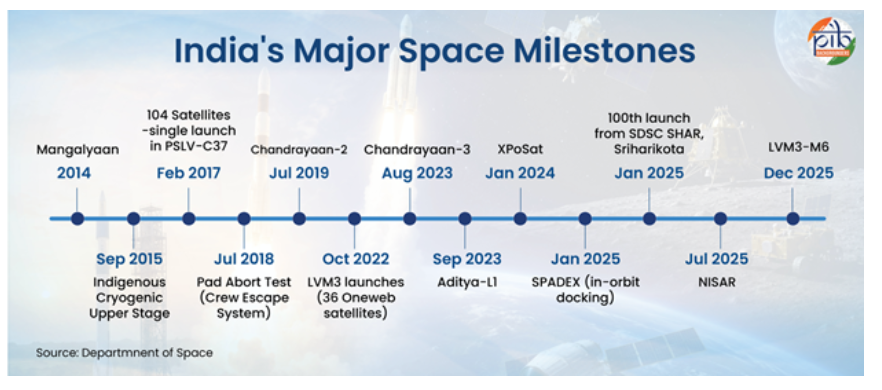
India’s Space Capability
How Has the Chandrayaan Programme Advanced Lunar Exploration?
Chandrayaan-1
Launched in 2008, Chandrayaan-1 was India’s first lunar mission. It:
- Detected evidence of water molecules and hydroxyl on the Moon
- Improved understanding of lunar resources
- Studied the lunar exosphere through the Moon Impact Probe
Chandrayaan-2
Launched in 2019, its orbiter:
- Operated from an altitude of about 100 km
- Provided high-resolution lunar images
- Captured surface details as fine as 30 centimetres
Chandrayaan-3
On 23 August 2023, India became:
- The first country to soft-land near the lunar south pole
- The fourth country to soft-land on the Moon, after the United States, Russia and China
The Vikram lander touched down near 69.3° South latitude. Scientific instruments conducted in-situ studies and confirmed the presence of sulphur through direct elemental analysis.
Future Lunar Missions
- Chandrayaan-4: Planned for 2027; aims to land, collect lunar samples and return them to Earth.
- Chandrayaan-5/LUPEX: A joint mission with Japan to study water and volatile materials in permanently shadowed regions near the lunar south pole.
What Was the Significance of Mangalyaan?
The Mars Orbiter Mission, or Mangalyaan, entered Martian orbit on 24 September 2014.
India became:
- The first country to reach Mars orbit on its maiden attempt
- The fourth space agency to place a spacecraft around Mars
Designed for six months, it functioned for more than eight years and generated data on:
- Martian atmosphere
- Exosphere
- Surface features
- Interaction with solar winds
The mission demonstrated India’s capacity to execute complex interplanetary missions efficiently.
What Has Aditya-L1 Achieved?
- Aditya-L1 is India’s first dedicated solar observatory.
- Launched in 2023, it was placed in a halo orbit around the Sun–Earth L1 Lagrange Point, nearly 1.5 million km from Earth.
It studies:
- Solar corona
- Solar winds
- Space weather
- Solar activity affecting Earth and technological systems
It functions as a proposal-driven observatory, and more than 27 TB of solar data has been released for scientific research.
How Has India Expanded Space Astronomy?
AstroSat
- India’s first multi-wavelength space observatory completed a decade in orbit in September 2025 and has contributed to major astronomical discoveries.
XPoSat
- Launched on 1 January 2024, XPoSat strengthened India’s capacity in X-ray astronomy.
- Both operate as proposal-driven observatories serving the global scientific community.
Why is SPADEX a Major Technological Breakthrough?
The Space Docking Experiment, or SPADEX, demonstrated autonomous docking and undocking in January 2025.
India became the fourth country after the:
- United States
- Russia
- China
ISRO also demonstrated:
- Power transfer between docked satellites
- Robotic-arm operations in microgravity
- Indigenous Bharatiya Docking System
Docking technology is essential for:
- Chandrayaan-4, Gaganyaan, Bharatiya Antariksh Station, Complex future orbital missions
What is India’s Venus Mission?
The Venus Orbiter Mission, targeted for March 2028, will study:
- Surface geology, Atmospheric composition, Ionosphere, Resurfacing processes, Impact of solar activity
It will also test advanced technologies such as:
- Aerobraking, High-performance thermal management
These capabilities will strengthen India’s deep-space expertise.
What is Gaganyaan?
Approved in January 2019, Gaganyaan is India’s first indigenous human-spaceflight programme.
It aims to:
- Send up to three astronauts, Place them in a 400-km orbit, Keep them in space for up to three days, Return them safely to Earth
The programme includes:
- Two uncrewed missions
- One crewed mission
It entered its final phase in 2025 and is strengthening Indian industry, life-support technology, crew safety and human-spaceflight capability.
How Did the Axiom-4 Mission Support Gaganyaan?
As part of India’s human-spaceflight preparations, Group Captain Shubhanshu Shukla participated in the ISRO–NASA-supported Axiom-4 mission to the International Space Station in 2025.
He conducted seven Indian microgravity experiments covering:
- Muscle regeneration, Algal growth, Crop viability, Microbial survivability, Cognitive performance, Cyanobacterial behaviour
The mission provided India operational experience in astronaut training, space research and international human-spaceflight procedures.
What is the Bharatiya Antariksh Station?
- The Bharatiya Antariksh Station, or BAS, is India’s proposed space station and a major component of Space Vision 2047.
It will be:
- A five-module station
- Located in Low Earth Orbit
- Designed for long-duration missions
- Used for microgravity research
The Union Cabinet approved the development of the first module, BAS-01, for launch by 2028.
Research areas will include:
- Life sciences
- Medicine
- Emerging technologies
- Future human exploration
Private Participation and Commercialisation
How Has India Opened the Space Sector?
The sector was opened to private players in 2020, followed by the Indian Space Policy 2023.
Major support measures include:
- IN-SPACe Seed Fund Scheme
- Pre-incubation Entrepreneurship Programme
- ₹1,000-crore Venture Capital Fund
- ₹500-crore Technology Adoption Fund
- Liberalised FDI rules
- Clear authorisation norms under NGP 2024
What are the Liberalised FDI Rules?
The government liberalised FDI in the space sector in February 2024.
- Up to 74% automatic-route FDI for satellite manufacturing, operations, data products and ground-user services
- Up to 49% automatic-route FDI for launch vehicles, related systems and spaceports
- 100% automatic-route FDI for satellite and ground-segment components and subsystems
These reforms seek to attract investment, technology and manufacturing capacity.
How Fast Has the Space Start-Up Ecosystem Grown?
- India had only one registered space start-up in 2014.
- By February 2026, the number had crossed 400.
- Investment in Indian space start-ups exceeded $500 million, including nearly $150 million in 2025.
Major private companies include:
- Pixxel, Dhruva Space, Skyroot Aerospace, Agnikul Cosmos, Bellatrix Aerospace
What is the Role of NSIL and IN-SPACe?
NewSpace India Limited
Established in 2019, NSIL commercialises:
- ISRO technologies, Launch services, Satellite services
Its revenue rose from ₹321.77 crore in 2021–22 to ₹3,246.09 crore in 2024–25.
IN-SPACe
It acts as a single-window institution to:
- Facilitate private participation, Authorise private space activities, Support technology transfer,Improve regulatory predictability
By January 2026, it had facilitated 71 ISRO technology transfers.
How Large is India’s Space Economy?
- India’s space economy is valued at approximately $8 billion, accounting for about 2–3% of the global space economy.
- It is projected to reach $40–45 billion over the next decade, with a targeted global share of 8% by 2030.
Launch Vehicles and Indigenous Technology
How Self-Reliant is India in Space Transportation?
India operates:
- PSLV, GSLV, LVM3
Together, these can place:
- Up to 10 tonnes in Low Earth Orbit
- Up to 4.2 tonnes in Geosynchronous Transfer Orbit
They provide independent access for communication, navigation, Earth observation and exploration missions.
What is the Next Generation Launch Vehicle?
The approved Next Generation Launch Vehicle will carry up to:
- 30 tonnes to Low Earth Orbit
A partially reusable variant is planned with a payload capacity of:
- 14 tonnes to Low Earth Orbit
Reusable technologies are being developed to reduce launch costs.
How is India Expanding Launch Infrastructure?
Kulasekarapattinam Spaceport
- India’s second spaceport is being developed in Tamil Nadu to support small-satellite launches.
SSLV Complex
- The complex is designed to support 20–25 orbital launches annually, with its first launch targeted for 2026–27.
Third Launch Pad
A third launch pad at Sriharikota was approved in January 2025 at a cost of ₹3,984.86 crore.
It will support:
- Next-generation launch vehicles
- Human-spaceflight missions
- Future lunar exploration
What Advances Have Been Made in Propulsion?
India is developing:
- Electric propulsion systems
- Advanced cryogenic engines
- Semi-cryogenic engines
- Reusable rocket technologies
- Multiple-restart capability
The first operational satellite using electric propulsion is targeted for 2026–27.
The upgraded SSLV upper stage has improved payload capacity by nearly 90 kg.
What is the RLV-TD Programme?
The Reusable Launch Vehicle–Technology Demonstrator programme develops technologies for low-cost reusable access to space.
It has tested:
- Hypersonic flight, Autonomous navigation, Runway landing, Thermal protection, Re-entry management
India has completed three successful autonomous runway-landing experiments.
What Indigenous Electronics Has India Developed?
ISRO and the Semiconductor Laboratory developed:
- VIKRAM3201: India’s first fully indigenous 32-bit space microprocessor
- KALPANA32: A processor for high-reliability space missions
These systems reduce dependence on imported components and strengthen mission security.
India’s Global Space Partnerships
How Has India’s Global Space Role Expanded?
ISRO launched only 35 foreign satellites between the 1990s and 2014.
After 2014 and up to March 2026, India launched 399 foreign satellites.
India has signed more than:
- 300 cooperation agreements
- With 61 countries
- And five multilateral organisations
What is India’s Major Space Partnerships?
- Russia: Supports astronaut training, life-support systems, crew safety and Gaganyaan; cooperation dates from Aryabhata (1975) and Rakesh Sharma’s spaceflight (1984).
- United States: The NASA–ISRO NISAR mission monitors land, forests, glaciers, oceans, climate change and natural disasters.
- France: The TRISHNA mission will study crop-water stress, irrigation needs, glaciers, urban ecosystems and climate change.
- Japan: The LUPEX mission will explore lunar water and ice near the Moon’s polar region.
- European Space Agency: Cooperation covers human spaceflight, astronaut training, Low Earth Orbit operations, Moon missions and the Bharatiya Antariksh Station.
- Germany: Focus areas include satellite and optical communication, human spaceflight, microgravity research, Earth observation and drone technologies.
- Italy: Cooperation covers Earth observation, heliophysics, lunar science, sustainable space use and commercial activities.
- Saudi Arabia: Partnership includes satellite development, space science, research, innovation and capacity building.
- Mauritius and Bhutan: India supports satellite development, ground stations, Earth observation, communication and peaceful space applications.
What is NavIC?
- NavIC is India’s indigenous regional satellite navigation system.
- It provides positioning, navigation and timing services across India and up to 1,500 km beyond its borders.
Applications include:
- Train tracking, Vehicle monitoring, Power-grid synchronisation, Geo-fencingVessel monitoring, Aadhaar device geo-tagging, Public-safety alerts
India has also worked with industry to integrate NavIC into mobile chipsets.
How Does Space Technology Support Agriculture and Water Security?
Satellite applications assist in:
- Crop-acreage mapping, Production forecasting, Drought assessment, Crop-yield estimation, Agricultural insurance, Irrigation planning, Water-resource management
India-WRIS and the National Hydrology Project use space-based information to improve water governance.
How Does Space Technology Strengthen Disaster Management?
Satellites monitor:
- Cyclones, Floods, Landslides, Forest fires, Other natural hazards
- The National Database for Emergency Management 5.0 provides real-time geospatial decision support.
- The Satellite Aided Search and Rescue programme supports distress alerts and emergency response.
What is the Role of Satellites in Health and Education?
Telemedicine
- Around 179 telemedicine nodes operate in remote and strategic areas, including nearly 80 in high-altitude regions.
Education
- Under PM e-VIDYA, 370 educational television channels are delivered through GSAT-15 and GSAT-9.
These services support:
- Digital education, Teacher training, Remote learning, educational outreach
Significance of India’s Space Transformation
- Strategic Autonomy: Indigenous launch systems, navigation and electronics reduce external dependence.
- Scientific Leadership: Lunar, solar, planetary and astronomical missions advance global knowledge.
- Economic Growth: Start-ups, FDI and commercial launches are expanding the space economy.
- Developmental Governance: Space technology supports agriculture, health, education and disaster management.
- International Credibility: Joint missions demonstrate India’s reliability as a global partner.
- National Security: Navigation, communication and Earth observation strengthen strategic capacity.
- Inclusive Development: Space applications increasingly benefit ordinary citizens.
- Future Readiness: Gaganyaan, BAS and NGLV prepare India for long-term human exploration.
Way Forward
- Strengthen Research: Increase investment in propulsion, reusable systems, robotics and human-spaceflight technology.
- Expand Private Participation: Provide stable authorisation, finance and technology-transfer mechanisms.
- Build Space Infrastructure: Complete new spaceports, launch pads and testing facilities.
- Promote Indigenous Manufacturing: Reduce dependence on imported electronics and critical components.
- Develop Human Capital: Expand education, skilling and research in space sciences.
- Improve Citizen Applications: Integrate satellite information more deeply into public administration.
- Promote Space Sustainability: Support responsible operations and peaceful use of outer space.
- Strengthen Global Cooperation: Continue joint missions, data sharing and capacity building.
Conclusion
India’s space programme has evolved from a scientific initiative into a powerful instrument of strategic autonomy, economic growth, global cooperation and public welfare. Missions such as Chandrayaan-3, Aditya-L1 and SPADEX demonstrate technological maturity, while Gaganyaan and the Bharatiya Antariksh Station represent the next phase of human-spaceflight ambition.At the same time, NavIC, disaster-warning systems, telemedicine, educational satellites and agricultural applications show that India’s space journey is not only about reaching distant frontiers. It is equally about using science to improve lives and build a self-reliant, responsible and globally respected space power.

UPSC PYQ
Q. Consider the following statements The Mangalyaan launched by ISRO:
- is also called the Mars Orbiter Mission.
- made India the second country to have a spacecraft orbit Mars after the USA.
- made India the only country to be successful in making its spacecraft orbit Mars in its very first attempt.
Which of the statements given above is/are correct?
A. 1 only
B. 2 and 3 only
C. 1 and 3 only
D. 1, 2 and 3
Answer: C
Explanation
- Statement 1 is correct: Mangalyaan is officially known as the Mars Orbiter Mission (MOM). ISRO launched it on 5 November 2013.
- Statement 2 is incorrect: India was not the second country to place a spacecraft in Mars orbit. Missions of the Soviet Union, the United States and the European Space Agency had reached Mars before India. India became the first Asian country and the fourth space agency to reach Mars orbit.
- Statement 3 is correct: India became the first country in the world to successfully place a spacecraft in Mars orbit on its maiden attempt. Mangalyaan entered Mars orbit on 24 September 2014.
CARE MCQ
Q. Consider the following countries in the context of the coverage area of South Asia Satellite (GSAT-9):
- Afghanistan
- Bangladesh
- Nepal
- Sri Lanka
Which of the above are covered by the South Asia Satellite?
A. 1 and 2 only
B. 1, 2 and 3 only
C. 2, 3 and 4 only
D. 1, 2, 3 and 4
Answer: D
Explanation:
- Afghanistan – Correct. South Asia Satellite provides coverage over Afghanistan.
- Bangladesh – Correct. Bangladesh is one of the countries covered by the satellite.
- Nepal – Correct. Nepal is also included in its coverage area.
- Sri Lanka – Correct. Sri Lanka is one of the countries covered by GSAT-9.
Additional Information:
South Asia Satellite (GSAT-9) also provides coverage over:
- Bhutan
- Maldives
It was launched on 5 May 2017 and was built by ISRO as a regional communication satellite.
FAQs
1. Which mission made India the first country to land near the lunar south pole?
Chandrayaan-3 achieved this feat in August 2023.
2. What is SPADEX?
It is India’s space-docking experiment that demonstrated autonomous docking and undocking.
3. What is the purpose of Gaganyaan?
It aims to send Indian astronauts into Low Earth Orbit and return them safely.
4. What is the Bharatiya Antariksh Station?
It is India’s proposed five-module space station in Low Earth Orbit.
5. How many space start-ups did India have by February 2026?
India had more than 400 registered space start-ups.
6. What is NavIC?
NavIC is India’s indigenous regional satellite navigation system.
7. What is the projected size of India’s space economy?
It is projected to reach approximately $40–45 billion over the next decade.
8. Which institutions promote private space activity?
NSIL commercialises ISRO services, while IN-SPACe facilitates and authorises private participation.
Relevance: UPSC GS Paper III: Science & Technology, Artificial Intelligence, Emerging Technologies, Cybersecurity and Innovation.
For Prelims:
- Global Dialogue on AI, International Scientific Panel on AI, Trusted AI Commons, Data Sovereignty, IndiaAI Mission
For Mains:
- Responsible AI, Global AI Governance, Digital Colonialism, Regulatory Fragmentation, Equitable Technology Access
Why in News?
Professor B. Ravindran, head of the Centre for Responsible AI at IIT Madras, has been appointed as the lone Indian among 40 members of the Independent International Scientific Panel on AI for a three-year term.
The Panel will periodically assess scientific developments in artificial intelligence and provide evidence-based inputs to the Global Dialogue on AI, a United Nations-backed platform in which every country has been invited to participate.
What is the Independent International Scientific Panel on AI?
The Independent International Scientific Panel on AI is the first global scientific body established specifically to assess developments in artificial intelligence.
Major Functions
- Periodically review the state of AI science.
- Assess emerging capabilities and risks.
- Prepare reports on the scientific aspects of AI.
- Provide scientific inputs to the Global Dialogue on AI.
- Support evidence-based international discussions.
The Panel will not directly decide political or regulatory questions. Its role is limited to scientific assessment, while governments participating in the Global Dialogue will address policy and governance issues.
What is the Global Dialogue on AI?
The United Nations General Assembly established the Global Dialogue on AI as an inclusive international platform for discussing the development, deployment and governance of artificial intelligence.
It seeks to:
- Include all countries in AI-governance discussions.
- Connect scientific assessments with policymaking.
- Protect the interests of developing countries.
- Encourage international cooperation.
- Ensure that AI benefits humanity as a whole.
The Scientific Panel and Global Dialogue together represent an emerging two-level governance framework: scientific assessment by experts and policy deliberation by governments.
Why is Global AI Governance Necessary?
Artificial intelligence is a transformative general-purpose technology capable of reshaping economies, industries, labour markets, governance and everyday life.
Its impact has been compared to that of the steam engine. Therefore, fragmented national approaches alone may be insufficient to govern a technology whose development and deployment cross national borders.
A global framework can help establish minimum standards relating to:
- Safety
- Accountability
- Transparency
- Responsible deployment
- Data protection
- Risk assessment
- Equitable access
How Can Regulatory Fragmentation Affect Innovation?
At present, countries are developing different regulatory frameworks for artificial intelligence.
If each country adopts widely differing standards, AI companies may have to modify their systems separately for every jurisdiction.
Possible Consequences
- Higher Compliance Costs: Companies must satisfy multiple regulatory requirements.
- Fragmented Development: AI systems may be designed differently for separate markets.
- Slower Innovation: Resources may shift from research to regulatory compliance.
- Unequal Deployment: Companies may introduce advanced services only in countries with favourable regulations.
- Regulatory Arbitrage: Firms may relocate activities to jurisdictions with weaker safeguards.
Internationally agreed minimum regulations can reduce such fragmentation while allowing countries to adopt additional protections suited to their circumstances.
What are the Concerns Around Data Sovereignty?
Data sovereignty refers to the principle that data generated within a country should remain subject to that country’s laws and control.
It can help protect:
- National security
- Citizens’ privacy
- Domestic data resources
- Strategic economic interests
However, excessive localisation requirements may create difficulties if every country insists that:
- All data must remain within national borders.
- AI infrastructure must be domestically located.
- AI development must occur entirely within the country.
- Cross-border data access must be severely restricted.
Many countries lack the computing power, financial resources and technical expertise needed to build an independent AI ecosystem. Strict national boundaries may therefore increase dependence on the few countries that already control advanced infrastructure.
What is Digital Colonialism?
Digital colonialism refers to a situation in which technologically weaker countries become dependent on foreign platforms, AI models, data infrastructure and technical standards controlled by powerful countries or corporations.
Developing countries may become digital colonies when they:
- Provide data without receiving proportional economic benefits.
- Depend on foreign AI systems for essential services.
- Lack influence over global technical standards.
- Remain passive consumers rather than technology developers.
- Cannot effectively regulate harmful AI applications.
- Lose control over strategic digital infrastructure.
Many countries in Asia and Africa may lack the institutional capacity required to frame robust AI regulations. Global minimum standards can help protect them from exploitation and technological dependence.
Can Global Regulation Control AI-Related Risks?
Artificial intelligence can support beneficial applications in healthcare, agriculture, education and governance. However, advanced AI tools may also be misused.
Potential risks include assistance in developing:
- Biological weapons
- Chemical weapons
- Advanced cyberattacks
- Disinformation systems
- Harmful autonomous applications
International treaties already regulate biological and chemical weapons. Similar global arrangements may be required to control high-risk AI models and tools that could enable the development of such weapons.
The challenge is to regulate dangerous applications without restricting beneficial innovation.
What is the Risk of an AI Non-Proliferation Regime?
AI governance could adopt language similar to nuclear non-proliferation.
Some technologically advanced countries or companies may claim that only they possess the capacity to develop safe and responsible AI. They may then seek unrestricted development rights for themselves while limiting access for others.
Such a regime could:
- Concentrate technological power.
- Permanently exclude developing countries.
- Restrict access to advanced models and computing resources.
- Create dependence on a few AI-producing nations.
- Reproduce inequalities associated with the global nuclear order.
Therefore, international regulation must prevent dangerous uses without becoming a mechanism for preserving technological monopolies.
Why Does AI Governance Matter for Developing Countries?
Equitable Access
- Developing countries should be able to use AI in agriculture, healthcare, education, disaster management and public administration.
Protection from Harm
- Common safeguards can protect citizens from unsafe, discriminatory or unaccountable AI systems.
Participation in Rule-Making
- Countries that are not major AI developers should still participate in determining global standards.
Capacity Building
- International cooperation can help countries develop scientific, regulatory and institutional expertise.
Prevention of Digital Dependence
- Inclusive governance can reduce excessive dependence on foreign technologies and corporations.
Developmental Opportunity
- Countries should not be denied AI-driven growth merely because they lack the resources to create large AI models or computing infrastructure.
What are the Trusted AI Commons?
The Trusted AI Commons is a proposed open repository containing tools and resources required to develop and deploy artificial intelligence safely and responsibly.
It was one of the major outcomes of the New Delhi AI Impact Summit held in February 2026.
The platform will initially be hosted and managed by India. The IndiaAI Mission will identify an appropriate institutional mechanism for its operation.
What Will the Trusted AI Commons Contain?
The platform is expected to provide:
- Safety-testing tools
- Evaluation benchmarks
- Datasets
- Deployment protocols
- Responsible-AI frameworks
- Model-assessment resources
- Testing methodologies
For example, an organisation developing an agricultural AI system could use the Commons to identify:
- Relevant datasets
- Suitable evaluation tools
- Safety benchmarks
- Testing procedures
- Deployment protocols
It would function as a one-stop platform for responsible AI resources.
Why is it Called a “Commons”?
It is called a Commons because its resources are intended to be:
- Openly available
- Commonly accessible
- Shared across institutions and countries
- Offered under liberal licensing conditions
- Usable by governments, researchers, start-ups and civil society
The Commons will not immediately commission the development of every tool. It will initially bring together existing resources created by organisations such as the Centre for Responsible AI at IIT Madras and technology companies such as Google.
How Can the Trusted AI Commons Help?
Lowering Entry Barriers
- Small countries, start-ups and research institutions may not have the resources to build independent AI-safety infrastructure.
Common Evaluation Standards
- Shared benchmarks can make AI testing more consistent across countries and sectors.
Responsible Deployment
- Developers can evaluate AI systems before deploying them in sensitive sectors such as healthcare or agriculture.
Inclusive Innovation
- Open resources can allow smaller organisations and developing countries to participate in AI development.
Transparency and Trust
- Common testing tools can improve public confidence in AI systems.
Global Capacity Building
- The platform can strengthen the technical capacity of countries that currently lack advanced AI-governance institutions.
What is India’s Significance in Emerging Global AI Governance?
- Scientific Representation: Professor B. Ravindran is the lone Indian member of the 40-member international scientific panel.
- Institutional Leadership: India will initially host and manage the Trusted AI Commons.
- Developing-Country Voice: India can represent countries that use AI extensively but do not dominate AI development.
- Responsible-AI Expertise: IIT Madras’ Centre for Responsible AI is developing tools for safe and accountable AI systems.
- Global Standard-Setting: Participation allows India to influence emerging international norms.
- Inclusive Technology Diplomacy: India can promote an AI order that balances innovation, safety and equitable access.
What are the Major Challenges in Global AI Governance?
- Differing national interests and regulatory approaches
- Rapidly changing AI capabilities
- Concentration of computing infrastructure
- Dominance of large technology companies
- Unequal regulatory capacity among countries
- Tension between data sovereignty and data sharing
- Difficulty in defining high-risk AI applications
- Risk of biological, chemical and cyber misuse
- Possibility of exclusionary technology controls
- Lack of common testing and accountability standards
Way Forward
Establish Minimum Global Standards
- Countries should agree on basic principles relating to safety, transparency, accountability and responsible use.
Adopt Risk-Based Regulation
- High-risk applications should face stricter scrutiny, while low-risk innovation should not be unnecessarily restricted.
Ensure Inclusive Representation
- Developing countries must have meaningful participation in global AI institutions.
Build Regulatory Capacity
- Technical and institutional assistance should be provided to countries lacking AI-governance expertise.
Promote Open Resources
- Platforms such as the Trusted AI Commons should provide accessible datasets, benchmarks and safety tools.
Prevent Technology Monopolies
- Global frameworks should not grant a few countries or corporations permanent control over advanced AI.
Strengthen Independent Scientific Assessment
- Periodic assessments should guide regulation as AI technology evolves.
Balance Sovereignty and Cooperation
- Countries must protect data and national interests without completely fragmenting the global AI ecosystem.
Conclusion
Artificial intelligence is too transformative and globally interconnected to be governed solely through fragmented national regulations. A global framework is necessary to control dangerous uses, reduce regulatory uncertainty and protect countries that lack advanced AI-governance capacity.
However, global regulation must not become an exclusionary non-proliferation regime controlled by a few countries or technology companies. The future AI order should be based on scientific evidence, minimum global standards, inclusive representation, open resources and equitable access to innovation.
CARE MCQ
Q. Consider the following statements regarding emerging global AI-governance institutions:
- The Independent International Scientific Panel on AI will periodically assess scientific developments in artificial intelligence.
- The Global Dialogue on AI is intended to include all countries.
- The Trusted AI Commons will provide openly accessible tools and resources for responsible AI development.
Which of the statements given above are correct?
(a) 1 and 2 only
(b) 2 and 3 only
(c) 1 and 3 only
(d) 1, 2 and 3
Answer: (d)
Explanation
- Statement 1 is correct: The Panel will periodically assess the state of AI science.
- Statement 2 is correct: Every country has been invited to participate in the Global Dialogue.
- Statement 3 is correct: The Trusted AI Commons will contain shared tools, datasets, benchmarks and protocols for responsible AI.
FAQs
1. What is the Independent International Scientific Panel on AI?
It is the first global scientific body created to periodically assess developments in artificial intelligence.
2. Who represents India on the Panel?
Professor B. Ravindran of IIT Madras is the lone Indian among its 40 members.
3. What is the Global Dialogue on AI?
It is a UN-backed platform in which countries discuss international AI governance and policy.
4. What is regulatory fragmentation?
It refers to the existence of different and conflicting AI regulations across countries.
5. What is data sovereignty?
It is the principle that data generated within a country should remain subject to that country’s laws and control.
6. What is digital colonialism?
It refers to technological dependence in which developing countries supply data and markets but lack control over AI infrastructure, platforms and standards.
7. What is the Trusted AI Commons?
It is an open repository of testing tools, benchmarks, datasets and protocols for responsible AI development and deployment.
8. Who will initially host the Trusted AI Commons?
India will initially host and manage it through an institutional mechanism to be identified by the India AI Mission.
9. Why is an AI non-proliferation regime a concern?
It could allow a few technologically advanced countries or companies to monopolise advanced AI development.
10. Why are minimum global AI standards needed?
They can reduce regulatory fragmentation, control serious risks and protect countries lacking strong AI-governance institutions.