Why in News?
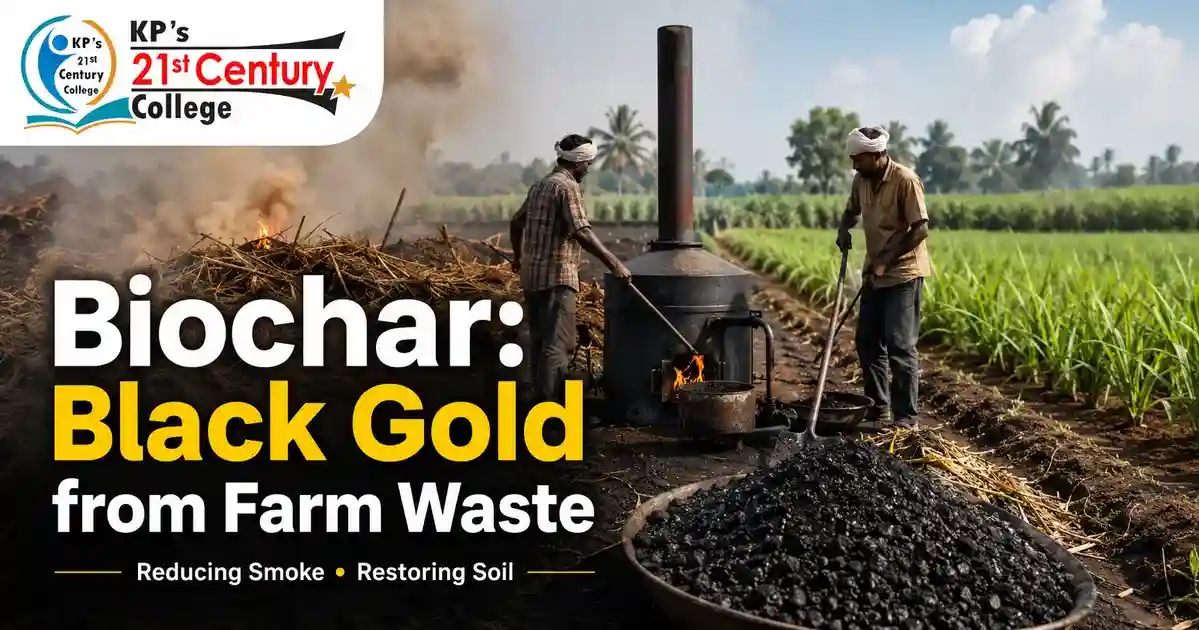
Biochar is emerging as a possible carbon-negative solution to India’s interconnected problems of crop-residue burning, declining soil fertility, climate vulnerability and growing organic-waste generation.By converting agricultural and biodegradable waste into a stable carbon-rich material, India can reduce farm smoke, improve degraded soils, produce renewable-energy by-products and create additional income through carbon credits.
What Problem Can Biochar Address?
- India produces more than 500 million tonnes of crop waste annually, but a significant quantity is treated as a disposal problem.
- Punjab and Haryana alone burn more than 20 million tonnes of paddy straw in open fields every year because of short post-harvest periods and limited practical alternatives.
This causes:
- Greenhouse-gas emissions
- Fine particulate pollution
- Loss of valuable organic matter
- Decline in regional air quality
- Wastage of a potential soil resource
At the same time, agricultural lands ranging from Maharashtra’s black soils to Kerala’s red soils suffer from:
- Low soil organic carbon
- Poor water-holding capacity
- Rapid nutrient loss
- Declining productivity
Crop-residue burning and soil degradation therefore reflect a common failure to recycle natural resources efficiently.
What is Biochar?
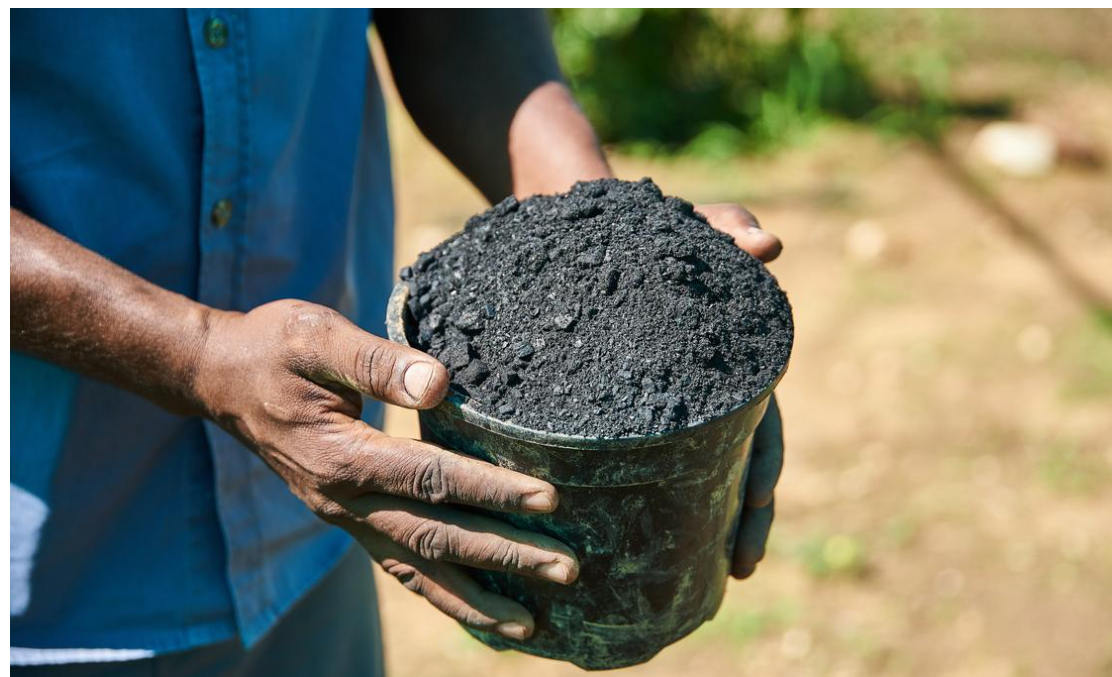
Biochar is a highly porous, carbon-rich material resembling charcoal, produced through the thermal decomposition of organic biomass.
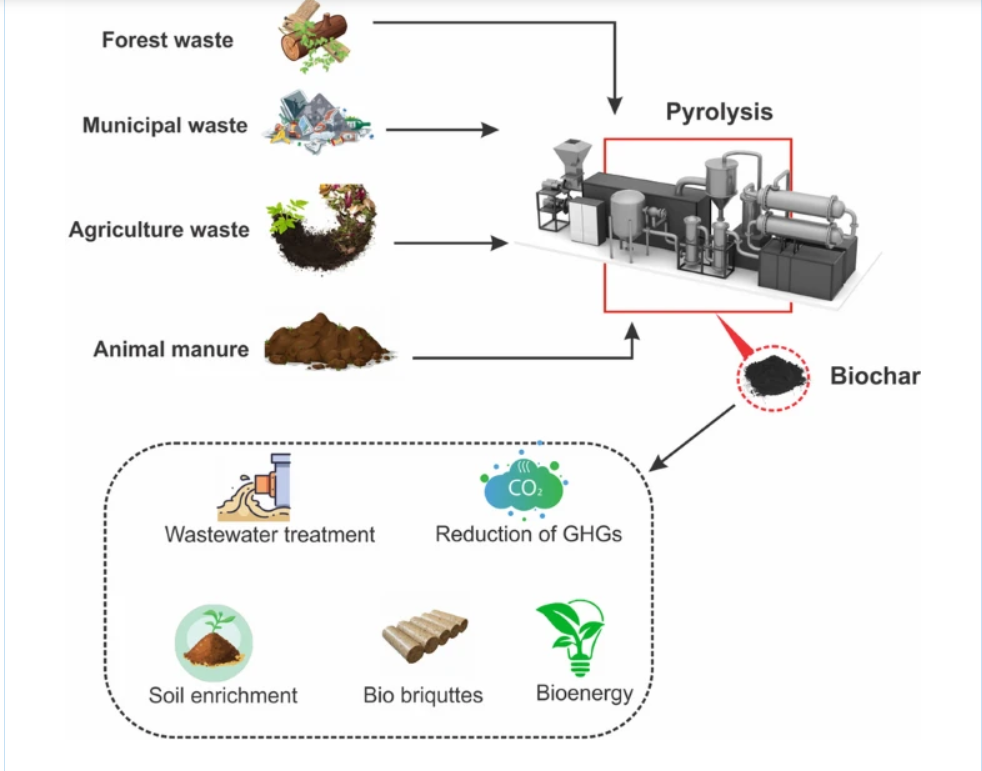
Its feedstock may include:
- Agricultural residues
- Forestry waste
- Food-processing waste
- Biodegradable municipal waste
- Sewage sludge
Biochar decomposes very slowly after being added to soil, allowing carbon to remain stored for long periods.
How is Biochar Produced?
Pyrolysis
Biochar is produced through pyrolysis, in which biomass is heated in an oxygen-depleted environment at temperatures generally ranging from 300°C to 700°C.
The process produces three valuable outputs:
- Biochar: A stable, solid carbon-rich material
- Syngas: A combustible gas that can be used for energy generation
- Bio-oil: A liquid fuel that can substitute some conventional fossil fuels
Thus, pyrolysis converts waste into soil inputs, energy products and climate benefits.
How Does Biochar Improve Agriculture?
Soil Structure
Its porous structure aggregates soil particles and improves the physical condition of degraded soils.
Water Retention
Biochar may increase water-holding capacity by 10% to 25%, helping crops withstand drought, heat waves and moisture stress.
Crop Productivity
Studies indicate that biochar application can improve crop productivity by 10% to 30%, particularly in nutrient-deficient soils.
Beneficial Microorganisms
Its pores provide a suitable habitat for beneficial soil microbes that support nutrient cycling and plant growth.
Nutrient Efficiency
Biochar helps retain nutrients in the root zone, reducing nutrient loss and dependence on external inputs.
Long-Term Soil Health
Because it decomposes slowly, biochar can maintain higher soil organic carbon, fertility and crop output over long periods.
What Do Indian Field Trials Show?
Maharashtra
Biochar produced from maize stalks and applied to black soils in Akola district improved soil organic carbon and overall fertility.
Kerala
Biochar made from coconut leaf stalks improved soil quality under different cropping systems.
These trials demonstrate the importance of using locally available biomass suited to regional soils and cropping systems.
How Can Biochar Support Climate Action?
Biochar contributes to climate mitigation in two ways:
- It prevents emissions that would have resulted from burning or decomposition of organic waste.
- It locks carbon into a stable form that may remain in soil for centuries.
One tonne of biochar can potentially sequester approximately 2.5–3 tonnes of carbon-dioxide equivalent.
Biochar is therefore recognised as a persistent carbon-dioxide removal technology and a nature-based climate solution.
Its soil benefits also support adaptation by helping crops cope with:
- Drought
- Heat waves
- Erratic rainfall
- Declining soil moisture
These benefits are particularly important for small and marginal farmers exposed to climatic and economic risks.
Can Biochar Generate Carbon-Credit Income?
Biochar activities can be linked with carbon markets by accounting for:
- Avoided emissions from crop-residue burning
- Long-term carbon sequestration in soils
VM0042 Methodology
- The VM0042 agricultural land-management methodology measures both avoided emissions and carbon stored through biochar application.
- Each tonne of certified biochar may generate around 2–2.8 tonnes of carbon-dioxide-equivalent credits.
Depending on carbon-market prices, this can provide additional income to:
- Farmers
- Rural communities
- Cooperatives
- Project developers
Projects using the KISAN kiln developed by IIT Kharagpur are testing how smallholders can convert and monetise farm waste.
What are Biochar’s Energy Applications?
The pyrolysis of biomass produces syngas and bio-oil in addition to solid biochar.
Syngas
- Biochar production in India could generate approximately 20–30 million tonnes of syngas.
- It could produce around 8–13 terawatt-hours of electricity annually.
Bio-oil
Pyrolysis may generate approximately 24–40 million tonnes of bio-oil.
This could substitute about 12–19 million tonnes of diesel or kerosene, helping to:
- Reduce crude-oil imports
- Lower fossil-fuel consumption
- Cut fossil-fuel emissions by more than 2%
Biochar production can therefore link agricultural waste management with renewable-energy generation.
How Can Biochar Support Urban Waste Management?
India generates around 62 million tonnes of municipal solid waste annually, of which more than 50% is biodegradable.
Suitable organic feedstock such as:
- Food waste
- Biodegradable municipal waste
- Sewage sludge
- Crop residues
can be converted into biochar.
This can:
- Divert organic waste from landfills
- Reduce methane emissions
- Produce useful agricultural inputs
- Improve municipal waste management
- Connect urban waste streams with rural soil restoration
It reflects the principles of a circular economy, where waste is converted into productive economic value.
What are Biochar’s Other Applications?
Water Purification
Chemically modified biochar can be used in wastewater treatment to filter toxic heavy metals such as:
- Chromium
- Arsenic
- Lead
Its porous structure allows it to absorb and retain contaminants.
Construction Sector
Adding approximately 2–5% biochar to concrete can:
- Improve mechanical strength
- Increase heat resistance by about 20%
- Capture nearly 115 kg of carbon dioxide per cubic metre
This expands biochar’s role beyond agriculture into low-carbon construction.
| What Do International Experiences Show?
Kenya Rice husks have been converted into biochar, producing certified carbon credits while improving soil pH and phosphorus content. Thailand National programmes link biochar use with soil rehabilitation, carbon management and access to the national carbon registry. Brazil Brazil’s Embrapa Institute has reported high carbon retention and major yield improvements from biochar produced using sugarcane bagasse. These experiences show that biochar can be scaled when production technology, certification, soil management and carbon markets operate together |
What Limits Biochar Adoption in India?
- Low Farmer Awareness: Biochar remains unfamiliar to many cultivators.
- Pilot-Scale Use: Most applications remain confined to research trials.
- Technology Gaps: Affordable and decentralised pyrolysis units are not widely available.
- Collection Challenges: Biomass must be collected, transported and processed efficiently.
- Certification Costs: Carbon-credit projects require credible measurement, reporting and verification.
- Weak Market Linkages: Farmers need buyers for biochar and access to carbon markets.
- Limited Investment: Innovation, entrepreneurship and commercial production remain fragmented.
- Affordability: Small farmers require cost-effective access to biochar and processing technologies.
Way Forward
Develop Decentralised Pyrolysis Units
Appropriately scaled plants should be established near farms and organic-waste generation centres to reduce transport costs.
Integrate with Agricultural Programmes
Biochar should be connected with natural farming, soil-health management, climate-resilient agriculture and carbon-farming initiatives.
Strengthen Carbon-Market Access
Farmers and cooperatives need institutional support for aggregation, certification and measurement, reporting and verification.
Promote Local Feedstock
Regional residues such as paddy straw, maize stalks, coconut leaf stalks and sugarcane bagasse should be used according to local availability.
Demonstrate Farm Benefits
Field trials and farmer demonstrations should communicate improvements in soil fertility, water retention and crop productivity.
Encourage Multiple Applications
Policy should support biochar use in agriculture, renewable energy, wastewater treatment and low-carbon construction.
Build an Integrated Ecosystem
Technology providers, farmers, researchers, cooperatives, municipalities, investors and carbon markets must be connected through a common framework.
Conclusion
Biochar offers India a practical pathway to convert crop residues and biodegradable waste into valuable “black gold.” It can improve degraded soils, conserve water, raise crop productivity, generate renewable energy, purify wastewater and reduce the carbon footprint of construction.
Its large-scale success, however, will depend on affordable pyrolysis technology, farmer awareness, credible carbon accounting, investment and strong market linkages. An integrated biochar ecosystem can simultaneously advance waste-to-wealth, climate action, energy security and agricultural resilience.