Mains Practice Questions for the Day
- Q. The U.S. Sanctioning Russia and Iran Act, 2026 creates an energy–trade dilemma for India. Examine its implications for India’s energy security, exports and strategic autonomy. Suggest an appropriate way forward. Introduction
- Q. The India Cine Hub represents the convergence of digital governance and the creative economy. Discuss its significance in promoting India as a global filming destination. Also examine the challenges involved and suggest a way forward.
Q. The U.S. Sanctioning Russia and Iran Act, 2026 creates an energy–trade dilemma for India. Examine its implications for India’s energy security, exports and strategic autonomy. Suggest an appropriate way forward. Introduction
Introduction:
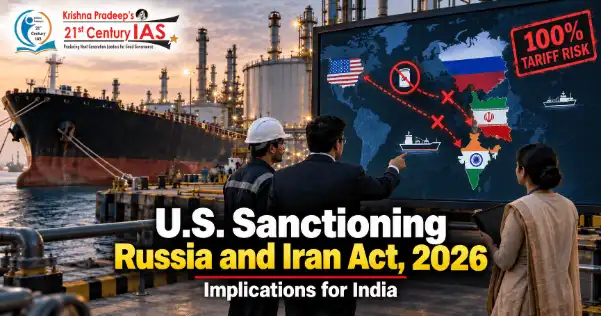
The U.S. Sanctioning Russia and Iran Act, 2026 permits tariffs of up to 100% on imports from countries that remain among the largest purchasers of Russian crude oil or natural gas. India is particularly exposed because Russian crude accounted for over 51% of its oil imports in July 2026, while the United States receives nearly 20% of India’s goods exports.
Body
Implications for India
- Energy security: Reducing Russian oil within the 30-day adjustment period would require India to locate alternative suppliers when oil prices exceed $100 per barrel and supplies through the Strait of Hormuz remain constrained.
- Higher inflation: Costlier crude may increase fuel, transportation, agricultural input and manufacturing costs.
- Export competitiveness: A tariff of up to 100%, imposed in addition to existing U.S. duties, could make Indian goods uncompetitive in the American market.
- MSME vulnerability: Smaller exporters may face shrinking margins, cancelled orders, cash-flow problems and employment losses.
- Strategic relations: India must balance its longstanding energy and strategic partnership with Russia against its expanding trade and technology relationship with the United States.
- Strategic autonomy: Secondary tariff pressure can restrict India’s freedom to make independent energy and foreign-policy decisions.
Challenges
- Short period for restructuring oil contracts
- Costly alternative energy supplies
- Dependence on the U.S. export market
- Possibility of cumulative tariffs
- Domestic political sensitivity of fuel-price increases
Way Forward
- Seek a lower tariff, transition period or presidential waiver through sustained diplomacy.
- Demonstrate that Indian oil purchases complied with applicable sanctions.
- Diversify crude suppliers gradually without disrupting domestic energy availability.
- Expand strategic petroleum reserves and accelerate renewable-energy adoption.
- Provide credit and market assistance to affected MSMEs.
- Diversify exports towards Europe, West Asia, Africa and ASEAN markets.
- Coordinate foreign, trade and energy policies through an inter-ministerial mechanism.
Conclusion:
India must avoid a sudden policy shift. A calibrated combination of diplomatic engagement, gradual energy diversification and export support can protect its energy security, economic interests and strategic autonomy.
Q. The India Cine Hub represents the convergence of digital governance and the creative economy. Discuss its significance in promoting India as a global filming destination. Also examine the challenges involved and suggest a way forward.
Introduction:
The India Cine Hub (ICH) is a single-window digital platform managed by the National Film Development Corporation of India (NFDC). It simplifies filming permissions, film visas, co-production approvals, incentives and access to verified production services for domestic and international filmmakers.
The initiative is important as India’s film, television and digital-content industry generated nearly $13.1 billion in 2023–24 and possesses significant potential for further growth.
Body
Significance of India Cine Hub
- Ease of doing business: A common online application reduces the need to approach Union Ministries, State governments, police and local authorities separately.
- Cooperative federalism: It connects Central, State and local agencies through nodal officers and standardised workflows.
- Global filming destination: Film-visa support, incentives and GIS-based location mapping can attract international productions.
- Creative economy: Film production generates employment for artists, technicians, vendors, hotels, transport operators and local workers.
- Film tourism: Cinema can popularise lesser-known destinations and support rural economies, handicrafts and cultural heritage.
- Cultural diplomacy: International co-productions enable Indian stories and creative talent to reach global audiences.
- Regional development: States can showcase their locations, infrastructure, incentives and service providers through the portal.
Challenges
- Delays caused by multiple approving authorities
- Uneven digital and administrative capacity among States
- Absence of fixed approval timelines
- Security and environmental concerns at sensitive locations
- Cybersecurity and protection of confidential production data
- Concentration of studios and post-production facilities in a few cities
- Limited awareness among small and regional filmmakers
Way Forward
- Integrate all States and Union Territories with the portal.
- Prescribe time-bound clearances and monitor administrative delays.
- Provide multilingual application and assistance facilities.
- Train State nodal officers and local officials.
- Regularly update location, incentive and vendor databases.
- Expand production infrastructure in emerging regional centres.
- Link film production with tourism and local-development policies.
- Strengthen cybersecurity and ensure local community participation.
Conclusion:
With effective federal coordination and timely clearances, the India Cine Hub can strengthen digital governance, generate employment and establish India as a globally competitive centre for audiovisual production.