Table of Contents
Relevance: GS Paper II: India–U.S. Relations; Effect of policies of developed countries on India
Prelims
- USTR, Executive Order, Section 301, Section 232, Ad Valorem Tariff, Presidential Waiver
Mains
- Secondary Sanctions, Strategic Autonomy, Energy Security, Export Competitiveness, Trade Protectionism
Why in News?
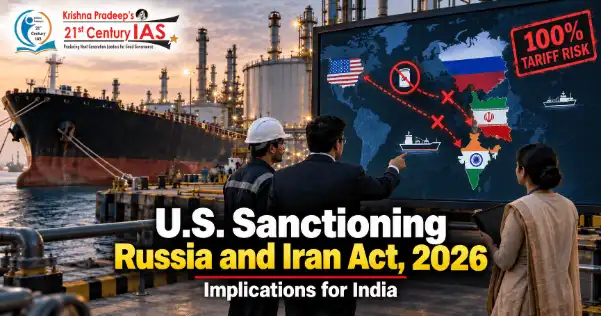
U.S. President Donald Trump has signed the Lindsey O. Graham Sanctioning Russia and Iran Act, 2026 into law. The Act allows the United States to impose tariffs of up to 100% on imports from countries that continue to buy large quantities of Russian crude oil or natural gas. India could be affected because it is one of the world’s largest buyers of Russian crude oil.
What is the U.S. Sanctioning Russia and Iran Act?
- The law seeks to reduce Russia’s energy revenue and thereby weaken its ability to finance the Russia–Ukraine war.
- It was proposed by the late U.S. Senator Lindsey O. Graham and was subsequently named after him.
- Its scope was later expanded to include Iran. Sanctions relating to Iran have been extended for five years, until 2031.
Main Objectives
- Reduce Russia’s earnings from oil and natural-gas exports
- Pressure major buyers of Russian energy
- Sanction important Russian individuals and entities
- Prevent the evasion of Russian oil sanctions
- Increase economic pressure connected with the Russia–Ukraine conflict
Why is the Act Important for India?
- The law creates the possibility of penalising Indian exports because of India’s energy transactions with Russia.
- This resembles a secondary sanction, in which a third country is targeted for maintaining specified economic relations with the main sanctioned country.
India is therefore required to balance:
- Affordable Russian oil
- Access to the U.S. export market
- Domestic fuel-price stability
- Strategic relations with Russia
- Growing economic ties with the United States
When Can the Tariff Apply?
- The relevant tariff provisions can be applied after a 30-day period following enactment.
- A country may face tariffs under either of two conditions.
Major Importer of Russian Energy
The country:
- Was among the five largest importers, by volume, of Russian crude oil or natural gas during the preceding 12 months; and
- Continues such purchases after the 30-day period.
This condition is especially relevant to India and China, the two largest importers of Russian crude oil.
Facilitating Sanctions Evasion
- A country may also face tariffs if it was among the five leading countries facilitating evasion of sanctions on Russian oil.
- India faces a lower risk under this condition because Indian oil-marketing companies have maintained that their purchases complied with the applicable sanctions.
Is a 100% Tariff Automatic?
No. The Act permits a tariff of up to 100%.
The United States may impose a lower rate. This provides India with diplomatic space to negotiate:
- A lower tariff
- An exemption
- A transition period
- A formal presidential waiver
Why is the New Law More Serious than the Earlier Measure?
Earlier Tariff
- The earlier 25% punitive tariff imposed on India for purchasing Russian oil was based on an Executive Order.
- In February 2026, the U.S. Supreme Court struck down the broader tariff regime that included this punitive tariff.
- An Executive Order can generally be modified or withdrawn through executive action and may face judicial review.
Present Tariff
The new measure has been:
- Passed by the U.S. Congress
- Signed by the President
- Converted into federal law
It therefore has greater legal permanence. A presidential waiver also requires formal justification to Congress.
Why is India Particularly Exposed?
Dependence on Russian Crude
Russia supplied more than 51% of India’s crude-oil imports in July 2026.
A major reduction within 30 days would require India to:
- Find alternative suppliers
- Renegotiate supply contracts
- Identify suitable crude grades
- Arrange new shipping routes
- Bear higher transportation and insurance costs
High Oil Prices
Global oil prices are above $100 per barrel. Alternative crude supplies could therefore be considerably more expensive.
Strait of Hormuz Constraints
Movement through the Strait of Hormuz remains constrained. This affects supplies from important West Asian producers and limits India’s immediate alternatives.
Importance of the U.S. Market
The United States accounts for roughly 20% of India’s goods exports.
A high tariff could therefore affect India’s export growth, manufacturing activity, employment and MSME sector.
Are the New Tariffs Additional to Existing Duties?
- Yes. The law states that the tariff will be imposed in addition to any other applicable duty.
Section 301 of the Trade Act, 1974
- Section 301 allows the United States Trade Representative to investigate foreign trade practices that harm American commerce and impose retaliatory measures.
- India faces a 10% tariff connected with a U.S. investigation into goods produced using forced labour.
Section 232 of the Trade Expansion Act, 1962
- Section 232 allows the U.S. government to restrict imports when they are considered a threat to national security.
- The United States imposed tariffs of 50% on steel, aluminium, copper and certain related products.
- A new Russia-related tariff may be imposed on top of these existing duties.
How Does a 100% Tariff Work?
Suppose an Indian product worth $100 enters the United States.
If a 100% tariff is imposed:
- Product value: $100
- Customs duty: $100
- Landed cost before other expenses: $200
The American importer pays the customs duty. However, the importer may demand a lower price from the Indian exporter or shift to another supplier.
Possible Impact on India
- The impact depends on two possible situations.
India Continues Russian Oil Imports
Decline in Exports
Indian products may become more expensive than goods supplied by competing countries.
This can result in:
- Lower export orders
- Loss of U.S. customers
- Reduced market share
- Pressure on export earnings
Evidence from Earlier Tariffs
- India’s merchandise exports to the U.S. grew by nearly 18% during April–August 2025 compared with the same period of the previous year.
- Part of this growth came from exporters sending goods early before the tariffs were imposed.
- However, export growth slowed to 3.8% during April 2025–February 2026, indicating a substantial slowdown after the earlier tariffs came into effect in August 2025.
Pressure on MSMEs
During the earlier 50% tariff period, some Indian exporters shared part of the additional cost with American buyers to retain them.
Absorbing a possible 100% tariff would be much more difficult.
MSMEs may face:
- Reduced profit margins
- Order cancellations
- Cash-flow problems
- Lower production
- Loss of customers
- Employment pressure
India Reduces Russian Oil Imports
- India has earlier reduced oil imports from Venezuela, Iran and Russia in response to American pressure.
- However, reducing Russian purchases under current conditions could create significant energy-related problems.
Higher Energy Costs
Alternative suppliers may charge higher prices, increasing India’s oil-import bill.
Domestic Fuel Prices
Higher crude costs may create pressure for increases in petrol and diesel prices.
Inflationary Impact
Expensive fuel can increase:
- Transportation costs
- Agricultural input costs
- Manufacturing expenses
- Prices of essential goods
Political Sensitivity
Large fuel-price increases may be politically difficult because several important State elections are scheduled in the following year.
Options Before India
Reduce Russian Oil Imports
Advantage:
- Indian exports may avoid very high U.S. tariffs.
Difficulties:
- Alternative crude may be more expensive.
- The oil-import bill may rise.
- Domestic fuel prices may increase.
- Thirty days may be insufficient for adjustment.
Continue Russian Imports
Advantage:
- India can maintain access to Russian crude supplies.
Risks:
- Indian exports may become uncompetitive.
- MSMEs may lose American customers.
- Manufacturing and employment may suffer.
Negotiate a Lower Tariff or Waiver
The provision for tariffs of “up to 100%” provides room for negotiations.
India can seek:
- A lower tariff rate
- A temporary exemption
- A longer transition period
- A presidential waiver
Waiver Provision
The U.S. President can waive the tariff after submitting to Congress:
- Written certification that the waiver is in the national interest of the United States
- A report explaining the reasons for granting it
The President therefore possesses waiver authority, but it is subject to congressional reporting.
Review Mechanism
The USTR, in consultation with the U.S. Secretary of State and Secretary of Energy, must review the list of major Russian oil and gas importers.
The review will:
- Take place within 180 days after the initial tariffs
- Use the most recent 12-month trade data
- Reassess the five largest importers of Russian crude oil and natural gas
India’s position may therefore change if its import pattern changes.
Conditions for Ending the Measures
The sanctions framework may be affected if Russia:
- Signs a peace agreement accepted by the internationally recognised Government of Ukraine
- Ceases military hostilities
- Ends activities aimed at undermining the Ukrainian government
Challenges for India
- Energy–trade dilemma: Affordable Russian oil must be balanced against access to the U.S. market.
- Short adjustment period: Thirty days is insufficient for changing major energy contracts.
- Expensive alternatives: Replacement crude may raise India’s import bill.
- Cumulative tariffs: The new duty may be added to existing tariffs.
- MSME vulnerability: Smaller firms cannot absorb a steep tariff burden.
- Inflation risk: Higher crude prices can increase costs across the economy.
- Export dependence: The U.S. receives a major share of Indian goods exports.
- Strategic balancing: India must protect relations with both Russia and the United States.
Way Forward
- Intensify diplomatic negotiations with the United States.
- Seek a reduced tariff, transition period or presidential waiver.
- Present evidence that Indian oil purchases complied with applicable sanctions.
- Avoid a sudden reduction that could threaten domestic energy security.
- Gradually diversify crude-oil suppliers.
- Support export-oriented MSMEs through credit and market assistance.
- Help exporters enter markets beyond the United States.
- Closely monitor crude prices and shipping conditions.
- Coordinate foreign, trade and energy policies through a unified approach.
- Protect India’s strategic autonomy while safeguarding economic interests.
Conclusion
The U.S. Sanctioning Russia and Iran Act presents India with a difficult choice. Continuing Russian oil imports may expose Indian exports to steep tariffs, while reducing those imports could raise energy costs and domestic fuel prices.
India requires a calibrated strategy based on diplomatic negotiations, gradual energy diversification and support for vulnerable exporters. The objective should be to protect energy security, export competitiveness and strategic autonomy simultaneously.
CARE MCQ
Q. Consider the following statements regarding the U.S. Sanctioning Russia and Iran Act, 2026:
- It allows tariffs of up to 100% on imports from certain major buyers of Russian energy.
- It automatically applies to every country importing Russian crude oil.
- Its tariff may be imposed in addition to other applicable American duties.
- A presidential waiver requires written certification to Congress.
Which of the statements given above are correct?
(a) 1 and 2 only
(b) 1, 3 and 4 only
(c) 2, 3 and 4 only
(d) 1, 2, 3 and 4
Answer: (b) 1, 3 and 4 only
Statement-wise Explanation
- Statement 1 is correct: The Act permits tariffs of up to 100% on goods from countries meeting the prescribed conditions.
- Statement 2 is incorrect: It focuses on major importers and leading facilitators of sanctions evasion.
- Statement 3 is correct: The tariff may be added to other applicable duties.
- Statement 4 is correct: The President must provide a national-interest certification and explanatory report.
FAQs
1. Why could India be affected by the Act?
India is a major importer of Russian crude oil and an important exporter to the United States.
2. Does India automatically face a 100% tariff?
No. The Act authorises tariffs of up to 100%. The actual rate may be lower.
3. When can the tariffs be applied?
The relevant tariff provisions can be applied after 30 days from enactment.
4. Are these tariffs additional to existing duties?
Yes. They may be imposed on top of other applicable American tariffs.
5. Can the U.S. President grant India a waiver?
Yes. A waiver requires written certification and an explanatory report to Congress.
6. Why is reducing Russian oil difficult?
Russian crude forms a major share of India’s imports, alternative supplies may be expensive and the Strait of Hormuz remains constrained.
7. How could MSMEs be affected?
They may face lower orders, reduced profit margins, loss of customers and employment pressure.
8. What is India’s most practical option?
India can seek a waiver or lower tariff while gradually diversifying its oil suppliers and export markets.