Menu

TGPSC Current Affairs 23 September 2026 highlighting Telangana EAGLE Force and major national current affairs

Relevance: TGPSC: Governance, Law and Order and Social Issues

Important Keywords for Prelims and Mains

Prelims

EAGLE Force, Anti-Narcotics Task Force, Narcotics Control Bureau, synthetic drugs, precursor chemicals, NCORD, NDPS Act


Mains

Zero-tolerance policy, intelligence-led enforcement, demand reduction, harm reduction, prosecution support, institutional coordination

Why in News?

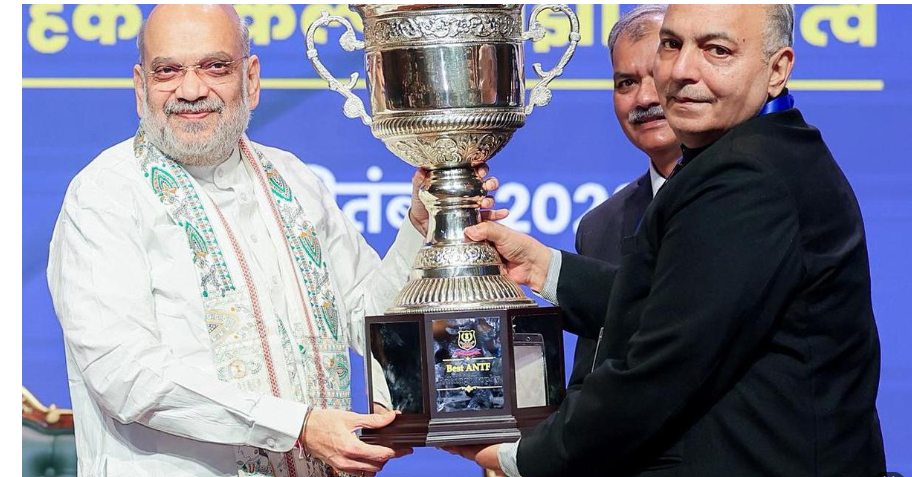
The Telangana Narcotics Bureau and EAGLE Force received national recognition for their performance in combating drug trafficking and substance abuse.EAGLE Force Director Sandeep Shandilya received the award from Union Home Minister Amit Shah at the Third National Conference of Heads of Anti-Narcotics Task Forces of States and Union Territories in New Delhi.
About the Recognition

Telangana secured more than 80% marks in the performance assessment conducted on seven parameters prescribed by the Union Government.

The award recognises the State’s efforts in:

  • Conducting intelligence-based operations
  • Controlling synthetic drugs and precursor chemicals
  • Strengthening investigation and prosecution
  • Reducing drug demand and related harm
  • Improving institutional coordination
  • Developing administrative and operational capacity

The Narcotics Control Bureau (NCB) organised the two-day national conference. ANTF heads from all 36 States and Union Territories, along with representatives of government departments and other stakeholders, participated in it.

What is an Anti-Narcotics Task Force?

An Anti-Narcotics Task Force (ANTF) is a specialised State-level enforcement mechanism created to prevent and investigate narcotics-related crimes.

Its major responsibilities include:

  • Identifying drug-trafficking networks
  • Conducting intelligence-based operations
  • Controlling synthetic drugs and precursor chemicals
  • Coordinating with the NCB and other enforcement agencies
  • Supporting investigation and prosecution
  • Promoting drug-abuse prevention

ANTFs have been notified in all 36 States and Union Territories. However, their structure, resources and responsibilities differ. The NCB circulated a model framework for an ideal State ANTF in June 2026 to improve institutional uniformity.

Seven Assessment Parameters

Intelligence Operations

This covers the collection, analysis and use of actionable information to identify drug suppliers and trafficking networks.

Control of Precursors and Synthetic Drugs

Precursor chemicals are substances that may have legal industrial or pharmaceutical uses but can also be diverted to manufacture illegal drugs. Monitoring their movement is essential for controlling synthetic drugs.

Prosecution

This evaluates the quality of investigation, legal preparation and follow-up of narcotics cases before courts.

Demand and Harm Reduction

Demand reduction seeks to prevent people from consuming drugs. Harm reduction aims to reduce the health and social consequences of substance abuse.

Coordination and Capacity Building

It assesses cooperation among police units, government departments and enforcement agencies, along with the training of personnel.

Research and Analysis

This involves studying drug-trafficking routes, consumption patterns and emerging narcotics-related threats.

Administration and Logistics

It examines the availability of trained personnel, equipment, technology and other operational facilities.

Telangana’s Anti-Narcotics Approach

Intelligence-led Enforcement

The EAGLE Force focuses on collecting intelligence and conducting coordinated operations against drug suppliers and trafficking networks.

Prosecution Support

Telangana has established specialised mechanisms covering:

  • Legal scrutiny of narcotics cases
  • Judicial analysis
  • Witness protection
  • Assistance to prosecutors

These mechanisms can improve the quality of evidence, reduce procedural weaknesses and strengthen cases during trial.

Administrative Monitoring

  • Telangana Director General of Police C.V. Anand regularly reviews the functioning of the EAGLE Force.
  • District Superintendents of Police and other unit officers have been directed to prioritise action against drug trafficking and substance abuse.

Institutional Coordination

The recognition reflects coordination among the EAGLE Force, district police units and other government departments.

National Anti-Narcotics Framework

The Union Government follows a zero-tolerance approach against drug trafficking. The national strategy rests on four major pillars:

  • Intelligence- and operation-based enforcement
  • Control of precursors and synthetic drugs
  • Demand and harm reduction
  • Capacity building and institutional coordination

The Vision Document on Narcotics Control, 2026–2029 seeks to strengthen:

  • State Anti-Narcotics Task Forces
  • Forensic laboratories
  • The Narcotics Control Bureau
  • Inter-agency coordination
  • The Narco-Coordination Centre mechanism

Emerging Narcotics-Related Threats

The conference focused on major challenges such as:

  • Organised drug cartels
  • Synthetic drugs
  • Clandestine drug laboratories
  • Diversion of precursor chemicals
  • Darknet-based drug trafficking
  • Cryptocurrency-enabled illegal payments
  • Inter-State and international drug networks

CARE MCQ

Q. Consider the following statements regarding Telangana’s EAGLE Force:

  1. It received recognition at the Third National Conference of ANTF Heads.
  2. Telangana secured more than 80% marks in the Union Government’s assessment.
  3. The assessment considered only the quantity of drugs seized.
  4. Prosecution and harm reduction were included in the assessment.

Which of the statements given above are correct?

(a) 1 and 3 only
(b) 1, 2 and 4 only
(c) 2, 3 and 4 only
(d) 1, 2, 3 and 4

Answer: (b) 1, 2 and 4 only

Statement-wise Explanation

  • Statement 1 is correct: The recognition was presented at the Third National Conference of ANTF Heads.
  • Statement 2 is correct: Telangana secured more than 80% marks in the overall assessment.
  • Statement 3 is incorrect: The evaluation covered seven parameters and was not limited to drug seizures.
  • Statement 4 is correct: Prosecution, demand reduction and harm reduction were included in the assessment.

FAQs

1. What is the EAGLE Force?

It is Telangana’s specialised institutional mechanism for combating drug trafficking and substance abuse.

2. Who received the national award?

EAGLE Force Director Sandeep Shandilya received it on behalf of the Telangana Police.

3. Who presented the award?

Union Home Minister Amit Shah presented the award in New Delhi.

4. What is an ANTF?

An ANTF is a State or Union Territory-level specialised force responsible for preventing and investigating narcotics-related crimes.

5. Which organisation conducted the national conference?

The Narcotics Control Bureau organised the conference.

6. Why is prosecution support important?

It improves legal scrutiny, evidence presentation, witness protection and coordination between investigators and prosecutors.


Relevance: GS Paper II: India–U.S. Relations; Effect of policies of developed countries on India

Important Keywords for Prelims and Mains

Prelims

  • USTR, Executive Order, Section 301, Section 232, Ad Valorem Tariff, Presidential Waiver

Mains

  • Secondary Sanctions, Strategic Autonomy, Energy Security, Export Competitiveness, Trade Protectionism

Why in News?

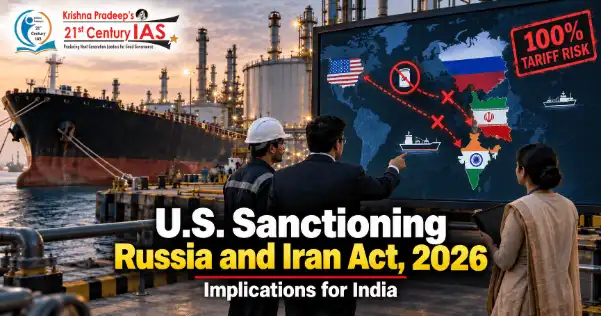
U.S. President Donald Trump has signed the Lindsey O. Graham Sanctioning Russia and Iran Act, 2026 into law. The Act allows the United States to impose tariffs of up to 100% on imports from countries that continue to buy large quantities of Russian crude oil or natural gas. India could be affected because it is one of the world’s largest buyers of Russian crude oil.

What is the U.S. Sanctioning Russia and Iran Act?

  • The law seeks to reduce Russia’s energy revenue and thereby weaken its ability to finance the Russia–Ukraine war.
  • It was proposed by the late U.S. Senator Lindsey O. Graham and was subsequently named after him.
  • Its scope was later expanded to include Iran. Sanctions relating to Iran have been extended for five years, until 2031.

Main Objectives

  • Reduce Russia’s earnings from oil and natural-gas exports
  • Pressure major buyers of Russian energy
  • Sanction important Russian individuals and entities
  • Prevent the evasion of Russian oil sanctions
  • Increase economic pressure connected with the Russia–Ukraine conflict

Why is the Act Important for India?

  • The law creates the possibility of penalising Indian exports because of India’s energy transactions with Russia.
  • This resembles a secondary sanction, in which a third country is targeted for maintaining specified economic relations with the main sanctioned country.

India is therefore required to balance:

  • Affordable Russian oil
  • Access to the U.S. export market
  • Domestic fuel-price stability
  • Strategic relations with Russia
  • Growing economic ties with the United States

When Can the Tariff Apply?

  • The relevant tariff provisions can be applied after a 30-day period following enactment.
  • A country may face tariffs under either of two conditions.

Major Importer of Russian Energy

The country:

  • Was among the five largest importers, by volume, of Russian crude oil or natural gas during the preceding 12 months; and
  • Continues such purchases after the 30-day period.

This condition is especially relevant to India and China, the two largest importers of Russian crude oil.

Facilitating Sanctions Evasion

  • A country may also face tariffs if it was among the five leading countries facilitating evasion of sanctions on Russian oil.
  • India faces a lower risk under this condition because Indian oil-marketing companies have maintained that their purchases complied with the applicable sanctions.

Is a 100% Tariff Automatic?

No. The Act permits a tariff of up to 100%.

The United States may impose a lower rate. This provides India with diplomatic space to negotiate:

  • A lower tariff
  • An exemption
  • A transition period
  • A formal presidential waiver

Why is the New Law More Serious than the Earlier Measure?

Earlier Tariff

  • The earlier 25% punitive tariff imposed on India for purchasing Russian oil was based on an Executive Order.
  • In February 2026, the U.S. Supreme Court struck down the broader tariff regime that included this punitive tariff.
  • An Executive Order can generally be modified or withdrawn through executive action and may face judicial review.

Present Tariff

The new measure has been:

  • Passed by the U.S. Congress
  • Signed by the President
  • Converted into federal law

It therefore has greater legal permanence. A presidential waiver also requires formal justification to Congress.

Why is India Particularly Exposed?

Dependence on Russian Crude

Russia supplied more than 51% of India’s crude-oil imports in July 2026.

A major reduction within 30 days would require India to:

  • Find alternative suppliers
  • Renegotiate supply contracts
  • Identify suitable crude grades
  • Arrange new shipping routes
  • Bear higher transportation and insurance costs

High Oil Prices

Global oil prices are above $100 per barrel. Alternative crude supplies could therefore be considerably more expensive.

Strait of Hormuz Constraints

Movement through the Strait of Hormuz remains constrained. This affects supplies from important West Asian producers and limits India’s immediate alternatives.

Importance of the U.S. Market

The United States accounts for roughly 20% of India’s goods exports.

A high tariff could therefore affect India’s export growth, manufacturing activity, employment and MSME sector.

Are the New Tariffs Additional to Existing Duties?

  • Yes. The law states that the tariff will be imposed in addition to any other applicable duty.

Section 301 of the Trade Act, 1974

  • Section 301 allows the United States Trade Representative to investigate foreign trade practices that harm American commerce and impose retaliatory measures.
  • India faces a 10% tariff connected with a U.S. investigation into goods produced using forced labour.

Section 232 of the Trade Expansion Act, 1962

  • Section 232 allows the U.S. government to restrict imports when they are considered a threat to national security.
  • The United States imposed tariffs of 50% on steel, aluminium, copper and certain related products.
  • A new Russia-related tariff may be imposed on top of these existing duties.

How Does a 100% Tariff Work?

Suppose an Indian product worth $100 enters the United States.

If a 100% tariff is imposed:

  • Product value: $100
  • Customs duty: $100
  • Landed cost before other expenses: $200

The American importer pays the customs duty. However, the importer may demand a lower price from the Indian exporter or shift to another supplier.

Possible Impact on India

  • The impact depends on two possible situations.

India Continues Russian Oil Imports

Decline in Exports

Indian products may become more expensive than goods supplied by competing countries.

This can result in:

  • Lower export orders
  • Loss of U.S. customers
  • Reduced market share
  • Pressure on export earnings

Evidence from Earlier Tariffs

  • India’s merchandise exports to the U.S. grew by nearly 18% during April–August 2025 compared with the same period of the previous year.
  • Part of this growth came from exporters sending goods early before the tariffs were imposed.
  • However, export growth slowed to 3.8% during April 2025–February 2026, indicating a substantial slowdown after the earlier tariffs came into effect in August 2025.

Pressure on MSMEs

During the earlier 50% tariff period, some Indian exporters shared part of the additional cost with American buyers to retain them.

Absorbing a possible 100% tariff would be much more difficult.

MSMEs may face:

  • Reduced profit margins
  • Order cancellations
  • Cash-flow problems
  • Lower production
  • Loss of customers
  • Employment pressure

India Reduces Russian Oil Imports

  • India has earlier reduced oil imports from Venezuela, Iran and Russia in response to American pressure.
  • However, reducing Russian purchases under current conditions could create significant energy-related problems.

Higher Energy Costs

Alternative suppliers may charge higher prices, increasing India’s oil-import bill.

Domestic Fuel Prices

Higher crude costs may create pressure for increases in petrol and diesel prices.

Inflationary Impact

Expensive fuel can increase:

  • Transportation costs
  • Agricultural input costs
  • Manufacturing expenses
  • Prices of essential goods

Political Sensitivity

Large fuel-price increases may be politically difficult because several important State elections are scheduled in the following year.

Options Before India

Reduce Russian Oil Imports

Advantage:

  • Indian exports may avoid very high U.S. tariffs.

Difficulties:

  • Alternative crude may be more expensive.
  • The oil-import bill may rise.
  • Domestic fuel prices may increase.
  • Thirty days may be insufficient for adjustment.

Continue Russian Imports

Advantage:

  • India can maintain access to Russian crude supplies.

Risks:

  • Indian exports may become uncompetitive.
  • MSMEs may lose American customers.
  • Manufacturing and employment may suffer.

Negotiate a Lower Tariff or Waiver

The provision for tariffs of “up to 100%” provides room for negotiations.

India can seek:

  • A lower tariff rate
  • A temporary exemption
  • A longer transition period
  • A presidential waiver

Waiver Provision

The U.S. President can waive the tariff after submitting to Congress:

  1. Written certification that the waiver is in the national interest of the United States
  2. A report explaining the reasons for granting it

The President therefore possesses waiver authority, but it is subject to congressional reporting.

Review Mechanism

The USTR, in consultation with the U.S. Secretary of State and Secretary of Energy, must review the list of major Russian oil and gas importers.

The review will:

  • Take place within 180 days after the initial tariffs
  • Use the most recent 12-month trade data
  • Reassess the five largest importers of Russian crude oil and natural gas

India’s position may therefore change if its import pattern changes.

Conditions for Ending the Measures

The sanctions framework may be affected if Russia:

  • Signs a peace agreement accepted by the internationally recognised Government of Ukraine
  • Ceases military hostilities
  • Ends activities aimed at undermining the Ukrainian government

Challenges for India

  • Energy–trade dilemma: Affordable Russian oil must be balanced against access to the U.S. market.
  • Short adjustment period: Thirty days is insufficient for changing major energy contracts.
  • Expensive alternatives: Replacement crude may raise India’s import bill.
  • Cumulative tariffs: The new duty may be added to existing tariffs.
  • MSME vulnerability: Smaller firms cannot absorb a steep tariff burden.
  • Inflation risk: Higher crude prices can increase costs across the economy.
  • Export dependence: The U.S. receives a major share of Indian goods exports.
  • Strategic balancing: India must protect relations with both Russia and the United States.

Way Forward

  • Intensify diplomatic negotiations with the United States.
  • Seek a reduced tariff, transition period or presidential waiver.
  • Present evidence that Indian oil purchases complied with applicable sanctions.
  • Avoid a sudden reduction that could threaten domestic energy security.
  • Gradually diversify crude-oil suppliers.
  • Support export-oriented MSMEs through credit and market assistance.
  • Help exporters enter markets beyond the United States.
  • Closely monitor crude prices and shipping conditions.
  • Coordinate foreign, trade and energy policies through a unified approach.
  • Protect India’s strategic autonomy while safeguarding economic interests.

Conclusion

The U.S. Sanctioning Russia and Iran Act presents India with a difficult choice. Continuing Russian oil imports may expose Indian exports to steep tariffs, while reducing those imports could raise energy costs and domestic fuel prices.

India requires a calibrated strategy based on diplomatic negotiations, gradual energy diversification and support for vulnerable exporters. The objective should be to protect energy security, export competitiveness and strategic autonomy simultaneously.

CARE MCQ

Q. Consider the following statements regarding the U.S. Sanctioning Russia and Iran Act, 2026:

  1. It allows tariffs of up to 100% on imports from certain major buyers of Russian energy.
  2. It automatically applies to every country importing Russian crude oil.
  3. Its tariff may be imposed in addition to other applicable American duties.
  4. A presidential waiver requires written certification to Congress.

Which of the statements given above are correct?

(a) 1 and 2 only
(b) 1, 3 and 4 only
(c) 2, 3 and 4 only
(d) 1, 2, 3 and 4

Answer: (b) 1, 3 and 4 only

Statement-wise Explanation

  • Statement 1 is correct: The Act permits tariffs of up to 100% on goods from countries meeting the prescribed conditions.
  • Statement 2 is incorrect: It focuses on major importers and leading facilitators of sanctions evasion.
  • Statement 3 is correct: The tariff may be added to other applicable duties.
  • Statement 4 is correct: The President must provide a national-interest certification and explanatory report.

FAQs

1. Why could India be affected by the Act?

India is a major importer of Russian crude oil and an important exporter to the United States.

2. Does India automatically face a 100% tariff?

No. The Act authorises tariffs of up to 100%. The actual rate may be lower.

3. When can the tariffs be applied?

The relevant tariff provisions can be applied after 30 days from enactment.

4. Are these tariffs additional to existing duties?

Yes. They may be imposed on top of other applicable American tariffs.

5. Can the U.S. President grant India a waiver?

Yes. A waiver requires written certification and an explanatory report to Congress.

6. Why is reducing Russian oil difficult?

Russian crude forms a major share of India’s imports, alternative supplies may be expensive and the Strait of Hormuz remains constrained.

7. How could MSMEs be affected?

They may face lower orders, reduced profit margins, loss of customers and employment pressure.

8. What is India’s most practical option?

India can seek a waiver or lower tariff while gradually diversifying its oil suppliers and export markets.

Relevance: GS Paper III: Creative Economy, Employment, Tourism and Digital Infrastructure

Important Keywords for Prelims and Mains

Prelims

India Cine Hub, NFDC, Film Visa, Film Bazaar, GIS Mapping, Co-production Treaty, Live Events Development Cell

Mains

Creative Economy, Ease of Doing Business, Film Tourism, Cultural Diplomacy, State Integration, Single-Window Clearance

Why in News?

The India Cine Hub is being developed as a centralised, single-window digital platform to simplify film-shooting permissions in India.The platform brings together permissions from Union Ministries, State governments, police departments and local authorities. It also facilitates film visas, co-production applications, filming incentives, location mapping and access to verified production services.

What is India Cine Hub?

  • The India Cine Hub, or ICH, is an online platform designed to facilitate domestic and international film production in India.
  • It is managed by the National Film Development Corporation of India and provides a common system through which filmmakers can apply for permissions required to shoot films, television programmes, documentaries and other audiovisual content.

It supports applications relating to:

  • Film-shooting permissions
  • Film visas
  • International co-productions
  • Central and State incentives
  • Aerial and animal filming
  • Forest and monument locations
  • Production vendors and local services
  • Live-event permissions

Thus, the platform seeks to replace multiple separate applications with a coordinated digital process.

Why Does India Need a Single-Window Film Portal?

Multiple Permissions

  • Filmmakers may require approvals from several authorities, including State governments, police departments, forest authorities, local bodies and agencies managing monuments.
  • Approaching every authority separately increases administrative delays and production costs.

Different State Procedures

  • States follow different rules, application formats and approval processes. This creates uncertainty, especially for projects filmed across multiple States.

Growing Content Industry

  • India’s film, television and digital-content sector generated approximately $13.1 billion in 2023–24, registering an increase of around 18% from 2019.
  • It is expected to grow by 6–10% and reach an estimated value of $17.5–19.7 billion by 2028–29.

Global Filming Potential

  • India offers diverse locations ranging from Himalayan landscapes and deserts to beaches, forests, historic cities, forts, palaces and UNESCO World Heritage Sites.
  • A simplified permission system can convert this geographical and cultural diversity into an economic opportunity.

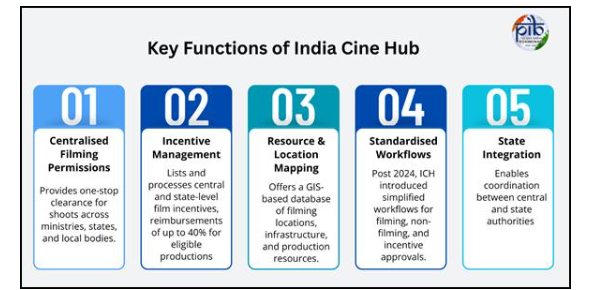
Key Functions of India Cine Hub

Centralised Filming Permissions

  • The portal provides a common application system for domestic and international creators.
  • Applications are digitally forwarded to the relevant Union Ministries, State nodal officers and local authorities.
  • For States without an online permission system, the platform provides a standard application format.

Film Visa Facilitation

  • Foreign filmmakers can use the portal to apply for filming permission and obtain assistance in securing a Film Visa.
  • A Film Visa allows foreign film crews and production professionals to undertake approved filming activities in India.

Incentive Management

  • The portal lists and processes Central and State-level incentives available to filmmakers.
  • Eligible international productions may receive incentives of up to 40% of qualifying production expenditure, subject to the applicable conditions.

GIS-Based Location Mapping

The portal provides a Geographic Information System-based database containing information about:

  • Shooting locations
  • Production infrastructure
  • Available local resources
  • Permit authorities
  • Major film-production hubs

This allows producers to assess potential locations before beginning production.

Standardised Workflows

Simplified and uniform procedures have been introduced for:

  • Film permissions
  • Non-film projects
  • Incentive applications
  • International productions
  • Co-production approvals

Standardisation improves transparency and reduces variations in administrative processing.

State Integration

The portal connects Union and State authorities through designated nodal officers.

States and Union Territories can use the platform to showcase their:

  • Filming locations
  • Studio infrastructure
  • Production facilities
  • Local service providers
  • Tourism potential
  • Film incentives

Regulatory Guidance

The portal provides guidelines relating to:

  • Film visas
  • Aerial filming
  • Filming with animals
  • Forest locations
  • Protected monuments
  • General filming regulations

Verified Resource Directory

Filmmakers can obtain information about verified local service providers, including:

  • Film studios
  • Equipment-rental agencies
  • Post-production companies
  • Casting agencies
  • Performers and technicians
  • Property-rental services
  • Hotels and accommodation
  • Catering services
  • Travel operators
  • Security and medical facilities

Digital Monitoring

  • A dashboard records the number of applications and tracks approvals at State, national and international levels.
  • The portal uses encryption and is designed to manage large volumes of applications and user traffic.

Extension to Live Events

  • The India Cine Hub is also being expanded as the core digital infrastructure of the Live Events Development Cell.

Under this system:

  • Event venues are digitally mapped.
  • Applications are routed to the concerned authorities.
  • Local nodal officers coordinate permissions.
  • Event organisers can monitor the approval process.

Nine major venues have already been included in the system.
What is a Film and Media Co-production?

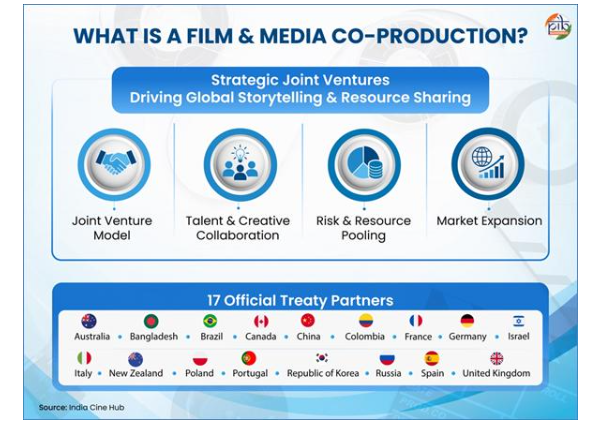
A film co-production is a collaborative project involving producers from two or more countries.

Such collaborations facilitate:

  • Joint production: Producers jointly develop and finance a project.
  • Talent collaboration: Artists, technicians and creative professionals work across countries.
  • Resource pooling: Partners share locations, equipment, finance and infrastructure.
  • Risk sharing: Financial and production risks are divided among partners.
  • Market expansion: Films gain easier access to audiences and distributors in partner countries.

The India Cine Hub processes applications for official co-productions and provides guidelines relating to co-production treaties.

India’s Co-production Treaty Partners

India has official audiovisual co-production treaties with 17 countries:

  • Australia
  • Bangladesh
  • Brazil
  • Canada
  • China
  • Colombia
  • France
  • Germany
  • Israel
  • Italy
  • New Zealand
  • Poland
  • Portugal
  • Republic of Korea
  • Russia
  • Spain
  • United Kingdom

Examples of official co-productions include:

  • Union Leader — India–Canada
  • Sir — India–France
  • Mujib: The Making of a Nation — India–Bangladesh
  • All We Imagine as Light — India–France
  • Quo Vadis — India–Poland
  • Parikrama — India–Italy

What is the National Film Development Corporation?

  • The National Film Development Corporation of India was established in 1975 to promote the growth of Indian cinema.

It developed into an integrated film institution after incorporating the functions of bodies such as:

  • Film Finance Corporation
  • Indian Motion Picture Export Corporation
  • Films Division
  • Directorate of Film Festivals
  • National Film Archive of India
  • Children’s Film Society, India

Major Functions of NFDC

  • Film production: Co-produces films through public-private partnerships.
  • Talent development: Supports scripts, workshops and emerging filmmakers.
  • International production: Provides line-production support to foreign filmmakers.
  • Film promotion: Promotes multilingual Indian cinema in domestic and international markets.
  • Film preservation: Supports the preservation of India’s cinematic heritage.
  • Film Bazaar: Conducts Film Bazaar alongside the International Film Festival of India in Goa.

Film Bazaar India is an important South Asian platform for co-production, distribution, financing and interaction among filmmakers and investors.

India’s Major Film-Production Hubs

  • India’s important production centres include Mumbai, Hyderabad, Chennai, Kolkata, Bengaluru, Delhi, Guwahati, Bhubaneswar, Thiruvananthapuram and Kochi.
  • These hubs together employ more than 1.6 lakh people.

Mumbai Film City

  • Established in 1977
  • Renamed Dadasaheb Phalke Chitranagari in 2001
  • Spread across more than 520 acres
  • Contains approximately 42 outdoor locations
  • Offers studios, forests, hills, valleys and water bodies

Ramoji Film City, Hyderabad

  • Established in 1996
  • Spread over approximately 2,000 acres
  • Provides more than 500 filming locations
  • Employs around 6,000 people
  • Can support nearly 40 Indian film projects simultaneously
  • Recognised as the world’s largest film-studio complex

Noida Film City

  • Spread over approximately 100 acres
  • Contains 16 studios
  • Houses media companies, broadcasters and publication organisations
  • Employs approximately 17,000 media professionals
  • Supports wider livelihood opportunities for nearly 1.5 lakh people

Development of New Film Cities

  • States such as Uttar Pradesh, Punjab, Madhya Pradesh, Assam, Chhattisgarh, Odisha and Bihar are developing film infrastructure in cooperation with private investors.

The expansion is being driven by:

  • Growth of regional cinema
  • Online streaming services
  • Short-form video content
  • Gaming
  • Live streaming
  • Vernacular digital platforms
  • State-level production incentives

Employment in the segment may reach around two lakh people by 2030.

Role of Digital Connectivity

India’s growing digital infrastructure has expanded the demand for audiovisual content.

  • Internet subscribers increased from 25.15 crore in 2014 to more than 109.2 crore by March 2026.
  • Wireless data costs fell from around ₹308 per GB to ₹7.51 per GB during the same period.
  • 5G services became available in 99.9% of districts.

Affordable internet has enabled India to move from being mainly a large content-consuming market towards becoming an important centre of content creation and distribution.

Role in Promoting Film Tourism

  • Films can transform lesser-known shooting locations into popular tourism destinations.
  • For example, 3 Idiots increased the visibility of Ladakh, while international productions such as Slumdog Millionaire and Life of Pi presented Indian locations to global audiences.

Film tourism can:

  • Generate local employment
  • Increase demand for hotels and transport
  • Support handicrafts and small businesses
  • Promote rural economies
  • Showcase cultural heritage
  • Improve the global visibility of destinations

Madhya Pradesh received the Most Film Friendly State Award at the 68th National Film Awards.

States such as Rajasthan, Uttar Pradesh, Kerala and Uttarakhand attract film productions through location-fee waivers, infrastructure support and financial subsidies.

Significance of India Cine Hub

  • Ease of doing business: It reduces the need to approach multiple authorities independently.
  • Administrative transparency: Digital applications and dashboards allow filmmakers to monitor approvals.
  • Cooperative federalism: It connects Union, State and local authorities through a common system.
  • Employment generation: Productions create work for artists, technicians, vendors and local workers.
  • Film tourism: States can promote their natural and cultural locations through cinema.
  • Regional development: Film crews create demand for accommodation, food, transport and other local services.
  • Cultural diplomacy: International co-productions help Indian stories and talent reach global audiences.
  • Foreign investment: Simplified procedures can attract international production companies.
  • Growth of creative industries: The platform supports films, television, streaming content and live events.

Challenges

  • Multiple authorities: Final permissions still depend on timely action by different departments.
  • Uneven State capacity: States differ in digital infrastructure and administrative preparedness.
  • Lack of fixed timelines: Delays may continue unless authorities follow defined approval periods.
  • Security concerns: Filming near borders, airports and strategic locations requires careful scrutiny.
  • Environmental concerns: Forests and ecologically sensitive areas require responsible filming practices.
  • Data protection: Information relating to locations, foreign applicants and production plans must be secured.
  • Infrastructure concentration: Major studios and post-production facilities remain concentrated in a few cities.
  • Limited awareness: Small and regional filmmakers may not know about the portal or available incentives.

Way Forward

  • Integrate all States and Union Territories with the platform.
  • Prescribe fixed timelines for processing permissions.
  • Develop a system for monitoring delays and fixing administrative responsibility.
  • Provide multilingual application and support services.
  • Train State nodal officers and local officials.
  • Regularly update location, incentive and vendor information.
  • Strengthen cybersecurity and protection of confidential production data.
  • Expand studios and post-production facilities in emerging regional centres.
  • Publish clear eligibility rules for film incentives.
  • Link film production with tourism and local-development policies.
  • Ensure that local workers and communities benefit from filming activities.
  • Expand international co-production partnerships and global promotion of Indian locations.

Conclusion

The India Cine Hub combines digital governance with the development of India’s creative economy. By simplifying permissions, film visas, co-productions, incentives and access to production resources, it can make India a more competitive filming destination.Its long-term success will depend on effective State integration, timely approvals, reliable digital systems and coordination among authorities. With these improvements, the platform can promote employment, tourism, cultural diplomacy and India’s emergence as a global centre for audiovisual content.
CARE MCQ

Q. Consider the following statements regarding the India Cine Hub:

  1. It is managed by the National Film Development Corporation of India.
  2. It facilitates film-shooting permissions and film-visa applications.
  3. It provides information about official international co-productions.
  4. Its services are restricted only to foreign filmmakers.

Which of the statements given above are correct?

(a) 1 and 2 only
(b) 1, 2 and 3 only
(c) 2, 3 and 4 only
(d) 1, 2, 3 and 4

Answer: (b) 1, 2 and 3 only

Explanation:

  • Statement 1 is correct: The NFDC manages the India Cine Hub.
  • Statement 2 is correct: It facilitates filming permissions and Film Visa-related applications.
  • Statement 3 is correct: The portal processes co-production applications and provides treaty guidelines.
  • Statement 4 is incorrect: It serves both domestic and international filmmakers.

FAQs

1. What is the India Cine Hub?

It is a single-window digital platform that simplifies film-shooting permissions and related production services in India.

2. Which organisation manages it?

The National Film Development Corporation of India manages the platform.

3. What is a Film Visa?

It is a visa that permits foreign filmmakers and production professionals to undertake authorised filming activities in India.

4. What is an official film co-production?

It is a jointly produced film involving partners from countries that have audiovisual co-production agreements.

5. What is Film Bazaar India?

It is a film market organised by the NFDC alongside the International Film Festival of India in Goa.

6. How does the portal support State governments?

It enables States to integrate their permission systems and showcase locations, incentives, infrastructure and local production services.

7. How can the platform promote tourism?

Films can bring lesser-known destinations into public attention and encourage audiences to visit those locations.

8. Why is State integration important?

Most filming permissions involve State and local authorities. Their digital integration is necessary for faster and more transparent approvals.

TGPSC Current Affairs September 22nd 2026

Enroll Now for Unlimited UPSC Utsav

Start Date

20/09/2026

Timings

08 AM – 4 PM

    Courses

    Scroll to Top