Mains Practice Questions for the Day
- Q. “India’s sanitation policy has gradually shifted from infrastructure creation to behavioural change and collective responsibility.” Discuss this statement with reference to the Swachh Bharat Mission and Swachhata Hi Seva 2026. Highlight the challenges and suggest a way forward.
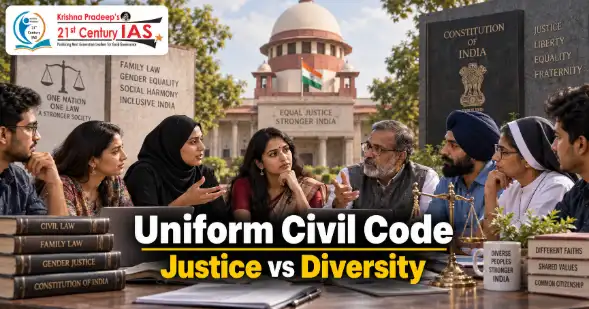
- Q. “The Uniform Civil Code debate is not merely about legal uniformity; it involves reconciling gender justice and constitutional equality with religious freedom and cultural diversity.” Discuss. Suggest a balanced approach for reforming personal laws in India.
Q. “India’s sanitation policy has gradually shifted from infrastructure creation to behavioural change and collective responsibility.” Discuss this statement with reference to the Swachh Bharat Mission and Swachhata Hi Seva 2026. Highlight the challenges and suggest a way forward.
Introduction:
The Swachh Bharat Mission (SBM), launched in 2014, initially concentrated on toilet construction and elimination of open defecation. After rural India was declared Open Defecation Free in 2019, the Mission expanded towards ODF Plus villages, source segregation, solid and liquid waste management, visual cleanliness and resource recovery. The annual Swachhata Hi Seva (SHS) campaign has supported this transition through public participation.
Body
Transition in India’s Sanitation Approach
- Infrastructure to sustainability: SBM now covers waste collection, processing, sewage treatment, public sanitation facilities and GOBARdhan plants alongside toilet access.
- Individual behaviour to community ownership: SHS promotes Jan Bhagidari and shramdaan, making cleanliness a shared responsibility of citizens, institutions and governments.
- Waste to resource: Composting, biogas, recycling, Kabaad Se Jugaad and Kabaad Se Kala connect sanitation with the circular economy.
- Worker-centred sanitation: SafaiMitra camps recognise the health, safety, welfare and dignity of sanitation workers.
- Contribution of SHS 2026
- With the theme “Swachhata Mein Sahbhag; Swachh Bharat, Viksit Bharat,” SHS 2026 follows Whole-of-Government and Whole-of-Society approaches. It focuses on transforming neglected Cleanliness Target Units, engaging students through Swachhata Gyan Yatras, promoting four-way source segregation, encouraging eco-friendly festivals and creating awareness about the Solid Waste Management Rules, 2026.
Challenges
Major challenges include weak source segregation, uneven local-body capacity, inadequate maintenance of cleaned sites, occupational risks faced by SafaiMitras and declining citizen participation after campaign periods. Cleanliness drives may also become symbolic without regular collection, processing and safe disposal.
Way Forward
Sanitation should become a year-round local responsibility. Every transformed site requires an accountable agency and maintenance plan. Local bodies need greater technical capacity, while digital platforms should monitor grievances and outcomes. Continuous school education, household-level segregation, worker protection and periodic review by Gram Sabhas and urban councils are essential.
Conclusion:
India’s sanitation transformation will remain sustainable only when infrastructure is supported by responsible behaviour, efficient institutions and permanent community ownership. SHS 2026 can therefore help convert Swachhata from a government programme into an everyday civic culture.
Q. “The Uniform Civil Code debate is not merely about legal uniformity; it involves reconciling gender justice and constitutional equality with religious freedom and cultural diversity.” Discuss. Suggest a balanced approach for reforming personal laws in India.
Introduction:
A Uniform Civil Code (UCC) seeks to provide common civil laws for all citizens in matters such as marriage, divorce, adoption, maintenance and inheritance. Article 44, a Directive Principle of State Policy, directs the State to endeavour to secure a UCC throughout India. However, under Article 37, this provision is non-justiciable.
Body
Factors Behind the Trade Reversal
- Increased Indian supply: A substantial Hilsa catch from the Bharuch region of Gujarat created an exportable surplus.
- Strong Bangladeshi demand: Hilsa remains central to Bangladesh’s food culture despite the country producing nearly 70% of the world’s Hilsa.
- Export restrictions: Bangladesh’s restrictions and limited seasonal export window reduced supplies to India.
- Improved market linkages: Connections among Gujarat suppliers, the Howrah wholesale market and Petrapole enabled reverse trade.
- Changing production patterns: Availability, prices and consumer demand have altered the traditional market structure.
Significance for India
The trade provides new income opportunities for fishers, traders and exporters. It can promote employment in processing, cold storage, transportation and retailing. Better grading, packaging and traceability can support a value-added Hilsa economy. The development also strengthens the Blue Economy and creates opportunities for closer India–Bangladesh commercial and cultural relations.
Challenges
- Overfishing and capture of juvenile Hilsa
- Obstruction of migration by dams and barrages
- Pollution and degradation of breeding habitats
- Climate-induced changes in river flow, temperature and salinity
- Inadequate cold-chain and processing infrastructure
- Unpredictable bilateral trade restrictions
Way Forward
India must adopt science-based catch limits, protect spawning seasons and regulate destructive fishing nets. River connectivity should be maintained through environmental flows and fish passages. PM Matsya Sampada Yojana can strengthen cold-chain, processing and traceability systems. India and Bangladesh should establish joint stock assessments, habitat protection mechanisms and a predictable trade framework.
Conclusion:
India requires inclusive personal-law reform rather than cultural standardisation. A consultative, gradual and gender-just approach can advance Article 44 while preserving religious freedom and India’s plural social character.