
Why in News?
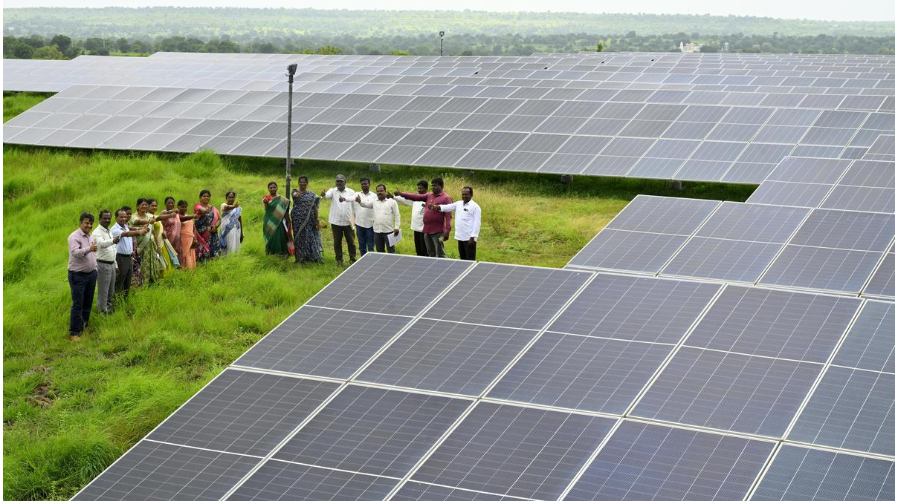
- Women’s SHG federations in Telangana are becoming owners and operators of solar power plants under the Indira Mahila Shakti programme. A one-megawatt ground-mounted solar plant established by the Vikarabad Zilla Samakhya and Kotepally Mandal Samakhya was recently connected to the electricity grid.
What is the Solar Entrepreneurship Initiative?
- The initiative enables women’s SHG federations, known as Samakhyas, to establish solar power plants on government land that is unsuitable for agriculture.
- The projects are being implemented by the Society for Elimination of Rural Poverty (SERP) in association with the Telangana Renewable Energy Development Corporation Limited (TGREDCO).
- Electricity generated by the plants is purchased by power distribution companies under formal agreements. Revenue from electricity sales accrues to the SHG federations, which represent thousands of rural women.
The initiative therefore combines:
- Women’s economic empowerment
- Renewable-energy generation
- Productive use of barren government land
- Creation of long-term community assets
- Regular income for SHG federations
How Does the Project Work?
- The solar plant at Barwad village in Kotepally mandal of Vikarabad district has a capacity of one megawatt.
- It was established by the Vikarabad Zilla Samakhya and Kotepally Mandal Samakhya at an estimated cost of ₹2.84 crore.
- The plant is expected to generate around 18.3 lakh units of electricity annually. The Telangana Electricity Regulatory Commission approved a tariff of ₹3.13 per unit for purchasing the electricity.
- The project is also eligible for capital subsidy under the State’s MSME policy. The remaining project cost can be financed through institutional credit and the resources of SHG federations.
The Three-Way Benefit
The initiative has been described as a “win-win-win” model because:
- Government Land is Protected: Non-agricultural government land is put to productive use and protected from encroachment.
- Clean Energy is Generated: Solar power supports Telangana’s transition towards renewable energy.
- Women Earn Revenue: Profits from electricity sales flow to the SHG federations.
The land is expected to remain under productive use for the project period of 25 years, creating a long-term asset for rural women.
Role of Major Institutions
Society for Elimination of Rural Poverty
- SERP mobilises rural women into SHGs and federations. Under this initiative, it facilitates project planning, financial arrangements, institutional coordination and capacity building.
TGREDCO
- TGREDCO provides technical support for renewable-energy development, including the establishment and grid integration of solar plants.
TGERC
- The Telangana Electricity Regulatory Commission determines the tariff at which electricity generated by these plants is purchased.
DISCOMs
- The State’s power distribution companies have signed agreements to purchase electricity from the SHG-owned plants. These agreements provide an assured buyer for the power generated.
SHG Federations
- The Zilla Samakhyas and Mandal Samakhyas own the projects and receive the resulting income. Women members also participate in monitoring and managing the assets.
Expansion across Telangana
- Land was initially identified across 31 districts for establishing solar projects.
- Plants with a combined capacity of nine megawatts have been established in:
- Khammam
- Kumaram Bheem Asifabad
- Vikarabad
- Peddapalli
- Wanaparthy
- Jangaon
- Mahabubnagar
- Plants in Khammam and Kumaram Bheem Asifabad have already been inaugurated. Projects in Vikarabad, Jangaon and Peddapalli were awaiting formal inauguration at the time of reporting.
- The Vikarabad administration is also considering another solar unit on land adjoining the existing plant.
Conclusion
The solar initiative under Indira Mahila Shakti represents a significant expansion of Telangana’s SHG movement. It enables rural women to own productive assets, generate clean energy and earn long-term income. Effective training, transparent management and reliable power-purchase arrangements can make the programme a strong model of women-led development and green rural growth.
Why in News?
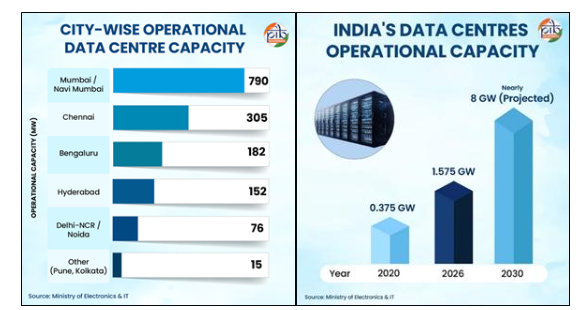
- India’s data-centre capacity has increased from approximately 375 MW in 2020 to 1.57 GW in August 2026.
- Installed capacity is projected to reach nearly 8 GW by 2030, supported by the growth of cloud computing, Artificial Intelligence, digital payments and e-Governance.
What is a Data Centre?
A data centre is a secure facility containing computing, storage and networking equipment. It stores, processes, manages and distributes large volumes of digital information.
Data centres support several essential services, including:
- Online banking and digital payments
- Government portals and e-Governance
- Cloud computing
- E-commerce and online communication
- Artificial Intelligence applications
- Healthcare, education and business platforms
- Storage and processing of government and commercial data
Modern data centres are designed to operate continuously. Therefore, they require uninterrupted electricity, efficient cooling, high-speed connectivity, physical security and protection against cyberattacks.
What are the Major Components of a Data Centre?
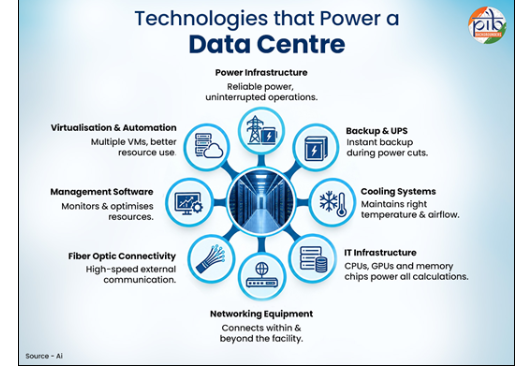
Power Infrastructure
Data-centre equipment requires an uninterrupted electricity supply.
- Uninterruptible Power Supply: Provides immediate backup during a power interruption.
- Backup generators: Maintain operations during prolonged power cuts.
- Electrical distribution systems: Deliver electricity safely to different parts of the facility.
- Redundant power systems: Ensure that failure in one component does not interrupt the entire service.
Cooling Infrastructure
Servers generate considerable heat during continuous operation. Excessive heat can damage equipment and reduce efficiency.
- Heating, Ventilation and Air Conditioning systems regulate temperature and airflow.
- Advanced airflow management prevents the formation of hot zones.
- Liquid-cooling technologies transfer heat more efficiently than conventional air cooling.
- Modern facilities increasingly use closed-loop systems to reduce water consumption.
Information Technology Infrastructure
- Servers process information and run digital applications.
- Storage systems hold digital information.
- Hard Disk Drives provide high-volume storage.
- Solid-State Drives provide faster data access without moving mechanical parts.
Networking Infrastructure
- Routers and high-speed switches allow information to move within the data centre and between the facility and external networks.
- Fibre-optic connections enable the rapid transmission of large volumes of data over long distances.
Security Systems
Data centres require both physical and digital security.
- Physical security protects buildings, equipment and access points.
- Cybersecurity systems protect networks and information from malware, unauthorised access and data theft.
- Backup and disaster-recovery systems help restore services after a failure or cyberattack.
Management Software
- Management software monitors power, cooling, storage and computing resources.
- Virtualisation allows a single physical server to operate several virtual machines. This improves the use of available computing capacity.
- Automation tools distribute workloads, identify operational problems and support preventive maintenance.
How Does a Data Centre Process a Digital Request?
- When a person opens an application, checks a bank balance or accesses a government document, the request travels through a network to a data centre.
Security Verification
- The security layer checks whether the request is safe and authorised. It protects the system from suspicious or harmful activity.
Load Distribution
- A load balancer directs the request to an available server. It prevents one server from becoming overloaded while others remain underused.
Application Processing
- The application server identifies the information or service requested by the user.
- When communication with another application is required, it uses an Application Programming Interface. An API enables different software systems to exchange information.
Data Retrieval
- The database server retrieves the required information from storage and returns it to the application server.
Response to the User
- The processed information travels through the network and reaches the user’s device. This entire process may be completed within one to two seconds.
- The operational sequence can be understood as:
- Connect → Receive → Secure → Process → Store or Retrieve → Respond
What is the Status of Data Centres in India?
- India’s data-centre ecosystem has expanded along with digital banking, online public services, cloud computing and Artificial Intelligence.
Government Data Centres
The National Informatics Centre has established National Data Centres at:
- Delhi
- Pune
- Hyderabad
- Bhubaneswar
NIC has also established 37 smaller data centres in different State capitals. These facilities support government departments through round-the-clock operations, system management and technical personnel.
Investment
- Investments currently underway: Nearly USD 70 billion
- Additional announced projects: Approximately USD 90 billion
This expansion indicates growing investor confidence in India’s cloud computing, digital services and Artificial Intelligence markets.
What Policy Support is Available?
Infrastructure Status
The Union Budget 2022–23 included data centres in the Harmonised List of Infrastructure.
Infrastructure status allows data-centre projects to access:
- Easier institutional credit
- Long-term project finance
- Better financing conditions
- Greater investor participation
It places data centres alongside other important infrastructure sectors such as power, transport and telecommunications.
Tax Incentive for Foreign Cloud Companies
The Union Budget 2026–27 introduced a tax holiday for eligible foreign cloud-service providers until 2047.
The incentive:
- Covers notified foreign companies;
- Applies from 2026–27 to 2046–47; and
- Supports global cloud operations using data-centre infrastructure located in India.
The measure is intended to attract international cloud companies and encourage them to use India as a major data-processing and storage destination.
Which Schemes Support the Data Centre Ecosystem?
- Data centres depend on semiconductors, servers, networking equipment, Artificial Intelligence systems and reliable electricity. Several government programmes support this wider ecosystem.
Semicon India Programme
The second phase of the Semicon India Programme—Semicon 2.0 was approved in July 2026.
- Implemented under the India Semiconductor Mission
- Financial outlay: ₹1,27,500 crore
- Objective: Build a trusted and resilient semiconductor ecosystem
Domestic semiconductor manufacturing can reduce dependence on imported chips used in servers, storage systems and networking equipment.
IndiaAI Mission
The IndiaAI Mission has a total budgetary outlay of ₹10,371.92 crore.
It aims to develop a comprehensive Artificial Intelligence ecosystem through computing capacity, datasets, innovation, skills and responsible AI development. The expansion of AI applications will further increase demand for high-performance data centres.
Electronics Components Manufacturing Scheme
- Financial support for the Electronics Components Manufacturing Scheme has been increased from ₹22,000 crore to ₹40,000 crore.
- The scheme supports domestic production of electronic components required for computing and digital infrastructure.
PLI Scheme 2.0 for IT Hardware
The Production Linked Incentive Scheme 2.0 for IT Hardware supports the domestic manufacturing of:
- Servers
- Laptops and tablets
- Personal computers
- Related IT hardware
It seeks to attract investment, reduce import dependence and integrate India into global electronics supply chains.
Why are Energy and Water Planning Important?
- Data centres consume significant quantities of electricity because their computing and cooling systems must operate continuously.
The Central Electricity Authority estimates that electricity demand from data centres could reach approximately 17 GW by 2031–32.
Unplanned expansion can increase pressure on electricity grids and local water resources. Therefore, India must promote energy-efficient and water-efficient facilities.
Renewable Energy and Clean Power
The government is promoting cleaner power for data centres through:
- Green Energy Open Access Rules
- Green Energy Corridor Scheme
- National Green Hydrogen Mission
- National Programme on High-Efficiency Solar PV Modules
- Solar Park Scheme
These initiatives can help data-centre operators obtain reliable renewable electricity and reduce their carbon footprint.
SHANTI Act and Nuclear Energy
The Sustainable Harnessing and Advancement of Nuclear Energy for Transforming India Act seeks to strengthen the clean-power ecosystem.
It supports reliable nuclear electricity for emerging energy-intensive sectors, including Artificial Intelligence and data centres. It also enables the future deployment of:
- Small Modular Reactors
- Micro Nuclear Reactors
These technologies could provide stable low-carbon power close to major digital infrastructure clusters.
Efficiency Standards for Data Centres
- The Bureau of Indian Standards has constituted the LITD 31 Technical Committee for cloud computing, information technology and data centres.
- BIS standards cover important efficiency indicators.
Power Usage Effectiveness
- PUE measures how efficiently a data centre uses electricity. It compares the total electricity consumed by the facility with the electricity used directly by computing equipment.
- A lower PUE generally indicates better energy efficiency.
Water Usage Effectiveness
- WUE measures the amount of water consumed in relation to the computing work performed by a data centre.
Carbon Usage Effectiveness
- CUE measures the carbon emissions associated with the electricity consumed by computing equipment.
Cooling Efficiency Ratio
- CER measures how efficiently the cooling system removes heat in relation to the electricity it consumes.
Building and Resource-Efficiency Codes
The Bureau of Energy Efficiency has notified:
- Energy Conservation Building Code, 2017
- Energy Conservation and Sustainable Building Code, 2024
These codes prescribe energy-efficiency and water-conservation standards for buildings, including provisions relevant to data-centre infrastructure.
Advanced Cooling and Water Management
The water requirement of a data centre depends mainly on the cooling technology used. Extraction of groundwater for industrial purposes is regulated through guidelines issued by the Ministry of Jal Shakti.
Artificial Intelligence infrastructure generates greater heat and is encouraging the adoption of advanced cooling systems, such as:
- Direct-to-chip liquid cooling
- Immersion cooling
- Adiabatic cooling
- Closed-loop liquid cooling
Closed-loop systems reuse cooling fluid and can reduce dependence on freshwater.
What is the Strategic Significance of Data Centres?
Foundation of the Digital Economy
Data centres enable digital payments, banking, e-commerce, cloud services, online education and Artificial Intelligence. Their reliability directly affects economic activity.
Better e-Governance
Government portals require secure and continuous data-processing capacity. Strong domestic data centres improve the reliability of online certificates, welfare platforms, tax systems and public databases.
Data Sovereignty
Domestic data-centre capacity allows important data to be stored and processed within India’s jurisdiction. This strengthens regulatory oversight and reduces excessive dependence on foreign infrastructure.
Employment and Investment
Data-centre development generates demand for construction, electrical equipment, cooling technology, cybersecurity, networking, maintenance and skilled IT services.
Technological Self-Reliance
Data centres support domestic capabilities in semiconductors, cloud computing, Artificial Intelligence, telecommunications and advanced electronics.
Disaster Resilience
Redundant systems, backup facilities and geographically distributed data centres help maintain digital services during natural disasters, power disruptions and cyberattacks.
What are the Major Challenges?
- High Energy Consumption: Continuous computing and cooling operations place additional pressure on electricity grids.
- Water Stress: Water-intensive cooling systems may compete with domestic, agricultural and industrial needs, particularly in water-scarce cities.
- Carbon Emissions: Dependence on fossil-fuel-based electricity can increase the environmental footprint of digitalisation.
- Cybersecurity Threats: Data centres are attractive targets for ransomware, espionage, sabotage and data theft.
- Import Dependence: India continues to depend on imported advanced chips, servers and specialised cooling equipment.
- Land and Connectivity Requirements: Large facilities need suitable land, reliable power, high-speed fibre networks and proximity to major digital markets.
- Regional Concentration: Excessive concentration in a few metropolitan centres can create infrastructure pressure and disaster-related risks.
- Data Governance: Expansion must be supported by clear rules regarding privacy, accountability, data localisation and cross-border data flows.
- Electronic Waste: Frequent replacement of servers and storage equipment can increase e-waste unless circular-economy practices are adopted.
Conclusion
Data centres are no longer merely storage facilities; they are strategic infrastructure supporting India’s digital economy, governance and national security. Their expansion can promote investment, innovation and technological self-reliance. However, rapid growth must be balanced with cybersecurity, data protection and efficient use of energy and water. Sustainable and secure data centres can become a foundational pillar of Viksit Bharat 2047.
Why in News?
- The Incentive Scheme for Promotion of Domestic PNG Connections was launched on August 18, 2026. The scheme came into effect on September 1, 2026 and will operate in two tranches spread over six months. It provides additional domestically produced APM gas to City Gas Distribution entities that add active, billed household PNG connections beyond prescribed targets. The scheme seeks to improve access to clean, safe and affordable piped cooking gas.
What is Piped Natural Gas?
- Piped Natural Gas is natural gas supplied directly to households through a network of underground pipelines. It is mainly used as a cooking fuel.
- Unlike Liquefied Petroleum Gas, PNG does not require households to book, store or replace cylinders. Consumption is measured through a meter, and consumers pay according to the quantity used.
PNG forms part of a wider City Gas Distribution network, which supplies natural gas to:
- Households
- Commercial establishments
- Industrial units
- Transport vehicles through CNG stations
What is a City Gas Distribution Network?
- A City Gas Distribution network consists of pipelines and associated facilities developed to supply natural gas within an authorised area.
- CGD networks are developed by entities authorised by the Petroleum and Natural Gas Regulatory Board.
- A Geographical Area is a specific region assigned by PNGRB to an authorised entity for developing and operating the CGD network.
Status of Domestic PNG Connections in India
- PNGRB has authorised CGD entities in 309 Geographical Areas. Together, these areas cover the entire mainland of India.As of August 18, 2026, India had approximately 1.74 crore domestic PNG connections.
- Although geographical authorisation has expanded, creating an authorised CGD area does not automatically mean that every household is connected. Pipeline construction, last-mile connections, consumer registration and conversion of inactive connections into billed connections remain important tasks.
About the Incentive Scheme
The Incentive Scheme for Promotion of Domestic PNG Connections aims to accelerate the addition of active household PNG connections.
Its major objectives are to:
- Convert unbilled connections into active, billed connections.
- Encourage CGD companies to connect households more rapidly.
- Extend pipeline networks to new localities.
- Improve access to clean and convenient cooking fuel.
- Reduce the time required by companies to recover the cost of household connections.
The scheme will be implemented in two tranches over six months.
How Does the Incentive Mechanism Work?
- A minimum number of connections has been prescribed for every Geographical Area.
- During the performance period, an eligible CGD entity must add billed domestic PNG connections beyond this minimum threshold.
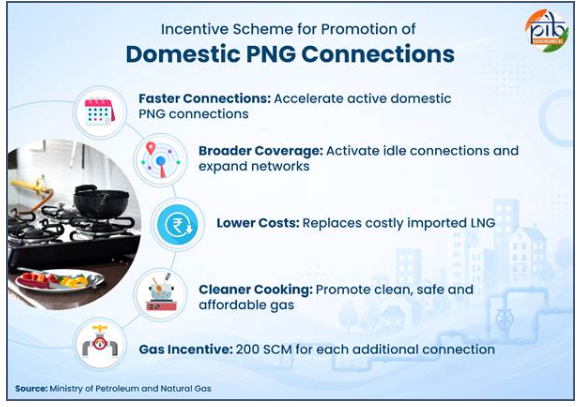
- For every eligible incremental connection, the entity will receive an additional allocation of 200 Standard Cubic Metres of gas.
What is an Incremental Connection?
- An incremental connection is an additional active and billed domestic PNG connection created beyond the minimum target fixed for a Geographical Area.
- Thus, the scheme rewards actual gas usage rather than the mere installation of an unused pipeline or meter.
What is a Standard Cubic Metre?
- A Standard Cubic Metre is a standard unit used for measuring the volume of gas under specified temperature and pressure conditions.
Why is APM Gas Provided as an Incentive?
- The additional allocation will consist of domestically produced gas supplied under the Administered Price Mechanism.
- APM gas is generally priced lower than imported Liquefied Natural Gas. The additional APM gas will replace costlier LNG presently purchased by CGD entities for their Compressed Natural Gas transport segment.
This mechanism will:
- Reduce the overall gas-purchasing cost of CGD companies.
- Improve the commercial viability of domestic PNG connections.
- Encourage faster expansion into new residential areas.
- Allow companies to recover their capital expenditure more quickly.
The payback period for the capital spent on a household connection is expected to decline from approximately ten years to nearly three years.
Therefore, the scheme aligns the commercial interests of CGD companies with the national objective of expanding clean household energy.
Benefits of PNG for Households
Safe and Secure Supply
- PNG is supplied through underground pipelines at low pressure. Households do not need to store or handle gas cylinders.
- Natural gas is lighter than air and generally rises and disperses when released. However, regular inspection, leak detection and adherence to safety standards remain essential.
Everyday Convenience
PNG provides a continuous household supply. Consumers need not book cylinders, wait for delivery or replace empty cylinders.
This is particularly useful for:
- High-rise residential buildings
- Densely populated urban colonies
- Large housing complexes
- Households with regular cooking requirements
Metered Billing
- Consumers pay for the gas they actually use. Billing is based on meter readings, similar to electricity and water services.
Lower Household Expenditure
- On a comparable energy basis, PNG generally costs less than LPG. Regular users may therefore experience a reduction in monthly cooking-fuel expenditure.
Cleaner Cooking Fuel
PNG burns more cleanly than many conventional cooking fuels and produces fewer local air pollutants.
It can:
- Improve indoor air quality
- Reduce smoke and soot
- Support cleaner urban energy use
- Lower carbon emissions compared with more polluting fuels
However, natural gas remains a fossil fuel. Therefore, leak prevention and methane-emission control are important for achieving its environmental benefits.
Assured Availability
- Pipeline supply reduces dependence on cylinder transportation and delivery logistics. It provides a more continuous and predictable cooking-fuel supply.
Initiatives Supporting PNG Expansion
Accelerated Approval Framework
An Accelerated Approval Framework has been introduced under the Natural Gas and Petroleum Products Distribution (Through Laying, Building, Operation and Expansion of Pipelines and Other Facilities) Order, 2026.
It seeks to:
- Process pipeline-related applications on priority.
- Ensure approvals within defined timelines.
- Reduce delays in CGD infrastructure development.
- Improve coordination among implementing authorities.
Uniform Right-of-Way Charges
- The 2026 Order provides for uniform charges for pipeline Right of Way.
- Right of Way refers to official permission to use land, roads or public spaces for laying, operating and maintaining pipelines.
- Uniform charges can reduce differences between jurisdictions and improve the predictability of project costs.
Reduction of VAT on Natural Gas
- States have been encouraged to reduce Value Added Tax on natural gas to 5%.
- Several States have already lowered VAT. Tax rationalisation can reduce the cost of piped gas and improve its affordability for consumers.
National PNG Drive 2.0
- The National PNG Drive 2.0 was conducted from January 1 to June 30, 2026.
- It aimed to accelerate domestic PNG connections across authorised Geographical Areas and increase public awareness about piped cooking gas.
Unified PNG Registration Portal
A unified digital platform is being developed to provide a single-window system for domestic PNG applications.
The proposed portal will allow consumers to:
- Apply for a new connection.
- Track the status of an application.
- Access information about service availability.
- Reduce the need to approach multiple offices.
Significance of the Scheme
Expansion of Clean Cooking Energy
The scheme can extend cleaner cooking fuel to more urban and semi-urban households, improving health, convenience and quality of life.
Improved Commercial Viability
Cheaper APM gas reduces the sourcing cost of CGD companies. This makes the expansion of household connections financially more attractive.
Activation of Existing Connections
By rewarding billed connections, the scheme encourages companies to convert installed but unused connections into active household services.
Development of Urban Infrastructure
Expansion of CGD networks strengthens the energy infrastructure of cities and growing towns.
Reduced Cylinder-Delivery Dependence
Piped supply can reduce the need for LPG cylinder transportation, storage and delivery in densely populated areas.
Energy Security
Greater use of domestically produced APM gas can reduce dependence on costlier imported LNG. However, long-term energy security will also depend on domestic gas availability and responsible demand management.
Ease of Living
Continuous supply, metered billing and digital registration can make household cooking-energy services more accessible and convenient.
Major Challenges
- High Initial Investment: Laying underground pipelines and providing last-mile household connections require substantial capital expenditure.
- Right-of-Way Delays: Pipeline construction often requires permission from urban local bodies, road authorities and other agencies.
- Inactive Connections: Some households may obtain a connection but continue using LPG due to familiarity, rental arrangements or uncertainty about consumption charges.
- Uneven Network Development: Authorisation of an area does not guarantee immediate pipeline access to every locality.
- Urban Construction Difficulties: Congested roads, underground utility lines and densely built settlements complicate pipeline installation.
- Tax Differences: Natural gas remains outside the Goods and Services Tax framework, and varying State VAT rates can affect consumer prices.
- Supply and Price Risks: Limited domestic gas availability may increase dependence on imported LNG, which is exposed to international price fluctuations.
- Safety and Maintenance: Pipeline integrity, accurate metering, emergency response and regular leak detection are necessary for consumer confidence.
- Regional Inclusion: Remote settlements and low-density areas may be less commercially attractive to CGD companies.
Way Forward
Ensure Last-Mile Connectivity
CGD companies should prioritise actual household connections and gas usage rather than limiting expansion to trunk pipelines.
Strengthen Centre–State Coordination
The Union Government, State governments and urban local bodies should coordinate to provide timely permissions and standardised Right-of-Way procedures.
Improve Consumer Awareness
Households should receive clear information about installation charges, billing, safety practices and the comparative cost of PNG.
Expand Digital Services
The unified registration portal should provide application tracking, billing support and grievance redressal in multiple Indian languages.
Maintain Safety Standards
Regular pipeline inspections, smart meters, leak-detection systems and emergency-response mechanisms should be made integral to network expansion.
Rationalise Taxes
Greater coordination among States on VAT rates can reduce regional price differences and improve consumer affordability.
Protect Vulnerable Consumers
Connection costs and security deposits should not prevent low-income households from accessing piped cooking gas. Suitable payment facilities may be considered.
Improve Environmental Performance
Methane leakage must be monitored across production, transportation and distribution networks. Expansion of natural gas should complement, rather than delay, the long-term transition towards renewable energy.
Conclusion
The Incentive Scheme for Promotion of Domestic PNG Connections shifts attention from network creation to active household usage. By providing lower-priced APM gas for incremental billed connections, it gives CGD entities a commercial reason to expand faster. Its success will depend on reliable gas availability, affordable tariffs, timely approvals and strict safety standards. Proper implementation can support cleaner cooking energy, urban infrastructure, energy security and improved ease of living.