Why in News?
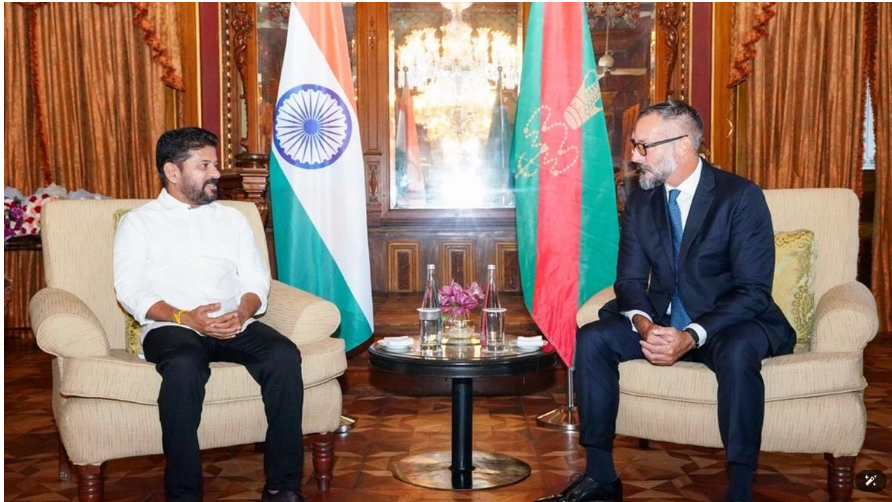
Telangana Chief Minister A. Revanth Reddy met Prince Rahim Aga Khan V at Falaknuma Palace, Hyderabad, on September 15, 2026. He sought the Aga Khan Foundation’s cooperation in rejuvenating the Musi River and restoring important heritage buildings situated along its banks.
Background
- The Musi River, a tributary of the Krishna, originates in the Ananthagiri Hills and flows through Hyderabad. It has played an important role in the city’s historical and cultural development.
- However, untreated sewage, solid waste, reduced natural flow and construction within the floodplain have affected its ecological health. Its restoration is therefore connected with pollution control, urban planning, flood management and heritage conservation.
- The Telangana Government approached the Aga Khan Foundation because of its experience in heritage restoration and community development. The Foundation had earlier contributed to the restoration of the Telangana Legislative Council building.
Areas of Proposed Cooperation
Musi River and Surrounding Areas
- The government sought institutional and technical cooperation for restoring the river and improving its surrounding urban landscape. The proposed engagement is expected to combine environmental rejuvenation with the protection of Hyderabad’s cultural identity.
Osmania General Hospital
- The government has decided to shift Osmania General Hospital to new premises being developed at Goshamahal Stadium.
- The old hospital building will be declared a heritage structure. The Foundation has been requested to undertake its renovation and conservation instead of allowing the historic structure to deteriorate.
City College
- The government also proposed restoration of City College, a prominent heritage building located on the banks of the Musi.
- Scientific conservation of the two structures could support the development of a heritage corridor along the riverfront.
Education, Health and Tourism
The State proposed wider cooperation with the Foundation in:
- Educational development
- Healthcare services
- Heritage and cultural tourism
- Institutional capacity-building
Prince Rahim Aga Khan V was also invited to participate in the Invest Telangana Global Summit, beginning on December 7, 2026.
Bharat Future City
Prince Rahim Aga Khan V expressed interest in the proposed Bharat Future City and its development model.
The project has the following features:
- It is proposed near Hyderabad’s international airport.
- Singapore-based consultants are preparing its master plan.
- It is planned as a net-zero city.
- It will include a green zone covering approximately 15,000 acres.
- Global companies, including Amazon Web Services, have begun work on establishing units there.
A net-zero city seeks to minimise greenhouse-gas emissions through renewable energy, energy-efficient buildings, low-emission transport, water recycling and scientific waste management.
Investment and Educational Outreach
- Telangana aims to become a USD 3-trillion economy by 2047 and contribute at least 10% of India’s GDP.
- Delegates from more than 100 countries are expected to participate in the Invest Telangana Summit and examine investment opportunities in the State.
- The government also highlighted agreements reached during its delegation’s visits to the United Kingdom and the United States. Institutions such as the London School of Business and Harvard University agreed to establish facilities in Telangana.
Conclusion
The proposed cooperation offers Telangana an opportunity to combine ecological recovery with the protection of Hyderabad’s architectural heritage. Transparent governance, scientific planning and community participation will determine whether the initiative becomes a model of inclusive and sustainable urban renewal.
Why in News?
The International Day of Clean Air for Blue Skies was observed on September 7, highlighting the need for coordinated action against air pollution. India marked the occasion as Swachh Vayu Diwas and reviewed progress under the National Clean Air Programme. During 2025–26, 108 NCAP cities recorded lower annual PM10 levels than in 2017–18.
International Day of Clean Air for Blue Skies
The United Nations General Assembly designated September 7 as the International Day of Clean Air for Blue Skies in 2019.
The observance seeks to:
- Increase public awareness about air pollution;
- Encourage national and international cooperation;
- Promote scientific air-quality management; and
- Support action for cleaner and healthier communities.
Clean air is essential for public health, environmental sustainability, labour productivity and economic development.
Understanding Air Pollution
- Air pollution occurs when harmful gases, liquid droplets or solid particles accumulate in the atmosphere at levels that damage human health or the environment.
- Major anthropogenic sources include transport, industries, thermal power, construction activity, road dust, waste burning and crop-residue burning. Natural sources include dust storms, forest fires and volcanic activity.
Particulate Matter
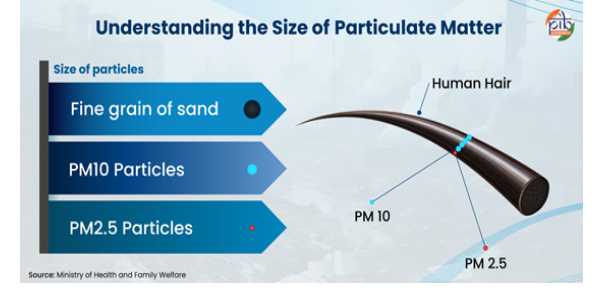
Particulate Matter consists of tiny solid particles or liquid droplets suspended in the atmosphere.
- PM10: Particles measuring 10 micrometres or less in diameter.
- PM2.5: Finer particles measuring 2.5 micrometres or less.
PM2.5 can penetrate deep into the lungs, while some particles may enter the bloodstream. Long-term exposure increases the risk of respiratory and cardiovascular illness.
Air-Quality Monitoring in India
National Air Quality Monitoring Programme
The Central Pollution Control Board initiated the National Ambient Air Quality Monitoring programme, which was subsequently renamed the National Air Quality Monitoring Programme.
Its objectives are to:
- Assess ambient air quality periodically;
- Identify pollution trends in urban areas;
- Estimate future changes;
- Detect violations of prescribed standards; and
- Evaluate possible health hazards.
As of March 2026, India’s monitoring network consisted of 1,646 stations across 603 cities, covering 28 States and seven Union Territories.
The SAMEER application and portal provide near real-time Air Quality Index information for more than 292 cities. Public grievance portals have also been established in NCAP cities.
Major Monitoring Systems
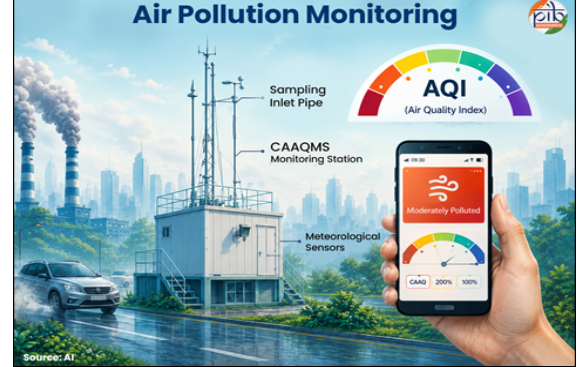
Continuous Ambient Air Quality Monitoring System
- CAAQMS provides automated, real-time monitoring of pollutants such as PM10, PM2.5, sulphur dioxide, nitrogen oxides, carbon monoxide, ozone and ammonia.
Ambient Air Quality Monitoring System
- AAQMS is a wider framework covering manual and automated stations. Manual monitoring generally involves collecting air samples over 24 hours and analysing them in laboratories.
- It also records meteorological factors such as temperature, humidity, wind speed and wind direction.
Online Continuous Emission Monitoring System
- OCEMS measures emissions directly at industrial facilities and continuously transmits data to regulatory authorities.
- The CPCB has directed 17 categories of highly polluting industries to install OCEMS. In Delhi-NCR, the requirement covers additional red-category industries, food-processing units and metal units.
Air Quality Index
The Air Quality Index communicates air quality through six categories. It is calculated using PM10, PM2.5, nitrogen dioxide, sulphur dioxide, carbon monoxide, ozone, ammonia and lead. The pollutant with the worst sub-index determines the overall AQI.
| AQI category | Range |
| Good | 0–50 |
| Satisfactory | 51–100 |
| Moderate | 101–200 |
| Poor | 201–300 |
| Very Poor | 301–400 |
| Severe | 401–500 |
National Clean Air Programme
- The government launched the National Clean Air Programme in 2019 as a mission-mode, multi-sectoral initiative covering 130 cities.
- It involves the Union Government, State governments, district administrations, Urban Local Bodies and other stakeholders. State- and city-specific action plans target locally important pollution sources through short- and long-term interventions.
Progress under NCAP
- Clean Air Action Plans have been prepared by 24 States and Union Territories and all participating cities.
- Between 2019–20 and 2025–26, ₹16,423.55 crore was provided through performance-linked grants.
- Cities reported utilisation of ₹11,575.54 crore, or 70.5% of the funds.
- In 2025–26, 108 cities recorded lower PM10 concentrations than the 2017–18 baseline.
- Of these, 72 achieved reductions exceeding 20%, while 26 recorded reductions above 40%.
- Fourteen cities complied with the National Ambient Air Quality Standards.
PRANA Portal
- The Portal for Regulation of Air Pollution in Non-Attainment Cities monitors the physical and financial implementation of NCAP action plans.
- It improves transparency by providing information on activities, expenditure and implementation progress.
Swachh Vayu Survekshan
Launched in 2022–23 by the Ministry of Environment, Forest and Climate Change, Swachh Vayu Survekshan assesses cities on their implementation of clean-air measures.
Cities are grouped into three categories:
- Population of 10 lakh or more;
- Population between three lakh and 10 lakh; and
- Population below three lakh.
In 2025, Indore, Amravati and Dewas topped the three respective categories.
In 2026, the leading cities were:
- Lucknow: Category 1
- Rourkela: Category 2
- Kalinganagar: Category 3
The 2026 assessment introduced ward-level evaluation across more than 7,400 wards. Ward 70 of Lucknow led the largest category, Wards 30 and 36 of Bhubaneswar topped the middle category, and Ward 13 of Rourkela led the smallest category.
Sector-wise Pollution-Control Measures
Vehicular Emissions
- BS-VI emission norms have applied nationwide since April 2020.
- The PM E-DRIVE Scheme and PM e-Bus Sewa promote cleaner mobility.
- Charging infrastructure is being expanded under Ministry of Power guidelines.
- Registered Vehicle Scrapping Facilities and Automated Testing Stations support the Vehicle Scrapping Policy.
- The Pollution Under Control certification system is being strengthened.
- The PARIVARTAN programme incentivises replacement of BS-IV and older trucks and buses in the NCR with BS-VI, CNG or electric vehicles.
- From November 1, 2026, only BS-VI, CNG or electric public transport buses will be permitted to enter Delhi.
- Electric three-wheelers are being introduced in phases across Delhi and high-volume NCR districts.
Industrial Emissions
The MoEFCC prescribes sector-specific standards, while industries without separate standards follow the Environment (Protection) Rules, 1986.
CPCB has classified 419 industrial sectors and subsectors according to their pollution potential:
- 125 Red
- 137 Orange
- 94 Green
- 54 White
- 9 Blue
In Delhi-NCR, approved fuel lists and continuous monitoring requirements apply to identified industries. Revised particulate-emission norms of 50 mg/Nm³ for large and polluting units become applicable from October 1, 2026.
The Comprehensive Environmental Pollution Index identifies Critically Polluted and Severely Polluted Areas for targeted remedial action.
Road and Construction Dust
Construction and road dust contribute around 40–50% of PM10 in many cities, based on source-apportionment studies under NCAP.
Important measures include:
- Guidelines for construction and demolition waste;
- Anti-smog guns at large construction sites;
- Online compliance monitoring in Delhi-NCR;
- Mechanised road sweeping;
- Improvement of roads and junctions;
- Greening of open spaces; and
- Dust Control and Management Cells for road-owning agencies.
Seventy such cells have been established across the NCR.
Open Waste Burning
- Waste-related emissions are regulated through rules concerning solid waste, plastic waste, hazardous waste, e-waste, batteries and biomedical waste.
- Extended Producer Responsibility makes producers responsible for post-consumer plastic packaging, e-waste, batteries, tyres and used oil.
- Twelve identified single-use plastic items with low utility and high littering potential have been prohibited since July 2022.
Crop-Residue and Biomass Burning
- CPCB supports paddy-straw pelletisation and torrefaction plants. CAQM has directed 5–10% biomass co-firing in specified thermal power plants, captive power plants and brick kilns.
Other measures include:
- ₹37.16 crore sanctioned for 34 pelletisation and torrefaction plants;
- ₹4,233.84 crore provided for crop-residue management between 2018–19 and 2025–26;
- More than 3.53 lakh machines distributed to farmers; and
- Over 43,535 Custom Hiring Centres established.
Compared with 2021, paddy-stubble-burning incidents declined in 2025 by 93% in Punjab and 91% in Haryana.
Afforestation and Urban Green Cover
- Green India Mission: ₹1,019.26 crore released to States by March 2026.
- CAMPA: More than 3.20 lakh hectares taken up for compensatory afforestation between 2020–21 and 2024–25.
- Nagar Van Yojana: Targets 1,000 Nagar Vans and Vatikas by 2026–27; 626 had received support by March 2026.
- Aravalli Green Wall: Targets ecological restoration across 6.31 million hectares in Rajasthan, Gujarat, Haryana and Delhi.
- Ek Ped Maa Ke Naam: Recorded plantation of 262.4 crore saplings by December 2025.
Institutional Framework
Central Pollution Control Board
- The CPCB is a statutory organisation established under the Water (Prevention and Control of Pollution) Act, 1974. It also exercises functions under the Air (Prevention and Control of Pollution) Act, 1981.
- It advises the Union Government, establishes standards and coordinates pollution-control activities.
Commission for Air Quality Management
- The CAQM was established under the Commission for Air Quality Management in National Capital Region and Adjoining Areas Act, 2021.
- It coordinates air-pollution management across the NCR airshed and supervises the implementation of the Graded Response Action Plan.
Graded Response Action Plan
- GRAP is an emergency framework under which increasingly strict measures are applied as Delhi’s air quality deteriorates.
- Its four stages extend from Poor, with AQI between 201 and 300, to Severe Plus, when AQI exceeds 450. Measures include restrictions on construction, industrial operations and certain categories of vehicles.
State Pollution Control Boards
- SPCBs implement pollution-control laws, monitor industries, grant regulatory consent and manage waste-related compliance at the State level.
Uniform Consent Framework
- Uniform guidelines for granting, refusing or cancelling consent under the Air and Water Acts were notified in January 2025.
- The Unified Consent and Authorisation Management System enables end-to-end online processing of industrial consent applications. It seeks to standardise fees, siting criteria and timelines while improving transparency.
Significance
India’s clean-air policy has gradually shifted from isolated pollution-control measures towards coordinated, city-specific and measurable interventions. Expanded monitoring improves identification of pollution hotspots, while performance-linked grants create incentives for Urban Local Bodies to deliver measurable outcomes.
The emphasis on transport, industry, dust, waste, biomass burning and green cover recognises that urban air pollution has multiple sources and cannot be addressed by a single department.
Challenges
- Monitoring remains uneven outside major cities.
- Many Urban Local Bodies lack adequate technical and financial capacity.
- Air pollution crosses municipal and State boundaries, while administration remains jurisdiction-based.
- Seasonal emergency measures often receive greater attention than year-round emission reduction.
- Weak enforcement reduces industrial and construction-site compliance.
- The gap between funds released and utilised delays local action.
- PM2.5, secondary pollutants and regional transport of pollution require advanced modelling.
- Public participation remains limited despite grievance platforms.
- Plantation drives require long-term survival audits rather than only sapling counts.
Way Forward
- Adopt airshed-based management extending beyond municipal boundaries.
- Expand real-time monitoring to smaller cities and rural industrial clusters.
- Regularly update source-apportionment and emission-inventory studies.
- Link grants to independently verified reductions in pollutant concentrations.
- Strengthen the staffing and laboratory capacity of SPCBs and Urban Local Bodies.
- Integrate public transport, walking and cycling into city clean-air plans.
- Enforce construction-dust, industrial-emission and waste-management standards consistently.
- Use satellite data, forecasting and artificial intelligence for early warning and targeted enforcement.
- Ensure transparent public disclosure through PRANA, SAMEER and city dashboards.
- Measure the survival and ecological performance of urban plantations.
Conclusion
Clean air requires continuous action rather than temporary responses during severe pollution episodes. Scientific monitoring, strong local institutions and coordinated action across airsheds can convert India’s expanding policy framework into lasting improvements in public health and environmental quality.
Why in News?
The 9th Rashtriya Poshan Maah was launched on September 9, 2026, at the Rudraksh International Cooperation and Convention Centre in Varanasi. Under the theme “Hamari Anganwadi, Hamari Jimmedari”, the campaign places Anganwadi Centres at the centre of community action for nutrition, caregiving and early childhood development.
Background
- Malnutrition affects physical growth, learning capacity, maternal health and future productivity. Addressing it requires coordinated action on food, health, sanitation, caregiving and social protection.
- The Government launched POSHAN Abhiyaan in March 2018 as a multi-ministerial convergence mission. It combines technology-based monitoring with community mobilisation and behavioural change.
- In the Union Budget 2021–22, major nutrition interventions were integrated under Mission Poshan 2.0, administered by the Ministry of Women and Child Development.
The mission brings together:
- POSHAN Abhiyaan: Digital monitoring, behavioural change and Jan Andolan.
- Anganwadi Services/ICDS: Supplementary nutrition, hot cooked meals and early childhood care.
- Scheme for Adolescent Girls: Nutritional support for eligible adolescent and out-of-school girls.
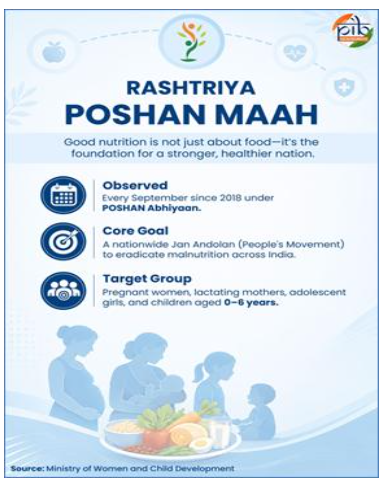
Rashtriya Poshan Maah is observed every September to mobilise communities around the objectives of Mission Poshan 2.0.
About the 9th Rashtriya Poshan Maah
- The 2026 campaign recognises Anganwadi Centres as the foundation of India’s community-based childcare and nutrition system.
- Its central theme calls upon families, local governments, community organisations and frontline workers to take collective responsibility for Anganwadi functioning.
The campaign is organised around five priorities:
- Dietary diversity and adequate protein
- Fresh and diverse hot cooked meals
- Community ownership and accountability
- Nutrition and early stimulation
- Ten years of the Pradhan Mantri Matru Vandana Yojana
Five Priority Themes
Dietary Diversity and Adequate Protein
- A balanced diet should include cereals and millets, pulses, fruits, vegetables, nuts, seeds, milk products and appropriate animal-source foods.
The campaign promotes affordable and locally available nutrition through:
- Recipe demonstrations at Anganwadi Centres
- Poshan Melas displaying local foods
- Awareness about plant- and animal-based protein
- Use of seasonal produce from Poshan Vatikas
- Counselling on complementary feeding
The objective is to move beyond calorie intake and improve the overall quality of household diets.
Fresh Hot Cooked Meals
The Supplementary Nutrition Programme provides nutrition support through Hot Cooked Meals and Take-Home Rations.
The campaign seeks to improve Hot Cooked Meals through:
- Weekly menu rotation
- Use of millets, pulses and seasonal vegetables
- Hygienic food preparation
- Quality testing in collaboration with FSSAI
- Community tasting sessions involving parents, Panchayats and Self-Help Groups
Fresh and acceptable meals can improve regular attendance and utilisation of Anganwadi services.
Community Ownership and Accountability
- The Ministry issued guidelines for Anganwadi Management Committees on June 23, 2026.
- Chaired by the Anganwadi Supervisor, these committees are expected to promote participatory oversight of nutrition and early childhood services.
Important measures include:
- Activation of AMCs at Anganwadi Centres
- At least one committee meeting during Poshan Maah
- Display of Supplementary Nutrition Programme menu boards
- Monitoring of meal quality, quantity and menu compliance
- Periodic social audits with Mothers’ Committees
Visible menu boards allow families to understand daily meals and beneficiary entitlements.
Nutrition and Early Stimulation
- Nutrition and responsive caregiving during the first 1,000 days are crucial for brain development. Undernutrition during this period can cause lasting cognitive, physical and socio-emotional effects.
- The revised Home Visit Scheduler contains a structured package covering 34 developmental milestones for children aged up to three years.
The campaign promotes:
- Caregiver counselling through home visits
- Early identification of developmental delays
- Referral to health facilities and Rashtriya Bal Swasthya Karyakram teams
- Implementation of Navchetna and Aadharshila curricula
- Age-appropriate learning and school readiness
This approach connects what a child eats with how the child learns and develops.
Ten Years of PMMVY
- The 2026 campaign commemorates ten years of the Pradhan Mantri Matru Vandana Yojana, India’s maternity-benefit programme.
- PMMVY supports maternal nutrition and health-seeking behaviour through income support during pregnancy.
The proposed campaign activities include:
- Saturation drives to identify eligible beneficiaries
- Faster verification and Direct Benefit Transfers
- Monitoring through PMMVY dashboards
- Awareness about eligibility, benefits and instalments
- Release of an implementation toolkit
- Dissemination of information in regional languages
Nutrition as a Jan Andolan
- POSHAN Abhiyaan treats nutrition as a Jan Andolan, or people’s movement, rather than only a government programme.
Community mobilisation seeks to improve behaviour related to:
- Maternal nutrition
- Infant and young child feeding
- Antenatal care
- Hand hygiene
- Growth monitoring
- Institutional healthcare
- Healthy household diets
Poshan Pakhwada 2026
- The two-week Poshan Pakhwada has been observed annually since 2018.
- Its eighth edition was held from April 9 to 23, 2026, under the theme “Maximising Brain Development in the First Six Years of Life.”
- Scientific evidence indicates that more than 85% of brain development occurs by six years of age, with the most rapid development taking place during the first 1,000 days.
Progress of Community Mobilisation
- The eighth Rashtriya Poshan Maah was launched in 2025 from Dhar, Madhya Pradesh, along with the Swasth Nari, Sashakt Parivar Abhiyaan.
- It focused on maternal nutrition, infant and young child feeding, early childhood education and reduction in excessive sugar and oil consumption. About 14.33 crore activities were conducted in convergence with more than 20 Ministries.
Poshan Tracker
Launched on March 1, 2021, the Poshan Tracker is the principal digital platform for monitoring Anganwadi infrastructure and service delivery.
It records:
- Opening of Anganwadi Centres
- Attendance of children
- Growth-monitoring activities
- Early childhood education activities
- Services for pregnant and lactating women
- Coverage of children and adolescent girls
Nutrition Infrastructure
As of July 31, 2026:
- India had nearly 13.99 lakh Anganwadi Centres.
- About 13.30 lakh Anganwadi Workers served at the grassroots.
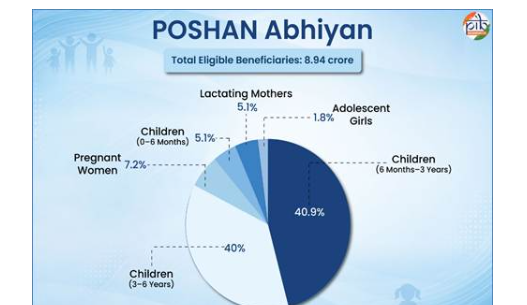
- The network covered approximately 8.94 crore beneficiaries.
- More than 7.2 crore children aged six months to six years received services.
- Pregnant and lactating women together accounted for nearly 1.1 crore beneficiaries.
Significance
Lifecycle Approach
The programme addresses nutrition from adolescence and pregnancy to infancy and early childhood, helping to break the intergenerational cycle of malnutrition.
Integration of Nutrition and Learning
Connecting nutrition with early stimulation recognises that cognitive development depends on both adequate food and responsive caregiving.
Localisation of Diets
Use of millets, pulses, seasonal vegetables and Poshan Vatika produce can make nutritious diets culturally acceptable and affordable.
Social Accountability
AMCs, Mothers’ Committees and menu boards allow communities to monitor entitlements and service quality.
Technology-Based Governance
The Poshan Tracker enables near real-time monitoring, beneficiary identification and administrative review.
Women’s Welfare
PMMVY combines income support with maternal health and nutrition, particularly during pregnancy and the first 1,000 days.
Challenges
- Poverty and food-price pressures restrict access to diverse diets.
- Protein-rich foods may remain unaffordable for vulnerable households.
- Anganwadi infrastructure and basic facilities vary across States.
- Vacancies and heavy workloads can reduce the quality of frontline services.
- Digital reporting may increase paperwork for Anganwadi Workers.
- Errors in beneficiary data can result in exclusion from services.
- Meal quality and Take-Home Ration standards are uneven.
- Social norms can lead to women eating last or receiving inadequate nutrition.
- Coordination among health, sanitation, education and food departments remains difficult.
- Awareness campaigns alone cannot overcome structural food insecurity.
Way Forward
- Upgrade Anganwadi buildings with safe kitchens, drinking water and sanitation.
- Fill frontline vacancies and provide continuous training to workers.
- Procure diverse foods locally through Panchayats, farmer groups and SHGs.
- Conduct independent testing of meals and Take-Home Rations.
- Use Poshan Tracker data for corrective action rather than only reporting.
- Strengthen convergence with healthcare, immunisation, sanitation and social-protection programmes.
- Institutionalise AMC meetings and community social audits.
- Ensure PMMVY saturation through simplified enrolment and timely transfers.
- Provide nutrition counselling in local languages.
- Monitor child-development milestones alongside height and weight.
Conclusion
Rashtriya Poshan Maah 2026 expands nutrition policy from food distribution to dietary quality, early learning and community accountability. Strengthened Anganwadi Centres, reliable data and timely maternal support can help convert public awareness into lasting improvements in human development.