Why in News?
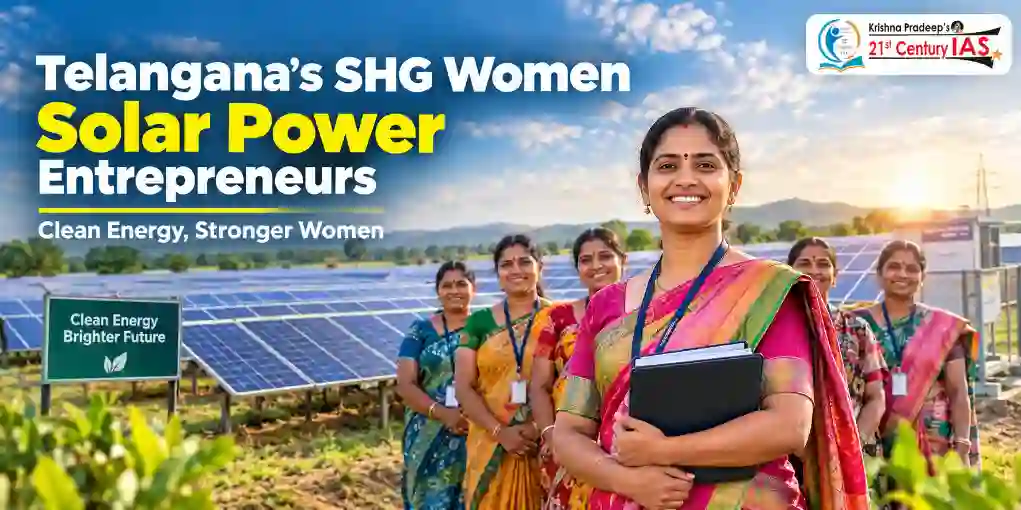
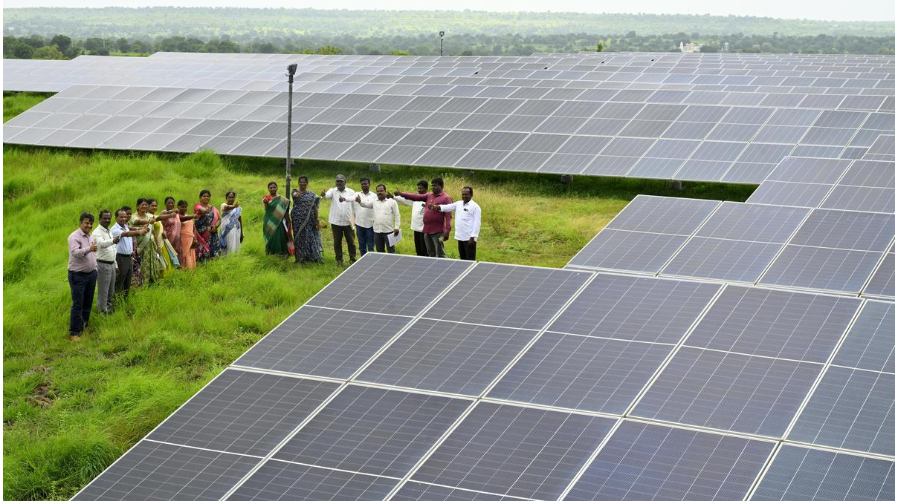
- Women’s SHG federations in Telangana are becoming owners and operators of solar power plants under the Indira Mahila Shakti programme. A one-megawatt ground-mounted solar plant established by the Vikarabad Zilla Samakhya and Kotepally Mandal Samakhya was recently connected to the electricity grid.
What is the Solar Entrepreneurship Initiative?
- The initiative enables women’s SHG federations, known as Samakhyas, to establish solar power plants on government land that is unsuitable for agriculture.
- The projects are being implemented by the Society for Elimination of Rural Poverty (SERP) in association with the Telangana Renewable Energy Development Corporation Limited (TGREDCO).
- Electricity generated by the plants is purchased by power distribution companies under formal agreements. Revenue from electricity sales accrues to the SHG federations, which represent thousands of rural women.
The initiative therefore combines:
- Women’s economic empowerment
- Renewable-energy generation
- Productive use of barren government land
- Creation of long-term community assets
- Regular income for SHG federations
How Does the Project Work?
- The solar plant at Barwad village in Kotepally mandal of Vikarabad district has a capacity of one megawatt.
- It was established by the Vikarabad Zilla Samakhya and Kotepally Mandal Samakhya at an estimated cost of ₹2.84 crore.
- The plant is expected to generate around 18.3 lakh units of electricity annually. The Telangana Electricity Regulatory Commission approved a tariff of ₹3.13 per unit for purchasing the electricity.
- The project is also eligible for capital subsidy under the State’s MSME policy. The remaining project cost can be financed through institutional credit and the resources of SHG federations.
The Three-Way Benefit
The initiative has been described as a “win-win-win” model because:
- Government Land is Protected: Non-agricultural government land is put to productive use and protected from encroachment.
- Clean Energy is Generated: Solar power supports Telangana’s transition towards renewable energy.
- Women Earn Revenue: Profits from electricity sales flow to the SHG federations.
The land is expected to remain under productive use for the project period of 25 years, creating a long-term asset for rural women.
Role of Major Institutions
Society for Elimination of Rural Poverty
- SERP mobilises rural women into SHGs and federations. Under this initiative, it facilitates project planning, financial arrangements, institutional coordination and capacity building.
TGREDCO
- TGREDCO provides technical support for renewable-energy development, including the establishment and grid integration of solar plants.
TGERC
- The Telangana Electricity Regulatory Commission determines the tariff at which electricity generated by these plants is purchased.
DISCOMs
- The State’s power distribution companies have signed agreements to purchase electricity from the SHG-owned plants. These agreements provide an assured buyer for the power generated.
SHG Federations
- The Zilla Samakhyas and Mandal Samakhyas own the projects and receive the resulting income. Women members also participate in monitoring and managing the assets.
Expansion across Telangana
- Land was initially identified across 31 districts for establishing solar projects.
- Plants with a combined capacity of nine megawatts have been established in:
- Khammam
- Kumaram Bheem Asifabad
- Vikarabad
- Peddapalli
- Wanaparthy
- Jangaon
- Mahabubnagar
- Plants in Khammam and Kumaram Bheem Asifabad have already been inaugurated. Projects in Vikarabad, Jangaon and Peddapalli were awaiting formal inauguration at the time of reporting.
- The Vikarabad administration is also considering another solar unit on land adjoining the existing plant.
Conclusion
The solar initiative under Indira Mahila Shakti represents a significant expansion of Telangana’s SHG movement. It enables rural women to own productive assets, generate clean energy and earn long-term income. Effective training, transparent management and reliable power-purchase arrangements can make the programme a strong model of women-led development and green rural growth.