Why in News?
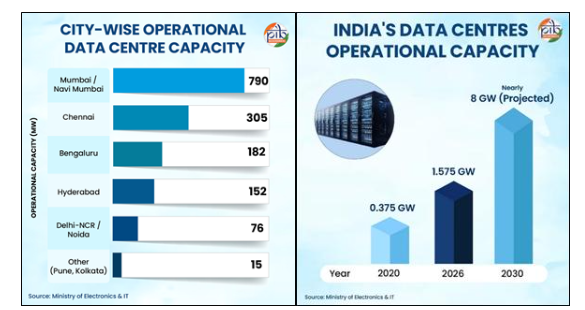
- India’s data-centre capacity has increased from approximately 375 MW in 2020 to 1.57 GW in August 2026.
- Installed capacity is projected to reach nearly 8 GW by 2030, supported by the growth of cloud computing, Artificial Intelligence, digital payments and e-Governance.
What is a Data Centre?
A data centre is a secure facility containing computing, storage and networking equipment. It stores, processes, manages and distributes large volumes of digital information.
Data centres support several essential services, including:
- Online banking and digital payments
- Government portals and e-Governance
- Cloud computing
- E-commerce and online communication
- Artificial Intelligence applications
- Healthcare, education and business platforms
- Storage and processing of government and commercial data
Modern data centres are designed to operate continuously. Therefore, they require uninterrupted electricity, efficient cooling, high-speed connectivity, physical security and protection against cyberattacks.
What are the Major Components of a Data Centre?
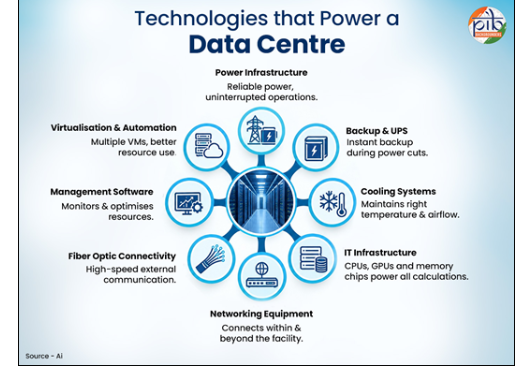
Power Infrastructure
Data-centre equipment requires an uninterrupted electricity supply.
- Uninterruptible Power Supply: Provides immediate backup during a power interruption.
- Backup generators: Maintain operations during prolonged power cuts.
- Electrical distribution systems: Deliver electricity safely to different parts of the facility.
- Redundant power systems: Ensure that failure in one component does not interrupt the entire service.
Cooling Infrastructure
Servers generate considerable heat during continuous operation. Excessive heat can damage equipment and reduce efficiency.
- Heating, Ventilation and Air Conditioning systems regulate temperature and airflow.
- Advanced airflow management prevents the formation of hot zones.
- Liquid-cooling technologies transfer heat more efficiently than conventional air cooling.
- Modern facilities increasingly use closed-loop systems to reduce water consumption.
Information Technology Infrastructure
- Servers process information and run digital applications.
- Storage systems hold digital information.
- Hard Disk Drives provide high-volume storage.
- Solid-State Drives provide faster data access without moving mechanical parts.
Networking Infrastructure
- Routers and high-speed switches allow information to move within the data centre and between the facility and external networks.
- Fibre-optic connections enable the rapid transmission of large volumes of data over long distances.
Security Systems
Data centres require both physical and digital security.
- Physical security protects buildings, equipment and access points.
- Cybersecurity systems protect networks and information from malware, unauthorised access and data theft.
- Backup and disaster-recovery systems help restore services after a failure or cyberattack.
Management Software
- Management software monitors power, cooling, storage and computing resources.
- Virtualisation allows a single physical server to operate several virtual machines. This improves the use of available computing capacity.
- Automation tools distribute workloads, identify operational problems and support preventive maintenance.
How Does a Data Centre Process a Digital Request?
- When a person opens an application, checks a bank balance or accesses a government document, the request travels through a network to a data centre.
Security Verification
- The security layer checks whether the request is safe and authorised. It protects the system from suspicious or harmful activity.
Load Distribution
- A load balancer directs the request to an available server. It prevents one server from becoming overloaded while others remain underused.
Application Processing
- The application server identifies the information or service requested by the user.
- When communication with another application is required, it uses an Application Programming Interface. An API enables different software systems to exchange information.
Data Retrieval
- The database server retrieves the required information from storage and returns it to the application server.
Response to the User
- The processed information travels through the network and reaches the user’s device. This entire process may be completed within one to two seconds.
- The operational sequence can be understood as:
- Connect → Receive → Secure → Process → Store or Retrieve → Respond
What is the Status of Data Centres in India?
- India’s data-centre ecosystem has expanded along with digital banking, online public services, cloud computing and Artificial Intelligence.
Government Data Centres
The National Informatics Centre has established National Data Centres at:
- Delhi
- Pune
- Hyderabad
- Bhubaneswar
NIC has also established 37 smaller data centres in different State capitals. These facilities support government departments through round-the-clock operations, system management and technical personnel.
Investment
- Investments currently underway: Nearly USD 70 billion
- Additional announced projects: Approximately USD 90 billion
This expansion indicates growing investor confidence in India’s cloud computing, digital services and Artificial Intelligence markets.
What Policy Support is Available?
Infrastructure Status
The Union Budget 2022–23 included data centres in the Harmonised List of Infrastructure.
Infrastructure status allows data-centre projects to access:
- Easier institutional credit
- Long-term project finance
- Better financing conditions
- Greater investor participation
It places data centres alongside other important infrastructure sectors such as power, transport and telecommunications.
Tax Incentive for Foreign Cloud Companies
The Union Budget 2026–27 introduced a tax holiday for eligible foreign cloud-service providers until 2047.
The incentive:
- Covers notified foreign companies;
- Applies from 2026–27 to 2046–47; and
- Supports global cloud operations using data-centre infrastructure located in India.
The measure is intended to attract international cloud companies and encourage them to use India as a major data-processing and storage destination.
Which Schemes Support the Data Centre Ecosystem?
- Data centres depend on semiconductors, servers, networking equipment, Artificial Intelligence systems and reliable electricity. Several government programmes support this wider ecosystem.
Semicon India Programme
The second phase of the Semicon India Programme—Semicon 2.0 was approved in July 2026.
- Implemented under the India Semiconductor Mission
- Financial outlay: ₹1,27,500 crore
- Objective: Build a trusted and resilient semiconductor ecosystem
Domestic semiconductor manufacturing can reduce dependence on imported chips used in servers, storage systems and networking equipment.
IndiaAI Mission
The IndiaAI Mission has a total budgetary outlay of ₹10,371.92 crore.
It aims to develop a comprehensive Artificial Intelligence ecosystem through computing capacity, datasets, innovation, skills and responsible AI development. The expansion of AI applications will further increase demand for high-performance data centres.
Electronics Components Manufacturing Scheme
- Financial support for the Electronics Components Manufacturing Scheme has been increased from ₹22,000 crore to ₹40,000 crore.
- The scheme supports domestic production of electronic components required for computing and digital infrastructure.
PLI Scheme 2.0 for IT Hardware
The Production Linked Incentive Scheme 2.0 for IT Hardware supports the domestic manufacturing of:
- Servers
- Laptops and tablets
- Personal computers
- Related IT hardware
It seeks to attract investment, reduce import dependence and integrate India into global electronics supply chains.
Why are Energy and Water Planning Important?
- Data centres consume significant quantities of electricity because their computing and cooling systems must operate continuously.
The Central Electricity Authority estimates that electricity demand from data centres could reach approximately 17 GW by 2031–32.
Unplanned expansion can increase pressure on electricity grids and local water resources. Therefore, India must promote energy-efficient and water-efficient facilities.
Renewable Energy and Clean Power
The government is promoting cleaner power for data centres through:
- Green Energy Open Access Rules
- Green Energy Corridor Scheme
- National Green Hydrogen Mission
- National Programme on High-Efficiency Solar PV Modules
- Solar Park Scheme
These initiatives can help data-centre operators obtain reliable renewable electricity and reduce their carbon footprint.
SHANTI Act and Nuclear Energy
The Sustainable Harnessing and Advancement of Nuclear Energy for Transforming India Act seeks to strengthen the clean-power ecosystem.
It supports reliable nuclear electricity for emerging energy-intensive sectors, including Artificial Intelligence and data centres. It also enables the future deployment of:
- Small Modular Reactors
- Micro Nuclear Reactors
These technologies could provide stable low-carbon power close to major digital infrastructure clusters.
Efficiency Standards for Data Centres
- The Bureau of Indian Standards has constituted the LITD 31 Technical Committee for cloud computing, information technology and data centres.
- BIS standards cover important efficiency indicators.
Power Usage Effectiveness
- PUE measures how efficiently a data centre uses electricity. It compares the total electricity consumed by the facility with the electricity used directly by computing equipment.
- A lower PUE generally indicates better energy efficiency.
Water Usage Effectiveness
- WUE measures the amount of water consumed in relation to the computing work performed by a data centre.
Carbon Usage Effectiveness
- CUE measures the carbon emissions associated with the electricity consumed by computing equipment.
Cooling Efficiency Ratio
- CER measures how efficiently the cooling system removes heat in relation to the electricity it consumes.
Building and Resource-Efficiency Codes
The Bureau of Energy Efficiency has notified:
- Energy Conservation Building Code, 2017
- Energy Conservation and Sustainable Building Code, 2024
These codes prescribe energy-efficiency and water-conservation standards for buildings, including provisions relevant to data-centre infrastructure.
Advanced Cooling and Water Management
The water requirement of a data centre depends mainly on the cooling technology used. Extraction of groundwater for industrial purposes is regulated through guidelines issued by the Ministry of Jal Shakti.
Artificial Intelligence infrastructure generates greater heat and is encouraging the adoption of advanced cooling systems, such as:
- Direct-to-chip liquid cooling
- Immersion cooling
- Adiabatic cooling
- Closed-loop liquid cooling
Closed-loop systems reuse cooling fluid and can reduce dependence on freshwater.
What is the Strategic Significance of Data Centres?
Foundation of the Digital Economy
Data centres enable digital payments, banking, e-commerce, cloud services, online education and Artificial Intelligence. Their reliability directly affects economic activity.
Better e-Governance
Government portals require secure and continuous data-processing capacity. Strong domestic data centres improve the reliability of online certificates, welfare platforms, tax systems and public databases.
Data Sovereignty
Domestic data-centre capacity allows important data to be stored and processed within India’s jurisdiction. This strengthens regulatory oversight and reduces excessive dependence on foreign infrastructure.
Employment and Investment
Data-centre development generates demand for construction, electrical equipment, cooling technology, cybersecurity, networking, maintenance and skilled IT services.
Technological Self-Reliance
Data centres support domestic capabilities in semiconductors, cloud computing, Artificial Intelligence, telecommunications and advanced electronics.
Disaster Resilience
Redundant systems, backup facilities and geographically distributed data centres help maintain digital services during natural disasters, power disruptions and cyberattacks.
What are the Major Challenges?
- High Energy Consumption: Continuous computing and cooling operations place additional pressure on electricity grids.
- Water Stress: Water-intensive cooling systems may compete with domestic, agricultural and industrial needs, particularly in water-scarce cities.
- Carbon Emissions: Dependence on fossil-fuel-based electricity can increase the environmental footprint of digitalisation.
- Cybersecurity Threats: Data centres are attractive targets for ransomware, espionage, sabotage and data theft.
- Import Dependence: India continues to depend on imported advanced chips, servers and specialised cooling equipment.
- Land and Connectivity Requirements: Large facilities need suitable land, reliable power, high-speed fibre networks and proximity to major digital markets.
- Regional Concentration: Excessive concentration in a few metropolitan centres can create infrastructure pressure and disaster-related risks.
- Data Governance: Expansion must be supported by clear rules regarding privacy, accountability, data localisation and cross-border data flows.
- Electronic Waste: Frequent replacement of servers and storage equipment can increase e-waste unless circular-economy practices are adopted.
Conclusion
Data centres are no longer merely storage facilities; they are strategic infrastructure supporting India’s digital economy, governance and national security. Their expansion can promote investment, innovation and technological self-reliance. However, rapid growth must be balanced with cybersecurity, data protection and efficient use of energy and water. Sustainable and secure data centres can become a foundational pillar of Viksit Bharat 2047.