Relevance: GS Paper III (Agriculture, Food Security, Nutrition) | GS Paper II (Health) | TGPSC (Agriculture & Welfare Schemes)
For Prelims:
Millets, Nutri-cereals, ICAR-IIMR, Nutrihub, National Institute of Nutrition (NIN), International Year of Millets 2023
For Mains:
Nutrition security, crop diversification, climate-resilient agriculture, behavioural change campaigns
Why in News?
A national initiative titled “One Meal a Day with Millets” has been launched in Hyderabad by ICAR-Indian Institute of Millets Research along with Nutrihub and Millet Marvels to promote millet consumption as part of daily diets for improved nutrition and sustainable agriculture.
Institutional Framework and Initiative Design
- The initiative is spearheaded by ICAR-Indian Institute of Millets Research, a premier institute under ICAR dedicated to millet research and promotion.
- Nutrihub, functioning as an incubation platform within IIMR, supports millet-based startups, value addition, and market linkages.
- The campaign adopts a behavioural change model, encouraging individuals to incorporate at least one millet-based meal daily and promote the idea through social outreach.
- The recommendation aligns with guidance from the National Institute of Nutrition that at least one-third of cereal intake should be millets.
Millets: Types, Nutritional Profile and Classification
Millets are a group of small-seeded coarse cereals cultivated primarily in semi-arid regions of Asia and Africa. In India, they are traditionally known as “nutri-cereals” because of their high nutritional value, climate resilience, and low input requirements. They are hardy crops capable of growing in poor soils, with minimal water, and under high temperature conditions, making them crucial for food security and climate-smart agriculture.
Classification of Millets
Millets are broadly classified into Major Millets and Minor Millets based on their cultivation scale, productivity, and historical importance.
1. Major Millets
These millets are widely cultivated and form a significant part of the diet in many regions:
- Sorghum (Jowar) – Scientifically known as Sorghum bicolor
It is a staple food in parts of Maharashtra, Karnataka, and Telangana. It is drought-resistant and used for making rotis and fodder. - Pearl Millet (Bajra) – Pennisetum glaucum
Grown extensively in Rajasthan and Gujarat, it is highly tolerant to heat and drought conditions. - Finger Millet (Ragi) – Eleusine coracana
Widely cultivated in southern India, especially Karnataka, it is known for its exceptionally high calcium content.
2. Minor Millets
These are less widely cultivated but highly nutritious and ecologically significant:
- Foxtail Millet – Setaria italica
- Little Millet – Panicum sumatrense
- Kodo Millet – Paspalum scrobiculatum
- Barnyard Millet – Echinochloa frumentacea
- Proso Millet – Panicum miliaceum
These millets are often grown in tribal and hilly regions and are gaining renewed importance due to their nutritional benefits and climate resilience.
Nutritional Profile of Millets
Category | Components | Nutritional Features | Health Significance |
Macronutrients | Complex Carbohydrates | Provide slow and sustained release of energy | Helps maintain energy levels and prevents sudden glucose spikes |
Protein (7–12%) | Moderate protein content compared to cereals | Supports growth, repair, and body functions | |
Dietary Fibre | High fibre content | Improves digestion, promotes gut health, and aids in weight management | |
Micronutrients | Iron | Present in significant amounts | Helps prevent anemia and improves hemoglobin levels |
Calcium (especially in Ragi) | Very high in finger millet | Essential for strong bones and teeth | |
Magnesium & Phosphorus | Important mineral content | Supports metabolic activities and bone health | |
Zinc & Potassium | Essential trace elements | Boost immunity and maintain heart health | |
Vitamins | B-complex Vitamins (B1, B2, B3, B6) | Rich source of essential vitamins | Helps in energy metabolism and proper functioning of the nervous system |
Bioactive Compounds | Antioxidants (Polyphenols) | Natural plant compounds | Reduce oxidative stress and help prevent chronic diseases like diabetes and cardiovascular disorders |
Health Benefits and Glycaemic Properties
Millets have a low glycaemic index (GI), meaning they release glucose slowly into the bloodstream. This makes them particularly beneficial for:
- Management of Type 2 Diabetes
- Prevention of lifestyle diseases such as obesity and cardiovascular disorders
- Maintaining stable blood sugar levels
Additionally, their high fibre content contributes to:
- Better digestion
- Reduced cholesterol levels
- Improved satiety, aiding in weight management
Agro-Climatic and Sustainability Dimensions
Millets are highly suited to India’s semi-arid regions due to their low water requirement and high drought tolerance.
They can grow in poor soils with minimal inputs, making them climate-resilient crops.
Compared to rice and wheat, millets have:
- Lower water footprint
- Lower carbon footprint
- Higher adaptability to climate variability
This makes them crucial in addressing climate change and sustainable agriculture goals.
Economic and Farmer-Centric Implications
Promotion of millets supports crop diversification, reducing overdependence on rice and wheat.
It enhances income security for small and marginal farmers, especially in rainfed regions.
The development of millet-based value chains through startups and food industries creates:
- Rural employment opportunities
- Processing and export potential
- Market expansion for traditional crops
Thus, millets connect nutrition, sustainability, and livelihoods.
Way Forward
- There is a need to strengthen procurement mechanisms and MSP support for millets to incentivise farmers.
- Awareness campaigns must be expanded to urban consumers to create sustained demand.
- Investment in processing, branding, and export infrastructure is required to make millets globally competitive.
- Integration of millets into institutional food programmes should be scaled up systematically.
Conclusion
The “One Meal a Day with Millets” initiative represents a shift towards integrating nutrition, sustainability, and agriculture within a single framework. By promoting millets in daily diets, India can address health challenges, support farmers, and build a resilient food system for the future.
CARE MCQ
Q. Consider the following statements:
- Millets require less water compared to rice and wheat.
- Millets have a high glycaemic index.
- India declared 2023 as the International Year of Millets.
Which of the statements given above are correct?
(a) 1 only
(b) 1 and 2 only
(c) 1 and 3 only
(d) 1, 2 and 3
Ans: (c)
Explanation:
Statement 1 is correct: Millets are drought-resistant crops and require significantly less water compared to water-intensive crops like rice and wheat, making them suitable for dryland agriculture.
Statement 2 is incorrect: Millets generally have a low to moderate glycaemic index, which helps in better blood sugar regulation, making them beneficial for diabetic diets.
Statement 3 is correct: India played a key role in proposing and promoting 2023 as the International Year of Millets, which was declared by the United Nations to boost awareness and production globally.
Q.Which of the following statements best describes the nutritional advantages of nutri-cereals?
(a) They are rich sources of dietary fiber, essential minerals like iron and calcium, and typically possess a low glycaemic index beneficial for metabolic health
(b) Their primary nutritional contribution is a high content of Vitamin C and Vitamin D
(c) They are devoid of carbohydrates and rich in omega-3 fatty acids
(d) They primarily provide protein comparable to animal sources and are genetically modified for enhanced nutrition
Ans: (a)
Explanation:
Nutri-cereals (millets such as jowar, bajra, and ragi) are rich in dietary fiber, contain essential minerals like iron, calcium, zinc, and have a low glycaemic index, making them beneficial for metabolic health and diabetes management.
Q.Consider the following statements regarding processing techniques for nutri-cereals:
Statement 1: Extrusion cooking, a high-temperature short-time process applied to nutri-cereals, often leads to a notable reduction in the bioactivity of specific phenolic compounds and certain heat-labile vitamins due to thermal degradation.
Statement 2: Dehulling (decortication) of nutri-cereals, while crucial for improving sensory attributes and reducing anti-nutritional factors concentrated in the outer layers, also results in a substantial loss of dietary fiber and some essential minerals.
Which one of the following is correct in respect of the above statements?
a) Both Statement 1 and Statement 2 are correct and Statement 2 is the correct explanation for Statement 1
b) Both Statement 1 and Statement 2 are correct and Statement 2 is not the correct explanation for Statement 1
c) Statement 1 is correct but Statement 2 is incorrect
d) Statement 1 is incorrect but Statement 2 is correct
Answer: (b)
Explanation:
Statement 1 is correct: Extrusion cooking is a high-temperature, short-time thermal process. While it offers benefits like starch gelatinization, improved protein digestibility, and inactivation of some anti-nutritional factors, the intense heat can indeed cause thermal degradation of heat-sensitive compounds. This includes certain vitamins (like Vitamin C and some B vitamins) and specific phenolic compounds, leading to a reduction in their bioactivity and nutritional value.
Statement 2 is correct: Dehulling, also known as decortication, is a common pre-processing step for many nutri-cereals (millets, sorghum, etc.) to remove the indigestible outer husk and bran layers. This process significantly improves the sensory attributes (like taste, texture, and cooking quality) and reduces the concentration of anti-nutritional factors (such as tannins and phytic acid) which are often concentrated in the bran. However, the bran layer is also a rich source of dietary fiber and essential micronutrients like iron, zinc, and magnesium. Therefore, dehulling, while beneficial in some aspects, inevitably leads to a reduction in the overall dietary fiber content and loss of some essential minerals.
Both statements are factually correct. However, Statement 2 describes the effects and trade-offs of the dehulling process, whereas Statement 1 describes the effects of extrusion cooking. The effects of dehulling do not explain the effects observed during extrusion cooking. Therefore, Statement II is not the correct explanation for Statement I.
TGPSC CARE MAINS:
Q.Discuss the role of millets in achieving nutrition security and sustainable agriculture in India. Examine the significance of behavioural initiatives like “One Meal a Day with Millets.” [250 WORDS]
FAQs
Q.Why are millets called nutri-cereals?
Ans: Because they are rich in essential nutrients such as fibre, minerals, vitamins, and antioxidants.
Q. Which institution leads millet research in India?
Ans: ICAR-Indian Institute of Millets Research.
Q. Why are millets important for climate change?
Ans: They require less water, tolerate drought, and grow in poor soils, making them climate-resilient crops.
Q. What is the key idea behind the initiative?
Ans: To promote daily consumption of millets for better health and sustainable food systems.
Relevance: GS Paper II – Health | GS Paper III – Biotechnology | Economy | Science & Technology
For Prelims:
Pulmonary Hypertension (PH), Endothelin Receptor Antagonists (ERAs), PDE5 inhibitors, Biopharma SHAKTI, ABDM 2.0, biologics, Ayushman Bharat Digital Mission
For Mains:
healthcare accessibility, domestic pharmaceutical manufacturing, digital health ecosystem, affordable healthcare, Atmanirbhar Bharat in healthcare, integrative medicine
Why in News?
- India is witnessing a major transformation in the treatment of Pulmonary Hypertension (PH), shifting from dependence on imported therapies to domestic innovation and manufacturing.
- Government initiatives like Biopharma SHAKTI and digital health expansion are improving accessibility and affordability of treatment.
- The focus is now on precision medicine, digital monitoring, and holistic healthcare approaches to improve patient outcomes.
What is Pulmonary Hypertension (PH)
- Pulmonary Hypertension is a serious medical condition in which there is abnormally high blood pressure in the pulmonary arteries that carry blood from the heart to the lungs.
- This increased pressure forces the heart to work harder, eventually leading to heart failure if untreated.
- Symptoms include:
– Shortness of breath during routine activity
– Fatigue and weakness
– Chest pain and dizziness
– Swelling in legs and abdomen - One major challenge in India has been delayed diagnosis, as symptoms are often misinterpreted as asthma or general fatigue.
Evolution of PH Care in India
- Earlier, treatment options for PH were largely dependent on imported drugs, which were expensive and inaccessible for most patients.
- Diagnosis infrastructure was limited, particularly in rural areas, leading to late detection and poor prognosis.
- Over time, India has developed capabilities in pharmaceutical manufacturing and clinical research, leading to improved availability of therapies.
- The healthcare system is now transitioning towards early diagnosis, targeted therapies, and continuous patient monitoring.
Role of Domestic Pharmaceutical Industry
- India has emerged as a major producer of affordable PH drugs, reducing dependence on costly imports.
- Key drug classes now manufactured domestically include:
– Endothelin Receptor Antagonists (ERAs)
– Phosphodiesterase-5 (PDE5) inhibitors - Endothelin Receptor Antagonists work by blocking endothelin, a substance that causes narrowing of blood vessels, thereby improving blood flow.
- Domestic production has significantly reduced treatment costs and increased access for patients across income groups.
- Government policies such as customs duty reductions and support for local manufacturing have further strengthened this ecosystem.
Biopharma SHAKTI Initiative
- The Biopharma SHAKTI is a flagship initiative aimed at transforming India into a global hub for biologics and advanced therapies.
- It has a financial outlay of ₹10,000 crore to support innovation, infrastructure, and clinical research.
- The initiative focuses on:
– Development of advanced biologic drugs
– Strengthening clinical trial infrastructure
– Promoting startups and research institutions
– Improving regulatory efficiency - For PH care, this initiative is expected to make cutting-edge therapies more accessible and affordable within India.
Role of Digital Health (ABDM 2.0)
- The Ayushman Bharat Digital Mission (ABDM 2.0) is creating a unified digital health ecosystem.
- It enables patients to maintain digital health records through ABHA IDs, ensuring continuity of care across hospitals and regions.
- For PH patients, this allows:
– Continuous monitoring of disease progression
– Seamless sharing of medical records between specialists
– Better follow-up and treatment adherence - Digital platforms also support telemedicine, improving access to specialists in remote areas.
Integrative and Holistic Approaches
- India is exploring integrative approaches combining modern medicine with traditional practices such as yoga.
- Clinical trials indicate that yoga can improve quality of life, exercise capacity, and mental well-being in Pulmonary Arterial Hypertension (PAH) patients.
- Holistic care includes:
– Lifestyle modification
– Breathing exercises
– Stress management
– Nutritional support - This approach complements pharmacological treatment and enhances overall patient outcomes.
Challenges in PH Care
- Despite progress, several challenges remain in ensuring universal access to PH care.
- Rural healthcare infrastructure is still inadequate, leading to delayed diagnosis and limited specialist availability.
- Awareness about PH among general practitioners and patients remains low.
- Advanced diagnostic tools and specialised centres are concentrated in urban areas.
- Financial constraints still affect access to long-term treatment for economically weaker sections.
Significance for India
- Reduces dependence on imported medicines and strengthens self-reliance in healthcare.
- Makes life-saving therapies affordable for a larger population.
- Enhances India’s position as a global pharmaceutical and biotech hub.
- Improves healthcare outcomes through integration of technology and innovation.
- Contributes to achieving universal health coverage and strengthening public health systems.
Way Forward
- Strengthen primary healthcare systems to ensure early diagnosis of PH, especially in rural areas.
- Expand awareness programs for both healthcare professionals and the general public.
- Increase investment in research and development for advanced therapies.
- Enhance digital health infrastructure to ensure seamless integration across regions.
- Promote integrative healthcare approaches combining modern and traditional medicine.
- Ensure affordability through continued policy support and subsidies for essential drugs.
Conclusion
India’s approach to Pulmonary Hypertension care reflects a broader transformation in the healthcare sector, moving towards self-reliance, innovation, and inclusivity. By combining domestic pharmaceutical strength, digital health infrastructure, and holistic care models, India is creating a sustainable and accessible healthcare ecosystem. However, addressing gaps in infrastructure and awareness remains essential to ensure that these advancements reach every section of society.
CARE MCQ
Q.Consider the following statements regarding Endothelin Receptor Antagonists (ERAs) used in pharmacotherapy:
- Bosentan is a non-selective endothelin receptor antagonist, blocking both ET-A and ET-B receptors.
- Ambrisentan is primarily an ET-B selective endothelin receptor antagonist.
- Macitentan is characterized by a more sustained receptor binding compared to bosentan, which contributes to its therapeutic efficacy.
- Endothelin-1 primarily exerts its potent vasoconstrictive effects by binding to ET-B receptors.
How many of the statements given above are correct?
a) Only one
b) Only two
c) All four
d) None of the above
Ans: (b)
Explanation:
Statement 1 is correct: Bosentan is a non-selective endothelin receptor antagonist (ERA), meaning it blocks both ET-A and ET-B receptors. It was the first oral ERA approved for pulmonary arterial hypertension (PAH).
Statement 2 is incorrect: Ambrisentan is an ET-A selective endothelin receptor antagonist. It specifically blocks the ET-A receptor, which is primarily responsible for vasoconstriction and cell proliferation, with potentially less impact on ET-B mediated effects like vasodilation and endothelin clearance.
Statement 3 is correct: Macitentan is a newer non-selective ERA. It has a distinct pharmacological profile characterized by more sustained receptor binding and a longer duration of action compared to bosentan, which contributes to its improved efficacy and safety profile, including reduced liver toxicity.
Statement 4 is incorrect: Endothelin-1 (ET-1) primarily exerts its potent vasoconstrictive effects by binding to ET-A receptors. ET-B receptors, while also binding ET-1, have more complex roles including mediating vasodilation (via nitric oxide and prostacyclin release) and facilitating the clearance of ET-1. Therefore, blocking ET-A receptors is crucial for reducing ET-1 mediated vasoconstriction.
Q.Which of the following statements accurately describes the primary mechanism of action of Endothelin Receptor Antagonists (ERAs) used in conditions like Pulmonary Arterial Hypertension?
a) They directly inhibit the enzyme responsible for the synthesis of Endothelin-1.
b) They block the binding of Endothelin-1 to its ETA and/or ETB receptors, preventing vasoconstriction and cell proliferation.
c) They enhance the degradation of circulating Endothelin-1 by promoting liver and kidney clearance.
d) They stimulate the production of vasodilatory substances like nitric oxide and prostacyclin in the endothelium.
Ans: (b)
Explanation:
Endothelin Receptor Antagonists (ERAs) are a class of drugs that work by blocking the action of endothelin, a potent vasoconstrictor peptide. Endothelin exerts its effects by binding to specific receptors, primarily Endothelin A (ETA) and Endothelin B (ETB) receptors, located on vascular smooth muscle cells and other cell types. By blocking these receptors, ERAs prevent endothelin-1 from inducing vasoconstriction (narrowing of blood vessels) and cell proliferation (excessive growth of cells), which are key pathological processes in diseases like Pulmonary Arterial Hypertension (PAH). Some ERAs are selective for ETA receptors (e.g., Ambrisentan), while others are non-selective, blocking both ETA and ETB receptors (e.g., Bosentan, Macitentan)
Q.Consider the following statements regarding biopharmaceutical production:
Statement 1: The production of complex recombinant therapeutic proteins, such as monoclonal antibodies, often necessitates expression in mammalian cell cultures rather than prokaryotic systems for optimal pharmacological activity.
Statement 2: Prokaryotic expression systems lack the sophisticated post-translational modification machinery, particularly for complex glycosylation, which is crucial for the correct folding, stability, and biological activity of many eukaryotic proteins, preventing aggregation and reducing immunogenicity in human patients.
Which one of the following is correct in respect of the above statements?
(a) Both Statement 1 and Statement 2 are correct and Statement 2 is the correct explanation for Statement 1
(b) Both Statement 1 and Statement 2 are correct and Statement 2 is not the correct explanation for Statement 1
(c)Statement 1 is correct but Statement 2 is incorrect
(d) Statement 1 is incorrect but Statement 2 is correct
Ans: (a)
Explanation:
Statement 1 is correct: Complex biopharmaceuticals like monoclonal antibodies require intricate post-translational modifications (PTMs), especially glycosylation, for proper folding, stability, and biological function.
Statement 2 is correct : It provides the direct explanation for Statement 1. Prokaryotic systems (like bacteria) are simpler and lack the cellular machinery to perform these complex eukaryotic PTMs. As a result, proteins produced in prokaryotic systems may be misfolded, aggregated, inactive, or highly immunogenic in humans, necessitating the use of more complex mammalian cell culture systems despite higher production costs and complexity.
Q.Which of the following statements best describes a primary regulatory challenge specific to advanced biopharmaceuticals (e.g., gene therapies, cell therapies) compared to traditional small-molecule chemical drugs?
a) Ensuring consistent product quality and manufacturing reproducibility due to their complex biological origin and inherent variability.
b) The requirement for large-scale, multi-country Phase III clinical trials to demonstrate efficacy and safety.
c) The rapid development of resistance mechanisms in target pathogens, necessitating frequent updates to formulations.
d) The high capital investment required for research and development before regulatory submission.
Ans: (a)
Explanation:
Advanced biopharmaceuticals, such as gene and cell therapies, are derived from living systems or complex biological processes. This inherent complexity leads to significant challenges in ensuring consistent product quality, purity, potency, and manufacturing reproducibility from batch to batch. Regulators must establish robust frameworks to assess and monitor these aspects throughout the product lifecycle, which is fundamentally different and often more complex than regulating the chemical synthesis and consistency of small-molecule drugs.
FAQs
Q1. What is Pulmonary Hypertension?
Ans: It is a condition where blood pressure in lung arteries is elevated, affecting heart function.
Q2. How is India improving PH care?
Ans: Through domestic drug manufacturing, digital health systems, and biotech initiatives.
Q3. What is Biopharma SHAKTI?
Ans: It is a government initiative to boost biologic drug innovation and manufacturing in India.
Q4. What role does ABDM play?
Ans: It enables digital health records and improves continuity of care.
Q5. Why is this topic important for UPSC?
Ans: It connects health, biotechnology, economy, and governance—important for GS II and GS III.
Relevance: GS Paper II – Governance | Tribal Rights | Judiciary | GS Paper III – Environment
For Prelims:
Forest Rights Act 2006, DLC, Gram Sabha, Tharu tribe, grazing rights, eviction, TNFA 1882
For Mains:
tribal rights, legal supremacy, judicial interpretation, forest governance, conservation vs livelihood debate, rights-based approach
Why in News?
- The Allahabad High Court reaffirmed the supremacy of the Forest Rights Act, 2006 while hearing a case related to forest rights claims of the Tharu tribal community in Uttar Pradesh.
- It set aside a District Level Committee (DLC) decision rejecting claims, stating that FRA overrides conflicting earlier laws or administrative orders.
- At the same time, the Madras High Court took a contrasting position by upholding eviction notices and ignoring grazing rights under FRA, citing the Tamil Nadu Forest Act, 1882.
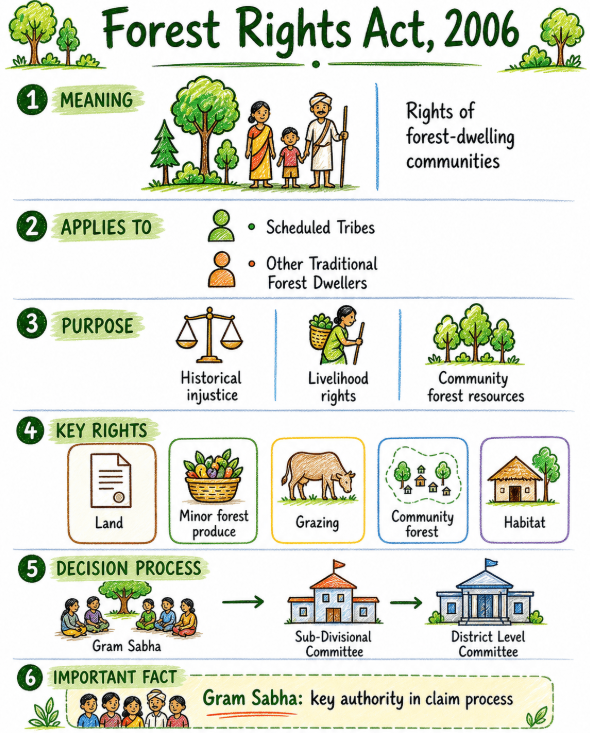
What is the Forest Rights Act (FRA), 2006
- The Forest Rights Act, 2006, officially known as the Scheduled Tribes and Other Traditional Forest Dwellers Act, was enacted to correct historical injustices against forest-dwelling communities.
- It recognizes legal rights of forest-dwelling Scheduled Tribes and Other Traditional Forest Dwellers over land and forest resources.
- It places Gram Sabhas at the centre of the decision-making process regarding recognition of forest rights.
- It prohibits eviction until the process of verification and recognition of rights is completed.
Key Judgements and Developments
Allahabad High Court
- The Allahabad High Court ruled that the DLC’s rejection of claims was legally incorrect.
- It emphasized that FRA, being a later law, overrides conflicting provisions of earlier laws or administrative decisions.
- It directed reconsideration of the claims of the Tharu tribal community.
- However, it did not impose penalties on authorities for violating FRA provisions.
Madras High Court
- The Madras High Court dismissed petitions challenging eviction notices.
- It held that entertaining FRA claims would delay administrative action.
- It allowed evictions under the Tamil Nadu Forest Act, 1882, even where FRA claims were pending.
- It upheld grazing bans despite FRA explicitly recognizing grazing rights.
Core Legal Principle Involved
- The doctrine of lex posterior derogat priori applies, meaning:
→ A later law overrides an earlier law in case of conflict. - Since FRA was enacted in 2006, it legally prevails over older forest laws such as the Tamil Nadu Forest Act, 1882.
- Courts are expected to interpret laws in a manner that upholds this principle.
Rights Recognised under FRA
The FRA provides a comprehensive framework of rights:
- Individual Forest Rights (IFR):
– Right to live and cultivate forest land for livelihood - Community Forest Rights (CFR):
– Grazing rights
– Collection of Minor Forest Produce
– Fishing and water access
– Forest management rights - Habitat Rights:
– For Particularly Vulnerable Tribal Groups (PVTGs) - Developmental Rights:
– Access to basic amenities like roads, schools, and health facilities
Issue of Grazing Rights
- FRA explicitly recognizes grazing rights across all forest categories, including:
– Reserved forests
– National parks
– Wildlife sanctuaries - These rights are essential for pastoral communities and traditional livelihoods.
- The Madras HC ruling contradicts this provision by upholding grazing bans under older laws.
Significance of Allahabad HC Ruling
- Reinforces FRA as a rights-based legislation with legal supremacy.
- Protects tribal communities from arbitrary eviction.
- Strengthens the role of Gram Sabha and due process in rights recognition.
- Provides judicial clarity on resolving conflicts between old and new laws.
Concerns Raised by Madras HC Approach
- Undermines the intent of FRA by prioritizing colonial-era forest laws.
- Weakens protection against eviction before claim verification.
- Ignores statutory recognition of grazing rights.
- Creates inconsistency in judicial interpretation across different High Courts.
Challenges in FRA Implementation
- Slow recognition of claims due to bureaucratic delays.
- Lack of awareness among tribal communities about their rights.
- Resistance from forest departments due to administrative control concerns.
- Overemphasis on individual rights while neglecting community rights.
- Conflicts between conservation goals and livelihood rights.
Way Forward
- Ensure uniform judicial interpretation across High Courts through Supreme Court guidance.
- Strengthen awareness campaigns among forest dwellers about FRA provisions.
- Improve administrative capacity for faster processing of claims.
- Promote community-based forest governance models.
- Balance conservation goals with livelihood rights using participatory approaches.
Conclusion
The recent rulings highlight a fundamental tension in India’s forest governance framework between colonial-era control and modern rights-based legislation. While the Allahabad High Court reinforces the primacy of the Forest Rights Act, the contrasting approach of the Madras High Court exposes gaps in uniform interpretation. Ensuring consistent enforcement of FRA is essential not only for tribal justice but also for sustainable and inclusive forest management.
CARE MCQ
Q.Which of the following rights are granted under the Forest Rights Act, 2006?
- Title rights to ownership of land cultivated by forest dwellers up to a maximum of 4 hectares.
- Rights to collect and use Minor Forest Produce (MFP), such as bamboo, honey, and medicinal plants.
- The right to clear forest land for cultivation beyond the existing limit of 4 hectares if approved by the Gram Sabha.
Select the correct answer using the code below:
a) 1 and 2 only
b) 2 and 3 only
c) 1 and 3 only
d)1, 2, and 3
Answer: (a)
Explanation:
Statement 1 is correct: The FRA provides title rights, allowing ownership of land actively cultivated by forest dwellers, subject to a maximum limit of 4 hectares.
Statement 2 is correct: The FRA grants use rights to collect Minor Forest Produce (MFP), which includes resources like bamboo, tendu leaves, honey, and medicinal plants. These are crucial for the livelihood of forest-dwelling communities.
Statement 3 is incorrect: The FRA does not allow forest dwellers to clear forest land for cultivation beyond the 4-hectare limit, even with Gram Sabha approval. The Act emphasizes conservation and sustainable use of forest resources.
Q.Which of the following statements is/are correct regarding the Gram Sabha?
- It consists of all the voters residing in the jurisdiction of a Gram Panchayat.
- It is the decision-making body for local self-governance at the village level.
Select the correct answer using the code given below:
a) 1 only
b) 2 only
c) Both 1 and 2
d) Neither 1 nor 2
Answer: (c)
Explanation: The Gram Sabha consists of all the registered voters residing in the jurisdiction of a Gram Panchayat and serves as the decision-making body for local self-governance at the village level.
Q.Consider the following statements about Gram Sabha:
- It is the primary body of the Panchayati Raj system and consists of all registered voters in the area of a Panchayat.
- The Gram Sabha must meet at least twice a year.
- The decisions of the Gram Sabha are not binding on the Gram Panchayat.
How many of the Statements given above are correct?
a) Only one
b) Only two
c) All three
d) None
Answer: (b)
Explanation:
Statement 1 is correct: As per Article 243(b) of the Constitution, the Gram Sabha is a body consisting of all persons registered in the electoral rolls relating to a village comprised within the area of a Panchayat at the village level. It is the foundation of the Panchayati Raj System.
Statement 2 is correct: While the Constitution does not specify the number of meetings, most State Panchayati Raj Acts mandate that the Gram Sabha must meet at least twice a year. The statement reflects this common statutory requirement.
Statement 3 is incorrect: The powers of the Gram Sabha, including whether its decisions are binding on the Gram Panchayat, are determined by the respective State Legislatures as per Article 243A. Many State Acts have provisions that make the recommendations or decisions of the Gram Sabha in specific matters (like approval of plans and selection of beneficiaries) binding on the Gram Panchayat. Therefore, the absolute statement that its decisions are ‘not binding’ is incorrect.
FAQs
Q1. What is the objective of the Forest Rights Act?
Ans: To correct historical injustices and recognize rights of forest-dwelling communities.
Q2. What did the Allahabad High Court rule?
Ans: It upheld FRA supremacy and ordered reconsideration of rejected tribal claims.
Q3. Why is the Madras High Court ruling controversial?
Ans: Because it ignores FRA provisions and allows evictions under older laws.
Q4. What are grazing rights under FRA?
Ans: They allow traditional pastoral communities to use forest land for livestock grazing.
Q5. Why is FRA important for UPSC?
Ans: It links governance, environment, tribal rights, and judiciary—important for GS II and GS III.