Relevance: : GS Paper III (Energy, Mining, Environment) | Telangana Economy | Coal Sector
For Prelims:
SCCL, Ramagundam, Opencast Mining, Underground Mining, Coal Grade G-10, Environmental Clearance, MoEFCC, EAC
For Mains:
Energy security, coal dependency, sustainable mining, environmental governance
Why in News?
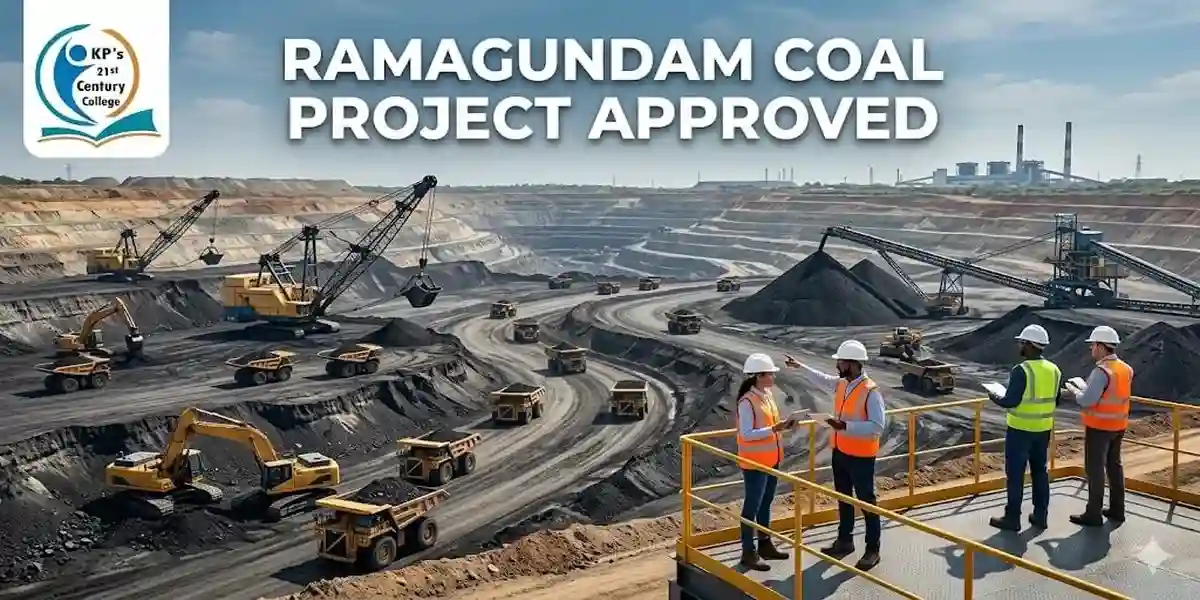
The Expert Appraisal Committee under the Ministry of Environment, Forest and Climate Change has recommended environmental clearance for the Ramagundam Integrated Coal Mine Project of Singareni Collieries Company Limited, located in Telangana.
Key Highlights
- The project has coal reserves of about 315 million tonnes and an annual production target of 21 million tonnes for a period of 25 years.
- It combines two opencast and three underground mines into a single integrated mining system. The coal will primarily supply thermal power plants such as NTPC Ramagundam.
Location and Resource
- The project is located in the Ramagundam coal belt of Peddapalli district in northern Telangana. This region lies in the Godavari Valley coalfields, which form part of the larger Gondwana coal deposits of India.
- The coalfields extend along the Godavari River basin and are known for non-coking coal reserves used in thermal power generation.
- Key regional linkage: Ramagundam is one of India’s major thermal power hubs due to proximity to coal reserves and water availability from the Godavari river.
Structure of the Integrated Mining Model
- The project combines multiple mining blocks into a unified operational system.
It includes:
- Two opencast mines for large-scale surface extraction
Three underground mines for deeper coal seams - A key feature is the conversion of exhausted underground mines into opencast mines to extract residual coal, ensuring maximum resource utilisation.
Coal Extraction Techniques: Opencast vs Underground
Feature | Opencast Mining | Underground Mining |
Depth | Shallow deposits | Deep deposits |
Method | Surface excavation | Tunnels/shafts |
Cost | Lower | Higher |
Environmental impact | High land disturbance | Lower surface impact |
Productivity | Higher | Lower |
The project uses both methods to optimise extraction efficiency and economic viability.
Technical Features of the Project
- The project has recoverable reserves of about 314.98 million tonnes.
- Coal extraction is divided into:
28 million tonnes through opencast mining
132.70 million tonnes through underground mining - The average coal grade is G-10, which is classified as non-coking coal suitable for thermal power generation.
- Mining methods include shovel-dumper techniques for opencast operations.
- The total land requirement is about 4,326 hectares.
Environmental Clearance Mechanism
- Environmental clearance for large projects is granted under the Environment Impact Assessment framework governed by the Ministry of Environment, Forest and Climate Change.
- The Expert Appraisal Committee evaluates:
Environmental impact
Forest diversion
Pollution and rehabilitation measures - Final approval ensures compliance with sustainability norms and mitigation strategies.
Role of Coal in India’s Energy Mix
Coal remains the dominant source of electricity generation in India, contributing around 70% of total power generation.
Thermal power plants such as NTPC Ramagundam depend heavily on nearby coal supply for base-load energy.
Despite renewable expansion, coal continues to be essential for grid stability and industrial energy demand.
Telangana Coal Economy
- Singareni Collieries Company Limited is a joint venture of the Government of Telangana and the Government of India.
- It operates in the Godavari Valley coalfields and is one of the few coal companies in India engaged in both underground and opencast mining.
- The Ramagundam region is one of its major production centres.
Significance of the Project
- The project is expected to compensate for declining output from older mines and extend the life of the Ramagundam coal belt.
- It ensures long-term fuel supply to thermal power plants and supports industrial growth in the region.
Way Forward
There is a need to balance coal extraction with environmental safeguards through afforestation, land reclamation, and adoption of cleaner mining technologies. Gradual integration with renewable energy systems is essential for sustainable energy transition.
Conclusion
The Ramagundam Integrated Coal Mine Project reflects India’s continued reliance on coal for energy security while highlighting the need for efficient and environmentally responsible mining practices.
CARE MCQ
Q. Consider the following statements:
- Ramagundam coalfields are part of Gondwana coal deposits.
- G-10 coal is primarily used for coking purposes.
- Opencast mining generally has higher environmental impact than underground mining.
Which of the statements given above are correct?
(a) 1 and 3 only
(b) 2 and 3 only
(c) 1 and 2 only
(d) 1, 2 and 3
Ans: (a)
Explanation:
Statement 1 is correct: The Ramagundam coalfields in Telangana belong to the Gondwana coal deposits, which are the major source of coal in India, formed during the Permian period.
Statement 2 is incorrect: G-10 coal is a grade of non-coking coal, primarily used for thermal power generation, not for coking (which is required in steel manufacturing).
Statement 3 is correct: Opencast mining involves removal of large areas of surface land, leading to deforestation, land degradation, and pollution, hence it generally has a higher environmental impact compared to underground mining.
Q.Consider the following statements regarding coal and its environmental impact:
Statement 1: India’s coal-fired power plants are significant global contributors to anthropogenic mercury emissions, disproportionate to their share of global coal consumption.
Statement 2: Indian coal is generally characterized by a higher concentration of mercury and other trace elements, coupled with a higher ash content, compared to the average global coal quality.
Which one of the following is correct in respect of the above statements?
a) Both Statement 1 and Statement 2 are correct and Statement 2 is the correct explanation for Statement 1
b) Both Statement 1 and Statement 2 are correct and Statement 2 is not the correct explanation for Statement 1
c) Statement 1 is correct but Statement 2 is incorrect
d) Statement 1 is incorrect but Statement 2 is correct
Ans: (a)
Explanation:
Statement 1 is correct: India’s coal-fired power plants are indeed a major source of global anthropogenic mercury emissions, often attributed to the specific characteristics of Indian coal. Statement 2 is also correct: Indian coal is well-known for its high ash content and, crucially, a higher concentration of various trace elements, including mercury, compared to coal from many other parts of the world.
Statement 2 directly explains Statement 1: the inherent higher mercury content in Indian coal is the primary reason why its combustion leads to significant mercury emissions, even if global consumption share might vary.
Q. Consider the following regulatory frameworks concerning mining operations in India:
- Environmental Impact Assessment Notification, 2006
- Forest (Conservation) Act, 1980
- Mines and Minerals (Development and Regulation) Act, 1957
- Mineral Conservation and Development Rules, 2017
Which of the frameworks listed above primarily govern the environmental clearance process and management of environmental impacts of mining operations?
a) 1, 2 and 3 only
b) 1, 2 and 4 only
c) 1, 3 and 4 only
d) 1, 2, 3 and 4
Ans: (b)
Explanation:
- The Environmental Impact Assessment (EIA) Notification, 2006, issued under the Environment (Protection) Act, 1986, mandates prior environmental clearance (EC) for all new projects, including mining, and expansion/modernization of existing projects. It details the process of EIA, public consultation, and appraisal by expert committees, making it central to the environmental clearance process.
- The Forest (Conservation) Act, 1980, requires prior approval of the Central Government for the diversion of forest land for non-forest purposes, including mining. The approval comes with conditions for compensatory afforestation and other environmental safeguards, effectively integrating environmental management into land-use change for mining.
- The Mines and Minerals (Development and Regulation) Act, 1957 (MMDR Act), is the principal act for mineral administration, granting of mining leases, and overall development of minerals. While it contains provisions that enable the Central Government to make rules for environmental protection (e.g., Section 18 mentions preventing pollution), its primary focus is not on the direct process of environmental clearance or detailed environmental impact management plans.
- These specific processes are primarily governed by other dedicated environmental laws or rules framed under it. The Mineral Conservation and Development Rules, 2017 (MCDR 2017), framed under the MMDR Act, specifically mandate the preparation and approval of mining plans and schemes, which include detailed environmental management plans, progressive mine closure plans, and provisions for land reclamation and rehabilitation during and after mining operations. Thus, they directly govern the management of environmental impacts. Therefore, statements 1, 2, and 4 primarily govern the environmental clearance process and management of environmental impacts, while the MMDR Act itself is more of an enabling framework for overall mineral development.
UPSC CARE MAINS:
Q.Coal remains indispensable for India’s energy security despite global decarbonisation commitments.”
Examine the challenges and opportunities associated with coal mining in India.
[250 Words]
FAQs
Q. Where is Ramagundam coal project located?
Ans: In Peddapalli district of Telangana in the Godavari Valley coalfields.
Q. What is G-10 coal?
Ans: It is non-coking coal used mainly in thermal power generation.
Q. What is opencast mining?
Ans: A method of extracting coal from surface deposits by removing overburden.
Q. Which company operates the project?
Ans: Singareni Collieries Company Limited (SCCL).
Relevance: : GS Paper III – Environment | Economy | Climate Change | International Trade
For Prelims:
Carbon Border Adjustment Mechanism (CBAM), India Border Adjustment Mechanism (IBAM), Carbon Credit Trading Scheme (CCTS), EU ETS, carbon pricing, Annex 14-A
For Mains:
Carbon Border Adjustment Mechanism (CBAM), India Border Adjustment Mechanism (IBAM), Carbon Credit Trading Scheme (CCTS), EU ETS, carbon pricing, Annex 14-A
Why in News?
- The European Union has operationalised its carbon border tax mechanism from January 2026, making it financially binding on imports of carbon-intensive goods.
- India, despite concluding a Free Trade Agreement with the EU, has not received any exemption from this mechanism.
- As a result, Indian exporters will have to pay additional carbon-related charges at the EU border, affecting trade competitiveness.
- To counter this and retain carbon-related revenues within the country, India is considering introducing an India Border Adjustment Mechanism (IBAM).
What is CBAM?
- The Carbon Border Adjustment Mechanism is a regulatory mechanism introduced by the European Union to impose a carbon cost on imported goods.
- It is designed to ensure that imported products face the same carbon price as goods produced within the EU under its Emissions Trading System.
- The primary objective is to prevent “carbon leakage,” which occurs when industries relocate to countries with weaker environmental regulations to avoid carbon costs.
- The mechanism currently covers carbon-intensive sectors such as cement, iron and steel, aluminium, fertilisers, electricity, and hydrogen.
How CBAM Works?
- Importers in the EU must calculate the amount of greenhouse gas emissions embedded in the imported goods.
- Based on these emissions, they are required to purchase CBAM certificates, whose price is linked to the EU carbon market.
- The number of certificates to be surrendered corresponds directly to the emissions associated with the imported product.
- If a carbon price has already been paid in the exporting country, that amount can be deducted from the CBAM liability to avoid double taxation.
- This mechanism effectively extends EU climate regulations beyond its borders, making global trade sensitive to carbon intensity.
Impact of CBAM on India
- Indian exporters will face increased costs, especially in sectors like steel, aluminium, cement, and fertilisers, which are energy-intensive and carbon-heavy.
- Unlike European industries, Indian industries do not receive comparable subsidies for decarbonisation, leading to an uneven playing field.
- The additional financial burden may reduce export competitiveness and profit margins for Indian firms in EU markets.
- Since the revenue collected through CBAM goes to the EU, India effectively loses potential financial resources linked to its own emissions.
- This raises concerns about fairness, as developing countries bear the cost while developed countries retain the revenue.
India’s Existing Framework: CCTS
- India has already introduced the Carbon Credit Trading Scheme to establish a domestic carbon pricing system.
- Under this scheme, industries can earn and trade carbon credits based on their emission reductions.
- The objective is to create a market-based mechanism that incentivises cleaner production and gradual decarbonisation.
- This domestic carbon pricing system provides a legal basis for India to argue that emissions have already been priced domestically.
- Under CBAM rules, such domestic carbon costs can potentially be deducted, reducing the burden on exporters.
What is IBAM ?
- The India Border Adjustment Mechanism (IBAM) is a proposed policy tool aimed at countering the impact of CBAM.
- Under IBAM, India would impose a carbon-based charge on goods exported to countries that apply CBAM-like measures.
- Instead of allowing foreign jurisdictions to collect carbon-related revenues, this mechanism ensures that such revenues are collected within India.
- The funds generated can then be utilised for domestic purposes such as green infrastructure development, renewable energy expansion, and industrial decarbonisation.
- IBAM essentially transforms a potential external tax burden into an internal resource for sustainable development.
Legal Dimension (FTA & Annex 14-A)
- The India–EU Free Trade Agreement includes provisions for technical dialogue on carbon-related measures under Annex 14-A.
- This framework allows both sides to engage in discussions on how CBAM will be implemented and how domestic carbon pricing systems can be recognised.
- If India successfully aligns IBAM with global norms, it can be treated as a legitimate carbon price paid in the country of origin.
- This would enable Indian exporters to claim deductions under CBAM provisions, thereby avoiding double taxation.
- Thus, IBAM must be carefully designed to ensure compatibility with international trade rules and agreements.
Carbon Leakage & Climate Justice Debate
Carbon Leakage
- Carbon leakage refers to the relocation of industries from countries with strict climate policies to those with weaker regulations.
- This leads to no real reduction in global emissions, as production simply shifts geographically.
- CBAM is intended to address this issue by ensuring uniform carbon costs across borders.
Climate Justice
- Developing countries argue that they have contributed less to historical emissions but are now being asked to bear a disproportionate burden of climate action.
- CBAM is criticised because it transfers the cost of decarbonisation to exporting countries while allowing developed nations to retain the financial benefits.
- India’s proposed IBAM is seen as a corrective step to ensure fairness and equity in global climate governance.
Significance for India
- It helps protect the competitiveness of Indian exports in international markets.
- It prevents the outflow of carbon-related revenues to foreign economies, thereby strengthening domestic financial resources.
- It supports India’s green transition by providing funds for renewable energy and low-carbon technologies.
- It enhances India’s bargaining position in global climate negotiations and trade discussions.
- It aligns economic policy with environmental sustainability, ensuring balanced development.
Challenges
- Designing IBAM in a manner consistent with WTO rules to avoid trade disputes is a major challenge.
- Measuring embedded emissions accurately across industries requires robust data systems and technical capacity.
- There is a risk that additional carbon charges may increase costs for Indian exporters in the short term.
- Institutional coordination between different ministries and regulatory bodies is essential but complex.
- Ensuring transparency and accountability in the use of IBAM revenues is critical for credibility.
- Strengthen domestic carbon markets under CCTS with clear pricing mechanisms and reliable monitoring systems.
- Develop IBAM as a transparent, WTO-compliant policy instrument aligned with international standards.
- Invest in technological upgrades to reduce carbon intensity in key export sectors.
- Use IBAM revenues in a ring-fenced manner for verifiable green projects and climate adaptation initiatives.
- Engage actively in international negotiations to ensure fair recognition of India’s climate efforts.
Conclusion
The introduction of CBAM reflects a new phase where climate policy directly influences global trade dynamics. For India, this creates both a challenge and an opportunity. While CBAM increases the cost burden on exports, the proposed IBAM offers a strategic pathway to retain financial resources and accelerate the domestic green transition. A well-designed policy framework can ensure that India safeguards its economic interests while contributing effectively to global climate goals.
CARE MCQ
Q. Which of the following best describes the main objective of the European Union’s Carbon Border Adjustment Mechanism (CBAM)?
(a) To collect taxes from all imports into the EU
(b) To reduce carbon emissions and prevent carbon leakage by imposing a carbon price on imported carbon-intensive goods
(c) To increase European export competitiveness through import subsidies
(d) To harmonise VAT rates across the EU
Ans: (b)
Explanation:
Option (a) is incorrect because CBAM is not a general import tax but a carbon pricing mechanism. Option (b) is correct as CBAM aims to reduce emissions and prevent carbon leakage by ensuring imported goods face similar carbon costs as EU-produced goods. Option (c) is incorrect since CBAM does not provide subsidies. Option (d) is unrelated as VAT harmonisation is a separate fiscal matter.
Q. Which of the following methods contribute to carbon sequestration?
- Afforestation and reforestation
- Ocean fertilization to enhance phytoplankton growth
- Urbanization and land development for industrial purposes
- Carbon capture and storage (CCS) in underground rock formations
Select the correct answer using the codes given below:
a) 1, 2, and 4 only
b) 1 and 2 only
c) 3 and 4 only
d) 1, 3, and 4 only
Ans: (a)
Explanation:
Statement 1 is correct: Afforestation and reforestation help to sequester carbon by increasing the amount of carbon stored in trees and soil.
Statement 2 is correct: Ocean fertilization involves adding nutrients to the ocean to enhance the growth of phytoplankton, which absorb CO2 through photosynthesis and eventually sequester it in the ocean.
Statement 3 is incorrect: Urbanization and land development for industrial purposes generally increase carbon emissions rather than sequester carbon, as these activities involve deforestation and land use changes that release CO2.
Statement 4 is correct: Carbon capture and storage (CCS) is a method where CO2 is captured from industrial processes and stored in deep underground geological formations, preventing it from entering the atmosphere.
Q. The Carbon Border Adjustment Mechanism (CBAM) primarily affects which of the following sectors?
(a) Agricultural exports from developing countries
(b) Carbon-intensive sectors like steel, aluminium, cement, and fertilisers
(c) Digital services and e-commerce
(d) Intellectual property related to green hydrogen
Ans: (b)
Explanation:
Option (b) is correct because CBAM targets carbon-intensive industries such as steel, aluminium, cement, fertilisers, electricity, and hydrogen, where emissions are high. These sectors are required to account for embedded carbon emissions. Other options are unrelated to CBAM’s scope.
Q. Which of the following Northeastern Indian states share a border with Bangladesh?
(a) Assam, Nagaland, Sikkim, Arunachal Pradesh
(b) West Bengal, Tripura, Mizoram, Meghalaya
(c) Assam, Meghalaya, Tripura, Mizoram
(d) Manipur, Nagaland, Arunachal Pradesh, Sikkim
Ans: (c)
Explanation:
The states sharing a border with Bangladesh are Assam, Meghalaya, Tripura, and Mizoram. West Bengal also shares a border but is not part of the Northeast. Nagaland, Manipur, Arunachal Pradesh, and Sikkim do not border Bangladesh.
Q.Consider the following statements about carbon-neutral cement:
- Carbon-neutral cement production aims to reduce carbon emissions by incorporating industrial by-products such as fly ash and slag.
- Limestone Calcined Clay Cement (LC3) is a widely recognized form of carbon-neutral cement that reduces clinker usage.
Which of the statements given above is/are correct?
a) 1 only
b) 2 only
c) Both 1 and 2
d0 Neither 1 nor 2
Ans: (c)
Explanation:
Statement 1 is correct: Carbon-neutral cement production reduces carbon emissions by using industrial by-products such as fly ash and slag, which help lower the amount of clinker required. Clinker is a major contributor to carbon emissions during cement production, so substituting it with these by-products is one way to reduce the carbon footprint.
Statement 2 is correct: Limestone Calcined Clay Cement (LC3) is indeed a widely recognized form of carbon-neutral cement. LC3 reduces the amount of clinker used in cement production by replacing a portion of it with calcined clay and limestone, leading to a substantial reduction in carbon emissions.
UPSC CARE MAINS
Q. “Carbon Border Adjustment Mechanisms (CBAM) reflect a new form of climate-linked trade protectionism.”
Discuss in the context of the European Union’s CBAM and examine India’s proposal for an International Border Adjustment Mechanism (IBAM). [250 WORDS]
FAQs
Q1. What is CBAM?
Ans: It is a European Union mechanism that imposes a carbon cost on imported goods to prevent carbon leakage.
Q2. What is IBAM?
Ans:It is India’s proposed mechanism to impose carbon charges domestically and retain revenues within the country.
Q3. Why is CBAM problematic for India?
Ans: It increases export costs and creates an uneven competitive environment for Indian industries.
Q4. How does CCTS support India’s position?
Ans: It establishes a domestic carbon pricing system, which can be used to claim deductions under CBAM.
Q5. Why is this topic important for UPSC?
Ans:It connects environment, economy, trade policy, and climate justice—key areas in GS Paper III.
Relevance: : GS Paper III – Internal Security | Space Technology | Cyber Security | International Relations
For Prelims:
Dual-use satellites, GPS spoofing, signal jamming, cyber warfare, Outer Space Treaty 1967, CERT-In guidelines, satellite constellations
For Mains:
space militarisation, cyber warfare in space, attribution problem, legal vacuum, civilian-military overlap, orbital dependency, secure-by-design, grey-zone conflict
Why in News?
- Recent global developments indicate that space warfare is no longer limited to physical destruction of satellites but increasingly involves cyber and electronic interference.
- Incidents such as cyberattacks on satellite communication networks and GPS spoofing have demonstrated how critical infrastructure can be disrupted without kinetic action.
- The growing reliance on satellites for communication, navigation, banking, governance, and military operations has made space systems highly strategic targets.
- The widespread use of dual-use satellites has blurred the distinction between civilian and military assets, creating legal and strategic ambiguity.
Concept of Dual-Use Satellites
- Dual-use satellites are space assets that are designed for civilian purposes but can also be used for military applications.
- These satellites provide essential services such as communication, navigation, weather forecasting, surveillance, and remote sensing.
- The same satellite system can simultaneously support civilian users (such as airlines, shipping companies, telecom providers) and military users (for intelligence, surveillance, reconnaissance, and command operations).
- For example, GPS satellites guide civilian transport systems while also enabling precision targeting and navigation for military forces.
- This dual functionality creates a situation where any attack on such satellites can affect both civilian life and military operations.
Changing Nature of Space Warfare
- Traditional space warfare focused on kinetic actions such as anti-satellite missile tests aimed at physically destroying satellites.
- Modern space warfare has shifted towards non-kinetic methods that aim to disrupt, degrade, or manipulate satellite systems without causing visible physical damage.
- The objective is to create maximum disruption with minimum escalation, allowing states to avoid direct military confrontation.
- These operations are often covert, continuous, and difficult to detect, forming part of grey-zone warfare strategies.
- Instead of destroying satellites, adversaries aim to disable their functionality, thereby paralysing communication, navigation, and surveillance systems.
Tools and Techniques Used in Space Cyber Warfare
- Jamming refers to the deliberate blocking or interference of satellite signals, which disrupts communication and navigation services.
- Spoofing involves sending false signals to deceive systems, such as misleading GPS receivers into calculating incorrect positions.
- Cyberattacks on ground stations target the control infrastructure on Earth that operates satellites, allowing attackers to manipulate or shut down satellite functions.
- Signal interference degrades the quality and reliability of satellite transmissions, leading to system failures.
- Malware attacks can be introduced into satellite software systems, compromising their operations over time.
- These techniques are particularly dangerous because they do not leave physical evidence and can be executed remotely.
Case Study: KA-SAT Cyberattack
- In 2022, a cyberattack targeted the KA-SAT satellite network operated by Viasat.
- The attack disrupted satellite-based internet and communication services across multiple European countries.
- It affected both civilian infrastructure and military communication systems, demonstrating the vulnerability of dual-use satellite networks.
- The incident showed that cyberattacks can cause widespread disruption without physically damaging satellites.
- It highlighted the increasing importance of cybersecurity in space systems.
Legal Challenges (Outer Space Treaty & UN Charter)
- The Outer Space Treaty provides the basic legal framework for activities in outer space.
- It mandates that outer space should be used for peaceful purposes and prohibits the placement of weapons of mass destruction in orbit.
- However, the treaty does not explicitly address cyber operations or electronic interference in space systems.
- The United Nations Charter prohibits the “use of force” in international relations, but it is unclear whether cyberattacks on satellites fall under this definition.
- This creates a legal vacuum where states can engage in disruptive activities without clearly violating international law.
Attribution Problem in Cyber Space Warfare
- Attribution refers to the ability to identify the origin of an attack and the responsible actor.
- In cyber warfare, attackers can conceal their identity by using proxy servers, encrypted networks, and false digital signatures.
- Attacks can be routed through multiple jurisdictions, making it difficult to trace their source.
- This lack of clear attribution weakens deterrence, as states cannot easily respond or retaliate against attackers.
- It also complicates the enforcement of international law and accountability mechanisms.
Civilian-Military Blurring and Its Implications
- International humanitarian law is based on the principle of distinction, which requires separating civilian targets from military targets.
- Dual-use satellites challenge this principle because they serve both civilian and military functions simultaneously.
- An attack on such a satellite may be justified as a military necessity but can have severe consequences for civilian populations.
- Commercial satellite constellations providing services to militaries further blur the line between private and military assets.
- This creates ethical dilemmas and increases the risk of unintended escalation in conflicts.
India’s Response (CERT-In Guidelines 2026)
- India has introduced space cybersecurity guidelines through CERT-In in collaboration with industry stakeholders.
- These guidelines emphasize a “secure-by-design” approach, which integrates cybersecurity measures at every stage of the satellite lifecycle.
- They cover areas such as satellite communication security, ground station protection, risk assessment, and incident response mechanisms.
- The guidelines aim to enhance resilience against cyber threats and ensure the safety of India’s growing space infrastructure.
- However, challenges remain in real-time monitoring, detection of sophisticated cyberattacks, and attribution of threats
Implications for Global and National Security
- Modern societies are heavily dependent on satellite systems for communication, navigation, financial transactions, weather forecasting, and disaster management.
- Disruption of satellite systems can lead to widespread economic, administrative, and security crises.
- Developing countries are particularly vulnerable due to their dependence on foreign satellite infrastructure, a phenomenon known as orbital dependency.
- The increasing use of cyber tools in space warfare raises the risk of continuous low-intensity conflicts that remain below the threshold of war.
- This shifts global security dynamics towards persistent instability and strategic competition.
- Absence of clear international legal frameworks governing cyber operations in space.
- Difficulty in distinguishing between civilian and military space assets due to dual-use nature.
- Weak attribution mechanisms that allow attackers to operate anonymously.
- Rapid technological advancements outpacing policy and regulatory frameworks.
- Increasing involvement of private companies in space activities complicating accountability.
Way Forward
- Develop comprehensive international norms and agreements to regulate cyber activities in outer space.
- Update existing treaties like the Outer Space Treaty to include provisions for cyber warfare and dual-use challenges.
- Strengthen global cooperation in space cybersecurity, including information sharing and joint response mechanisms.
- Invest in resilient and redundant satellite systems to minimize the impact of disruptions.
- Promote secure-by-design principles across all space missions globally.
- Enhance India’s indigenous satellite capabilities to reduce dependence on external systems
Conclusion
The evolution of space warfare from kinetic destruction to cyber disruption marks a fundamental shift in global security dynamics. Dual-use satellites have blurred the distinction between civilian and military domains, creating complex legal and strategic challenges. Addressing these challenges requires a combination of technological innovation, legal reform, and international cooperation. Ensuring the security of space infrastructure is essential for maintaining stability in an increasingly interconnected and space-dependent world.
CARE MCQ
Q.Which of the following historical contexts primarily influenced the drafting and adoption of the 1967 Outer Space Treaty (OST)?
a) The Cold War rivalry between the United States and the Soviet Union, marked by the Space Race and concerns over the weaponization of outer space.
b) The rise of commercial space tourism and private ventures, necessitating international regulations to ensure safety and fair access.
c) Efforts by newly independent developing nations to ensure equitable access to space resources and technology.
d) The need to establish a framework for international cooperation on Mars exploration missions after the first successful probes.
Ans: (a)
Explanation:
The Outer Space Treaty (OST) was a direct outcome of the Cold War Space Race between the United States and the Soviet Union. Following the launch of Sputnik 1 in 1957, there were growing international concerns about the potential militarization of outer space and the spread of nuclear weapons beyond Earth. Both superpowers, while competing, recognized the mutual benefit of preventing an arms race in space and ensuring its peaceful exploration. This led to negotiations within the United Nations Committee on the Peaceful Uses of Outer Space (COPUOS) and ultimately the treaty’s opening for signature in 1967. The other options describe developments or concerns that either emerged much later or were not the primary driving forces behind the original treaty.
Q.Consider the following statements regarding collaborations and initiatives of National Aeronautics and Space Administration (NASA) with other space agencies:
- NASA and the European Space Agency (ESA) jointly developed and operate the James Webb Space Telescope.
- NASA collaborated with the Indian Space Research Organisation (ISRO) on the NISAR mission, which aims to study Earth’s land and ice surfaces.
- NASA partnered with Roscosmos, the Russian space agency, on the International Space Station until the suspension of cooperation in 2022.
- NASA’s Artemis Accords are a set of guidelines open to any country willing to adhere to them for the peaceful and cooperative exploration of outer space, including the Moon.
Which of the statements given above are correct?
a) 1 and 2 only
b) 1, 2 and 3 only
c) 1, 2 and 4 only
d) None of the above
Ans: (c)
Explanation:
Statement 1 is correct: The James Webb Space Telescope is an international collaboration between NASA, the European Space Agency (ESA), and the Canadian Space Agency (CSA). Statement 2 is correct: The NASA-ISRO Synthetic Aperture Radar (NISAR) is a joint Earth-observing mission to study changes in Earth’s land and ice surfaces using advanced radar imaging.
Statement 3 is incorrect: Despite geopolitical tensions in 2022, the core operational partnership between NASA and Roscosmos on the International Space Station (ISS) was not suspended; it was maintained to ensure crew safety and continued station operations. Statement 4 is correct: The Artemis Accords are a set of non-binding principles to guide civil space exploration, open to any nation willing to adhere to them for peaceful and cooperative purposes.
Q.Consider the following statements regarding the Outer Space Treaty (1967):
- It prohibits the national appropriation of outer space, including the Moon and other celestial bodies.
- It mandates that States shall not place in orbit around the Earth any objects carrying nuclear weapons or any other kinds of weapons of mass destruction.
- It establishes a binding framework for all States to share space technology and data with developing nations for peaceful purposes.
- It declares astronauts as ‘envoys of mankind’ and requires their assistance in case of distress.
a) Only one
b) Only two
c) Only three
d) All four
Ans: (c)
Explanation:
Statement 1 is correct: Article II of the Outer Space Treaty explicitly states that outer space, including the Moon and other celestial bodies, is not subject to national appropriation by claim of sovereignty, by means of use or occupation, or by any other means.
Statement 2 is correct: Article IV of the Treaty prohibits States Parties from placing in orbit around the Earth any objects carrying nuclear weapons or any other kinds of weapons of mass destruction, installing such weapons on celestial bodies, or stationing such weapons in outer space in any other manner.
Statement 3 is incorrect: While the Treaty promotes international cooperation in the exploration and use of outer space (Article I, Article IX), it does not establish a specific ‘binding framework for all States to share space technology and data with developing nations’ as a direct, explicit, legally binding provision within the treaty itself. Such detailed provisions are typically found in subsequent, more specific agreements or resolutions.
Statement 4 is correct: Article V of the Treaty designates astronauts as ‘envoys of mankind’ and requires States to render them all possible assistance in the event of accident, distress, or emergency landing on the territory of another State Party or on the high seas.
UPSC CARE MAINS
Q.“The increasing use of dual-use satellites is blurring the distinction between civilian and military domains in outer space, raising new challenges for global security and governance.”
Discuss with reference to emerging threats such as cyberattacks, GPS spoofing, and legal ambiguities in space warfare.[250 words]
FAQs
Q1. What are dual-use satellites?
Ans: Dual-use satellites are space systems that provide services for both civilian and military purposes simultaneously.
Q2. What is GPS spoofing?
Ans:GPS spoofing is a technique where false navigation signals are transmitted to mislead receivers about their actual location.
Q3. Why is attribution difficult in space cyber warfare?
Ans: Because attackers can hide their identity using proxy networks, encrypted systems, and multi-layered routing techniques.
Q4. What is the major legal gap in space warfare?
Ans: Existing international laws do not clearly define cyberattacks in space as acts of war, creating ambiguity.
Q5. Why is this topic important for UPSC?
Ans: It connects space technology, cybersecurity, and international law, which are key areas in GS Paper III.