
Table of Contents
Relevance: GS Paper II – Governance | Tribal Rights | Judiciary | GS Paper III – Environment
For Prelims:
Forest Rights Act 2006, DLC, Gram Sabha, Tharu tribe, grazing rights, eviction, TNFA 1882
For Mains:
tribal rights, legal supremacy, judicial interpretation, forest governance, conservation vs livelihood debate, rights-based approach
Why in News?
- The Allahabad High Court reaffirmed the supremacy of the Forest Rights Act, 2006 while hearing a case related to forest rights claims of the Tharu tribal community in Uttar Pradesh.
- It set aside a District Level Committee (DLC) decision rejecting claims, stating that FRA overrides conflicting earlier laws or administrative orders.
- At the same time, the Madras High Court took a contrasting position by upholding eviction notices and ignoring grazing rights under FRA, citing the Tamil Nadu Forest Act, 1882.
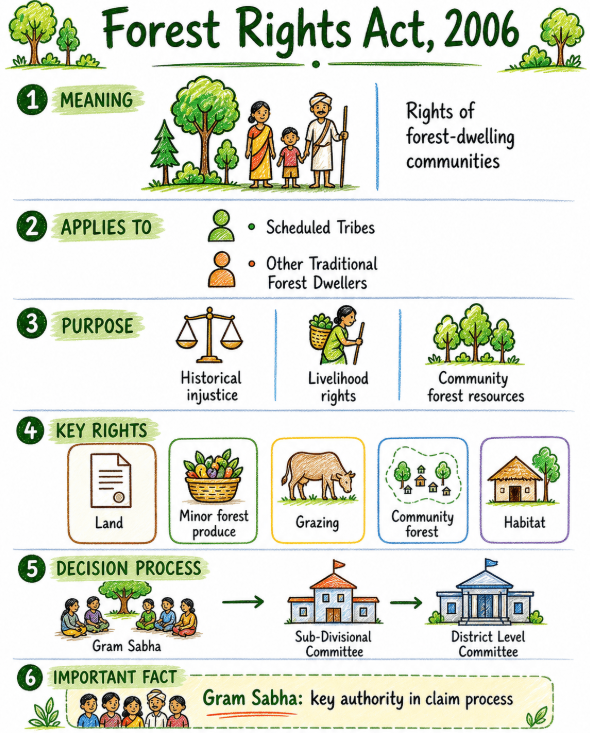
What is the Forest Rights Act (FRA), 2006
- The Forest Rights Act, 2006, officially known as the Scheduled Tribes and Other Traditional Forest Dwellers Act, was enacted to correct historical injustices against forest-dwelling communities.
- It recognizes legal rights of forest-dwelling Scheduled Tribes and Other Traditional Forest Dwellers over land and forest resources.
- It places Gram Sabhas at the centre of the decision-making process regarding recognition of forest rights.
- It prohibits eviction until the process of verification and recognition of rights is completed.
Key Judgements and Developments
Allahabad High Court
- The Allahabad High Court ruled that the DLC’s rejection of claims was legally incorrect.
- It emphasized that FRA, being a later law, overrides conflicting provisions of earlier laws or administrative decisions.
- It directed reconsideration of the claims of the Tharu tribal community.
- However, it did not impose penalties on authorities for violating FRA provisions.
Madras High Court
- The Madras High Court dismissed petitions challenging eviction notices.
- It held that entertaining FRA claims would delay administrative action.
- It allowed evictions under the Tamil Nadu Forest Act, 1882, even where FRA claims were pending.
- It upheld grazing bans despite FRA explicitly recognizing grazing rights.
Core Legal Principle Involved
- The doctrine of lex posterior derogat priori applies, meaning:
→ A later law overrides an earlier law in case of conflict. - Since FRA was enacted in 2006, it legally prevails over older forest laws such as the Tamil Nadu Forest Act, 1882.
- Courts are expected to interpret laws in a manner that upholds this principle.
Rights Recognised under FRA
The FRA provides a comprehensive framework of rights:
- Individual Forest Rights (IFR):
– Right to live and cultivate forest land for livelihood - Community Forest Rights (CFR):
– Grazing rights
– Collection of Minor Forest Produce
– Fishing and water access
– Forest management rights - Habitat Rights:
– For Particularly Vulnerable Tribal Groups (PVTGs) - Developmental Rights:
– Access to basic amenities like roads, schools, and health facilities
Issue of Grazing Rights
- FRA explicitly recognizes grazing rights across all forest categories, including:
– Reserved forests
– National parks
– Wildlife sanctuaries - These rights are essential for pastoral communities and traditional livelihoods.
- The Madras HC ruling contradicts this provision by upholding grazing bans under older laws.
Significance of Allahabad HC Ruling
- Reinforces FRA as a rights-based legislation with legal supremacy.
- Protects tribal communities from arbitrary eviction.
- Strengthens the role of Gram Sabha and due process in rights recognition.
- Provides judicial clarity on resolving conflicts between old and new laws.
Concerns Raised by Madras HC Approach
- Undermines the intent of FRA by prioritizing colonial-era forest laws.
- Weakens protection against eviction before claim verification.
- Ignores statutory recognition of grazing rights.
- Creates inconsistency in judicial interpretation across different High Courts.
Challenges in FRA Implementation
- Slow recognition of claims due to bureaucratic delays.
- Lack of awareness among tribal communities about their rights.
- Resistance from forest departments due to administrative control concerns.
- Overemphasis on individual rights while neglecting community rights.
- Conflicts between conservation goals and livelihood rights.
Way Forward
- Ensure uniform judicial interpretation across High Courts through Supreme Court guidance.
- Strengthen awareness campaigns among forest dwellers about FRA provisions.
- Improve administrative capacity for faster processing of claims.
- Promote community-based forest governance models.
- Balance conservation goals with livelihood rights using participatory approaches.
Conclusion
The recent rulings highlight a fundamental tension in India’s forest governance framework between colonial-era control and modern rights-based legislation. While the Allahabad High Court reinforces the primacy of the Forest Rights Act, the contrasting approach of the Madras High Court exposes gaps in uniform interpretation. Ensuring consistent enforcement of FRA is essential not only for tribal justice but also for sustainable and inclusive forest management.
CARE MCQ
Q.Which of the following rights are granted under the Forest Rights Act, 2006?
- Title rights to ownership of land cultivated by forest dwellers up to a maximum of 4 hectares.
- Rights to collect and use Minor Forest Produce (MFP), such as bamboo, honey, and medicinal plants.
- The right to clear forest land for cultivation beyond the existing limit of 4 hectares if approved by the Gram Sabha.
Select the correct answer using the code below:
a) 1 and 2 only
b) 2 and 3 only
c) 1 and 3 only
d)1, 2, and 3
Answer: (a)
Explanation:
Statement 1 is correct: The FRA provides title rights, allowing ownership of land actively cultivated by forest dwellers, subject to a maximum limit of 4 hectares.
Statement 2 is correct: The FRA grants use rights to collect Minor Forest Produce (MFP), which includes resources like bamboo, tendu leaves, honey, and medicinal plants. These are crucial for the livelihood of forest-dwelling communities.
Statement 3 is incorrect: The FRA does not allow forest dwellers to clear forest land for cultivation beyond the 4-hectare limit, even with Gram Sabha approval. The Act emphasizes conservation and sustainable use of forest resources.
Q.Which of the following statements is/are correct regarding the Gram Sabha?
- It consists of all the voters residing in the jurisdiction of a Gram Panchayat.
- It is the decision-making body for local self-governance at the village level.
Select the correct answer using the code given below:
a) 1 only
b) 2 only
c) Both 1 and 2
d) Neither 1 nor 2
Answer: (c)
Explanation: The Gram Sabha consists of all the registered voters residing in the jurisdiction of a Gram Panchayat and serves as the decision-making body for local self-governance at the village level.
Q.Consider the following statements about Gram Sabha:
- It is the primary body of the Panchayati Raj system and consists of all registered voters in the area of a Panchayat.
- The Gram Sabha must meet at least twice a year.
- The decisions of the Gram Sabha are not binding on the Gram Panchayat.
How many of the Statements given above are correct?
a) Only one
b) Only two
c) All three
d) None
Answer: (b)
Explanation:
Statement 1 is correct: As per Article 243(b) of the Constitution, the Gram Sabha is a body consisting of all persons registered in the electoral rolls relating to a village comprised within the area of a Panchayat at the village level. It is the foundation of the Panchayati Raj System.
Statement 2 is correct: While the Constitution does not specify the number of meetings, most State Panchayati Raj Acts mandate that the Gram Sabha must meet at least twice a year. The statement reflects this common statutory requirement.
Statement 3 is incorrect: The powers of the Gram Sabha, including whether its decisions are binding on the Gram Panchayat, are determined by the respective State Legislatures as per Article 243A. Many State Acts have provisions that make the recommendations or decisions of the Gram Sabha in specific matters (like approval of plans and selection of beneficiaries) binding on the Gram Panchayat. Therefore, the absolute statement that its decisions are ‘not binding’ is incorrect.
FAQs
Q1. What is the objective of the Forest Rights Act?
Ans: To correct historical injustices and recognize rights of forest-dwelling communities.
Q2. What did the Allahabad High Court rule?
Ans: It upheld FRA supremacy and ordered reconsideration of rejected tribal claims.
Q3. Why is the Madras High Court ruling controversial?
Ans: Because it ignores FRA provisions and allows evictions under older laws.
Q4. What are grazing rights under FRA?
Ans: They allow traditional pastoral communities to use forest land for livestock grazing.
Q5. Why is FRA important for UPSC?
Ans: It links governance, environment, tribal rights, and judiciary—important for GS II and GS III.