Table of Contents
Relevance: GS Paper III (Agriculture, Food Security, Nutrition) | GS Paper II (Health) | TGPSC (Agriculture & Welfare Schemes)
For Prelims:
Millets, Nutri-cereals, ICAR-IIMR, Nutrihub, National Institute of Nutrition (NIN), International Year of Millets 2023
For Mains:
Nutrition security, crop diversification, climate-resilient agriculture, behavioural change campaigns
Why in News?
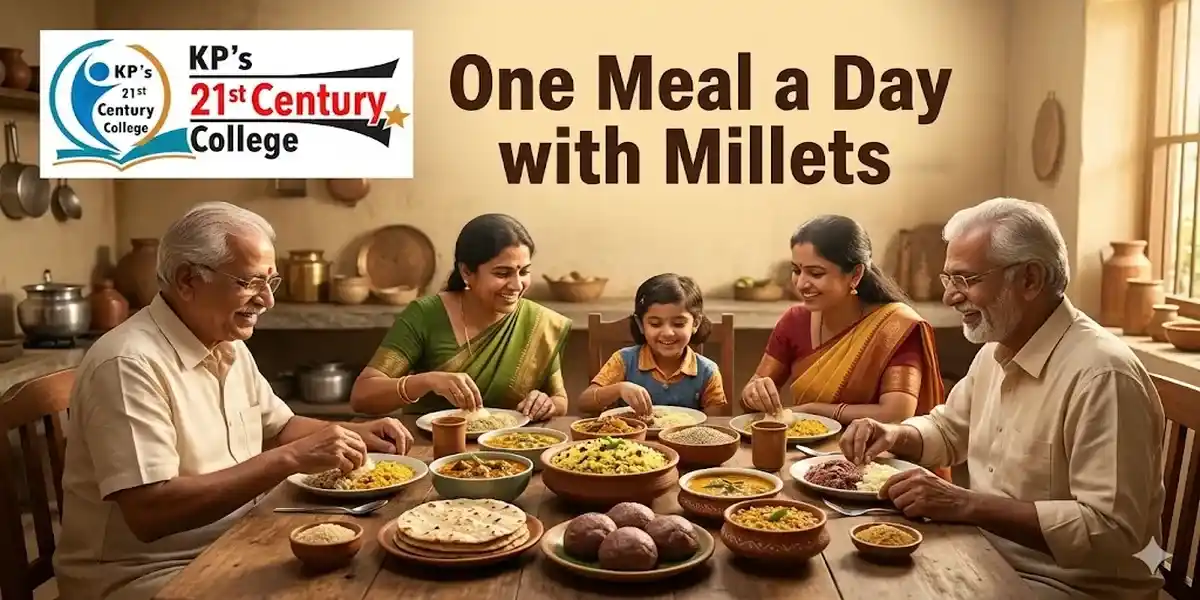
A national initiative titled “One Meal a Day with Millets” has been launched in Hyderabad by ICAR-Indian Institute of Millets Research along with Nutrihub and Millet Marvels to promote millet consumption as part of daily diets for improved nutrition and sustainable agriculture.
Institutional Framework and Initiative Design
- The initiative is spearheaded by ICAR-Indian Institute of Millets Research, a premier institute under ICAR dedicated to millet research and promotion.
- Nutrihub, functioning as an incubation platform within IIMR, supports millet-based startups, value addition, and market linkages.
- The campaign adopts a behavioural change model, encouraging individuals to incorporate at least one millet-based meal daily and promote the idea through social outreach.
- The recommendation aligns with guidance from the National Institute of Nutrition that at least one-third of cereal intake should be millets.
Millets: Types, Nutritional Profile and Classification
Millets are a group of small-seeded coarse cereals cultivated primarily in semi-arid regions of Asia and Africa. In India, they are traditionally known as “nutri-cereals” because of their high nutritional value, climate resilience, and low input requirements. They are hardy crops capable of growing in poor soils, with minimal water, and under high temperature conditions, making them crucial for food security and climate-smart agriculture.
Classification of Millets
Millets are broadly classified into Major Millets and Minor Millets based on their cultivation scale, productivity, and historical importance.
1. Major Millets
These millets are widely cultivated and form a significant part of the diet in many regions:
- Sorghum (Jowar) – Scientifically known as Sorghum bicolor
It is a staple food in parts of Maharashtra, Karnataka, and Telangana. It is drought-resistant and used for making rotis and fodder. - Pearl Millet (Bajra) – Pennisetum glaucum
Grown extensively in Rajasthan and Gujarat, it is highly tolerant to heat and drought conditions. - Finger Millet (Ragi) – Eleusine coracana
Widely cultivated in southern India, especially Karnataka, it is known for its exceptionally high calcium content.
2. Minor Millets
These are less widely cultivated but highly nutritious and ecologically significant:
- Foxtail Millet – Setaria italica
- Little Millet – Panicum sumatrense
- Kodo Millet – Paspalum scrobiculatum
- Barnyard Millet – Echinochloa frumentacea
- Proso Millet – Panicum miliaceum
These millets are often grown in tribal and hilly regions and are gaining renewed importance due to their nutritional benefits and climate resilience.
Nutritional Profile of Millets
Category | Components | Nutritional Features | Health Significance |
Macronutrients | Complex Carbohydrates | Provide slow and sustained release of energy | Helps maintain energy levels and prevents sudden glucose spikes |
Protein (7–12%) | Moderate protein content compared to cereals | Supports growth, repair, and body functions | |
Dietary Fibre | High fibre content | Improves digestion, promotes gut health, and aids in weight management | |
Micronutrients | Iron | Present in significant amounts | Helps prevent anemia and improves hemoglobin levels |
Calcium (especially in Ragi) | Very high in finger millet | Essential for strong bones and teeth | |
Magnesium & Phosphorus | Important mineral content | Supports metabolic activities and bone health | |
Zinc & Potassium | Essential trace elements | Boost immunity and maintain heart health | |
Vitamins | B-complex Vitamins (B1, B2, B3, B6) | Rich source of essential vitamins | Helps in energy metabolism and proper functioning of the nervous system |
Bioactive Compounds | Antioxidants (Polyphenols) | Natural plant compounds | Reduce oxidative stress and help prevent chronic diseases like diabetes and cardiovascular disorders |
Health Benefits and Glycaemic Properties
Millets have a low glycaemic index (GI), meaning they release glucose slowly into the bloodstream. This makes them particularly beneficial for:
- Management of Type 2 Diabetes
- Prevention of lifestyle diseases such as obesity and cardiovascular disorders
- Maintaining stable blood sugar levels
Additionally, their high fibre content contributes to:
- Better digestion
- Reduced cholesterol levels
- Improved satiety, aiding in weight management
Agro-Climatic and Sustainability Dimensions
Millets are highly suited to India’s semi-arid regions due to their low water requirement and high drought tolerance.
They can grow in poor soils with minimal inputs, making them climate-resilient crops.
Compared to rice and wheat, millets have:
- Lower water footprint
- Lower carbon footprint
- Higher adaptability to climate variability
This makes them crucial in addressing climate change and sustainable agriculture goals.
Economic and Farmer-Centric Implications
Promotion of millets supports crop diversification, reducing overdependence on rice and wheat.
It enhances income security for small and marginal farmers, especially in rainfed regions.
The development of millet-based value chains through startups and food industries creates:
- Rural employment opportunities
- Processing and export potential
- Market expansion for traditional crops
Thus, millets connect nutrition, sustainability, and livelihoods.
Way Forward
- There is a need to strengthen procurement mechanisms and MSP support for millets to incentivise farmers.
- Awareness campaigns must be expanded to urban consumers to create sustained demand.
- Investment in processing, branding, and export infrastructure is required to make millets globally competitive.
- Integration of millets into institutional food programmes should be scaled up systematically.
Conclusion
The “One Meal a Day with Millets” initiative represents a shift towards integrating nutrition, sustainability, and agriculture within a single framework. By promoting millets in daily diets, India can address health challenges, support farmers, and build a resilient food system for the future.
CARE MCQ
Q. Consider the following statements:
- Millets require less water compared to rice and wheat.
- Millets have a high glycaemic index.
- India declared 2023 as the International Year of Millets.
Which of the statements given above are correct?
(a) 1 only
(b) 1 and 2 only
(c) 1 and 3 only
(d) 1, 2 and 3
Ans: (c)
Explanation:
Statement 1 is correct: Millets are drought-resistant crops and require significantly less water compared to water-intensive crops like rice and wheat, making them suitable for dryland agriculture.
Statement 2 is incorrect: Millets generally have a low to moderate glycaemic index, which helps in better blood sugar regulation, making them beneficial for diabetic diets.
Statement 3 is correct: India played a key role in proposing and promoting 2023 as the International Year of Millets, which was declared by the United Nations to boost awareness and production globally.
Q.Which of the following statements best describes the nutritional advantages of nutri-cereals?
(a) They are rich sources of dietary fiber, essential minerals like iron and calcium, and typically possess a low glycaemic index beneficial for metabolic health
(b) Their primary nutritional contribution is a high content of Vitamin C and Vitamin D
(c) They are devoid of carbohydrates and rich in omega-3 fatty acids
(d) They primarily provide protein comparable to animal sources and are genetically modified for enhanced nutrition
Ans: (a)
Explanation:
Nutri-cereals (millets such as jowar, bajra, and ragi) are rich in dietary fiber, contain essential minerals like iron, calcium, zinc, and have a low glycaemic index, making them beneficial for metabolic health and diabetes management.
Q.Consider the following statements regarding processing techniques for nutri-cereals:
Statement 1: Extrusion cooking, a high-temperature short-time process applied to nutri-cereals, often leads to a notable reduction in the bioactivity of specific phenolic compounds and certain heat-labile vitamins due to thermal degradation.
Statement 2: Dehulling (decortication) of nutri-cereals, while crucial for improving sensory attributes and reducing anti-nutritional factors concentrated in the outer layers, also results in a substantial loss of dietary fiber and some essential minerals.
Which one of the following is correct in respect of the above statements?
a) Both Statement 1 and Statement 2 are correct and Statement 2 is the correct explanation for Statement 1
b) Both Statement 1 and Statement 2 are correct and Statement 2 is not the correct explanation for Statement 1
c) Statement 1 is correct but Statement 2 is incorrect
d) Statement 1 is incorrect but Statement 2 is correct
Answer: (b)
Explanation:
Statement 1 is correct: Extrusion cooking is a high-temperature, short-time thermal process. While it offers benefits like starch gelatinization, improved protein digestibility, and inactivation of some anti-nutritional factors, the intense heat can indeed cause thermal degradation of heat-sensitive compounds. This includes certain vitamins (like Vitamin C and some B vitamins) and specific phenolic compounds, leading to a reduction in their bioactivity and nutritional value.
Statement 2 is correct: Dehulling, also known as decortication, is a common pre-processing step for many nutri-cereals (millets, sorghum, etc.) to remove the indigestible outer husk and bran layers. This process significantly improves the sensory attributes (like taste, texture, and cooking quality) and reduces the concentration of anti-nutritional factors (such as tannins and phytic acid) which are often concentrated in the bran. However, the bran layer is also a rich source of dietary fiber and essential micronutrients like iron, zinc, and magnesium. Therefore, dehulling, while beneficial in some aspects, inevitably leads to a reduction in the overall dietary fiber content and loss of some essential minerals.
Both statements are factually correct. However, Statement 2 describes the effects and trade-offs of the dehulling process, whereas Statement 1 describes the effects of extrusion cooking. The effects of dehulling do not explain the effects observed during extrusion cooking. Therefore, Statement II is not the correct explanation for Statement I.
TGPSC CARE MAINS:
Q.Discuss the role of millets in achieving nutrition security and sustainable agriculture in India. Examine the significance of behavioural initiatives like “One Meal a Day with Millets.” [250 WORDS]
FAQs
Q.Why are millets called nutri-cereals?
Ans: Because they are rich in essential nutrients such as fibre, minerals, vitamins, and antioxidants.
Q. Which institution leads millet research in India?
Ans: ICAR-Indian Institute of Millets Research.
Q. Why are millets important for climate change?
Ans: They require less water, tolerate drought, and grow in poor soils, making them climate-resilient crops.
Q. What is the key idea behind the initiative?
Ans: To promote daily consumption of millets for better health and sustainable food systems.