
Why in News?
The Telangana Cabinet has granted administrative approval for the first phase of the Musi River Rejuvenation Project at an estimated cost of ₹7,345.12 crore.Phase-I covers a 21-km stretch of the river and marks the formal beginning of implementation of the riverfront development initiative.The government plans to complete technical sanction and tender-related procedures before awarding contracts for the works.

What is the Musi River Rejuvenation Project?
The project is an urban river-restoration and riverfront-development initiative intended to transform the Musi into a cleaner, safer and more sustainable urban waterway.
The Phase-I Detailed Project Report focuses on:
- Ensuring continuous flow of fresh water
- Developing modern riverfront infrastructure
- Strengthening flood-mitigation measures
- Improving the ecological and urban condition of the river corridor
- Rehabilitating families and structures affected by project implementation
The project combines river restoration with urban infrastructure, flood management and planned redevelopment.
| MUSI RIVER
The Musi River is a major tributary of the Krishna River and flows through Hyderabad in Telangana. About Musi River
Course
Important Water Structures
Historical Importance
|
Key Features of Phase-I
Project cost:
- The Cabinet approved an expenditure of ₹7,345.12 crore for Phase-I.
Total length:
- The first phase covers approximately 21 km.
Fresh-water flow:
- The project seeks to maintain continuous fresh-water flow in the Musi.
Riverfront infrastructure:
- Modern public and riverfront infrastructure is proposed along the selected stretches.
Flood mitigation:
- The plan includes measures to reduce flood risk and improve management of the river corridor.
Implementation schedule:
- The government intends to fast-track technical sanctions, tender invitations and contract awards.
Project Area and Alignment
- Phase-I begins from the streams originating from Himayatsagar and Osmansagar, which converge near Bapu Ghat at Langar Houz.
It comprises two stretches:
Stretch-A
- Extends from Himayatsagar
- Covers approximately 9.2 km
Stretch-B
- Extends from Osmansagar or Gandipet
- Covers approximately 11.8 km
- Both stretches converge near the proposed Gandhi Sarovar at Bapu Ghat.
- This alignment connects the two major reservoir-fed streams with the proposed central riverfront-development zone.
Institutional and Administrative Measures
Creation of new posts:
- The Cabinet approved the creation of 147 posts for project implementation and maintenance.
Deputation of personnel:
- Officials may be deputed from other government departments to support execution and management.
Detailed Project Report:
- The draft DPR was submitted by Singapore-based consultancy Meinhardt, working with an international consortium that includes Cushman & Wakefield and RIOS.
Tender process:
- The government plans to issue technical sanction and the Notice Inviting Tenders before finalising contracts.
- These measures seek to create a dedicated administrative structure for the project.
Rehabilitation and Land-Acquisition Measures
- Large urban river projects often involve displacement, land acquisition and relocation. The Cabinet therefore approved several rehabilitation measures.
Housing for riverbed residents:
Families residing in the Musi riverbed are to be allotted double-bedroom houses.
Compensation for landowners:
Affected landowners may be provided either:
- Transferable Development Rights, or
- Suitable monetary compensation
Relocation of structures:
- Structures situated on defence land required for the Gandhi Sarovar project are to be shifted, with the State government taking responsibility for relocation.
- These measures seek to balance urban redevelopment with rehabilitation and compensation.
Proposed Gandhi Sarovar
- The proposed Gandhi Sarovar near Bapu Ghat is expected to form a central component of Phase-I.
- The two project stretches from Himayatsagar and Osmansagar will converge in this area.
Its development is linked with:
- Riverfront infrastructure
- Water-flow management
- Landscape and public-space development
- Relocation of affected structures
- Integration of the surrounding urban area
The project seeks to make this zone a major focal point of the rejuvenated river corridor.
Musi Experience Centre
The Chief Minister directed officials to establish a Musi Experience Centre on Necklace Road–P.V. Narasimha Rao Marg, near Hussainsagar.
The centre is intended to:
- Explain the project’s overall vision
- Display proposed development components
- Inform the public about implementation plans
- Collect feedback and suggestions
- Build public awareness and participation
Such a centre can improve transparency and provide a platform for citizen engagement.
Significance of the Project
Urban river restoration:
- The project seeks to revive a river corridor affected by urbanisation and environmental degradation.
Flood resilience:
- Flood-mitigation works can reduce vulnerability of low-lying settlements and infrastructure.
Improved urban infrastructure:
- Planned riverfront development may support better roads, public spaces and civic amenities.
Environmental improvement:
- Continuous fresh-water flow and river management may improve the ecological condition of the corridor.
Public-space creation:
- Riverfront development can create accessible recreational and cultural spaces for residents.
Integrated planning:
- The project brings together water management, land use, housing, transport and urban design.
Economic potential:
- Improved infrastructure may attract investment, tourism and commercial activity along the corridor.
Participatory governance:
- The experience centre and feedback mechanism may help involve citizens in project planning.
Way Forward
- Prevent untreated sewage and solid waste from entering the river.
- Conduct detailed environmental and social-impact assessments.
- Protect the natural floodplain and river-carrying capacity.
- Ensure rehabilitation before displacement.
- Provide fair and transparent compensation to affected landowners.
- Establish clear coordination among all implementing departments.
Conclusion
The approval of Phase-I of the Musi River Rejuvenation Project marks an important step in Telangana’s urban-development agenda. Its success, however, will depend on whether the initiative goes beyond riverfront beautification to achieve genuine pollution control, ecological restoration, flood resilience and humane rehabilitation. A transparent, participatory and environmentally sensitive approach can help transform the Musi into a sustainable urban waterway while protecting the rights of affected communities.
Why in News?
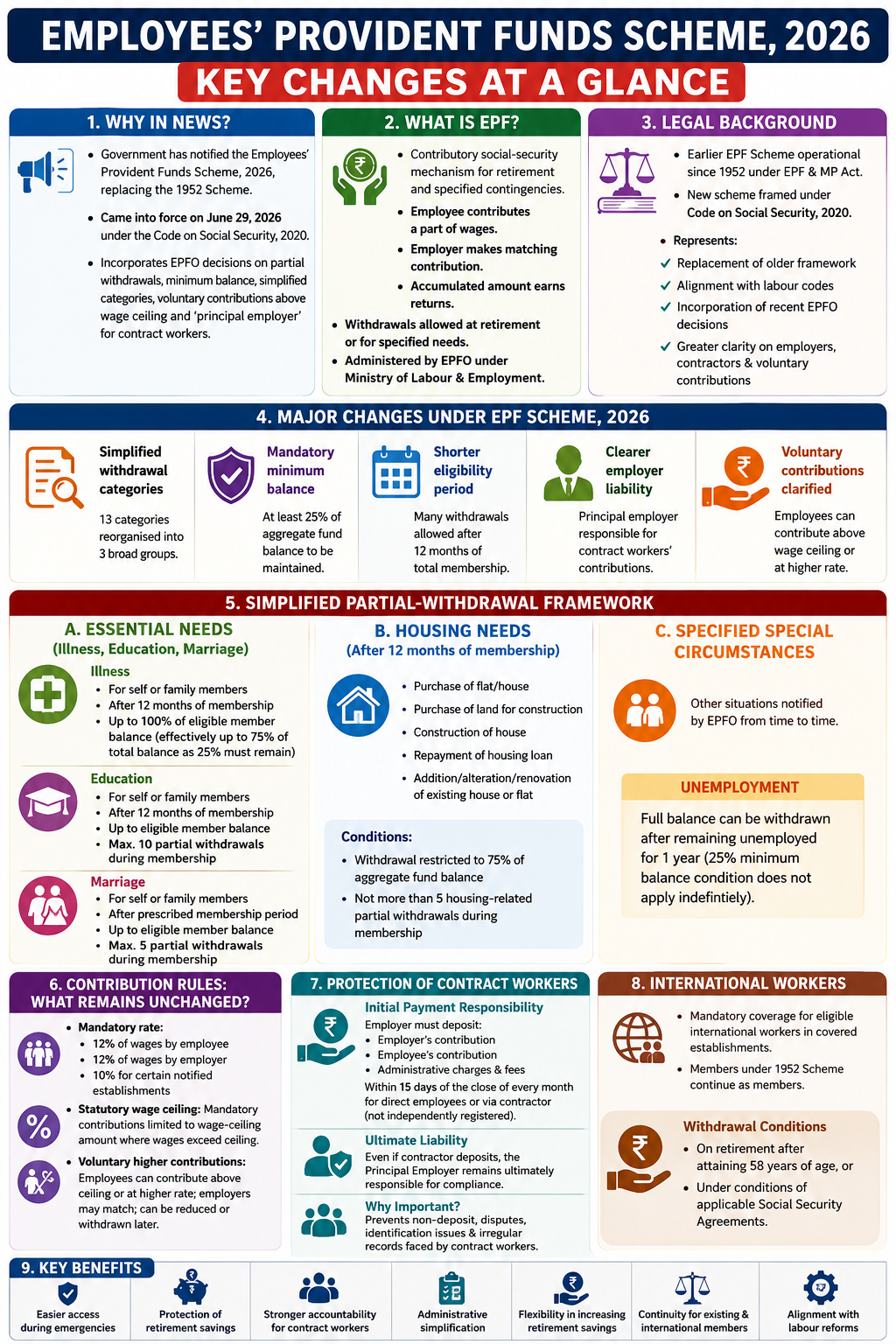
- The Union government has notified the Employees’ Provident Funds Scheme, 2026, replacing the Employees’ Provident Funds Scheme, 1952.
- The new scheme came into force on June 29, 2026, as part of the implementation of the Code on Social Security, 2020.
- It incorporates recent EPFO decisions relating to partial withdrawals, the compulsory maintenance of a minimum balance and simplified withdrawal categories. It also explicitly provides for voluntary contributions above the statutory wage ceiling and introduces the concept of a principal employer for contract workers.
What is the Employees’ Provident Fund?
The Employees’ Provident Fund is a contributory social-security mechanism intended to provide workers with financial support after retirement or during specified contingencies.
Under the system:
- The employee contributes a prescribed proportion of wages.
- The employer makes a matching contribution.
- The accumulated amount earns returns.
- Withdrawals are permitted at retirement or for specified needs subject to conditions.
The scheme is administered by the Employees’ Provident Fund Organisation, under the Ministry of Labour and Employment.
Legal Background of the New Scheme
The earlier EPF Scheme had been operating since 1952 under the Employees’ Provident Funds and Miscellaneous Provisions Act.
The new scheme has been framed under the broader architecture of the Code on Social Security, 2020, which seeks to consolidate and rationalise various labour-related social-security laws.
The EPF Scheme, 2026 therefore represents:
- Replacement of an older statutory framework
- Alignment with the labour codes
- Incorporation of recent EPFO policy decisions
- Greater clarity regarding employers, contractors and voluntary contributions
Major Changes under the EPF Scheme, 2026
Simplified withdrawal categories:
The earlier 13 categories of partial withdrawals have been reorganised into three broad groups:
- Essential needs
- Housing needs
- Specified special circumstances
Mandatory minimum balance:
Members must generally maintain at least 25% of the aggregate fund balance in their EPF account.
Shorter eligibility period:
Many partial withdrawals are permitted after completing 12 months of total fund membership.
Clearer employer liability:
The responsibility of the principal employer for contributions relating to contract workers has been explicitly recognised.
Voluntary contributions clarified:
Employees can contribute above the statutory wage ceiling or at a rate exceeding the mandatory contribution rate.
Simplified Partial-Withdrawal Framework
Essential Needs
The essential-needs category covers illness, education and marriage.
Illness
A member may withdraw funds for the illness of:
- Self
- Eligible family members
The withdrawal may be made after completing 12 months of total membership.
A member can withdraw up to 100% of the eligible member balance.
However, because at least 25% of the total balance must remain in the account, the maximum ordinarily available is effectively 75% of the aggregate fund balance.
Education
Members may withdraw for the education of:
- Self
- Eligible family members
The conditions include:
- Completion of 12 months of membership
- Withdrawal up to the eligible member balance
- A maximum of 10 partial withdrawals during the entire membership period
Marriage
A member may withdraw for the marriage of:
- Self
- Eligible family members
The conditions include:
- Completion of the prescribed membership period
- Withdrawal up to the eligible balance
- A maximum of five partial withdrawals during the membership period
Housing Needs
Partial withdrawal is permitted for:
- Purchase of a residential flat or house
- Purchase of land for construction
- Construction of a house
- Repayment of a housing loan
- Addition, alteration or renovation of an existing house or flat
The principal conditions are:
- At least 12 months of total membership
- Withdrawal restricted to 75% of the aggregate fund balance
- Not more than five housing-related partial withdrawals during membership
The simplified housing category combines several earlier sub-categories into one broader framework.
Withdrawal during Unemployment
The compulsory 25% minimum balance does not apply indefinitely in cases of prolonged unemployment.
A member may withdraw the entire EPF balance after remaining unemployed for one year, subject to the prescribed procedure.
This provision balances:
- Immediate financial support during unemployment
- Preservation of some retirement savings during shorter employment gaps
Contribution Rules: What Remains Unchanged?
Mandatory rate
The prescribed contribution rate continues to be:
- 12% of wages by the employee
- 12% of wages by the employer
For certain notified establishments, the contribution rate continues to be 10%.
Statutory wage ceiling
Where wages exceed the statutory ceiling, mandatory contributions are ordinarily restricted to the wage-ceiling amount.
Thus, the new scheme does not automatically make contribution on the entire salary compulsory.
Voluntary higher contributions
Employees may choose to:
- Contribute on wages exceeding the statutory ceiling, or
- Contribute at a rate higher than 12%
Employers may also choose to make matching contributions.
These additional voluntary contributions may later be reduced or discontinued by the employee or employer.
The provision provides flexibility to individuals who wish to increase retirement savings without imposing a fresh universal obligation.
Protection of Contract Workers
A significant feature of the new scheme is the explicit recognition of the principal employer.
Initial payment responsibility
The employer must deposit:
- The employer’s contribution
- The employee’s contribution
- Applicable administrative charges and fees
This must generally be completed within 15 days of the close of every month for workers employed directly or through a contractor who is not independently registered.
Ultimate liability
Where a contractor deposits the provident-fund contribution, the principal employer remains ultimately responsible for ensuring compliance.
This provision is important because contract workers frequently face:
- Non-deposit of deducted contributions
- Disputes between contractors and establishments
- Difficulty in identifying the responsible employer
- Irregular employment records
The new scheme seeks to prevent employers from avoiding social-security obligations by outsourcing labour.
Provisions for International Workers
The EPF Scheme, 2026 retains mandatory coverage for eligible international workers employed in covered establishments.
It also clarifies that international workers who were members under the 1952 Scheme will continue as members under the new framework.
Withdrawal conditions
International workers are generally permitted to withdraw their funds:
- On retirement after attaining 58 years of age, or
- Under conditions provided through applicable Social Security Agreements
This ensures continuity of rights while recognising India’s bilateral social-security arrangements with other countries.
Significance of the New Scheme
Easier access during emergencies:
- Simplified withdrawal categories reduce procedural confusion and make funds more accessible during illness, education, marriage and housing needs.
Protection of retirement savings:
- The 25% minimum-balance rule seeks to prevent complete depletion of the provident fund through repeated partial withdrawals.
Greater accountability:
- The principal-employer provision strengthens the protection of contract workers.
Administrative simplification:
- Consolidating multiple withdrawal categories can reduce documentation and processing delays.
Flexibility in savings:
- Voluntary higher contributions allow workers to build a larger retirement corpus according to their financial capacity.
Legal continuity:
- Existing members, including international workers, continue under the new scheme without disruption.
Alignment with labour reforms:
- The framework brings provident-fund regulation in line with the Code on Social Security, 2020.
Key Concerns
Retirement-corpus erosion:
- Even with a 25% reserve, frequent withdrawals may significantly reduce long-term savings.
Limited adequacy of minimum balance:
- Retaining only one-fourth of the corpus may be insufficient for retirement, particularly for workers with low or irregular contributions.
Contract-worker enforcement:
- The principal-employer rule will be effective only if inspection, digital verification and grievance mechanisms are strengthened.
Awareness deficit:
- Workers may not understand the difference between total balance, eligible balance and voluntary contributions.
Digital exclusion:
- Workers with limited digital literacy may face difficulties in filing claims or correcting employment records.
Employer compliance:
- Delayed remittances and incorrect wage reporting may continue unless penalties and monitoring are effective.
Short-term versus long-term needs:
- The scheme must balance emergency liquidity with the central purpose of retirement security.
Way Forward
- Provide clear multilingual guidance on withdrawal limits and eligible balances.
- Send real-time alerts to employees whenever contributions are deposited.
- Allow workers to verify contractor and principal-employer compliance digitally.
- Strengthen grievance redressal for delayed or missing contributions.
- Introduce financial counselling before high-value withdrawals.
- Ensure portability of records across employers and contractors.
- Use data analytics to identify establishments with repeated defaults.
- Protect informal and low-wage workers from unauthorised deductions.
- Simplify claim processing without weakening verification.
- Periodically assess whether the 25% minimum balance adequately protects retirement security.
Conclusion
The Employees’ Provident Funds Scheme, 2026 modernises India’s provident-fund framework by simplifying withdrawals, clarifying contribution rules and strengthening accountability for contract workers.
Its worker-friendly withdrawal provisions can provide timely financial relief. However, provident-fund savings remain primarily a source of retirement protection.
The scheme’s success will therefore depend on maintaining a careful balance between present financial needs, employer accountability and long-term social security.
Why in News?
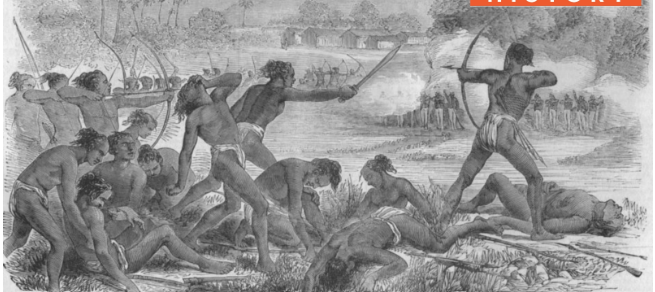
June 30 is observed as Hul Diwas, commemorating the Santal rebellion that began on June 30, 1855.The uprising, led by Sido and Kanhu Murmu from Bhognadih, emerged from growing exploitation, indebtedness, land insecurity and administrative injustice in the Santal-inhabited region of Damin-i-Koh.The rebellion is also part of a wider history of displacement that scattered Santal communities across eastern and north-eastern India while strengthening their shared cultural memory and sense of belonging.
Who are the Santals?
- The Santals are one of India’s major tribal communities, concentrated primarily in:
- Jharkhand
- West Bengal
- Odisha
- Bihar
- Assam
- Their social and cultural life has historically been shaped by forests, agriculture, village institutions, oral traditions, songs and collective memory.
- Santal origin narratives refer to places such as Hihiri-Pipiri and Sasan Beda. Although these places cannot be identified geographically, they remain central to the community’s remembered beginnings.
- This illustrates how belonging may be preserved through oral history even when communities move across regions.
Settlement in Damin-i-Koh
- In 1832, British authorities demarcated Damin-i-Koh, a tract along the Rajmahal Hills in present-day eastern Jharkhand.
Colonial objective
The British encouraged Santal settlement in the region to:
- Clear forests
- Expand agriculture
- Increase land revenue
- Develop the frontier region
Many Santal families migrated from areas such as Manbhum and Chotanagpur.
Creation of a homeland
Through collective labour, the Santals:
- Cleared forests
- Cultivated previously uncultivated land
- Established villages
- Raised families
- Developed emotional and social attachment to the region
Thus, a colonial revenue project gradually became a settled Santal homeland.
Causes of the Santal Hul
- The rebellion was not an isolated outbreak. It resulted from the gradual destruction of the conditions that made settled life possible.
Rising rent demands:
- Land-revenue demands increased, reducing the economic security of cultivators.
Indebtedness:
- Moneylenders extended loans on exploitative terms, trapping families in recurring debt.
Intermediary exploitation:
- Mahajans, landlords, traders, revenue officials and other intermediaries multiplied between cultivators and the colonial administration.
Land alienation:
- Debt and unequal contracts weakened Santal control over the lands they had cleared and cultivated.
Administrative failure:
- The colonial system offered limited access to justice or meaningful grievance redressal.
Social humiliation:
- Affronts to Santal elders and women intensified resentment and insecurity.
- The Hul therefore emerged from both material exploitation and the erosion of dignity, autonomy and belonging.
Course and Meaning of the Rebellion
- On June 30, 1855, Sido and Kanhu Murmu called upon the Santals at Bhognadih to resist colonial authority and its exploitative local agents.
- The uprising came to be known as Hul, meaning rebellion or movement in Santali.
Nature of the movement
The rebellion was directed against:
- Colonial officials
- Revenue authorities
- Moneylenders
- Zamindars
- Exploitative intermediaries
The Santals sought to end a system that had made their economic and social existence increasingly insecure.
Beyond physical displacement
- The rebellion reflected not only the fear of being driven from the land but also a deeper form of uprooting.
- A community may continue to live in the same geographical area but become dispossessed when it loses:
- Control over land
- Economic security
- Social dignity
- Access to justice
- Cultural autonomy
The Hul was therefore a struggle against both colonial rule and internal dispossession.
Suppression and Displacement after the Hul
- The British suppressed the rebellion with extensive military force.
- Its aftermath produced further displacement and dispersal of Santal families.
- The Bengal District Gazetteer of 1910 recorded migration towards:
- Purnea
- Malda
- Burdwan
- Jalpaiguri
- Assam’s tea plantations
- By 1901, nearly 31,000 residents of Santal Pargana were reportedly working in Assam, while around 10,000 more had settled in Jalpaiguri.
- The colonial economy converted many displaced Santals into labourers in:
- Tea gardens
- Agricultural estates
- Road-building projects
- Distant districts
Thus, the suppression of the rebellion did not end movement; it accelerated the dispersal of the community.
Migration, Memory and Community Identity
- Migration separated Santal families across distant regions, but geographical distance did not completely dissolve community identity.
- A Santal proverb recorded by W.G. Archer states that “a million Santals have a single word.”
- The proverb reflects the idea that a community may remain united through:
- Shared origin narratives
- Oral traditions
- Collective memories
- Songs and festivals
- Language
- Historical experiences
- For the Santals, identity was preserved not merely by remaining in one territory but by continuing a shared story across generations.
Memory as a form of belonging
The Hul became an important cultural memory that linked:
- Those who remained in Santal Pargana
- Labourers who migrated to Assam
- Families settled in Bengal
- Later generations working in cities and distant regions
The remembrance of rebellion became a means of sustaining belonging despite dispersal.
Ol Chiki and the Politics of Language
- In 1925, Pandit Raghunath Murmu developed the Ol Chiki script for the Santali language.
Importance of Ol Chiki
The script:
- Represented Santali sounds more accurately
- Reduced dependence on scripts borrowed from other languages
- Strengthened cultural assertion
- Provided a common symbol of identity
- Supported literacy and literary development
Santali was included in the Eighth Schedule of the Constitution in 2003.
Multiple-script reality
Santali has also historically been written in:
- Roman
- Bengali
- Odia
- Devanagari
- Many Santali speakers, particularly in parts of Santal Pargana, continue to use these scripts.
- The demand for wider implementation of Ol Chiki therefore represents both cultural unity and a practical challenge. A script may become a symbol of collective identity even when sections of the community cannot yet read or write it.
Central issue
The debate is not simply about which script best represents Santali. It also raises questions of:
- Access to education
- Teacher availability
- Textbook production
- Regional variation
- Cultural inclusion
Language policy must therefore promote Ol Chiki while recognising the community’s diverse literacy practices.
Contemporary Migration of Santals
- Migration continues to influence Santal social life.
People from districts such as:
- Dumka
- Godda
- Pakur
- regularly migrate for employment to cities, farms, factories and construction projects.
- Some workers travel as far as Leh-Ladakh for high-altitude road construction.
- The Jharkhand Migration Survey of 2023 estimated that around 45 lakh residents of the State lived and worked elsewhere. While this figure is not limited to the Santal community, it reflects the wider migration environment affecting the old Santal heartland.
Impact on families left behind
Migration affects not only workers but also:
- Children
- Elderly family members
- Women managing households
- Siblings assuming caregiving roles
- Communities facing labour shortages
In many villages, the social consequences of absence may be as important as the economic benefits of remittances.
Continuing Challenges
Land alienation:
Tribal communities continue to face displacement caused by mining, dams, infrastructure and commercial acquisition.
Livelihood insecurity:
Limited employment opportunities encourage distress and seasonal migration.
Educational barriers:
Shortage of Santali-medium teachers and learning material restricts access to mother-tongue education.
Script-related divisions:
Regional use of different scripts can complicate standardisation and educational policy.
Cultural erosion:
Migration and urbanisation may weaken traditional institutions, oral traditions and community practices.
Poor migrant protection:
Seasonal workers may lack secure contracts, social security, housing and healthcare.
Historical marginalisation:
Tribal uprisings such as the Hul often receive less attention than mainstream nationalist movements.
Care burden:
Migration can shift childcare and eldercare responsibilities to women, siblings and elderly relatives.
Conclusion
The Santal Hul of 1855 arose from the destruction of economic security, land rights, dignity and the conditions necessary for belonging. Its suppression scattered Santal families across distant regions, but displacement did not erase their identity. Oral traditions, memories of the Hul, the Santali language and the Ol Chiki script sustained a sense of common community. For the Santals, movement and belonging have not always been opposites. Across two centuries, migration often became the means through which livelihood survived, while memory ensured that identity endured.