Why in News?
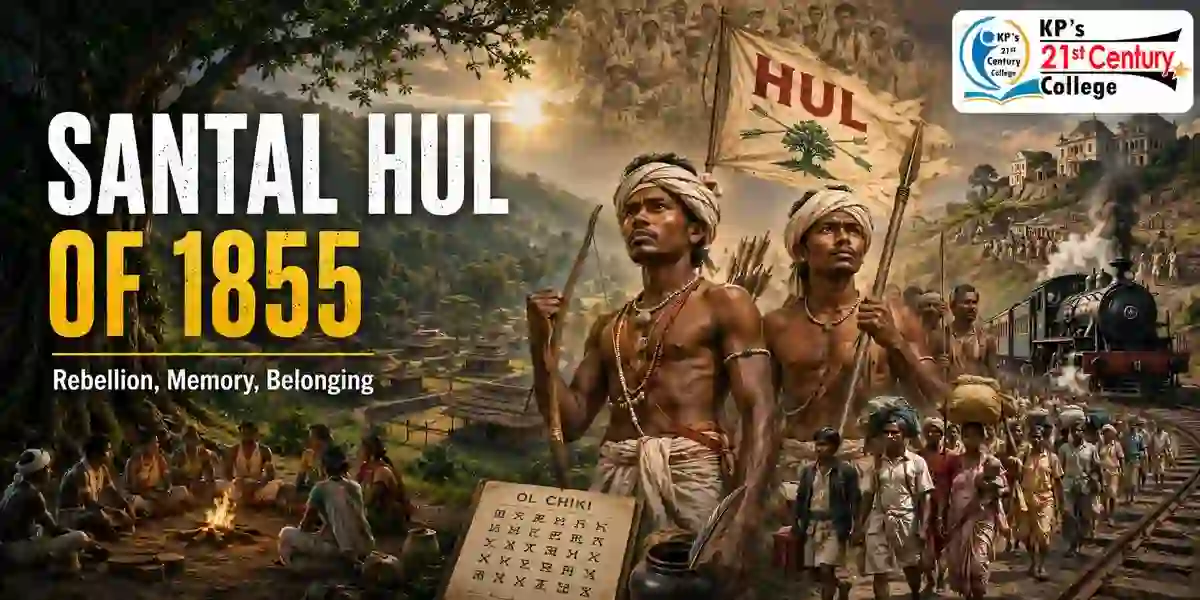
June 30 is observed as Hul Diwas, commemorating the Santal rebellion that began on June 30, 1855.The uprising, led by Sido and Kanhu Murmu from Bhognadih, emerged from growing exploitation, indebtedness, land insecurity and administrative injustice in the Santal-inhabited region of Damin-i-Koh.The rebellion is also part of a wider history of displacement that scattered Santal communities across eastern and north-eastern India while strengthening their shared cultural memory and sense of belonging.
Who are the Santals?
- The Santals are one of India’s major tribal communities, concentrated primarily in:
- Jharkhand
- West Bengal
- Odisha
- Bihar
- Assam
- Their social and cultural life has historically been shaped by forests, agriculture, village institutions, oral traditions, songs and collective memory.
- Santal origin narratives refer to places such as Hihiri-Pipiri and Sasan Beda. Although these places cannot be identified geographically, they remain central to the community’s remembered beginnings.
- This illustrates how belonging may be preserved through oral history even when communities move across regions.
Settlement in Damin-i-Koh
- In 1832, British authorities demarcated Damin-i-Koh, a tract along the Rajmahal Hills in present-day eastern Jharkhand.
Colonial objective
The British encouraged Santal settlement in the region to:
- Clear forests
- Expand agriculture
- Increase land revenue
- Develop the frontier region
Many Santal families migrated from areas such as Manbhum and Chotanagpur.
Creation of a homeland
Through collective labour, the Santals:
- Cleared forests
- Cultivated previously uncultivated land
- Established villages
- Raised families
- Developed emotional and social attachment to the region
Thus, a colonial revenue project gradually became a settled Santal homeland.
Causes of the Santal Hul
- The rebellion was not an isolated outbreak. It resulted from the gradual destruction of the conditions that made settled life possible.
Rising rent demands:
- Land-revenue demands increased, reducing the economic security of cultivators.
Indebtedness:
- Moneylenders extended loans on exploitative terms, trapping families in recurring debt.
Intermediary exploitation:
- Mahajans, landlords, traders, revenue officials and other intermediaries multiplied between cultivators and the colonial administration.
Land alienation:
- Debt and unequal contracts weakened Santal control over the lands they had cleared and cultivated.
Administrative failure:
- The colonial system offered limited access to justice or meaningful grievance redressal.
Social humiliation:
- Affronts to Santal elders and women intensified resentment and insecurity.
- The Hul therefore emerged from both material exploitation and the erosion of dignity, autonomy and belonging.
Course and Meaning of the Rebellion
- On June 30, 1855, Sido and Kanhu Murmu called upon the Santals at Bhognadih to resist colonial authority and its exploitative local agents.
- The uprising came to be known as Hul, meaning rebellion or movement in Santali.
Nature of the movement
The rebellion was directed against:
- Colonial officials
- Revenue authorities
- Moneylenders
- Zamindars
- Exploitative intermediaries
The Santals sought to end a system that had made their economic and social existence increasingly insecure.
Beyond physical displacement
- The rebellion reflected not only the fear of being driven from the land but also a deeper form of uprooting.
- A community may continue to live in the same geographical area but become dispossessed when it loses:
- Control over land
- Economic security
- Social dignity
- Access to justice
- Cultural autonomy
The Hul was therefore a struggle against both colonial rule and internal dispossession.
Suppression and Displacement after the Hul
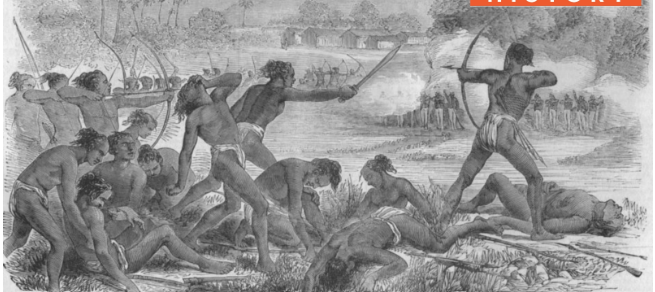
- The British suppressed the rebellion with extensive military force.
- Its aftermath produced further displacement and dispersal of Santal families.
- The Bengal District Gazetteer of 1910 recorded migration towards:
- Purnea
- Malda
- Burdwan
- Jalpaiguri
- Assam’s tea plantations
- By 1901, nearly 31,000 residents of Santal Pargana were reportedly working in Assam, while around 10,000 more had settled in Jalpaiguri.
- The colonial economy converted many displaced Santals into labourers in:
- Tea gardens
- Agricultural estates
- Road-building projects
- Distant districts
Thus, the suppression of the rebellion did not end movement; it accelerated the dispersal of the community.
Migration, Memory and Community Identity
- Migration separated Santal families across distant regions, but geographical distance did not completely dissolve community identity.
- A Santal proverb recorded by W.G. Archer states that “a million Santals have a single word.”
- The proverb reflects the idea that a community may remain united through:
- Shared origin narratives
- Oral traditions
- Collective memories
- Songs and festivals
- Language
- Historical experiences
- For the Santals, identity was preserved not merely by remaining in one territory but by continuing a shared story across generations.
Memory as a form of belonging
The Hul became an important cultural memory that linked:
- Those who remained in Santal Pargana
- Labourers who migrated to Assam
- Families settled in Bengal
- Later generations working in cities and distant regions
The remembrance of rebellion became a means of sustaining belonging despite dispersal.
Ol Chiki and the Politics of Language
- In 1925, Pandit Raghunath Murmu developed the Ol Chiki script for the Santali language.
Importance of Ol Chiki
The script:
- Represented Santali sounds more accurately
- Reduced dependence on scripts borrowed from other languages
- Strengthened cultural assertion
- Provided a common symbol of identity
- Supported literacy and literary development
Santali was included in the Eighth Schedule of the Constitution in 2003.
Multiple-script reality
Santali has also historically been written in:
- Roman
- Bengali
- Odia
- Devanagari
- Many Santali speakers, particularly in parts of Santal Pargana, continue to use these scripts.
- The demand for wider implementation of Ol Chiki therefore represents both cultural unity and a practical challenge. A script may become a symbol of collective identity even when sections of the community cannot yet read or write it.
Central issue
The debate is not simply about which script best represents Santali. It also raises questions of:
- Access to education
- Teacher availability
- Textbook production
- Regional variation
- Cultural inclusion
Language policy must therefore promote Ol Chiki while recognising the community’s diverse literacy practices.
Contemporary Migration of Santals
- Migration continues to influence Santal social life.
People from districts such as:
- Dumka
- Godda
- Pakur
- regularly migrate for employment to cities, farms, factories and construction projects.
- Some workers travel as far as Leh-Ladakh for high-altitude road construction.
- The Jharkhand Migration Survey of 2023 estimated that around 45 lakh residents of the State lived and worked elsewhere. While this figure is not limited to the Santal community, it reflects the wider migration environment affecting the old Santal heartland.
Impact on families left behind
Migration affects not only workers but also:
- Children
- Elderly family members
- Women managing households
- Siblings assuming caregiving roles
- Communities facing labour shortages
In many villages, the social consequences of absence may be as important as the economic benefits of remittances.
Continuing Challenges
Land alienation:
Tribal communities continue to face displacement caused by mining, dams, infrastructure and commercial acquisition.
Livelihood insecurity:
Limited employment opportunities encourage distress and seasonal migration.
Educational barriers:
Shortage of Santali-medium teachers and learning material restricts access to mother-tongue education.
Script-related divisions:
Regional use of different scripts can complicate standardisation and educational policy.
Cultural erosion:
Migration and urbanisation may weaken traditional institutions, oral traditions and community practices.
Poor migrant protection:
Seasonal workers may lack secure contracts, social security, housing and healthcare.
Historical marginalisation:
Tribal uprisings such as the Hul often receive less attention than mainstream nationalist movements.
Care burden:
Migration can shift childcare and eldercare responsibilities to women, siblings and elderly relatives.
Conclusion
The Santal Hul of 1855 arose from the destruction of economic security, land rights, dignity and the conditions necessary for belonging. Its suppression scattered Santal families across distant regions, but displacement did not erase their identity. Oral traditions, memories of the Hul, the Santali language and the Ol Chiki script sustained a sense of common community. For the Santals, movement and belonging have not always been opposites. Across two centuries, migration often became the means through which livelihood survived, while memory ensured that identity endured.