Why in News?
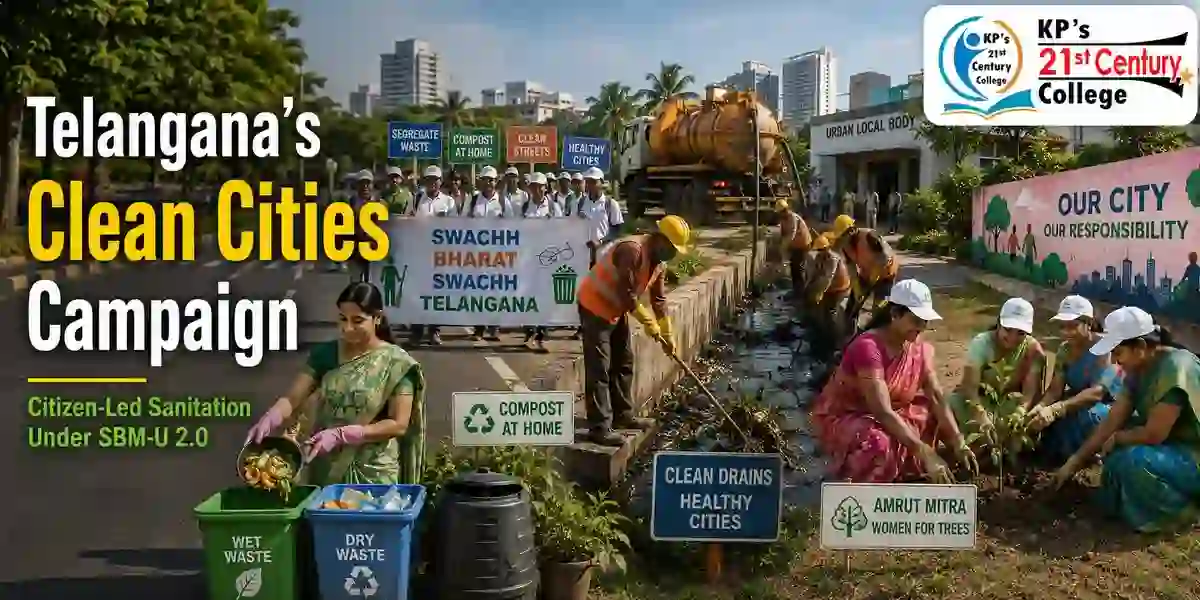
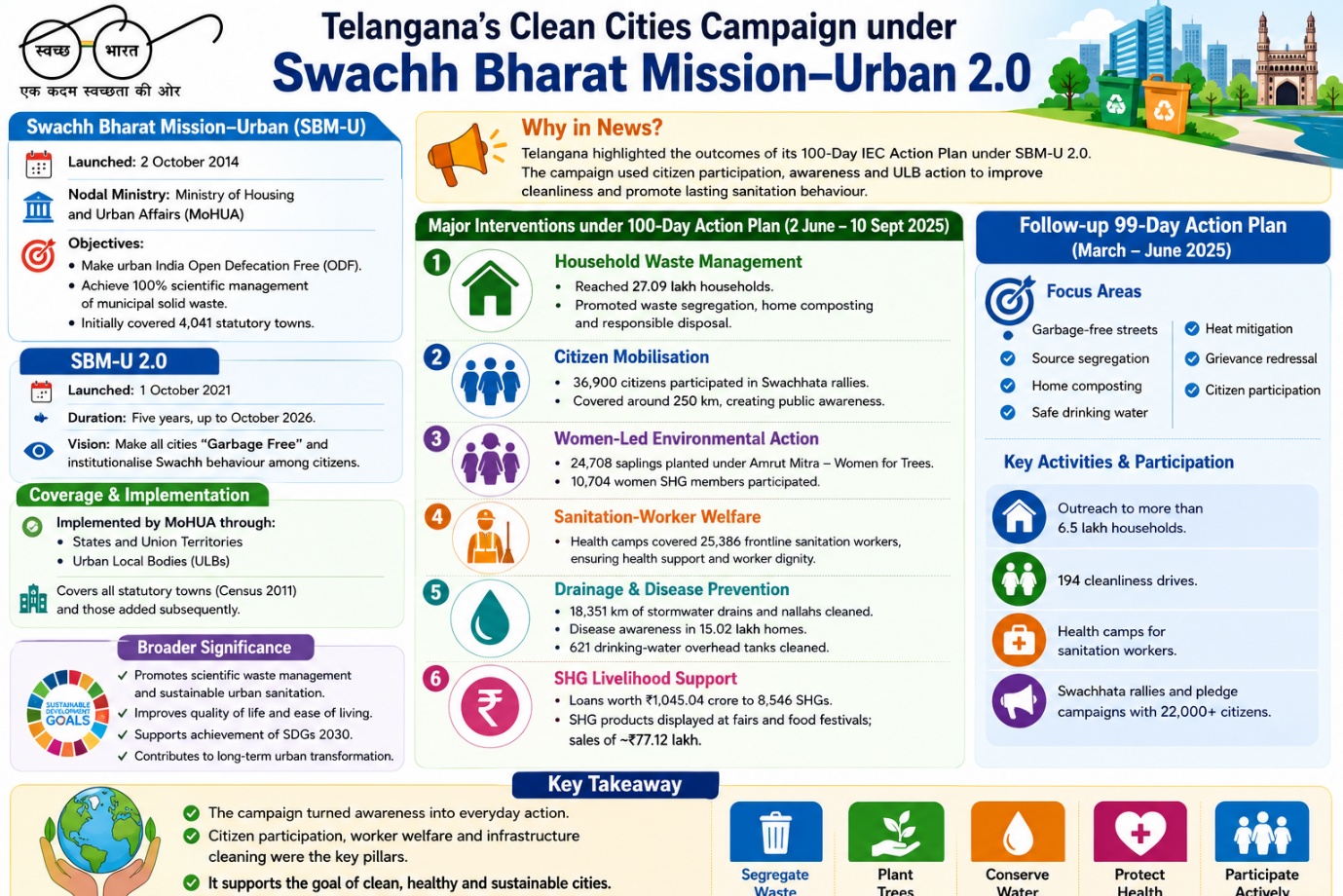
Telangana has highlighted the outcomes of its 100-Day Information, Education and Communication Action Plan implemented under Swachh Bharat Mission-Urban 2.0.
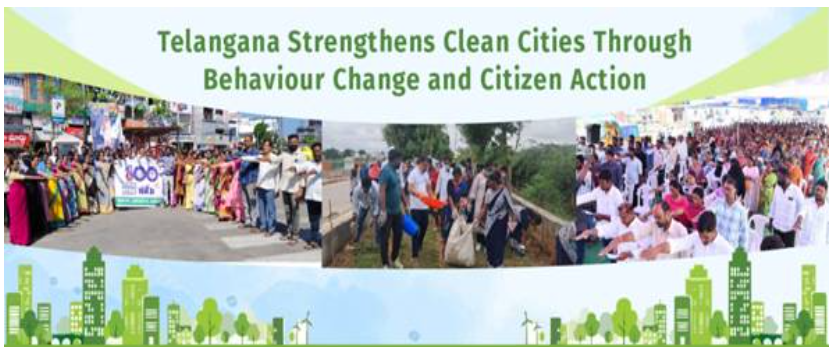
The campaign used citizen mobilisation, household awareness, public-health measures and Urban Local Body action to improve cleanliness and promote lasting sanitation behaviour.
What is Telangana’s Clean Cities Campaign?
The campaign was a time-bound urban sanitation programme conducted from June 2 to September 10, 2025 across Telangana’s Urban Local Bodies.
Its central objective was to convert awareness into everyday practice by encouraging citizens to:
- Segregate waste at source
- Adopt home composting
- Maintain public spaces
- Participate in local cleanliness activities
- Support healthier and safer urban neighbourhoods
The programme treated sanitation not merely as a municipal function, but as a shared responsibility of citizens, workers, women’s groups and local institutions.
Major Interventions under the 100-Day Action Plan
1. Household Waste Management
Door-to-door campaigns reached 27.09 lakh households.
The outreach promoted:
- Separation of wet and dry waste
- Home composting
- Responsible disposal
- Reduction of neighbourhood littering
This was important because efficient waste processing depends on segregation at the household level.
2. Citizen Mobilisation
- Around 36,900 citizens participated in Swachhata rallies covering approximately 250 kilometres.The rallies created public visibility and encouraged community ownership of urban cleanliness.
3. Women-Led Environmental Action
Under Amrut Mitra–Women for Trees:
- 24,708 saplings were planted
- 10,704 women SHG members participated
The initiative linked women’s collective action with urban greening and environmental responsibility.
4. Sanitation-Worker Welfare
Health camps covered 25,386 frontline sanitation workers.
The camps recognised that urban cleanliness must be accompanied by:
- Occupational health protection
- Medical support
- Worker dignity
- Safer working conditions
5. Drainage and Disease Prevention
The campaign facilitated the cleaning of 18,351 kilometres of stormwater drains and nallahs.
It also included:
- Seasonal disease awareness in about 15.02 lakh homes
- Cleaning of 621 drinking-water overhead tanks
These measures supported flood prevention, safer drinking water and control of waterborne and vector-borne diseases.
6. SHG Livelihood Support
- Loans worth ₹1,045.04 crore were disbursed to 8,546 Self-Help Groups.
- SHG products were displayed at fairs and street-food festivals, generating sales of approximately ₹77.12 lakh.
- This connected sanitation outreach with women’s financial empowerment and local livelihoods.
Follow-up 99-Day Action Plan
Building on the earlier campaign, Telangana launched a 99-Day Action Plan from March to June 2026.
Its focus included:
- Garbage-free streets
- Source segregation
- Home composting
- Safe drinking water
- Heat mitigation
- Grievance redressal
- Citizen participation
Major activities included:
- Outreach to more than 6.5 lakh households
- 194 cleanliness drives
- Health camps for sanitation workers
- Swachhata rallies and pledge campaigns involving more than 22,000 citizens
The follow-up plan indicated an effort to move from a one-time campaign towards continuous urban service improvement.
Significance
Behavioural change:
The programme recognised that sanitation infrastructure works only when citizens consistently follow responsible waste practices.
Integrated public health:
Drain cleaning, water-tank maintenance and disease awareness linked cleanliness with health protection.
Women’s leadership:
Women SHGs participated in environmental action and livelihood activities.
Worker-centred sanitation:
Health camps brought attention to the welfare of frontline sanitation personnel.
Urban resilience:
Cleaning drainage networks supported flood mitigation and reduced disease risks.
Local governance:
The campaign strengthened cooperation between Urban Local Bodies and communities.
Way Forward
- Make IEC campaigns continuous and ward-based.
- Link awareness drives with reliable door-to-door segregated waste collection.
- Expand composting and material-recovery facilities.
- Ensure regular health checks, insurance and protective equipment for sanitation workers.
- Use SHGs as local sanitation educators and monitoring partners.
- Integrate drain maintenance with urban flood-management plans.
- Publish ULB-level cleanliness and service-delivery dashboards.
- Strengthen citizen grievance redressal and neighbourhood-level accountability.
Conclusion
Telangana’s campaign demonstrates that sustainable urban sanitation requires more than municipal cleaning operations. It depends on household practices, citizen participation, worker welfare, women’s involvement and effective Urban Local Bodies.The initiative can become a durable model only if campaign-based mobilisation is converted into routine public behaviour and accountable local governance.