Why in News?
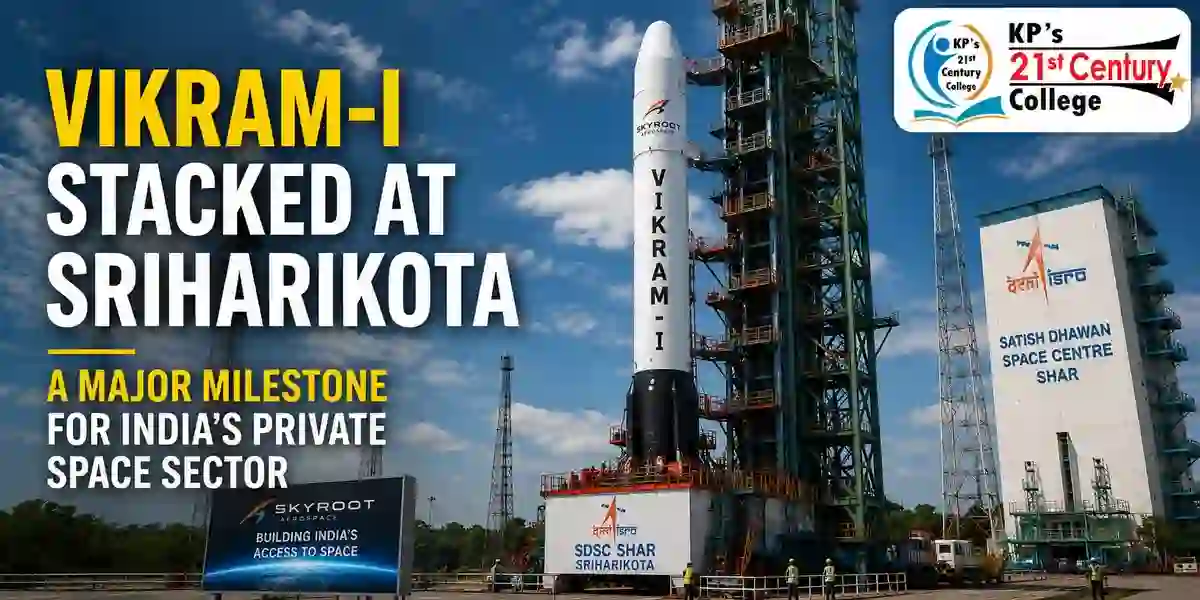
Hyderabad-based Skyroot Aerospace has successfully stacked the first stage of its Vikram-I rocket at the First Launch Pad of the Satish Dhawan Space Centre, Sriharikota.
This is the first time a privately designed, developed and manufactured orbital-class rocket has been stacked at ISRO’s First Launch Pad.

What is Vikram-I?
- Vikram-I is Skyroot Aerospace’s maiden orbital launch vehicle.
- It is designed to carry small satellites into Low-Earth Orbit and is currently undergoing final integration and technical testing.
- The vehicle is part of India’s growing commercial launch ecosystem, which seeks to meet the rising demand for affordable and flexible small-satellite launches.
Why is the Stacking Milestone Important?
First private orbital rocket at the pad:
- The event marks the first stacking of a privately developed orbital-class launch vehicle at ISRO’s First Launch Pad.
Transition from development to launch preparation:
- Stacking indicates that individual stages are being assembled into a flight-ready vehicle.
Use of national launch infrastructure:
- The milestone demonstrates how private companies can access ISRO facilities for commercial space missions.
Proximity to maiden orbital flight:
- With integration and testing underway, Vikram-I has moved closer to its first orbital launch.
Institutional Ecosystem
Skyroot Aerospace
- Skyroot Aerospace is a Hyderabad-based private space start-up engaged in the design and development of launch vehicles.
- Its Vikram series is intended to provide launch services for small satellites.
ISRO
- The Indian Space Research Organisation provides launch infrastructure, technical facilities and range support at Sriharikota.
- The First Launch Pad has previously supported major missions, including Chandrayaan and the Mars Orbiter Mission.
IN-SPACe
The Indian National Space Promotion and Authorisation Centre facilitates and authorises private-sector space activities.
For the Vikram-I mission, final scheduling will depend on:
- Completion of technical integration tests
- Safety and mission clearances
- Range availability
- Coordination with IN-SPACe and launch authorities
Significance for India’s Private Space Sector
Commercial launch capability:
Vikram-I can strengthen India’s capacity to serve the global small-satellite launch market.
Validation of private-sector reforms:
The milestone reflects the outcome of reforms that opened India’s space sector to non-government entities.
Start-up innovation:
It demonstrates the growing role of Indian start-ups in advanced engineering, propulsion and launch-vehicle development.
Public-private collaboration:
The use of ISRO infrastructure by a private company shows a shift from a government-dominated model to a collaborative space ecosystem.
Regional innovation hub:
Skyroot’s progress reinforces Hyderabad’s position as an emerging centre for aerospace and deep-technology enterprises.
Strategic capability:
Domestic private launch capacity can improve India’s technological self-reliance and reduce dependence on foreign launch providers.
Way Forward
- Complete all technical tests with strong safety assurance.
- Build a reliable pipeline of domestic and international satellite customers.
- Expand access to shared testing and launch infrastructure.
- Encourage private investment in propulsion, avionics and satellite manufacturing.
- Strengthen coordination among ISRO, IN-SPACe, NSIL and private companies.
- Support research partnerships between start-ups, universities and public institutions.
- Develop dedicated launch facilities for commercial missions as demand grows.
- Ensure that rapid commercialisation is matched by safety, accountability and regulatory clarity.
Conclusion
The stacking of Vikram-I at Sriharikota marks a significant step in India’s transition towards a broader and more competitive space economy.
The milestone is important not only for Skyroot Aerospace but also for India’s private space ecosystem. Its lasting significance will depend on a successful orbital launch, reliable commercial operations and continued cooperation between public institutions and private innovators.