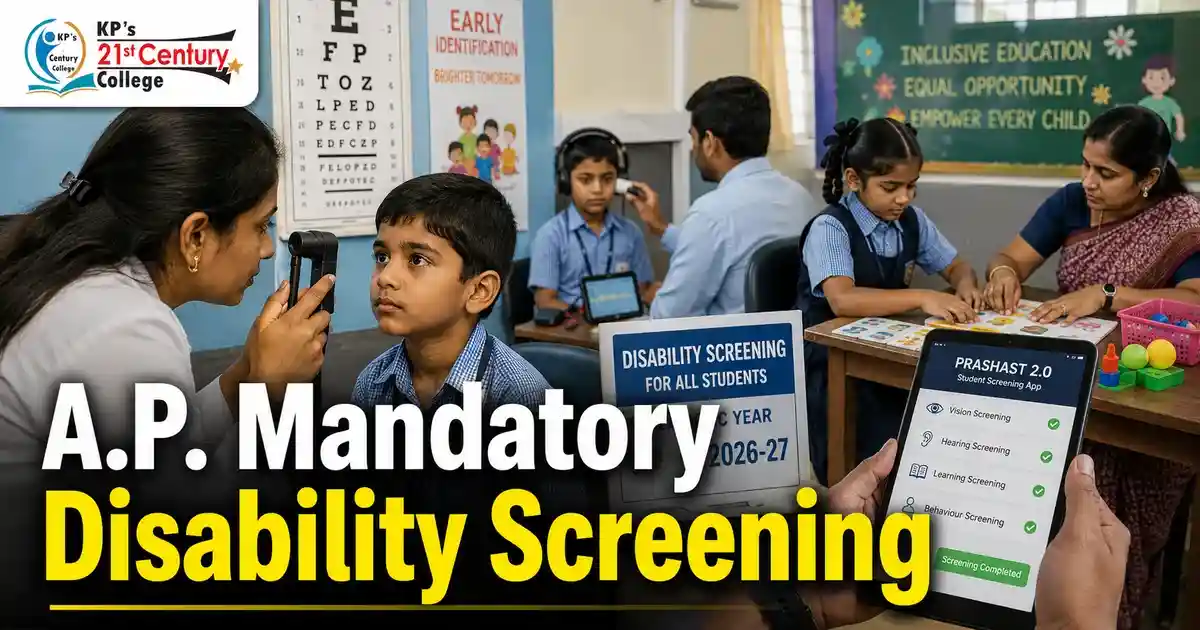
Why in News?
The Andhra Pradesh government announced mandatory disability screening for all students studying in:
- Government schools
- Local-body schools
- Aided schools
- Private schools
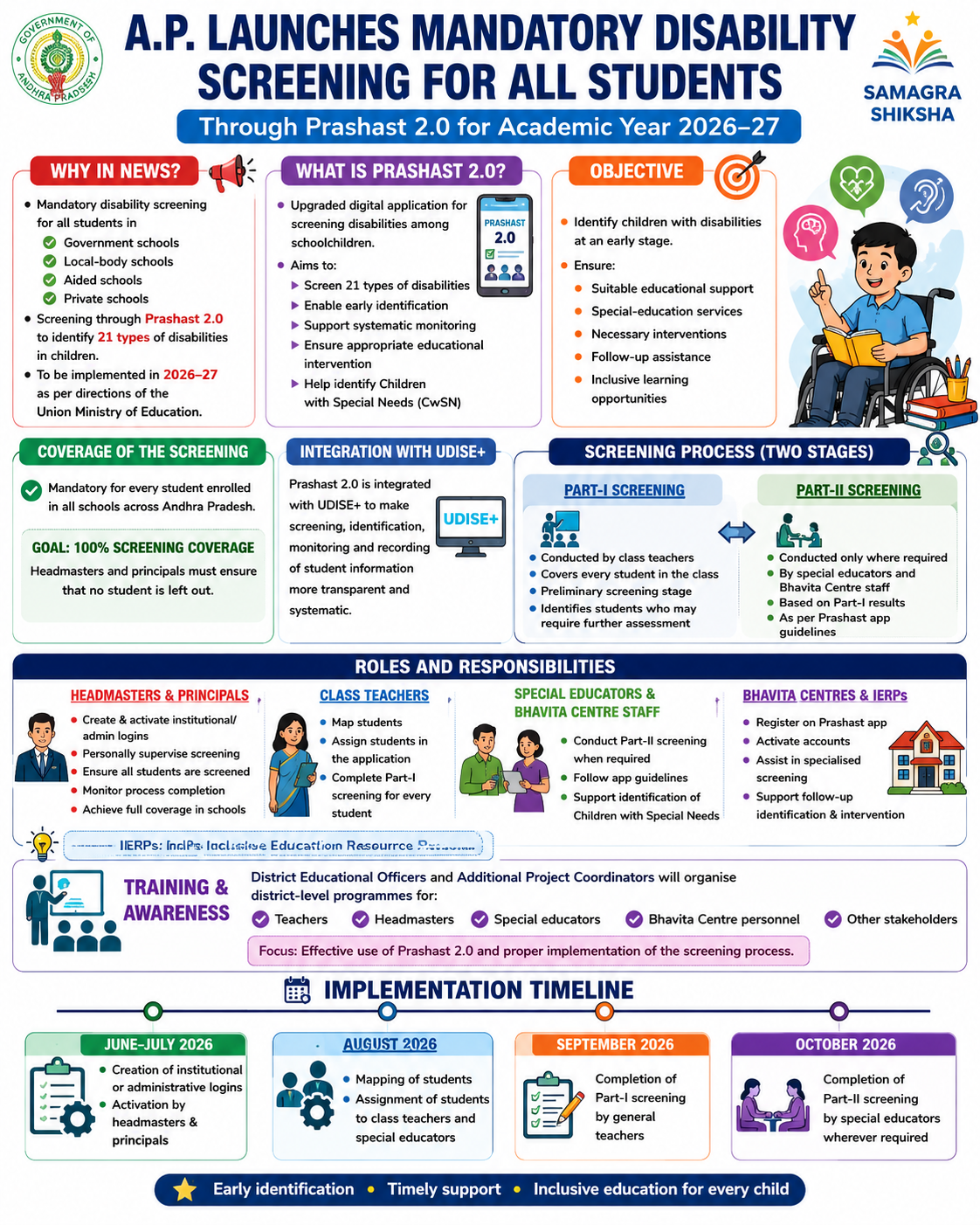
The screening will be conducted through Prashast 2.0, an upgraded application designed to identify 21 types of disabilities among children.
The initiative will be implemented during the 2026–27 academic year in accordance with directions from the Union Ministry of Education.
What is Prashast 2.0?
Prashast 2.0 is an upgraded digital application used for screening disabilities among schoolchildren.
It aims to:
- Screen students for 21 types of disabilities
- Facilitate early identification
- Support systematic monitoring
- Enable appropriate educational intervention
- Help identify Children with Special Needs
Objective of the Initiative
The main purpose is to identify children with disabilities at an early stage and ensure that they receive:
- Suitable educational support
- Special-education services
- Necessary interventions
- Follow-up assistance
- Inclusive learning opportunities
Early identification can help schools respond to the educational needs of students before learning difficulties become more serious.
Coverage of the Screening
The screening is mandatory for every student enrolled in schools across Andhra Pradesh.
The government aims to achieve:
100% Screening Coverage
Headmasters and principals have been instructed to ensure that no enrolled student is excluded from the process.
Integration with UDISE+
Prashast 2.0 has been integrated with UDISE+.
This integration is expected to make the process of:
- Screening
- Identification
- Monitoring
- Recording student information
more transparent and systematic.
Screening Process
The screening will take place in two stages.
Part-I Screening
- Conducted by class teachers
- Covers every student in the class
- Functions as the preliminary screening stage
- Identifies students who may require further assessment
Part-II Screening
- Conducted only where required
- Undertaken by special educators and Bhavita Centre staff
- Based on the results of Part-I
- Follows the guidelines available in the Prashast application
Role of School Authorities
Headmasters and Principals
They must:
- Create and activate institutional or administrative logins
- Personally supervise the screening
- Ensure all students are screened
- Monitor the completion of the process
- Achieve full coverage in their institutions
Class Teachers
They are responsible for:
- Mapping students
- Assigning students in the application
- Completing Part-I screening for every student
Special Educators and Bhavita Centre Staff
They will:
- Conduct Part-II screening when required
- Follow application guidelines
- Support the identification of Children with Special Needs
Role of Bhavita Centres and IERPs
Special Education School Assistants and Inclusive Education Resource Persons working in Bhavita Centres have been directed to:
- Register on the Prashast application
- Activate their accounts
- Assist in specialised screening
- Support follow-up identification and intervention
Training and Awareness
District Educational Officers and Additional Project Coordinators have been instructed to organise district-level programmes for:
- Teachers
- Headmasters
- Special educators
- Bhavita Centre personnel
- Other stakeholders
These programmes will focus on the effective use of Prashast 2.0 and the proper implementation of the screening process.
Implementation Timeline
June–July 2026
- Creation of institutional or administrative logins
- Activation by headmasters and principals
August 2026
- Mapping of students
- Assignment of students to class teachers and special educators
September 2026
- Completion of Part-I screening by general teachers
October 2026
- Completion of Part-II screening by special educators wherever required
Conclusion
The mandatory screening initiative through Prashast 2.0 marks an important step towards inclusive education in Andhra Pradesh.
Its success will depend not only on identifying disabilities but also on ensuring timely assessment, appropriate educational intervention and continuous support. Effective implementation can help Children with Special Needs participate fully and equally in the school system.