
Why in News?
Nipah Resurgence: Nipah virus has resurfaced in Kozhikode, where a 43-year-old patient who tested positive is battling for life at Government Medical College Hospital.
The latest case has renewed attention on Kerala’s recurring Nipah risk, ecological vulnerability, zoonotic-disease profile and public-health preparedness.
What Has Been Kerala’s Nipah Outbreak History?
- 2018 Outbreak: Kerala’s first Nipah outbreak identified 23 cases, including 18 laboratory-confirmed cases. The case-fatality rate was 91%, with only two survivors.
- 2019 Spillover: A single case was detected in Ernakulam, and the patient survived.
- 2021 Case: A 12-year-old boy was diagnosed with Nipah in Malappuram.
- 2023 Cluster: Kozhikode reported a cluster of six Nipah cases.
- 2024 Spillovers: Two isolated cases were reported from separate spillover events in Malappuram during July and September.
- 2025 Independent Events: Four cases were recorded in Malappuram and Palakkad. Epidemiological investigations found no links between them, suggesting independent spillovers from the natural reservoir.
- 2026 Resurgence: Nipah has again surfaced in Kozhikode, reinforcing the pattern of recurrent spillovers.
Why is Nipah Recurring in Kerala?
- Natural Reservoir: The Indian flying fox bat, Pteropus medius, has been consistently identified as the natural reservoir of Nipah virus in Kerala. Serological studies and viral detection show that the virus circulates among bat colonies, particularly in northern districts.
- Evidence from Bat Samples: During the 2018 outbreak, nearly 25% of sampled bats tested positive for Nipah viral RNA. Subsequent spillover investigations also detected the virus in bat samples.
- Roosts Near Settlements: Pteropus bats are distributed across Kerala and often roost close to human habitation. A Kerala Forest Research Institute mapping study found that almost all identified roosting sites were near human settlements.
- Persistent Environmental Presence: Repeated spillovers suggest that the virus has established itself within Kerala’s ecological environment. The perennial natural reservoir makes complete prevention of future spillovers difficult.
Why is Spillover Risk Highest Between April and September?
- Seasonal Fruit Availability: Fruit-laden trees become abundant during this period, increasing bat-foraging activity near farms and human settlements.
- Bat Breeding Cycle: Bat breeding and associated behavioural changes coincide with this period, increasing movement and interaction with food sources.
- Viral-Shedding Dynamics: Seasonal changes in viral shedding by bats may raise the chances of environmental contamination and human exposure.
- Recurring Seasonal Pattern: The April–September risk window has remained consistent since Kerala’s first Nipah outbreak in 2018.
What Makes Kerala Vulnerable to Zoonotic Diseases?
- Biodiversity Hotspot: The Western Ghats along Kerala’s eastern flank is one of the world’s richest biodiversity regions. Its tropical rainforest climate supports hundreds of species of birds, reptiles and mammals.
- Limited Protected Area: Only about 1,60,000 sq. km of this rich biosphere is formally protected, leaving extensive zones where human activity and wildlife habitats overlap.
- High Population Density: Dense human settlements, plantations and agricultural lands are located close to forest fringes, increasing human-wildlife interaction.
- Habitat Disturbance: Deforestation, habitat fragmentation, urbanisation and agricultural intensification force wildlife closer to settlements and cultivated food sources.
- Climate-Related Disruption: Climate-driven ecological changes may alter animal behaviour, food availability and disease dynamics, increasing future spillover risk.
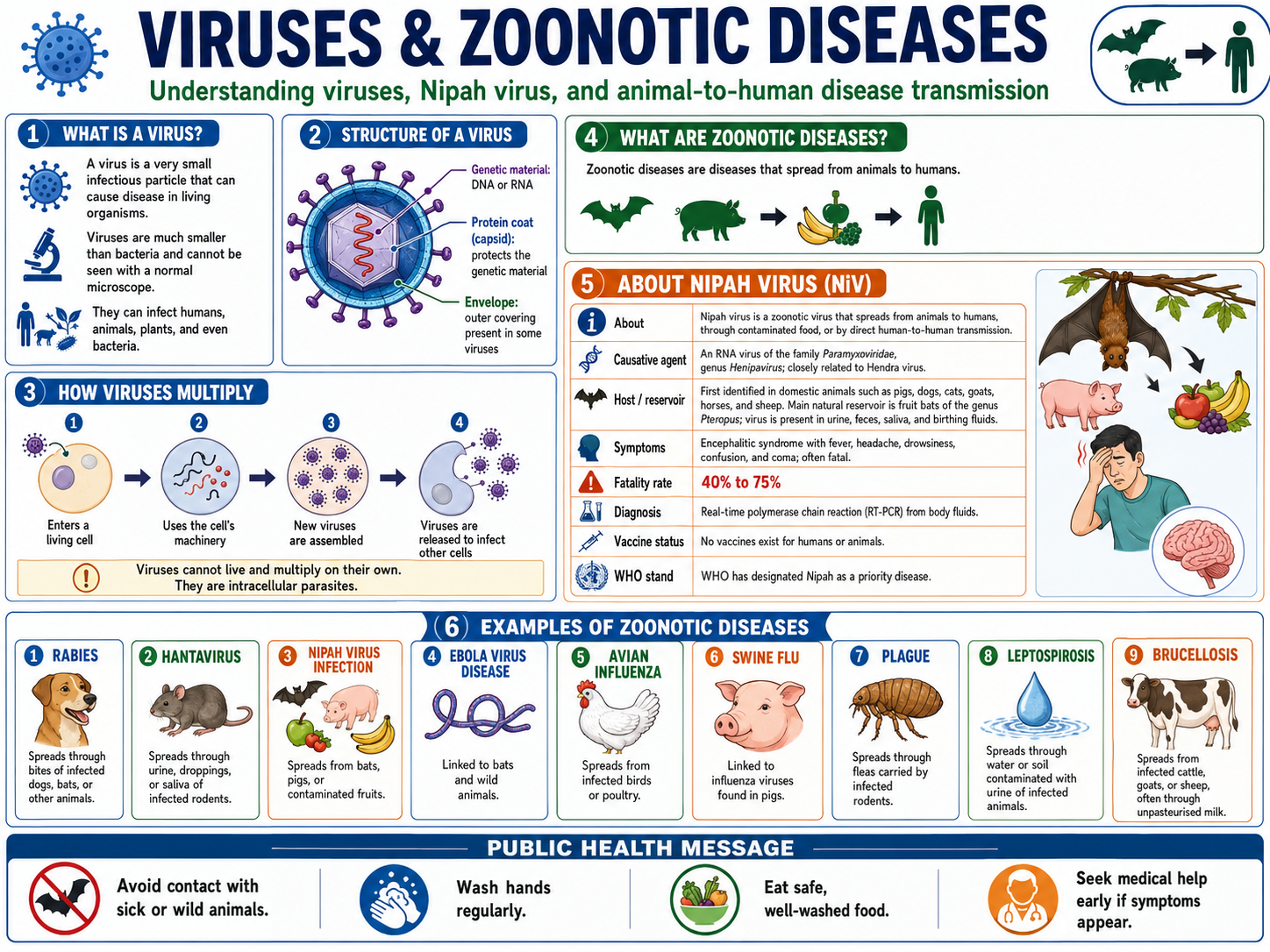 Intensified Human-Wildlife Interface: Kerala’s ecological richness, dense settlement pattern and land-use changes create frequent opportunities for exposure to novel pathogens.
How Do Ecological and Human Factors Intersect?
- Shared Landscapes: Bat roosts, fruit trees, plantations and human settlements often occupy the same geographical space. This proximity increases the probability of contaminated fruit, surfaces or other indirect exposure.
- Habitat Fragmentation: Disturbed habitats push bats and other wildlife towards cultivated areas and settlements in search of food and shelter.
- Agricultural Intensification: Expansion of farms and plantations near forest margins increases contact between wildlife, domestic environments and humans.
- Urbanisation Pressure: Rapid settlement expansion reduces ecological buffers and increases overlap between natural reservoirs and human activity.
- Seasonal Exposure: Bat foraging, fruit availability, breeding and viral shedding come together during the high-risk months, creating favourable conditions for spillover.
Why is Nipah Considered a High-Threat Pathogen?
- High Mortality: Nipah has a severe mortality profile, as demonstrated by Kerala’s 2018 case-fatality rate of 91%.
- Unpredictable Spillovers: Cases may arise independently from the natural reservoir, making outbreaks difficult to predict.
- Human Transmission Risk: The virus can spread between humans, particularly in healthcare settings without adequate infection control.
- Pandemic Potential: The World Health Organization classifies Nipah as a priority pathogen because of its lethality, unpredictability and potential to cause large outbreaks or a future pandemic.
- Kerala’s High-Threat Profile: WHO has advised Kerala to remain vigilant regarding Nipah, Avian Influenza H5N1 and Kyasanur Forest Disease, all of which have high mortality, transmissibility or pandemic potential.
What Other Zoonotic Diseases Affect Kerala?
Kerala’s broader zoonotic-risk profile includes:
- Kyasanur Forest Disease, Leptospirosis, Scrub typhus, Japanese encephalitis, West Nile fever, Rabies, Avian influenza
Nipah is therefore part of a wider landscape of animal-origin diseases linked to Kerala’s ecology and human-wildlife interface.
What Did Kerala Learn from the 2018 Outbreak?
- Nosocomial Transmission Risk: Of the 23 cases identified in 2018, only the index patient contracted the infection in the community. All other cases resulted from nosocomial transmission across three hospitals.
- Need for Clinical Suspicion: The outbreak demonstrated that clinicians must maintain a high index of suspicion when encountering unusual cases of acute encephalitis syndrome or clusters of severe illness.
- Infection-Control Priority: Kerala strengthened standard infection-prevention and control procedures in hospitals to reduce healthcare-associated transmission.
- Clinical Algorithms: The State developed clinical algorithms for emerging viral infections at tertiary-care institutions.
- Diagnostic Strengthening: The experience led to improved diagnostic, laboratory and research capacity for rapid pathogen detection.
What Makes Kerala’s Nipah Response Effective?
- Rapid Index-Case Identification: Kerala’s public-health system has repeatedly demonstrated the ability to identify the first case quickly and initiate containment.
- Coordinated Surveillance: Disease surveillance, clinical monitoring, laboratory diagnosis and public-health action operate in close coordination.
- Early Laboratory Confirmation: Expanded Virus Research and Diagnostic Laboratory networks enable faster confirmation and identification of pathogens.
- Monitoring Encephalitis Cases: The State closely monitors acute encephalitis cases of unknown cause and screens severe respiratory infections.
- Hospital Infection Control: Stronger infection-control practices have reduced human-to-human transmission after the major 2018 outbreak.
- Limited Secondary Spread: Following the initial outbreak, human-to-human transmission has occurred only once, during the 2023 cluster.
- Emergency Management: Intensive health-emergency management allows isolation, contact tracing and containment to begin rapidly.
How is Kerala Strengthening Long-Term Preparedness?
- Community Awareness: The Health Department focuses on reducing bat-human interaction by educating communities about the perennial spillover risk.
- One Health Strategy: Kerala combines human, animal and environmental surveillance to detect zoonotic threats at an early stage.
- Grassroots Surveillance: More than 2.5 lakh trained volunteers track unusual disease patterns and report unusual animal or bird deaths.
- Early Warning Network: Community reporting supports early detection of zoonotic outbreaks such as Nipah and Mpox.
- Nipah Research Centre: Kerala established the One Health Centre for Nipah Research and Resilience in Kozhikode in 2023.
- Resilience Building: The Centre focuses on community awareness, capacity building, spillover reduction and rapid-response preparedness.
- Outbreak Documentation: Every Nipah outbreak in Kerala has been documented to improve future surveillance and response.
- Research Priorities: The State is focusing on epidemiology, sero-surveillance and research into host factors.
Conclusion
Kerala’s Nipah risk arises from the intersection of a permanent bat reservoir, dense human settlement, rich biodiversity, habitat disturbance and seasonal ecological conditions. Complete prevention of spillovers may not be possible, but Kerala has significantly strengthened its ability to detect cases early, prevent hospital transmission and contain outbreaks.
Its experience shows that One Health surveillance, community participation, rapid laboratory diagnosis, infection control and sustained research are central to managing recurrent zoonotic threats.