Historian Seeks State Protection for 3,000-Year-Old Settlement in Telangana
Table of Contents
Relevance:
TGPSC Paper-II – History, Culture and Geography
Important Keywords
For Prelims:
- Megalithic Burials (Cairns), Iron Age (Deccan), Krishna River Valley, Banjar Raallu / Palnadu Stone
For Mains:
- Riverine Civilisations and Settlement Patterns, Megalithic Culture and Burial Practices, Technological Advancement in Iron Production, Continuity of Habitation (Iron Age to Medieval Period)
Why in News?
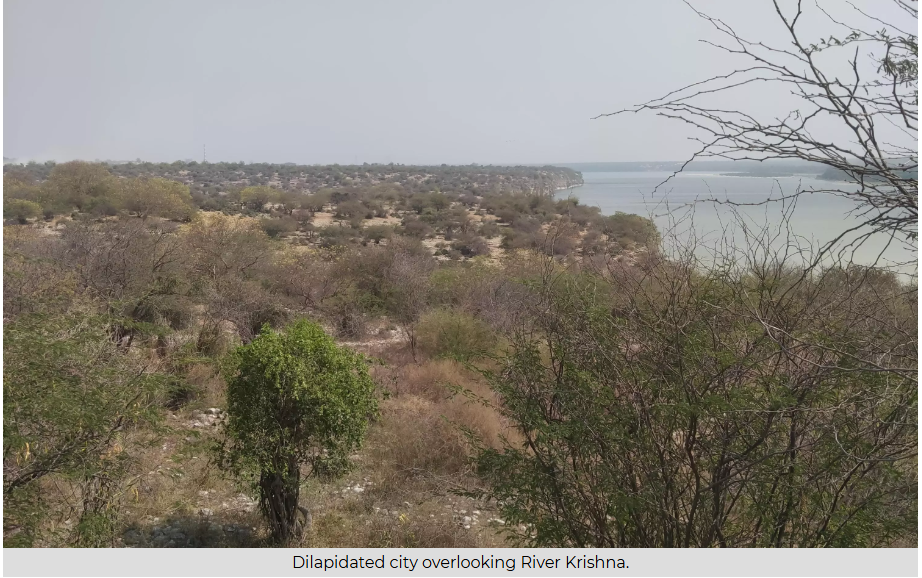
A previously undocumented ancient settlement dating back nearly 3,000 years has been identified along the left bank of the Krishna River in Veerlapalem–Veerappa Gudem villages of Damarcherla mandal, Nalgonda district. Historian Dr. Dyavanapalli Satyanarayana has urged the State government to provide immediate protection to the site, warning that invaluable archaeological evidence is rapidly disappearing.
Discovery of an Ancient Urban Centre
- The ruins point to a major city that flourished from the Iron Age (c. 1000 BCE) and continued to be occupied until the 15th century CE.
- The site contains hundreds of megalithic burials (cairns), a hallmark of Iron Age cultures in the Deccan.
- Local traditions associate these burials with fallen warriors, reflected in village names such as Veerulapadu and Veerappa Gudem.
Megalithic Burials and Material Culture
- The burial structures consist of four large upright stone slabs (about two yards long and one yard high) forming walls, capped by a flat stone slab.
- The stones used are locally available Banjar Raallu (Palnadu stone).
- Due to the abundance of this stone, a cement factory was established in the region nearly 50 years ago.
- Over time, locals removed stones from burial sites for construction and other needs, leaving only a small number of cairns intact today.
Evidence of Iron Age Technology and Riverine Economy
- The settlement thrived due to the perennial Krishna River, which provided water, fish, and fertile conditions.
- Archaeological indicators such as iron slag scattered across the site suggest local iron production, advanced enough to work on massive stone structures.
- These findings underline the technological sophistication of the Iron Age community.
Later Historical Layers: Medieval Telangana
- The site also preserves remains from medieval periods, indicating long-term continuity of habitation.
- Shrines and sculptures discovered include deities such as Vanadurga, Pochamma, Potharaju, Veerabhadra/Bhairava, along with hero stones depicting warrior couples and individual warriors.
- Based on architectural and sculptural styles, fort walls and idols date to the period of the Kanduri Cholas and Recherla Padmanayakas (10th–15th centuries CE).
Kakatiya and Padmanayaka Associations
- Local tradition holds that Kakatiya queen Rudramadevi (13th century CE) used the fort to store grain reserves.
- Supporting this belief are circular granary structures with diameters of about six yards.
- The site also contains a Lakshmi Narasimha temple from the Recherla Padmanayaka period (14th–15th centuries CE).
- While the temple’s inner sanctum survives, the garbhagriha is only partially functional.
CARE MCQ
Q. Consider the following statements regarding Rudramadevi (1263–1289 CE):
- Rudramadevi was nominated as successor by Ganapatideva and ascended the throne in 1263 CE.
- She successfully repelled invasions by the Ganga and Yadava rulers and asserted authority over the Godavari region.
- She died while suppressing the revolt of her cousin Harihara, as mentioned in the Tripurantakam inscription.
Which of the statements given above are correct?
- 1 and 2 only
- 2 and 3 only
- 1 and 3 only
- 1, 2 and 3
Answer: A
Explanation:
- Statement 1 – Correct
Ganapatideva nominated his daughter Rudramadevi as his successor, and she assumed power in 1263 CE, after being trained in warfare and statecraft. - Statement 2 – Correct
Rudramadevi defeated Ganga and Yadava rulers, established control over the Godavari region, and humiliated Yadava king Mahadeva through her generals like Recherla Prasaditya. - Statement 3 – Incorrect
Rudramadevi did not die fighting her cousin Harihara.
According to the Chandupatla epigraph (1289 CE), she died while confronting the revolt of her official Kayasta Ambedava, not Harihara. The Tripurantakam inscription only mentions Ambedava’s challenge