Table of Contents
Relevance: APPSC G1 MAINS Paper V: Science and Technology, Defence Manufacturing, Infrastructure, Industrial Development
For Prelims:
- Bharat Forge, Marine Gas Turbine, MGT, Andhra Pradesh Defence Manufacturing Corridor, Visakhapatnam, INS Eksila, Eastern Naval Command, Hot Test Cell, Naval Propulsion, Defence Manufacturing
For Mains:
- Atmanirbhar Bharat in Defence, Naval Self-Reliance, Private Sector Participation, Defence Industrial Corridor, Import Dependence, Maintenance Repair and Overhaul, Strategic Autonomy, Maritime Security
Why in News?
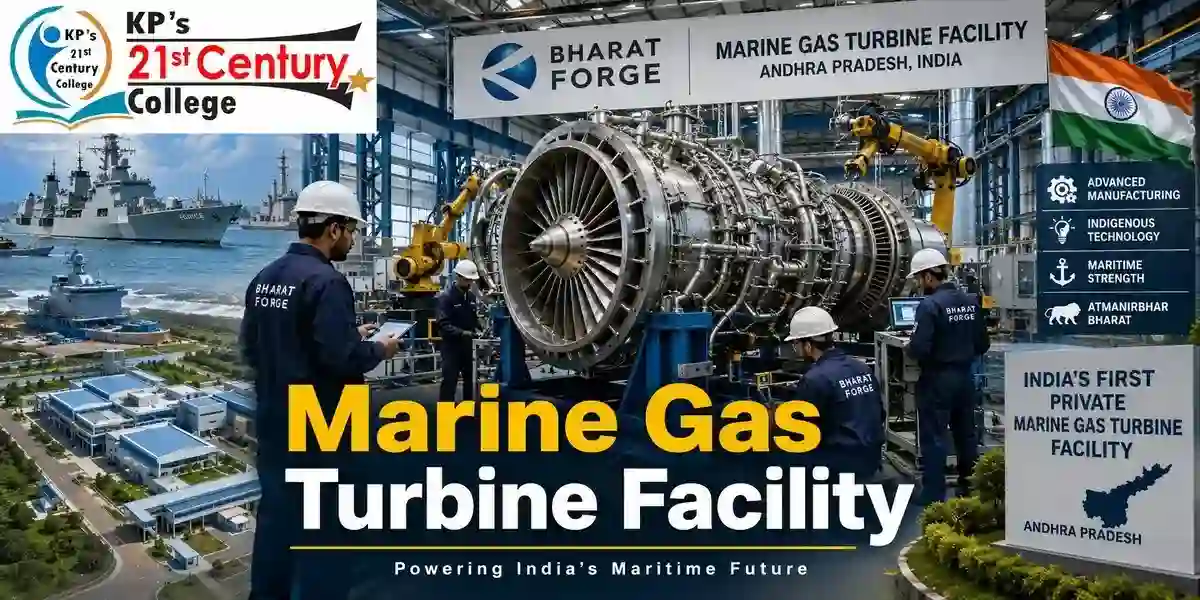
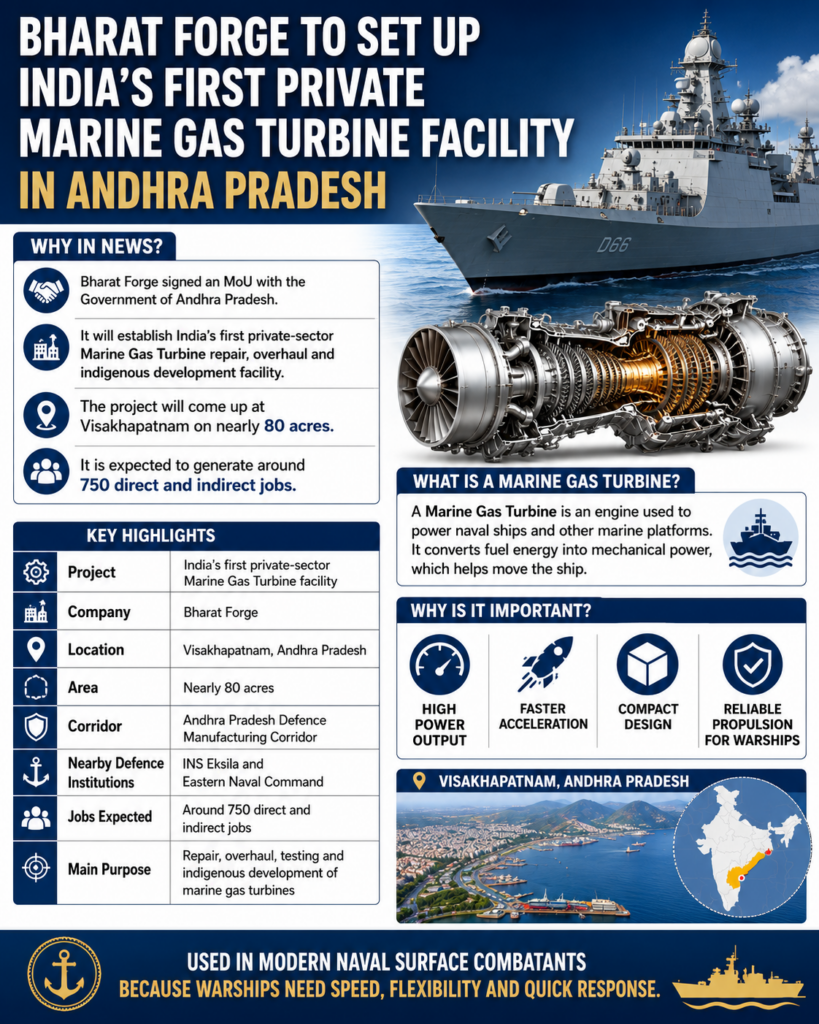
Bharat Forge has signed a Memorandum of Understanding with the Government of Andhra Pradesh to establish India’s first private-sector Marine Gas Turbine repair, overhaul and indigenous development facility at Visakhapatnam.
The facility will be developed over nearly 80 acres within the Andhra Pradesh Defence Manufacturing Corridor and is expected to generate around 750 direct and indirect jobs.
What is a Marine Gas Turbine?
A Marine Gas Turbine is an engine used to power naval ships and other marine platforms. It converts fuel energy into mechanical power, which helps in moving the ship.
Marine gas turbines are important because they provide:
- High power output
- Faster acceleration
- Compact design
- Reliable propulsion for warships
They are widely used in modern naval surface combatants because warships need speed, flexibility and quick response during operations.
Project Phases
Phase 1: Repair and Overhaul Facility
The first phase will establish a Marine Gas Turbine repair and overhaul complex.
It will include:
- Repair of gas turbine components
- Hot-section restoration
- Repair of blades, vanes and combustion liners
- Component manufacturing
- Non-destructive evaluation laboratory
- Faster repair support for naval assets
Hot-section parts operate under very high temperature and pressure. Their repair is technically difficult and strategically important.
Phase 2: Indigenous Development and Testing
The second phase will add:
- Marine Gas Turbine development and assembly hall
- Hot test cell
- Testing of engines under real operating conditions
- Development and qualification of indigenous marine gas turbines
A hot test cell is important because engines must be tested before being deployed on naval platforms.
Importance for the Indian Navy
Marine gas turbines power many frontline surface combatants of the Indian Navy. These engines are central to naval propulsion.
Till now, India has depended heavily on foreign suppliers for:
- Repair and overhaul
- Critical components
- Engine servicing
- Advanced propulsion technology
Global supply-chain disruptions have affected repair cycles and operational readiness of naval fleets. Therefore, a domestic repair and development facility will help reduce dependence on external suppliers.
Significance of the Project
1. Boost to Defence Self-Reliance
The project supports Atmanirbhar Bharat in defence manufacturing. It brings a critical naval propulsion capability into the Indian private sector for the first time.
2. Strengthening Naval Readiness
When marine gas turbines can be repaired in India, the Indian Navy can reduce delays in maintenance. This improves operational readiness of warships.
3. Private Sector Role in Defence
The project shows the growing role of private companies in strategic defence manufacturing. Earlier, such areas were mainly controlled by public sector units or foreign suppliers.
4. Visakhapatnam as a Defence Hub
The facility will be located close to INS Eksila and the Eastern Naval Command. This location is useful because Visakhapatnam is one of India’s most important naval centres.
5. Employment and Industrial Development
The project is expected to create around 750 direct and indirect jobs. It can also support local industries, component suppliers, skilled technicians and defence-related MSMEs.
6. Regional MRO Hub
The facility may also serve as a regional repair and overhaul hub for friendly foreign navies. This can strengthen India’s role as a defence service provider in the Indo-Pacific region.
Andhra Pradesh Perspective
For Andhra Pradesh, this project is important because it strengthens the state’s position in the defence manufacturing sector.
It can help the state in the following ways:
- Promotes Visakhapatnam as a naval technology hub
- Supports the Andhra Pradesh Defence Manufacturing Corridor
- Attracts defence and aerospace investments
- Creates skilled employment
- Links local industry with national defence needs
- Strengthens AP’s role in India’s maritime security ecosystem
Challenges and Concerns
1. Technology Absorption
Marine gas turbines involve advanced metallurgy, precision engineering and thermal systems. India needs strong research and technical capacity to fully absorb this technology.
2. Skilled Workforce
The project requires highly skilled engineers and technicians. Training institutions must support manpower development.
3. Supply Chain Development
India must build domestic supply chains for critical components such as blades, vanes, combustion liners and high-temperature materials.
4. Quality and Certification
Naval engines require strict testing, safety and certification. Any failure can affect warship operations.
5. Competition with Global Suppliers
India must develop cost-effective and reliable systems to compete with established global defence suppliers.
Way Forward
- Develop strong industry–Navy collaboration for faster technology absorption.
- Promote defence MSMEs around Visakhapatnam for component manufacturing.
- Establish skill centres for gas turbine maintenance and naval engineering.
- Encourage research in high-temperature materials and precision manufacturing.
- Link this project with India’s larger maritime security and Indo-Pacific strategy.
- Use the facility to support friendly foreign navies and expand defence exports.
Conclusion
Bharat Forge’s Marine Gas Turbine facility in Andhra Pradesh is a major step towards naval self-reliance and private sector participation in defence manufacturing. It will reduce India’s dependence on foreign suppliers for critical naval propulsion systems.
For Andhra Pradesh, the project strengthens Visakhapatnam’s role as a major defence and maritime technology hub. In the long term, such projects can improve India’s defence preparedness, industrial capacity and strategic autonomy.
CARE MCQ
Q. With reference to Bharat Forge’s proposed Marine Gas Turbine facility in Andhra Pradesh, consider the following statements:
- It will be India’s first private-sector Marine Gas Turbine repair and development facility.
- The facility will be located in Visakhapatnam.
- It will be co-located near the Eastern Naval Command and INS Eksila.
How many of the above statements are correct?
A. Only one
B. Only two
C. All three
D. None
Answer: C
Explanation
Statement 1 is correct:
The facility is India’s first private-sector Marine Gas Turbine repair, overhaul and indigenous development facility.
Statement 2 is correct:
It will be established at Visakhapatnam in Andhra Pradesh.
Statement 3 is correct:
The facility will be located close to INS Eksila and the Eastern Naval Command, which are important naval institutions.
Additional Information
The project is part of India’s effort to reduce dependence on foreign suppliers in critical naval propulsion systems.
FAQs
1. What is Bharat Forge setting up in Andhra Pradesh?
Bharat Forge is setting up India’s first private-sector Marine Gas Turbine repair, overhaul and development facility.
2. Where will the facility be located?
It will be located at Visakhapatnam in Andhra Pradesh.
3. Why are Marine Gas Turbines important?
They power naval warships and are critical for propulsion, speed and operational readiness.
4. Why is this project important for India?
It reduces dependence on foreign suppliers and strengthens India’s defence self-reliance.