Budget 2026: Three Macro Worries for the Finance Minister
Table of Contents
Relevance:
GS Paper III – Indian Economy and issues relating to growth, development and employment – Fiscal deficit, taxation, investment, macroeconomic stability
Important Keywords
For Prelims:
- Nominal GDP, Real GDP, Fiscal Deficit, Tax Buoyancy, Capital Expenditure, Crowding Out Effect, Private Corporate Investment, PLI Scheme, Government Borrowing, Bond Yields
For Mains:
- Fiscal Space Constraint, Nominal vs Real Growth Dilemma, Revenue–Expenditure Gap, Public Capex Multiplier, Investment-led Growth, Macroeconomic Stability, Policy Transmission Failure
Why in News?
The Union Budget 2026 is in focus as it will be presented amid slowing nominal GDP growth, weak tax buoyancy, and subdued private investment, raising concerns about the government’s fiscal space and its ability to revive economic growth.
When the Finance Minister prepares the Union Budget, it is not a blank-slate exercise. Her choices are tightly constrained by:
- Committed expenditures (salaries, pensions, interest payments)
- Revenue performance of the current year
- Overall macroeconomic conditions
Looking at how the economy performed in 2025–26, three big macroeconomic worries stand out.
Budget 2026: Three Macro Worries for the Finance Minister
1. Weak Nominal GDP Growth (Most critical concern)
Why nominal GDP matters more than real GDP for Budget
- Nominal GDP = value of goods and services at current prices
- Real GDP = growth adjusted for inflation
- Budget calculations (tax revenue, deficit, borrowing) are based on nominal GDP, not real GDP
The problem
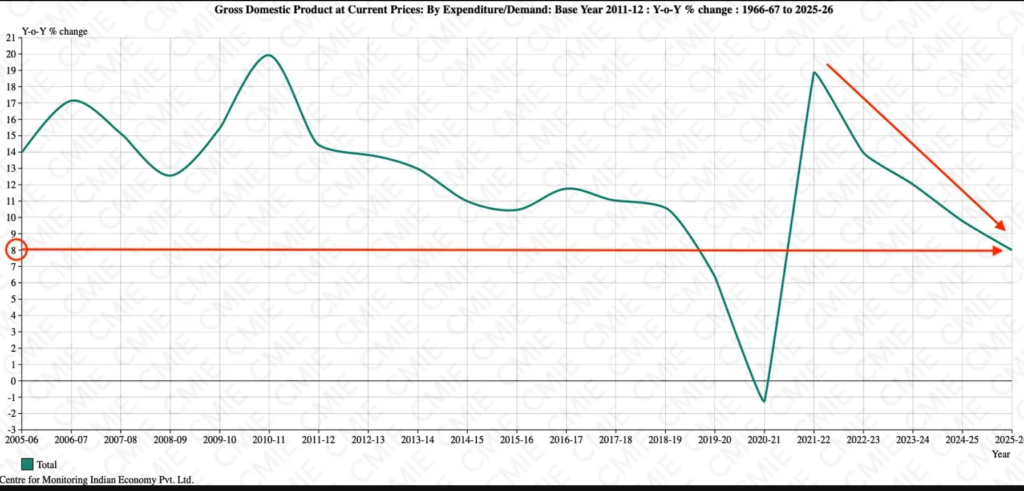
- Nominal GDP growth has fallen to ~8%, the lowest in many years
- In February 2025 Budget, the government assumed 10.1% growth
- This gap creates a revenue shortfall
Why it is dangerous
If nominal GDP grows slower than expected:
- Government earns less tax revenue
- It must either:
- Borrow more → higher interest rates, crowding out private investment
- Cut spending → hurts poor, R&D, infrastructure, defence
Thus, weak nominal GDP directly weakens Budget arithmetic
2. Weak Tax Buoyancy (Revenue problem)
What is tax buoyancy?
It shows how much tax revenue grows when GDP grows.
- Buoyancy of 1 → tax grows at same rate as GDP
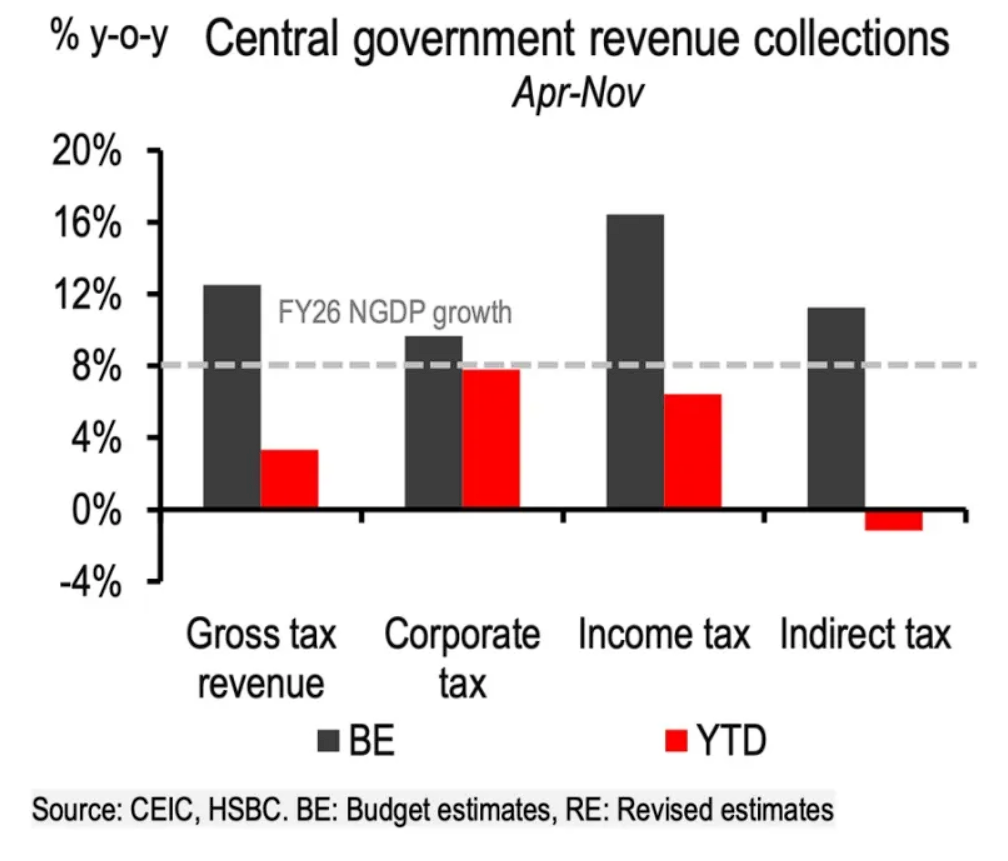
- Government assumed 1.1
- Actual buoyancy is only 0.6
What this means
Even when GDP grows:
- Tax revenues are growing much slower
- GST, income tax, corporate tax all underperforming
- Tax growth is below even weak GDP growth
Impact
- Bigger fiscal stress
- Less money for welfare and capital expenditure
- More borrowing pressure
This means the government’s revenue engine is misfiring
Weak Private Corporate Investment (Growth problem)
Despite:
- Corporate tax cuts (since 2019)
- Massive government capex (roads, ports, rail)
- PLI subsidies
- Income tax relief
- GST cuts to boost demand
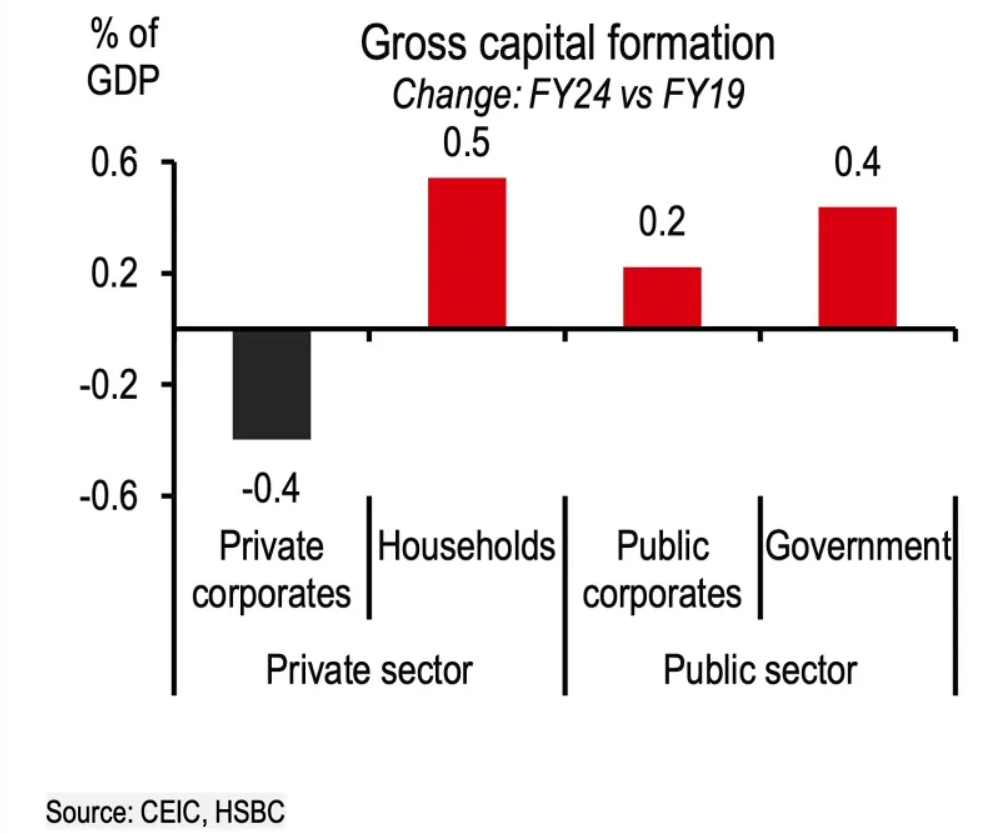
Private investment is still low
- Corporates are not expanding capacity
- Demand is not strong enough
- Sales growth is weak
- Firms prefer sitting on cash rather than investing
New worry: Global investors pulling out
- FPI outflows rising
- Rupee under pressure
- Exchange rate instability
- Political & economic concern for FM
Without private investment, sustainable job creation is impossible
Macro-Political Implications for the FM
- Harder to meet fiscal deficit targets
- Less room for:
- Tax cuts
- New schemes
- Big announcements
- Political pressure due to:
- Rupee weakness
- Investor sentiment
- Employment concerns
What the FM may try in Budget 2026 (Policy Direction)
Boost nominal GDP
- Demand support (targeted, not populist)
- Export incentives
- Services sector push
- Manufacturing competitiveness
2. Improve tax buoyancy
- Widen tax base
- Rationalise GST slabs
- Technology-based compliance
- Avoid aggressive rate cuts
3. Crowd-in private investment
- Policy stability
- Faster clearances
- MSME support
- Long-term credit availability
- Reduce regulatory uncertainty
CARE MCQ
With reference to Union Budget formulation, consider the following statements:
- Nominal GDP is more important than real GDP for budgetary calculations.
- Weak tax buoyancy implies tax revenues grow faster than GDP.
- Weak private investment reduces the effectiveness of public capital expenditure.
Which of the statements given above is/are correct?
A. 1 and 3 only
B. 1 and 2 only
C. 2 and 3 only
D. 1, 2 and 3
Answer: A
Explanation:
- Statement 1 is correct – Budget estimates are based on nominal GDP.
- Statement 2 is incorrect – weak buoyancy means tax grows slower than GDP.
- Statement 3 is correct – private investment is required to crowd in growth.