Table of Contents
Relevance: GS Paper I – Geography – Physical Geography; GS Paper III – Environment, Climate Change, Agriculture and Disaster Management
For Prelims:
- Western Disturbance, El Niño, La Niña, ENSO, Heat Wave, Severe Heat Wave, Wet Bulb Temperature, Feels Like Temperature, Heat Index, IMD
For Mains:
- Climate Variability, Extreme Weather Events, Monsoon Uncertainty, Heat Stress, Public Health Risk, Agricultural Vulnerability, Urban Heat Island, Climate Adaptation
Why in News?
- Lebanon accused Israel of committing “ecocide” during the 2023–24 conflict by allegedly causing massive environmental destruction.
- Iran also alleged ecocide after Israeli strikes on fuel depots reportedly caused toxic “black rain” and severe pollution.
- Several countries and environmental organizations are now demanding formal recognition of ecocide as an international crime under the Rome Statute.
- The Council of Europe adopted a convention in 2025 criminalizing severe environmental destruction.
Why in News?
India is entering a summer marked by multiple climate risks such as unseasonal rainfall, heatwaves, humidity-related heat stress and possible monsoon uncertainty. The India Meteorological Department forecast a fresh Western Disturbance over North India between May 11 and May 13, while global climate agencies have indicated rising chances of El Niño conditions in 2026.
Key Climate Terms Explained
1. Western Disturbance
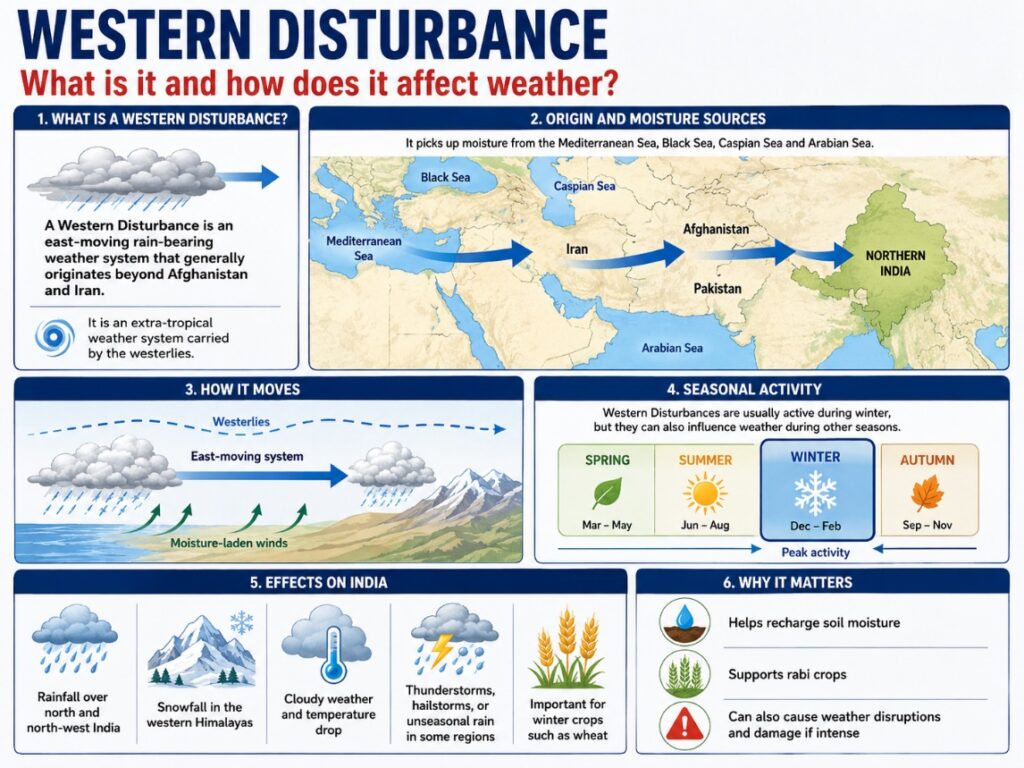
A Western Disturbance is an east-moving rain-bearing weather system that generally originates beyond Afghanistan and Iran. It picks up moisture from regions such as the Mediterranean Sea, Black Sea, Caspian Sea and Arabian Sea. These systems are usually active during winter but can also influence weather during other seasons.
Impact on India
- Brings rainfall to North and Northwest India
- Causes snowfall in the Himalayan region
- Helps winter crops such as wheat
- May also cause unseasonal rain, hailstorms and crop damage
2. ENSO
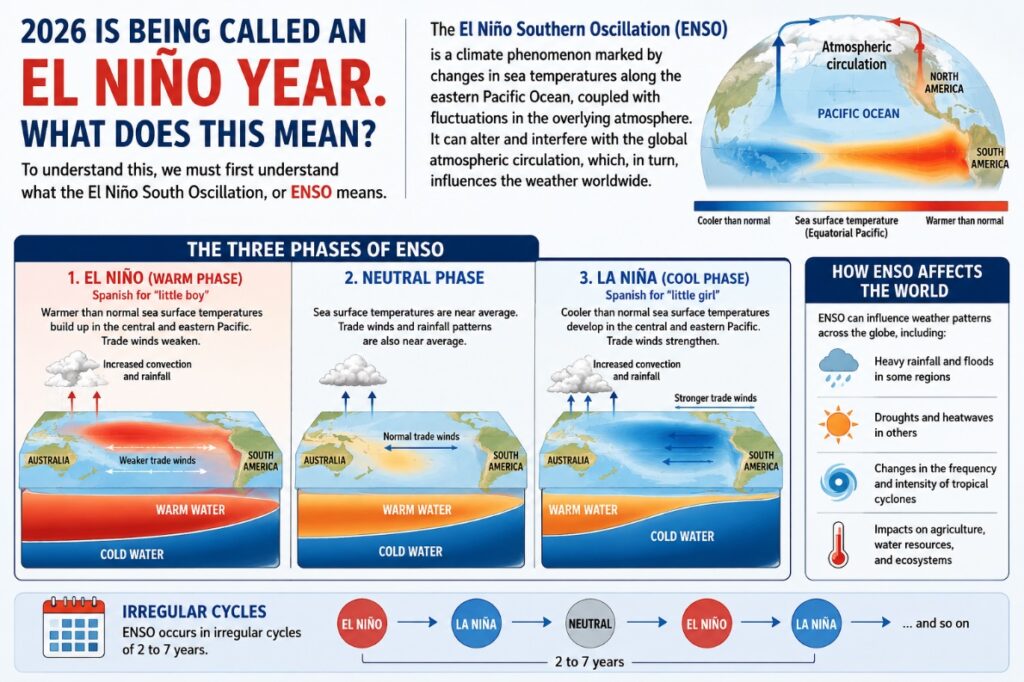
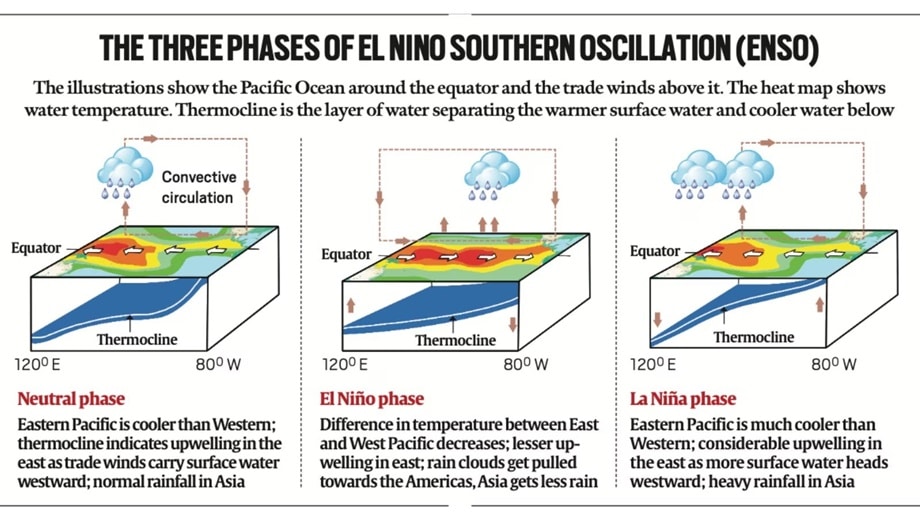
ENSO stands for El Niño Southern Oscillation. It is a climate phenomenon linked with changes in sea surface temperature and atmospheric conditions over the tropical Pacific Ocean. It has three phases: El Niño, La Niña and Neutral.
3. El Nino
El Nino is the warm phase of ENSO. It occurs when the surface waters of the central and eastern Pacific Ocean become unusually warm.
Impact on India
- May weaken the southwest monsoon
- Can increase dry spells in agricultural regions
- May intensify heatwaves
- Can affect food production and water availability
The US Climate Prediction Center stated in April 2026 that ENSO-neutral conditions were present, but El Niño was likely to emerge during May–July 2026 with a 61% chance and persist at least till the end of 2026.
4. La Nina
La Nina is the cool phase of ENSO. It occurs when the eastern Pacific Ocean becomes cooler than normal.
Impact on India
- Usually supports a stronger southwest monsoon
- Can increase rainfall in many regions
- In extreme cases, may cause floods and crop damage
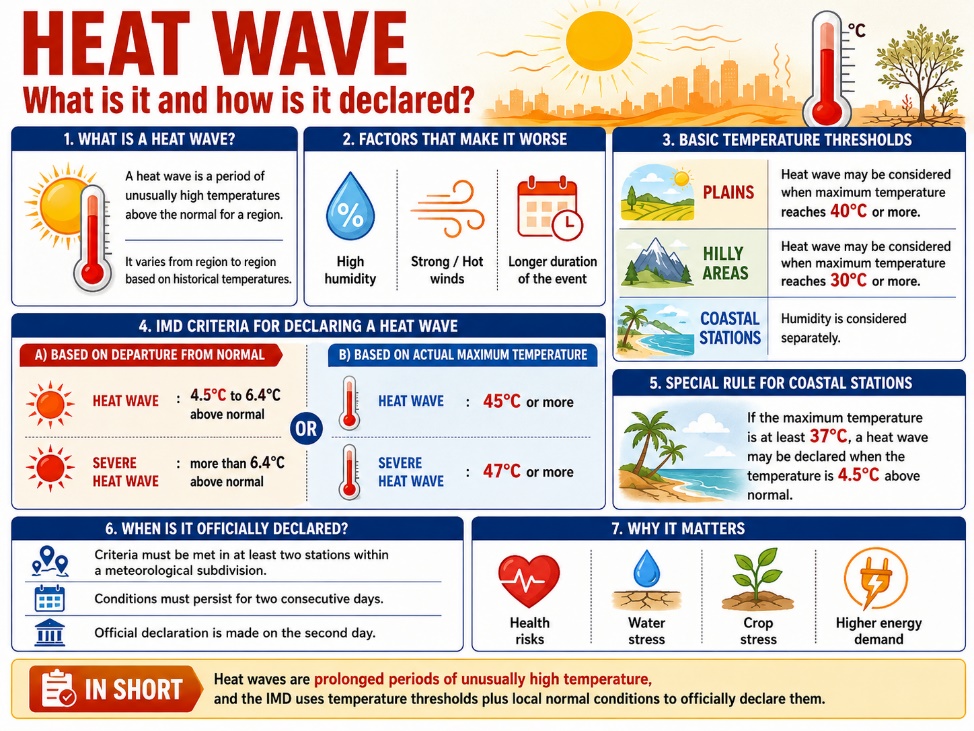
5. Heat Wave
A heat wave is a period of abnormally high temperature compared to the normal temperature of a region.
As per IMD criteria, a heat wave is considered when the maximum temperature reaches at least 40°C in plains and 30°C in hilly regions. A heat wave is declared when the departure from normal is 4.5°C to 6.4°C, while a severe heat wave is declared when the departure is more than 6.4°C. A heat wave is also declared when actual maximum temperature reaches 45°C, and a severe heat wave when it reaches 47°C.
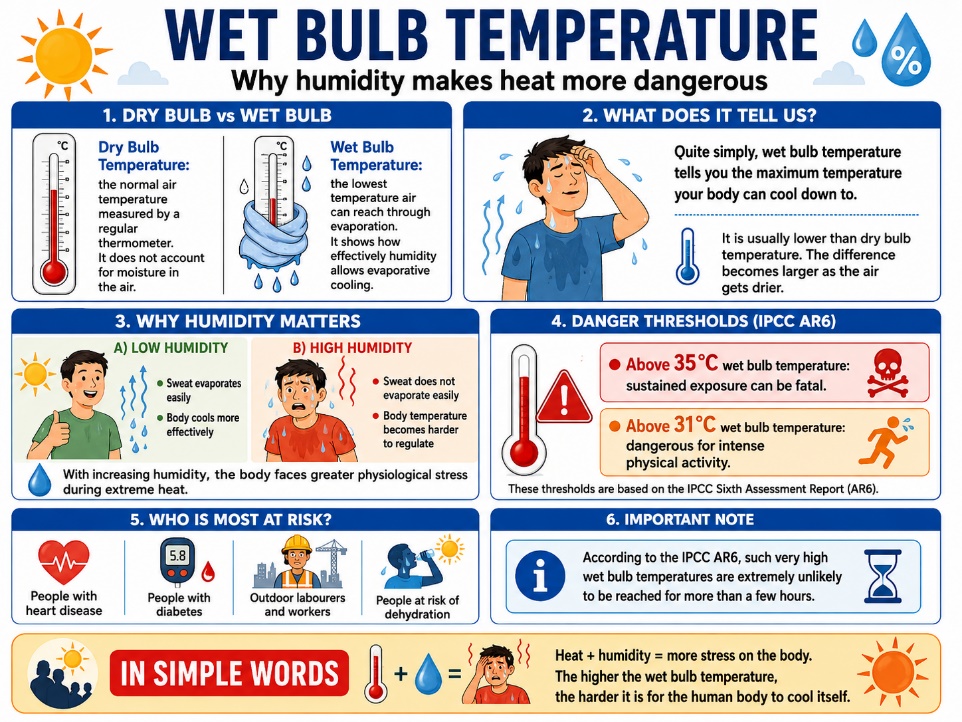
6. Wet Bulb Temperature
Wet Bulb Temperature measures the lowest temperature to which air can be cooled by evaporation. It shows how effectively the human body can cool itself through sweating.
When humidity is high, sweat does not evaporate easily. This increases heat stress on the body. Sustained exposure to wet bulb temperatures above 35°C can be fatal, while high wet bulb temperatures are dangerous for intense physical activity.
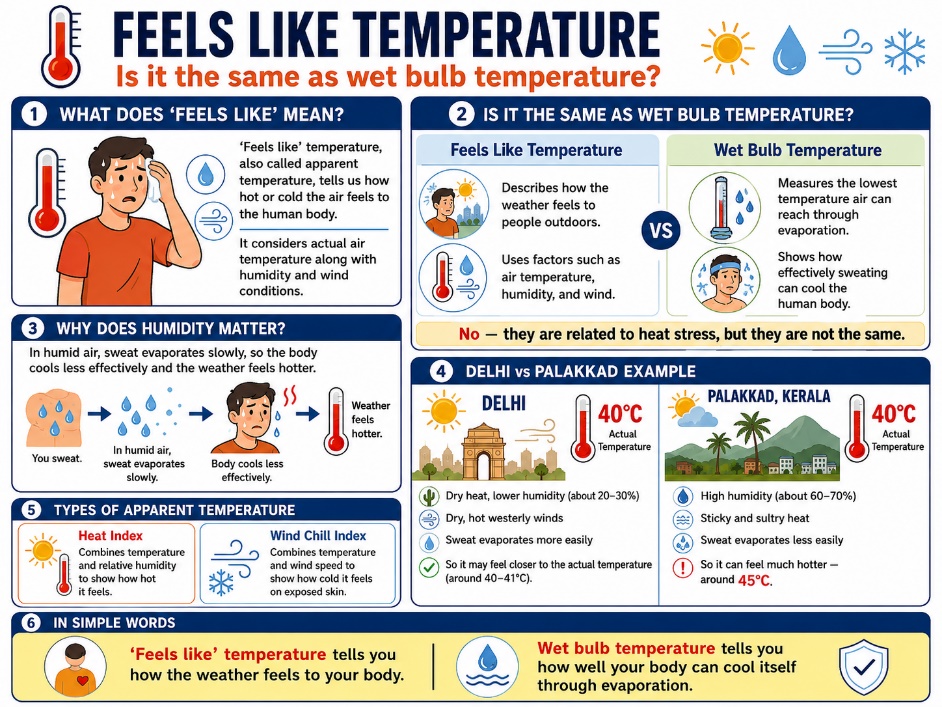
7. “Feels Like” Temperature
Feels like temperature is also called apparent temperature. It shows how hot or cold the weather feels to the human body after considering:
- Actual temperature
- Humidity
- Wind speed
For example, 40°C in Delhi and 40°C in Kerala may not feel the same. A humid place may feel hotter because sweat does not evaporate easily.
Significance

1. Agriculture
Climate phenomena like El Niño and Western Disturbances directly affect rainfall, soil moisture and crop productivity. A weak monsoon can affect crops such as paddy, pulses, cotton and oilseeds.
2. Public Health
Heatwaves and high humidity increase the risk of heat exhaustion, dehydration and heatstroke. Labourers, elderly people, children and people with existing diseases are more vulnerable.
3. Water Security
Weak monsoon or prolonged heat can reduce reservoir levels, groundwater recharge and drinking water availability.
4. Disaster Management
Extreme heat, unseasonal rainfall and floods require better forecasting, early warning systems and local-level preparedness.
5. Economy
Climate extremes affect agriculture, power demand, labour productivity, health expenditure and urban infrastructure.
Challenges
- Increasing frequency of extreme weather events
- Weak public awareness of climate terms and warnings
- Urban heat island effect in cities
- Poor heat-resilient infrastructure
- Vulnerability of outdoor workers
- Crop losses due to unseasonal rain and heatwaves
- Pressure on electricity and water supply during summer
Government Initiatives / Institutional Measures
- India Meteorological Department issues weather forecasts and heatwave warnings.
- National Disaster Management Authority provides guidelines for heatwave management.
- States prepare Heat Action Plans for vulnerable districts and cities.
- Climate-resilient agriculture is promoted through advisories, crop insurance and improved irrigation.
- Early warning systems are being strengthened for extreme weather events.
Way Forward
- Improve local-level weather forecasting and early warnings.
- Prepare heat action plans for all vulnerable districts.
- Provide drinking water, shade and rest breaks for outdoor workers.
- Promote heat-resilient crops and climate-smart agriculture.
- Increase urban green cover and cool-roof practices.
- Strengthen public awareness on heatwave safety.
- Improve coordination between IMD, disaster management authorities, health departments and local bodies.
Conclusion
Climate terms such as Western Disturbance, El Niño, heat wave, wet bulb temperature and feels like temperature are not only scientific concepts. They directly affect agriculture, health, water security, urban life and disaster preparedness.
UPSC PYQ
Q. Which one of the following is not a resultant of the El Niño effect? (CDS – I, 2022)
(a) Distortion of equatorial atmospheric circulation
(b) Flow of the South-East Trade Winds towards the Indian Ocean
(c) Irregularities in the evaporation of sea water
(d) Reduction in the amount of planktons which reduces the number of fish in the sea
Answer: (b)
Explanation
El Niño is caused by the unusual warming of surface waters in the eastern and central equatorial Pacific Ocean.
During El Niño:
- The normal equatorial atmospheric circulation gets disturbed.
- The trade winds weaken or become irregular.
- Evaporation and rainfall patterns change.
- Upwelling of cold, nutrient-rich water reduces.
- This reduces planktons, which affects fish population.
Therefore, the flow of South-East Trade Winds towards the Indian Ocean is not a resultant of El Niño effect.
CARE MCQ
How many of the above statements are correct? (a) Only one Answer: (b) Explanation:
Additional Information:
How many of the above statements are correct? (a) Only one Answer: (b) Explanation:
Additional Information: |
FAQs
1. What is a Western Disturbance?
It is an east-moving rain-bearing system that brings rain and snowfall to North India.
2. What is ENSO?
ENSO is a Pacific Ocean climate cycle with three phases: El Niño, La Niña and Neutral.
3. How does El Niño affect India?
It may weaken the monsoon and increase heatwaves and dry spells.
4. What is Wet Bulb Temperature?
It shows how difficult it is for the human body to cool itself through sweating.